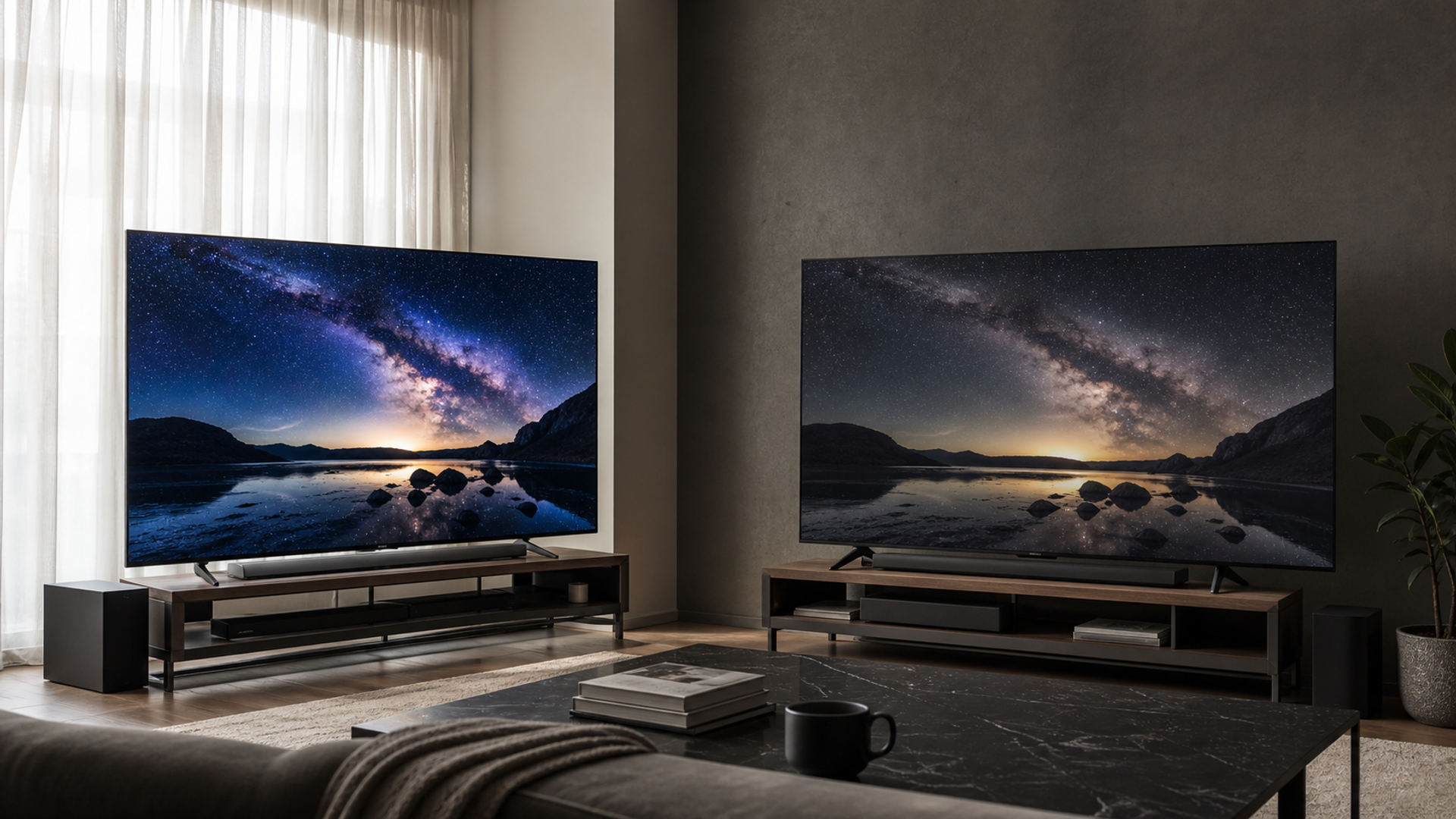
Mini-LED versus QLED is often presented as two rival display types, but the labels describe different layers. QLED generally refers to an LCD television using quantum-dot colour technology; Mini-LED refers to much smaller backlight LEDs that can support more local-dimming zones. A television can therefore be both QLED and Mini-LED. The real decision is whether the exact model's backlight control, panel, processing and room fit justify its price.
Start with room and content
Choose a well-executed Mini-LED set when bright-room impact, HDR highlights and stronger local contrast matter and blooming is controlled. Choose a conventional QLED LCD when good brightness and colour at a lower price meet the room. Choose OLED or another format when dark-room black level, viewing angle or size-price fit changes the priority.
| Decision factor | Mini-LED television | Conventional QLED television | Choose another display |
|---|---|---|---|
| Ambient light | High brightness fights daylight | Moderate brightness meets the room | Improve blinds first |
| Dark scenes | Many controlled zones reduce haloing | Some blooming is acceptable | Consider OLED |
| HDR | Sustained highlights justify premium | Standard dynamic range dominates | Spend on size or audio |
| Viewing angle | Exact panel remains consistent off-axis | Most viewers sit centrally | Test another panel type |
| Gaming | Ports, refresh and local dimming work together | Core console features are sufficient | Prioritise input support |
| Budget | Measured contrast gain is visible | Price difference funds a larger screen | Buy the better complete system |
This mini led vs qled matrix is the article's working value object. Read the mini led vs qled rows together: the decisive failure mode depends on this topic's evidence, operating context and reader objective.
How the backlight terms relate
Evidence 1. Samsung explains that QLED uses quantum dots while Mini-LED describes a smaller backlight technology used in some LCD televisions.
Evidence 2. Samsung's 2026 lineup places Mini-LED and Neo QLED across different models, confirming that labels must be read at model level.
Evidence 3. More or smaller backlight zones can improve local contrast but do not guarantee perfect black or eliminate blooming.
Evidence 4. Panel type, processing, anti-reflection, viewing angle, ports and firmware can outweigh the headline backlight term.
Reader-visible sources checked for this article:
samsung.com — reader-visible current or official evidence
news.samsung.com — reader-visible current or official evidence
For mini led vs qled, these sources establish only the claims inside their documented scope. Recheck every changeable specification, availability condition, price, policy or service term in the relevant market before acting.
Test blooming, brightness and viewing angle
For ambient light, the first route works when high brightness fights daylight; the second requires moderate brightness meets the room. The control for the third is improve blinds first. Verify this row against the exact product, property, account or environment before it can reverse the decision.
The dark scenes row exposes a practical boundary. Route one assumes many controlled zones reduce haloing, while route two is defensible only when some blooming is acceptable. Route three depends on consider OLED. If that evidence is absent, keep the more reversible option.
Read hdr as a stop/go test: sustained highlights justify premium supports the first option; standard dynamic range dominates supports the second; and spend on size or audio supports the third. Record which source proves the condition and when it was checked.
A buyer can resolve viewing angle without starting from a brand preference. Ask whether exact panel remains consistent off-axis; compare that with whether most viewers sit centrally; then use test another panel type as the third route's safeguard. An unknown condition stays unknown.
On gaming, popularity is not enough. The evidence for option one is that ports, refresh and local dimming work together. Option two means core console features are sufficient. Option three is rational where prioritise input support. Recheck any changeable term immediately before commitment.
The decision changes at budget. Choose the first path only if measured contrast gain is visible; move to the second when price difference funds a larger screen; use the third when buy the better complete system. Save the downside that would make this row fail.
Facts that would reverse the current choice
Reversal control 1 — Ambient light. Before choosing Mini-LED television, write down how the decision changes if “High brightness fights daylight” proves false. Do the same for Conventional QLED television and “Moderate brightness meets the room”. Keep the Choose another display route available until “Improve blinds first” is verified. This control belongs to mini led vs qled; update it from the cited source or exact supplier rather than copying a generic checklist.
Reversal control 2 — Dark scenes. Before choosing Mini-LED television, write down how the decision changes if “Many controlled zones reduce haloing” proves false. Do the same for Conventional QLED television and “Some blooming is acceptable”. Keep the Choose another display route available until “Consider OLED” is verified. This control belongs to mini led vs qled; update it from the cited source or exact supplier rather than copying a generic checklist.
Reversal control 3 — HDR. Before choosing Mini-LED television, write down how the decision changes if “Sustained highlights justify premium” proves false. Do the same for Conventional QLED television and “Standard dynamic range dominates”. Keep the Choose another display route available until “Spend on size or audio” is verified. This control belongs to mini led vs qled; update it from the cited source or exact supplier rather than copying a generic checklist.
Reversal control 4 — Viewing angle. Before choosing Mini-LED television, write down how the decision changes if “Exact panel remains consistent off-axis” proves false. Do the same for Conventional QLED television and “Most viewers sit centrally”. Keep the Choose another display route available until “Test another panel type” is verified. This control belongs to mini led vs qled; update it from the cited source or exact supplier rather than copying a generic checklist.
Reversal control 5 — Gaming. Before choosing Mini-LED television, write down how the decision changes if “Ports, refresh and local dimming work together” proves false. Do the same for Conventional QLED television and “Core console features are sufficient”. Keep the Choose another display route available until “Prioritise input support” is verified. This control belongs to mini led vs qled; update it from the cited source or exact supplier rather than copying a generic checklist.
Reversal control 6 — Budget. Before choosing Mini-LED television, write down how the decision changes if “Measured contrast gain is visible” proves false. Do the same for Conventional QLED television and “Price difference funds a larger screen”. Keep the Choose another display route available until “Buy the better complete system” is verified. This control belongs to mini led vs qled; update it from the cited source or exact supplier rather than copying a generic checklist.
Measure the room
Record viewing distance, seating spread, window position and light at day and night. Use those measurements to set screen size and brightness need before comparing labels. Record the exact model, recipe, room, climate, material or operating condition and the time of the check. Separate observed behaviour from a marketing label, and repeat the test in the intended setting rather than under ideal showroom conditions. If glare causes the problem, window control or placement may beat a more expensive backlight. Save the evidence that would reverse the choice, because a change in fit, specification, maintenance, service, price or environment must reopen the decision rather than inherit an old conclusion.
Use difficult scenes
Test subtitles on black, stars, letterbox bars, shadow detail and bright objects moving across darkness. Keep picture mode and source equal and disable showroom processing that will not be used at home. Record the exact model, recipe, room, climate, material or operating condition and the time of the check. Separate observed behaviour from a marketing label, and repeat the test in the intended setting rather than under ideal showroom conditions. If haloing distracts at normal distance, the zone count has not solved the experience. Save the evidence that would reverse the choice, because a change in fit, specification, maintenance, service, price or environment must reopen the decision rather than inherit an old conclusion.
Verify gaming and ports
Check the exact HDMI bandwidth, refresh, variable refresh, latency and eARC behaviour per port. Test the actual console or PC and confirm local dimming remains usable in game mode. Record the exact model, recipe, room, climate, material or operating condition and the time of the check. Separate observed behaviour from a marketing label, and repeat the test in the intended setting rather than under ideal showroom conditions. If key features cannot operate together, the specification list overstates practical capability. Save the evidence that would reverse the choice, because a change in fit, specification, maintenance, service, price or environment must reopen the decision rather than inherit an old conclusion.
Judge complete ownership
Price calibration, stand or mount, audio, warranty, firmware policy and local service. Confirm the exact regional model because similarly named televisions can use different panels or tuners. Record the exact model, recipe, room, climate, material or operating condition and the time of the check. Separate observed behaviour from a marketing label, and repeat the test in the intended setting rather than under ideal showroom conditions. If support or room fit is weak, a brighter specification is not the better system. Save the evidence that would reverse the choice, because a change in fit, specification, maintenance, service, price or environment must reopen the decision rather than inherit an old conclusion.
Three rooms, three answers
Bright family room
A strong Mini-LED implementation can preserve HDR and daytime visibility. Define the fact that would reverse this recommendation before committing.
Centred evening viewing
A lower-cost QLED may meet the brief. Define the fact that would reverse this recommendation before committing.
Dark cinema room with wide seating
OLED or another panel type may reverse the decision. Define the fact that would reverse this recommendation before committing.
Action checklist
Measure distance.
Map windows.
Set screen size.
Test subtitles.
Check blooming.
View off-axis.
Verify every port.
Test game mode.
Price audio.
Confirm regional model.
Continue the decision
The linked VERTU articles expand adjacent parts of the mini led vs qled decision. They do not substitute for the external evidence above.
The Mini-LED-versus-QLED verdict
Choose a well-executed Mini-LED set when bright-room impact, HDR highlights and stronger local contrast matter and blooming is controlled. Choose a conventional QLED LCD when good brightness and colour at a lower price meet the room. Choose OLED or another format when dark-room black level, viewing angle or size-price fit changes the priority.
Keep the mini led vs qled decision reversible until its material cost, safety, access, privacy and compatibility facts are verified. Unknown evidence stays unknown; it is never silently scored as favourable.