

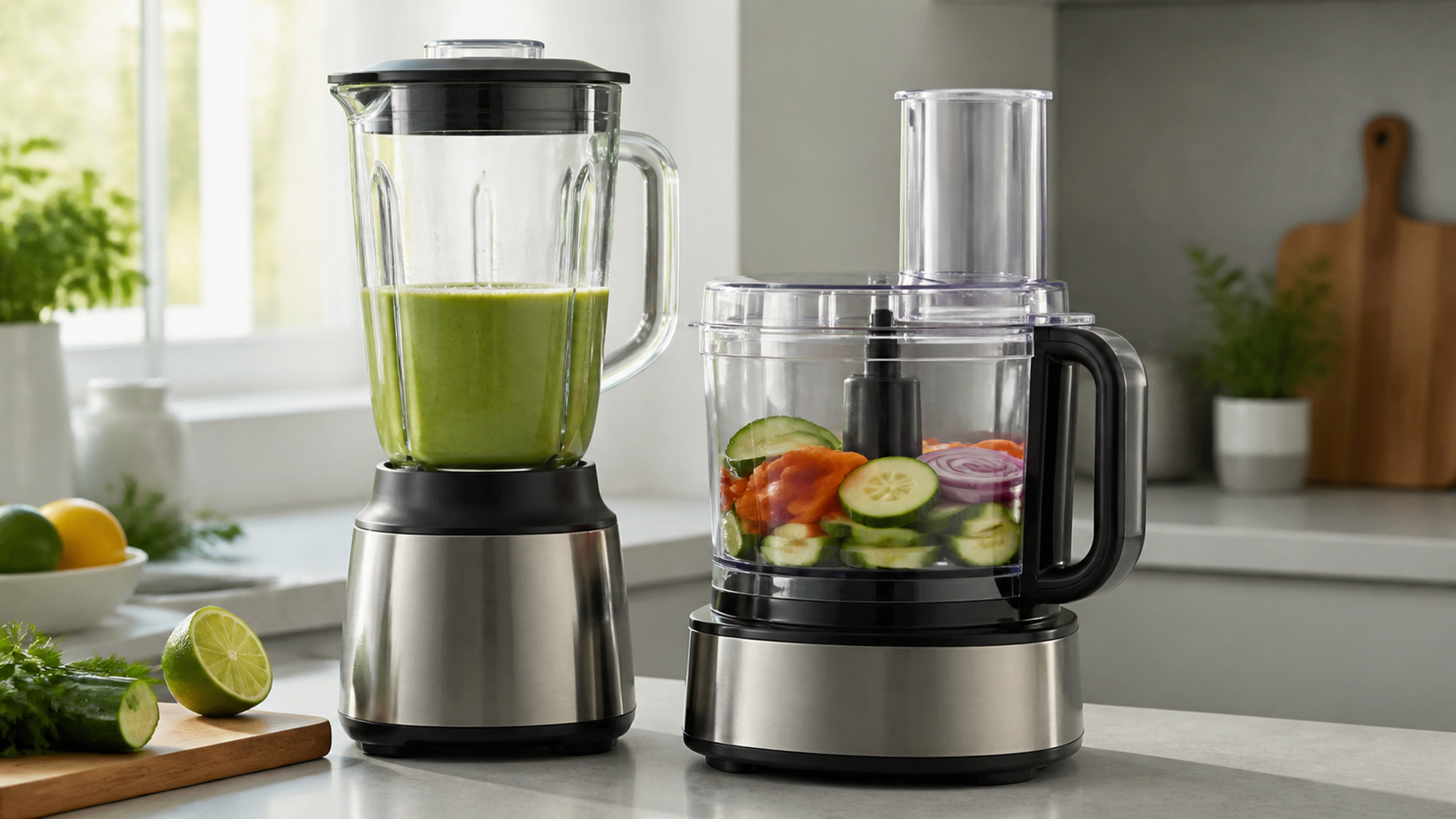
A blender and a food processor can both reduce ingredients, but they are engineered around different flows. A blender's tall jar and fast blades favour liquids, emulsions and smooth circulation. A food processor's broad bowl, interchangeable discs and pulsing control favour chopping, slicing, grating and some doughs. Motor wattage alone does not reveal which one will do a particular job well; vessel geometry, blade position, minimum load, feed tube and cleaning friction often decide whether an appliance earns counter space.
Start with the food, not the appliance
Choose a blender when smoothies, soups, sauces and pourable mixtures dominate. Choose a food processor when repeated chopping, slicing, shredding, pastry or larger low-liquid batches dominate. Keep both only when the weekly task log proves distinct use; otherwise buy the better machine for the decisive jobs and use a knife, grater or immersion blender for the margins.
| Decision factor | Blender | Food processor | Keep both only if justified |
|---|---|---|---|
| Liquid circulation | Tall jar forms a controlled vortex | Wide bowl may splash or leave pockets | Use an immersion blender for small hot batches |
| Chopping control | Fast blades can over-process dry pieces | Pulse control and wide bowl suit coarse chopping | Use a knife for tiny quantities |
| Slicing and grating | Usually unsupported | Feed tube and discs create repeatable cuts | Use a mandoline or box grater |
| Dough and pastry | Not the normal design brief | Dough blade and pulse may cut fat or mix dough | Mix by hand for tactile control |
| Batch shape | Pourable batches suit the jar | Broad, low-liquid batches suit the bowl | Split batches rather than overfill |
| Cleaning and storage | Jar and blade need safe access | Bowl, lid, pusher and discs add parts | Choose one system if storage is tight |
This blender vs food processor matrix is the article's working value object. Read the blender vs food processor rows together: the decisive failure mode depends on this topic's evidence, operating context and reader objective.
How the two machines move ingredients
Evidence 1. KitchenAid distinguishes blenders by liquid-driven blending and food processors by chopping, slicing, shredding and mixing functions.
Evidence 2. A blender needs enough liquid and headspace for circulation; a food processor can work with drier mixtures but still has minimum and maximum loading limits.
Evidence 3. Hot-liquid handling, dishwasher suitability and blade removal vary by exact model and must be checked in the manual.
Evidence 4. Interchangeable discs add capability but also add storage, cleaning and handling requirements.
Reader-visible sources checked for this article:
kitchenaid.com — reader-visible current or official evidence
kitchenaid.com — reader-visible current or official evidence
For blender vs food processor, these sources establish only the claims inside their documented scope. Recheck every changeable specification, availability condition, price, policy or service term in the relevant market before acting.
Run a controlled kitchen test
The liquid circulation row exposes a practical boundary. Route one assumes tall jar forms a controlled vortex, while route two is defensible only when wide bowl may splash or leave pockets. Route three depends on use an immersion blender for small hot batches. If that evidence is absent, keep the more reversible option.
Read chopping control as a stop/go test: fast blades can over-process dry pieces supports the first option; pulse control and wide bowl suit coarse chopping supports the second; and use a knife for tiny quantities supports the third. Record which source proves the condition and when it was checked.
A buyer can resolve slicing and grating without starting from a brand preference. Ask whether usually unsupported; compare that with whether feed tube and discs create repeatable cuts; then use use a mandoline or box grater as the third route's safeguard. An unknown condition stays unknown.
On dough and pastry, popularity is not enough. The evidence for option one is that not the normal design brief. Option two means dough blade and pulse may cut fat or mix dough. Option three is rational where mix by hand for tactile control. Recheck any changeable term immediately before commitment.
The decision changes at batch shape. Choose the first path only if pourable batches suit the jar; move to the second when broad, low-liquid batches suit the bowl; use the third when split batches rather than overfill. Save the downside that would make this row fail.
For cleaning and storage, the first route works when jar and blade need safe access; the second requires bowl, lid, pusher and discs add parts. The control for the third is choose one system if storage is tight. Verify this row against the exact product, property, account or environment before it can reverse the decision.
Facts that would reverse the current choice
Reversal control 1 — Liquid circulation. Before choosing Blender, write down how the decision changes if “Tall jar forms a controlled vortex” proves false. Do the same for Food processor and “Wide bowl may splash or leave pockets”. Keep the Keep both only if justified route available until “Use an immersion blender for small hot batches” is verified. This control belongs to blender vs food processor; update it from the cited source or exact supplier rather than copying a generic checklist.
Reversal control 2 — Chopping control. Before choosing Blender, write down how the decision changes if “Fast blades can over-process dry pieces” proves false. Do the same for Food processor and “Pulse control and wide bowl suit coarse chopping”. Keep the Keep both only if justified route available until “Use a knife for tiny quantities” is verified. This control belongs to blender vs food processor; update it from the cited source or exact supplier rather than copying a generic checklist.
Reversal control 3 — Slicing and grating. Before choosing Blender, write down how the decision changes if “Usually unsupported” proves false. Do the same for Food processor and “Feed tube and discs create repeatable cuts”. Keep the Keep both only if justified route available until “Use a mandoline or box grater” is verified. This control belongs to blender vs food processor; update it from the cited source or exact supplier rather than copying a generic checklist.
Reversal control 4 — Dough and pastry. Before choosing Blender, write down how the decision changes if “Not the normal design brief” proves false. Do the same for Food processor and “Dough blade and pulse may cut fat or mix dough”. Keep the Keep both only if justified route available until “Mix by hand for tactile control” is verified. This control belongs to blender vs food processor; update it from the cited source or exact supplier rather than copying a generic checklist.
Reversal control 5 — Batch shape. Before choosing Blender, write down how the decision changes if “Pourable batches suit the jar” proves false. Do the same for Food processor and “Broad, low-liquid batches suit the bowl”. Keep the Keep both only if justified route available until “Split batches rather than overfill” is verified. This control belongs to blender vs food processor; update it from the cited source or exact supplier rather than copying a generic checklist.
Reversal control 6 — Cleaning and storage. Before choosing Blender, write down how the decision changes if “Jar and blade need safe access” proves false. Do the same for Food processor and “Bowl, lid, pusher and discs add parts”. Keep the Keep both only if justified route available until “Choose one system if storage is tight” is verified. This control belongs to blender vs food processor; update it from the cited source or exact supplier rather than copying a generic checklist.
Build a seven-day task log
List every smoothie, soup, pesto, nut mixture, sliced vegetable, grated cheese and dough actually prepared. Mark desired texture, batch size and whether liquid can be added before assigning a machine. Record the exact product, material, room, garment, vehicle, water report or operating condition and the time of the check. Separate observed behaviour from marketing language, and repeat the comparison in the intended setting rather than an ideal demonstration. If the supposed second appliance has fewer than two recurring jobs, delay it. Preserve the evidence that would reverse the choice: a change in fit, specification, maintenance, safety, price or environment must reopen the decision rather than inherit an old conclusion.
Test texture, not speed
Use equal ingredients and stop both machines at matched intervals. Photograph particle size, smoothness, heat build-up, trapped pockets and material left under the blade. Record the exact product, material, room, garment, vehicle, water report or operating condition and the time of the check. Separate observed behaviour from marketing language, and repeat the comparison in the intended setting rather than an ideal demonstration. If one machine wins only by running longer while damaging texture, it has not won the job. Preserve the evidence that would reverse the choice: a change in fit, specification, maintenance, safety, price or environment must reopen the decision rather than inherit an old conclusion.
Measure operating friction
Time assembly, loading, scraping, decanting, washing, drying and storage. Repeat with the smallest and largest normal batch and include the awkward lid or gasket. Record the exact product, material, room, garment, vehicle, water report or operating condition and the time of the check. Separate observed behaviour from marketing language, and repeat the comparison in the intended setting rather than an ideal demonstration. If cleanup exceeds the time saved, a manual tool may be the better system. Preserve the evidence that would reverse the choice: a change in fit, specification, maintenance, safety, price or environment must reopen the decision rather than inherit an old conclusion.
Check safety and service
Read the exact manual for hot food, fill lines, interlocks, blades and replacement parts. Verify local availability of jars, bowls, seals and discs before buying a premium model. Record the exact product, material, room, garment, vehicle, water report or operating condition and the time of the check. Separate observed behaviour from marketing language, and repeat the comparison in the intended setting rather than an ideal demonstration. If a critical vessel or seal cannot be replaced, serviceability can reverse the purchase. Preserve the evidence that would reverse the choice: a change in fit, specification, maintenance, safety, price or environment must reopen the decision rather than inherit an old conclusion.
Three kitchens, three answers
Daily smoothies and occasional soup
A capable blender is likely to earn the counter space. Define the fact that would reverse this recommendation before committing.
Weekly meal preparation with chopped and sliced vegetables
A food processor may remove more repetitive knife work. Define the fact that would reverse this recommendation before committing.
Small kitchen with mixed cooking
One machine plus simple manual tools can outperform two stored appliances. Define the fact that would reverse this recommendation before committing.
Action checklist
Log weekly tasks.
Set texture targets.
Measure batches.
Check hot-liquid rules.
Test pulse control.
Count all parts.
Time cleanup.
Check storage.
Price replacement vessels.
Buy for repeated jobs.
Continue the decision
The linked VERTU articles expand adjacent parts of the blender vs food processor decision. They do not substitute for the external evidence above.
The blender-versus-food-processor verdict
Choose a blender when smoothies, soups, sauces and pourable mixtures dominate. Choose a food processor when repeated chopping, slicing, shredding, pastry or larger low-liquid batches dominate. Keep both only when the weekly task log proves distinct use; otherwise buy the better machine for the decisive jobs and use a knife, grater or immersion blender for the margins.
Keep the blender vs food processor decision reversible until its material cost, safety, access, privacy and compatibility facts are verified. Unknown evidence stays unknown; it is never silently scored as favourable.

![Top 10 Tourbillon Watches for Men [2026 Latest]](https://cdn.sanity.io/images/e0gp1l2g/production/8cb6bc45133cf9453382fc7d074465af588bb610-1800x1080.webp?w=800&h=450&q=82&auto=format&fit=crop)