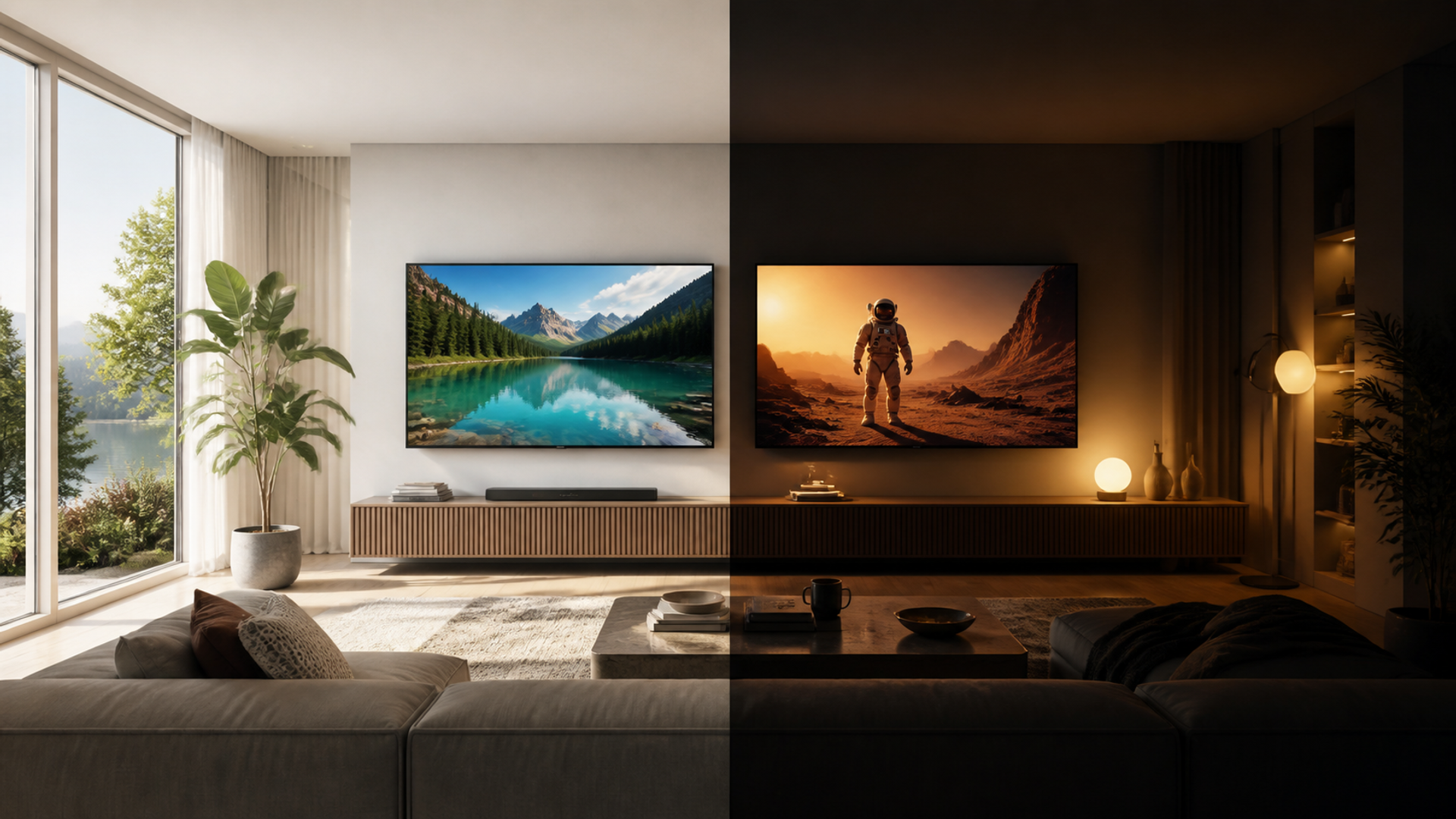
Mini-LED and OLED solve the same premium-TV problem from opposite directions. OLED controls light at each pixel, which produces exact blacks and clean dark scenes. Mini-LED uses a powerful backlight divided into many dimming zones, which can deliver exceptional brightness but may reveal blooming around bright objects. Search demand is rising because neither technology is universally better: the room, content and daily viewing pattern choose the winner.
Search demand for Mini-LED vs OLED is rising as premium televisions converge on price while retaining different strengths. The useful comparison starts with room light, seating pattern, content mix and tolerance for blooming or retention risk—not with a universal winner.
The short answer on Mini-LED vs OLED
Choose OLED for dark-room films, wide seating and viewers who value black-level precision. Choose Mini-LED for bright rooms, sustained high-brightness sport or news and very large screens where daylight performance matters. Gamers should compare ports, input lag and supported refresh modes on the exact model. Buyers worried about static interfaces should evaluate real usage rather than treating either burn-in or blooming as an absolute verdict.
Treat the room as part of the display system. Bright daylight and frequent static interfaces change the risk calculation, while controlled evening light and cinematic viewing increase the value of OLED's per-pixel contrast.
Mini-LED vs OLED decision matrix
| Decision factor | OLED | Mini-LED LCD | Room-first shortlist |
|---|---|---|---|
| Black level | Pixel-level light control | Local dimming with zone-dependent blooming | Test dark scenes from the normal seat |
| Bright-room impact | Strong on premium models but reflection control matters | Usually offers higher sustained brightness | Measure windows and daytime use |
| Viewing angle | Typically broad and consistent | Panel type affects off-axis colour and contrast | Map every seat before choosing |
| HDR highlights | Precise small highlights | Very bright highlights and full-screen scenes | Match content and room light |
| Static content | Image-retention controls and usage pattern matter | No OLED-style organic-pixel ageing | Assess news tickers, games and desktop use |
| Motion and gaming | Fast pixel response | Strong results vary by model and processing | Verify ports, refresh rate and latency |
| Large sizes | Premium pricing can rise sharply | Broad choice at very large sizes | Compare delivered cost and wall fit |
| Main artefact | Near-black handling and potential retention | Blooming, haloing and zone transitions | View real test material, not store loops |
Use the matrix after measuring viewing distance and noting the brightest hour in the room. It translates panel technology into visible trade-offs, so a showroom demo under unfamiliar lighting does not decide a purchase that will live in a different environment.
Evidence checked for Mini-LED vs OLED
Verified point 1. OLED displays generate light at the pixel level rather than using a conventional full-panel backlight.
Verified point 2. Mini-LED televisions remain LCD systems and improve local dimming by using many smaller backlight emitters and zones.
Verified point 3. Independent testing shows that final performance varies materially by model, so technology labels alone do not determine brightness, reflection handling or processing quality.
Reader-visible sources:
rtings.com current source —
https://www.rtings.com/tv/learn/qled-vs-oled-vs-ledoled-info.com current source —
https://www.oled-info.com/oled-introduction
The linked technical sources explain how the two display approaches produce light and contrast. Model-level brightness, processing, ports and warranty still vary, so verify the exact television rather than transferring a category claim to every set.
How to read the E05 matrix
Mini-LED vs OLED: black level test 1
The OLED route is supported only when pixel-level light control. The alternative Mini-LED LCD route means local dimming with zone-dependent blooming. For Room-first shortlist, the relevant control is that test dark scenes from the normal seat. Resolve this black level row with the exact product, account, room, service or schedule in front of the reader. If a decisive fact remains unavailable, preserve the least irreversible option and set a dated recheck; the E05-1 comparison is not permission to convert an unknown into a favourable assumption.
Mini-LED vs OLED: bright-room impact test 2
The OLED route is supported only when strong on premium models but reflection control matters. The alternative Mini-LED LCD route means usually offers higher sustained brightness. For Room-first shortlist, the relevant control is that measure windows and daytime use. Resolve this bright-room impact row with the exact product, account, room, service or schedule in front of the reader. If a decisive fact remains unavailable, preserve the least irreversible option and set a dated recheck; the E05-2 comparison is not permission to convert an unknown into a favourable assumption.
Mini-LED vs OLED: viewing angle test 3
The OLED route is supported only when typically broad and consistent. The alternative Mini-LED LCD route means panel type affects off-axis colour and contrast. For Room-first shortlist, the relevant control is that map every seat before choosing. Resolve this viewing angle row with the exact product, account, room, service or schedule in front of the reader. If a decisive fact remains unavailable, preserve the least irreversible option and set a dated recheck; the E05-3 comparison is not permission to convert an unknown into a favourable assumption.
Mini-LED vs OLED: hdr highlights test 4
The OLED route is supported only when precise small highlights. The alternative Mini-LED LCD route means very bright highlights and full-screen scenes. For Room-first shortlist, the relevant control is that match content and room light. Resolve this hdr highlights row with the exact product, account, room, service or schedule in front of the reader. If a decisive fact remains unavailable, preserve the least irreversible option and set a dated recheck; the E05-4 comparison is not permission to convert an unknown into a favourable assumption.
Mini-LED vs OLED: static content test 5
The OLED route is supported only when image-retention controls and usage pattern matter. The alternative Mini-LED LCD route means no OLED-style organic-pixel ageing. For Room-first shortlist, the relevant control is that assess news tickers, games and desktop use. Resolve this static content row with the exact product, account, room, service or schedule in front of the reader. If a decisive fact remains unavailable, preserve the least irreversible option and set a dated recheck; the E05-5 comparison is not permission to convert an unknown into a favourable assumption.
Mini-LED vs OLED: motion and gaming test 6
The OLED route is supported only when fast pixel response. The alternative Mini-LED LCD route means strong results vary by model and processing. For Room-first shortlist, the relevant control is that verify ports, refresh rate and latency. Resolve this motion and gaming row with the exact product, account, room, service or schedule in front of the reader. If a decisive fact remains unavailable, preserve the least irreversible option and set a dated recheck; the E05-6 comparison is not permission to convert an unknown into a favourable assumption.
Mini-LED vs OLED: large sizes test 7
The OLED route is supported only when premium pricing can rise sharply. The alternative Mini-LED LCD route means broad choice at very large sizes. For Room-first shortlist, the relevant control is that compare delivered cost and wall fit. Resolve this large sizes row with the exact product, account, room, service or schedule in front of the reader. If a decisive fact remains unavailable, preserve the least irreversible option and set a dated recheck; the E05-7 comparison is not permission to convert an unknown into a favourable assumption.
Mini-LED vs OLED: main artefact test 8
The OLED route is supported only when near-black handling and potential retention. The alternative Mini-LED LCD route means blooming, haloing and zone transitions. For Room-first shortlist, the relevant control is that view real test material, not store loops. Resolve this main artefact row with the exact product, account, room, service or schedule in front of the reader. If a decisive fact remains unavailable, preserve the least irreversible option and set a dated recheck; the E05-8 comparison is not permission to convert an unknown into a favourable assumption.
Start with the room at the worst hour
Stand where the television will be at midday and again after dark. Record direct reflections, window position and whether blinds are realistically used. A bright showroom cannot simulate this geometry. OLED may look spectacular at night but lose perceived contrast opposite a window; Mini-LED may dominate daylight yet reveal halos in a dark credits sequence. The important condition is the one that occurs most often.
Blooming is a seating and subtitle problem
Mini-LED blooming becomes most visible when a small bright object sits on black, especially subtitles, stars and interface elements. Zone count alone does not predict the result because algorithms and panel contrast matter. Watch familiar subtitled material from the centre and side seats. If halos distract the most sensitive viewer, more brightness will not compensate during evening films.
Use pattern matters more than fear
Modern OLED sets include protection systems, yet prolonged static elements remain a different use case from varied films. A household showing financial channels all day, using the TV as a desktop monitor or playing one title for thousands of hours should include that pattern in the decision. A varied evening schedule carries a different risk. Follow the maker's care guidance and avoid extreme claims in either direction.
Compare the exact model, then the size
A better 65-inch television can outperform a weaker 75-inch one, but viewing distance may make size the dominant benefit. Shortlist models that fit the room and sources, then compare measurements for brightness, colour, input lag and ports. Confirm stand width, wall-mount position, cable access and delivery. Premium picture quality is lost quickly when the screen is too small or badly placed.
Three practical Mini-LED vs OLED scenarios
Dedicated dark cinema room
Start with OLED and verify near-black handling, HDR tone mapping and the exact screen size at the intended distance. Record the fact that would reverse this choice and the date on which it must be checked.
Bright open-plan living room
Start with a high-brightness Mini-LED shortlist and prioritise reflections, viewing angle and daytime control. Record the fact that would reverse this choice and the date on which it must be checked.
Mixed gaming and television
Test static-interface exposure, HDMI bandwidth, variable refresh rate, latency and household viewing balance on each exact model. Record the fact that would reverse this choice and the date on which it must be checked.
Verification checklist for Mini-LED vs OLED
Photograph the room at midday.
Measure viewing distance.
Map side seats.
List static-content hours.
Test subtitles in a dark scene.
Check reflections.
Verify HDMI features.
Compare measured brightness.
Confirm stand or mount fit.
Read warranty and return terms.
Repeat the comparison with the actual screen size and content habits. If gaming dominates, confirm ports and latency; if films dominate, test shadow detail; if the room stays bright, assess reflections before paying for theoretical black-level superiority.
Related VERTU context for Mini-LED vs OLED
The VERTU home-technology guides add room-planning context, not laboratory evidence for a particular television. Manufacturer specifications and independent model tests should decide final suitability.
Verdict on Mini-LED vs OLED
Choose OLED for dark-room films, wide seating and viewers who value black-level precision. Choose Mini-LED for bright rooms, sustained high-brightness sport or news and very large screens where daylight performance matters. Gamers should compare ports, input lag and supported refresh modes on the exact model. Buyers worried about static interfaces should evaluate real usage rather than treating either burn-in or blooming as an absolute verdict.
OLED is usually the stronger dark-room cinema choice; Mini-LED often has the advantage in brighter, mixed-use rooms. The best premium TV is the one whose compromises are least visible in the buyer's normal environment.