

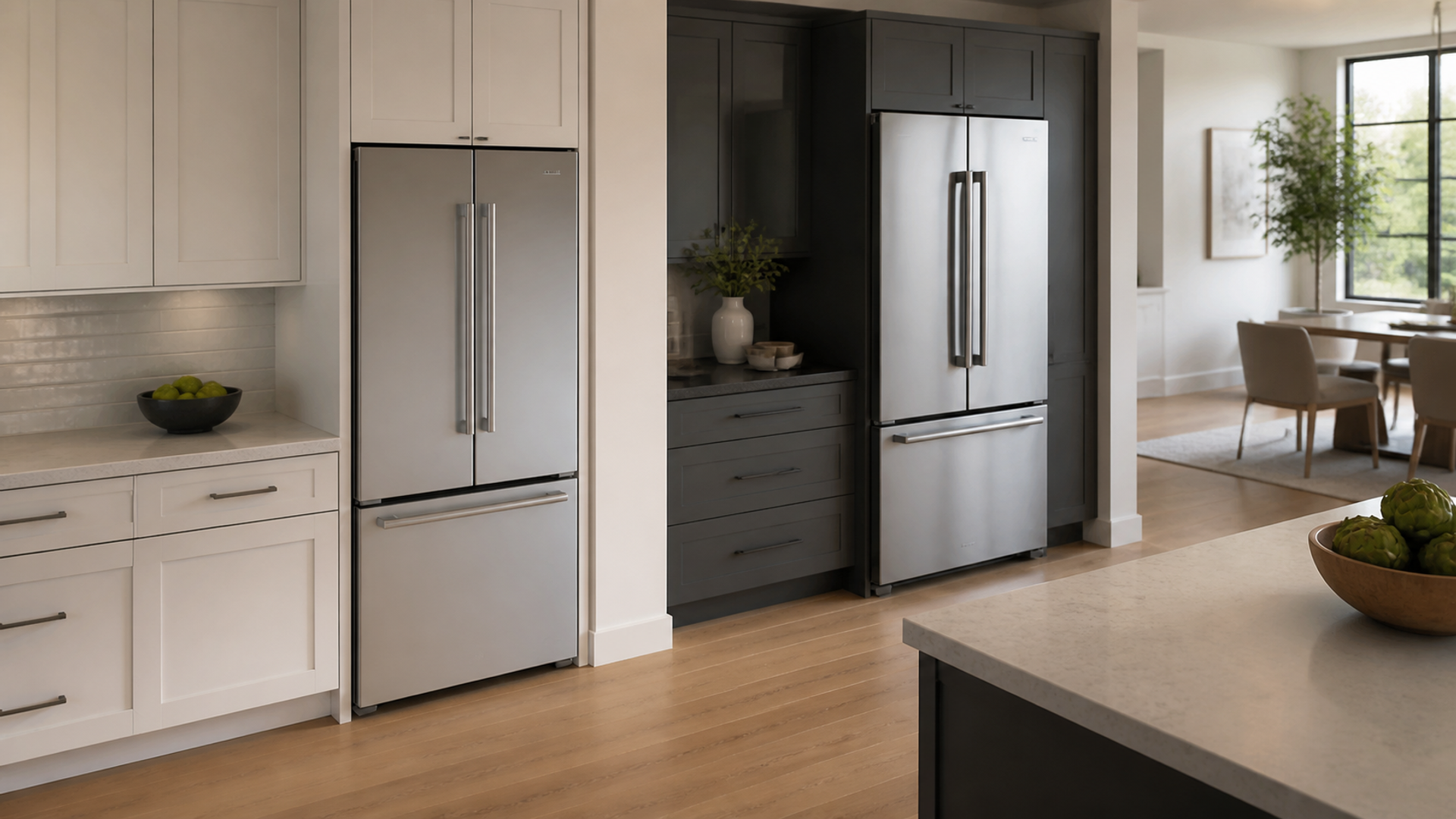
Counter-depth versus standard-depth refrigerator is a space-and-capacity decision. Counter-depth models sit closer to cabinetry, improving aisle flow and sight lines, while standard-depth models usually project farther and can offer more volume at the same width. Handles, doors, hinges and ventilation mean the marketing label never guarantees a flush fit. The answer starts with the room and the food actually stored.
Measure before comparing capacity
Choose counter depth when aisle clearance, a near-built-in look and easy visibility outweigh lower depth. Choose standard depth when bulk food and capacity value matter more than projection. Keep the current refrigerator when bins, shelf zoning, seal repair or temperature correction solves the complaint.
| Decision factor | Counter-depth refrigerator | Standard-depth refrigerator | Keep and reorganise the current unit |
|---|---|---|---|
| Cabinet line | Shallower depth improves circulation | Projection does not obstruct the kitchen | Reconfigure adjacent storage |
| Capacity | Visible shelves fit the normal load | Extra depth is repeatedly used | Add bins before replacing |
| Door clearance | Hinges and drawers clear walls and islands | The deeper body clears the aisle | Change swing or location |
| Visibility | Shallower shelves reduce forgotten food | Deep shelves remain organised | Use pull-out organisers |
| Installation | Ventilation, water and power fit drawings | The larger envelope fits delivery | Repair the current installation |
| Ownership cost | Workflow justifies the premium | Capacity per currency unit wins | Delay until layout changes |
This counter depth vs standard depth refrigerator matrix is the article's working value object. Read the counter depth vs standard depth refrigerator rows together: the decisive failure mode depends on this topic's evidence, operating context and reader objective.
What depth changes every day
Evidence 1. Whirlpool describes counter-depth models as roughly 24 to 25 inches deep while noting that dimensions vary.
Evidence 2. LG distinguishes the near-flush appearance of counter depth from deeper standard storage.
Evidence 3. Door, handle, hinge and ventilation geometry require exact installation drawings.
Evidence 4. Advertised volume does not prove that household platters, bottles or bulk packs fit usable shelves.
Reader-visible sources checked for this article:
whirlpool.com — reader-visible current or official evidence
lg.com — reader-visible current or official evidence
For counter depth vs standard depth refrigerator, these sources establish only the claims inside their documented scope. Recheck every changeable specification, availability condition, price, policy or service term in the relevant market before acting.
Load the exact shelves
A buyer can resolve cabinet line without starting from a brand preference. Ask whether shallower depth improves circulation; compare that with whether projection does not obstruct the kitchen; then use reconfigure adjacent storage as the third route's safeguard. An unknown condition stays unknown.
On capacity, popularity is not enough. The evidence for option one is that visible shelves fit the normal load. Option two means extra depth is repeatedly used. Option three is rational where add bins before replacing. Recheck any changeable term immediately before commitment.
The decision changes at door clearance. Choose the first path only if hinges and drawers clear walls and islands; move to the second when the deeper body clears the aisle; use the third when change swing or location. Save the downside that would make this row fail.
For visibility, the first route works when shallower shelves reduce forgotten food; the second requires deep shelves remain organised. The control for the third is use pull-out organisers. Verify this row against the exact product, property, account or environment before it can reverse the decision.
The installation row exposes a practical boundary. Route one assumes ventilation, water and power fit drawings, while route two is defensible only when the larger envelope fits delivery. Route three depends on repair the current installation. If that evidence is absent, keep the more reversible option.
Read ownership cost as a stop/go test: workflow justifies the premium supports the first option; capacity per currency unit wins supports the second; and delay until layout changes supports the third. Record which source proves the condition and when it was checked.
Facts that would reverse the current choice
Reversal control 1 — Cabinet line. Before choosing Counter-depth refrigerator, write down how the decision changes if “Shallower depth improves circulation” proves false. Do the same for Standard-depth refrigerator and “Projection does not obstruct the kitchen”. Keep the Keep and reorganise the current unit route available until “Reconfigure adjacent storage” is verified. This control belongs to counter depth vs standard depth refrigerator; update it from the cited source or exact supplier rather than copying a generic checklist.
Reversal control 2 — Capacity. Before choosing Counter-depth refrigerator, write down how the decision changes if “Visible shelves fit the normal load” proves false. Do the same for Standard-depth refrigerator and “Extra depth is repeatedly used”. Keep the Keep and reorganise the current unit route available until “Add bins before replacing” is verified. This control belongs to counter depth vs standard depth refrigerator; update it from the cited source or exact supplier rather than copying a generic checklist.
Reversal control 3 — Door clearance. Before choosing Counter-depth refrigerator, write down how the decision changes if “Hinges and drawers clear walls and islands” proves false. Do the same for Standard-depth refrigerator and “The deeper body clears the aisle”. Keep the Keep and reorganise the current unit route available until “Change swing or location” is verified. This control belongs to counter depth vs standard depth refrigerator; update it from the cited source or exact supplier rather than copying a generic checklist.
Reversal control 4 — Visibility. Before choosing Counter-depth refrigerator, write down how the decision changes if “Shallower shelves reduce forgotten food” proves false. Do the same for Standard-depth refrigerator and “Deep shelves remain organised”. Keep the Keep and reorganise the current unit route available until “Use pull-out organisers” is verified. This control belongs to counter depth vs standard depth refrigerator; update it from the cited source or exact supplier rather than copying a generic checklist.
Reversal control 5 — Installation. Before choosing Counter-depth refrigerator, write down how the decision changes if “Ventilation, water and power fit drawings” proves false. Do the same for Standard-depth refrigerator and “The larger envelope fits delivery”. Keep the Keep and reorganise the current unit route available until “Repair the current installation” is verified. This control belongs to counter depth vs standard depth refrigerator; update it from the cited source or exact supplier rather than copying a generic checklist.
Reversal control 6 — Ownership cost. Before choosing Counter-depth refrigerator, write down how the decision changes if “Workflow justifies the premium” proves false. Do the same for Standard-depth refrigerator and “Capacity per currency unit wins”. Keep the Keep and reorganise the current unit route available until “Delay until layout changes” is verified. This control belongs to counter depth vs standard depth refrigerator; update it from the cited source or exact supplier rather than copying a generic checklist.
Measure the envelope
Record width, height and depth at several points, including baseboards, ventilation gaps and hinge clearance. Use cardboard door templates against walls and islands and measure the full delivery route. Record the exact model, material, room, recipe or operating condition and the time of the check. Keep the observation separate from a marketing promise, and repeat the test under the intended use rather than an ideal showroom condition. If drawers cannot open or shelves cannot be removed, nominal cabinet fit is a failure. Save the result and the evidence that would reverse it, because a change in fit, specification, service, price or environment must reopen this decision rather than inherit an old conclusion.
Create a food model
Photograph a normal week and measure platters, meal boxes, bottles, frozen trays and bulk purchases. Re-create the load in a showroom and count usable positions rather than nominal shelves. Record the exact model, material, room, recipe or operating condition and the time of the check. Keep the observation separate from a marketing promise, and repeat the test under the intended use rather than an ideal showroom condition. If the rear of the current unit is mostly waste, capacity loss may be acceptable. Save the result and the evidence that would reverse it, because a change in fit, specification, service, price or environment must reopen this decision rather than inherit an old conclusion.
Audit utilities
Verify outlet, water pressure, shut-off, filters, floor protection and service access. Check whether doors must come off for delivery and whether sealed systems, ice makers and hinges have local support. Record the exact model, material, room, recipe or operating condition and the time of the check. Keep the observation separate from a marketing promise, and repeat the test under the intended use rather than an ideal showroom condition. If service or access is missing, features should lose weight. Save the result and the evidence that would reverse it, because a change in fit, specification, service, price or environment must reopen this decision rather than inherit an old conclusion.
Compare equal capacity
Use certified energy data for models that meet the same storage brief. Add purchase, installation, cabinetry, water line, filters and likely food-waste change. Record the exact model, material, room, recipe or operating condition and the time of the check. Keep the observation separate from a marketing promise, and repeat the test under the intended use rather than an ideal showroom condition. If renovation is near, organise the current unit rather than buying twice. Save the result and the evidence that would reverse it, because a change in fit, specification, service, price or environment must reopen this decision rather than inherit an old conclusion.
Three kitchens, three answers
Narrow kitchen with island
Counter depth can recover aisle space when door geometry is verified. Define the fact that would reverse this recommendation before committing.
Bulk-buying household
Standard depth can deliver more useful volume when deep shelves stay organised. Define the fact that would reverse this recommendation before committing.
Cold but chaotic current unit
Bins, zoning and seal maintenance may avoid replacement. Define the fact that would reverse this recommendation before committing.
Action checklist
Measure opening.
Add ventilation.
Template doors.
Map delivery.
Inventory food.
Measure containers.
Check utilities.
Verify service.
Compare equal capacity.
Price installation.
Continue the decision
The linked VERTU articles expand adjacent parts of the counter depth vs standard depth refrigerator decision. They do not substitute for the external evidence above.
The counter-depth verdict
Choose counter depth when aisle clearance, a near-built-in look and easy visibility outweigh lower depth. Choose standard depth when bulk food and capacity value matter more than projection. Keep the current refrigerator when bins, shelf zoning, seal repair or temperature correction solves the complaint.
Keep the counter depth vs standard depth refrigerator decision reversible until its material cost, safety, access, privacy and compatibility facts are verified. Unknown evidence stays unknown; it is never silently scored as favourable.



![Top 10 Tourbillon Watches for Men [2026 Latest]](https://cdn.sanity.io/images/e0gp1l2g/production/8cb6bc45133cf9453382fc7d074465af588bb610-1800x1080.webp?w=800&h=450&q=82&auto=format&fit=crop)