A luxury watch auction condition report should tell you what the specialist could observe, not everything that may be wrong with the watch. Read it as a structured disclosure, then test its silences. Before bidding, you need to reconcile six areas: the case, dial and hands, movement, bracelet or strap, provenance and accessories, and the commercial terms that turn a hammer price into your final cost.
That distinction matters because the market is active and increasingly international. Phillips reported more than US$235 million in watch-auction sales in the first half of 2026, with 937 lots sold and bidders from more than 70 countries. The same Phillips results announcement also emphasised originality, condition and provenance in its discussion of major results. More people can now bid remotely on important watches; fewer can hold every lot in their hands before committing.
The correct response is not to distrust every auction house. It is to understand what a report can establish, what it cannot, and which unanswered question changes your maximum bid.
A condition report is not a mechanical inspection or a warranty
The most important sentence may sit in the auction terms rather than the lot description. Phillips' Hong Kong guide for prospective watch buyers, effective 12 April 2026, says its reports are prepared honestly and carefully but are not exhaustive. They may not identify every mechanical replacement or imperfection in the movement, case or dial. The absence of stated damage does not mean a lot is in good condition, working order or free from repair.
Christie's gives buyers a similar warning in its explanation of condition reports: a report is guidance, lots are sold in their condition at the time of sale, and buyers should request, receive and consider the report before bidding. Both houses recommend viewing in person where possible.
That means a useful report can still be incomplete. It may describe visible scratches without measuring case thickness; say a movement is running without testing power reserve or accuracy; or list a box without establishing that the box was originally supplied with that watch. A catalogue image can support the report, but colour, reflections, compression and angle can conceal or exaggerate details.
Treat the report as one layer in a due-diligence file alongside photographs, catalogue text, serial and reference information, service documents, the auction terms and direct answers from the specialist.
The six-part condition-report red-flag matrix
Use the matrix below to turn descriptive language into an action. A red flag is not always a reason to reject a watch. It is a reason to ask a precise question, reprice the risk or stop bidding when the answer remains uncertain.
| Area | Reassuring evidence | Wording or silence to investigate | Action before bidding |
|---|---|---|---|
| 1. Case | Clear photographs from every side; stated polishing history; legible hallmarks and serials; edges and lug proportions consistent with the reference | “Previously polished”; “surface wear commensurate with age”; no side-profile or caseback images; soft edges; shallow hallmarks; corrosion around the back or crown | Request straight-on side, lug, caseback and hallmark photographs. Ask whether dimensions were measured and whether material loss, laser welding or refinishing is known |
| 2. Dial and hands | Printing, lume, hands and ageing appear consistent; replacement or restoration is explicitly disclosed; macro images show edges, apertures and plots | “Attractive patina” without detail; bright or mismatched lume; unusually fresh dial on a heavily worn case; flaking, bubbling, stains or blurred printing; no disclosure of service parts | Ask whether the dial, hands and luminous material are believed original to the watch. Request neutral-light macro images and disclosure of refinishing, reluming or service replacement |
| 3. Movement | Correct calibre is identified; movement image supplied; recent service invoice; timing, function and power-reserve observations are dated and qualified | “Running at time of cataloguing”; “functions appear operational”; no movement photo; damaged screw heads; corrosion; no service history; complications not individually tested | Ask what was tested, when and for how long. Request timing information, service documents and a movement photograph. Budget for inspection or service unless evidence supports otherwise |
| 4. Bracelet or strap | Bracelet reference, end links, clasp code, link count and fit are documented; stretch or wear is described; original accessories are distinguished from later replacements | “Associated bracelet”; short bracelet; excessive stretch; mismatched end links; damaged clasp; strap described as branded without confirming age or originality | Confirm wrist fit and available links. Ask which components are period-correct, later service parts or merely compatible. Price missing links and replacements before bidding |
| 5. Provenance and accessories | Ownership history is supported by named records; archive extract, warranty papers, invoices and serials reconcile; box and accessories are accurately dated | “From an important collection” without support; “full set” without an itemised list; papers with inconsistent serials; later box presented beside an earlier watch; gaps in export history | Ask for an itemised accessory list and document images. Verify serial consistency and what the auction house has independently checked. Treat a story as unproven until it is supported |
| 6. Commercial terms | Buyer’s premium, taxes, payment deadline, shipping, storage, import restrictions and return or warranty provisions are visible for that sale | Maximum bid is based only on the estimate; wildlife-material strap; cross-border shipment; currency exposure; unclear guarantee symbols; no allowance for service, insurance or duties | Read the sale-specific terms. Calculate an all-in ceiling including premium, tax, shipping, insurance, permits and immediate service. Do not assume a cancelled permit or delayed shipment cancels the sale |
Start with consistency, then inspect detail
Condition is not synonymous with perfection. A properly aged watch may show scratches, softened luminous material and a faded dial while remaining coherent and desirable. The problem is inconsistency: one component tells a different story from the rest.
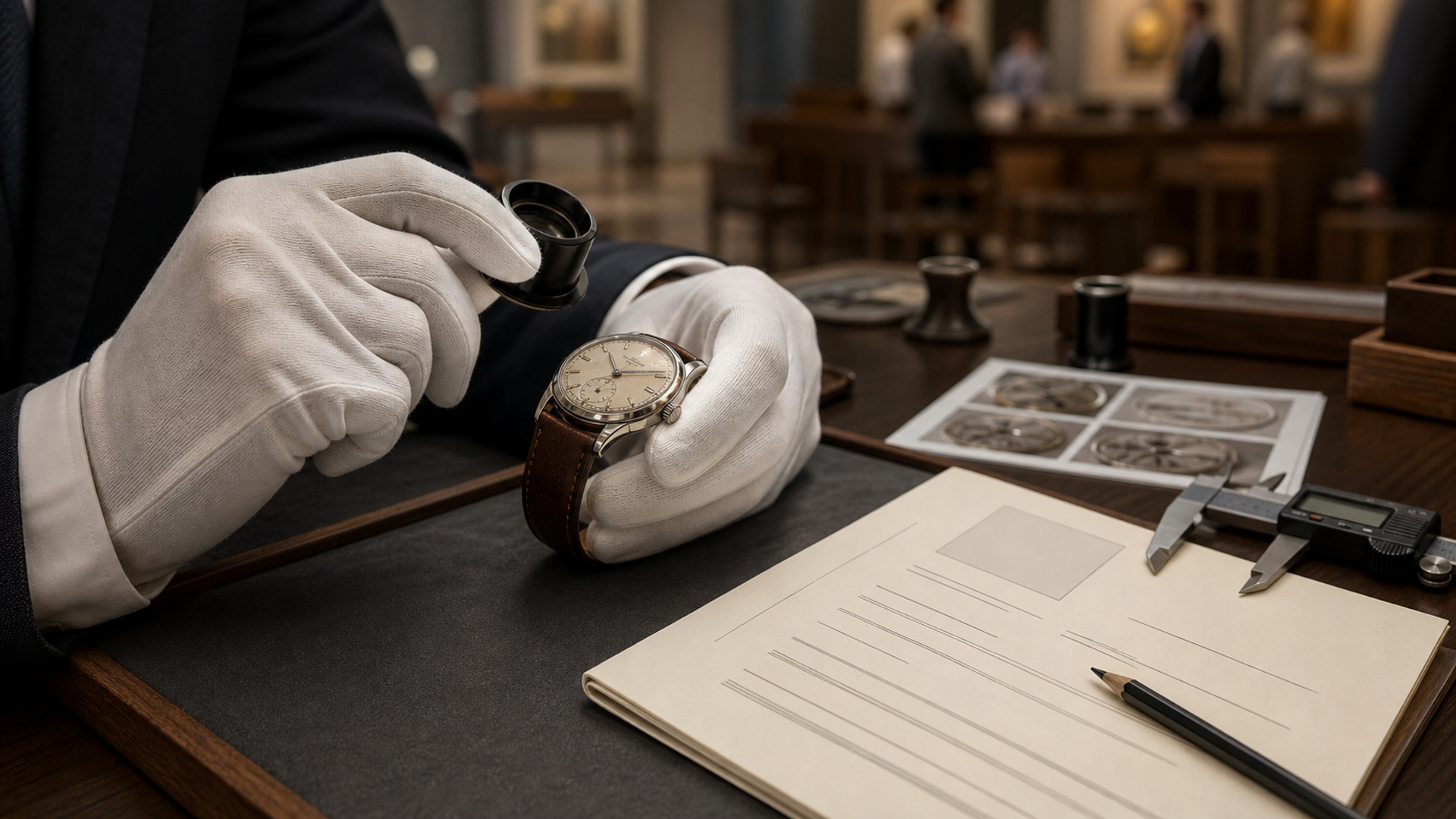
Sotheby's collector guide to watch condition recommends first assessing the watch as a whole. A heavily worn case paired with a dial that looks new should trigger questions. The guide then points to more specific signs: polishing can alter lug proportions or weaken hallmarks; replacement or refinished dials can disrupt the expected relationship between printing, lume and age; tool marks on movement screws can reveal the quality of past intervention.
This consistency test is useful because isolated flaws have different meanings. A scratch is usually an ownership mark. Rounded lugs may represent irreversible loss of case geometry. A service crown can improve daily reliability while reducing originality for a collector seeking a period-correct example. A restored dial may be acceptable at one price and unacceptable at another.
The report should therefore help you answer two different questions:
Is the watch coherent and honestly represented?
Is this particular condition suitable for my reason for buying?
A collector seeking an untouched vintage reference and a buyer seeking a reliable daily watch can rationally reach different conclusions about the same lot.
Translate auction language into questions
Auction reports use compressed, qualified language. Do not argue with the wording; convert it into a testable question.
If a report says the movement was “running at the time of cataloguing”, ask whether accuracy, amplitude, power reserve and every complication were tested. That phrase should not be upgraded in your mind to “recently serviced” or “ready for daily wear”. If the watch will be exposed to water, do not infer water resistance from the original model specification, especially after an auction-house inspection or an unknown service history.
If the case is “believed to be unpolished”, ask what visual or dimensional evidence supports the belief and whether laser repair or local refinishing was considered. If the dial has “patina”, ask for photographs under diffuse neutral light and for a direct statement about moisture, flaking, corrosion, reluming and refinishing.
If a lot is described as a “full set”, ask for a complete inventory. Box, outer box, warranty paper, manuals, tags, spare links, service records and sale receipts do not have equal evidential value. A period-correct box is not necessarily the original box; an archive extract may confirm production data without proving an unbroken chain of ownership.
For a broader pre-owned purchase framework, VERTU's guide to which luxury-watch service records actually matter explains why a detailed dated invoice is usually more useful than a vague claim that a watch was “recently serviced”. For a valuation perspective, what AI watch valuations can and cannot tell you shows why identification and transaction estimates do not replace physical inspection.
Set an all-in bid ceiling, not an emotional hammer-price target
The pre-sale estimate is not your invoice. Phillips' 2026 Hong Kong guide states that the purchase price combines the hammer price, buyer's premium, applicable tax and charges. Its published premium tiers are specific to that location and effective date; another sale can use different rates. The estimate itself excludes premium and tax.
Build your ceiling backwards:
Maximum hammer bid = total acquisition budget − premium − taxes and duties − shipping and insurance − immediate service reserve − missing-part or documentation reserve.
Use the actual sale calculator and terms rather than a generic percentage. Cross-border purchases may also involve currency conversion, import restrictions, storage deadlines and permits for straps or components containing protected wildlife materials. Phillips' guide makes clear that obtaining export and import licences is the buyer's responsibility and that a refused or delayed permit may not justify cancelling the sale.
If you intend to travel with the watch after purchase, the documentation, insurance and customs checklist is a useful next step. The acquisition file you build before bidding can later support insurance, customs and resale.
A remote bidder's pre-bid request
For a meaningful lot, send one consolidated request rather than a string of vague messages. Include:
the lot number, reference and your bidding deadline;
the latest condition report and any amendments;
high-resolution, neutral-light images of the dial, case sides, lugs, caseback, hallmarks, bracelet, clasp and movement;
an itemised list of replaced, restored, refinished or later components known to the specialist;
the date and scope of any functional observation or timing test;
copies or clear images of service and provenance documents;
confirmation of bracelet length, link count and included accessories;
the sale-specific premium, taxes, shipping limits and relevant lot symbols.
Ask for a video appointment or an independent inspection when the value, complexity or uncertainty warrants it. Phillips expressly recommends that buyers of significant lots consider retaining their own professional adviser. The cost of expert review is easier to accept before a bid than the cost of discovering an altered dial or corroded movement afterwards.
Decide what kind of imperfection you are willing to own
The right lot is not the one with the shortest condition report. It is the one whose condition is sufficiently understood, appropriately priced and compatible with your collecting purpose.
Use three possible outcomes:
Bid: the watch is coherent, material issues are disclosed, the documentation supports the story and your all-in ceiling includes foreseeable work.
Ask an expert: originality, movement condition or provenance could materially affect value, but the uncertainty can still be resolved before the sale.
Stop: the auction house cannot provide decisive images or answers, the cost exposure is open-ended, or the lot only works if you assume that silence means good condition.
Collectors often focus on rarity because it is easy to describe. Condition is harder because it requires judgement. A disciplined reading of the report does not remove that judgement; it makes the judgement visible. That is the difference between bidding on a compelling watch and bidding on an optimistic interpretation of one.