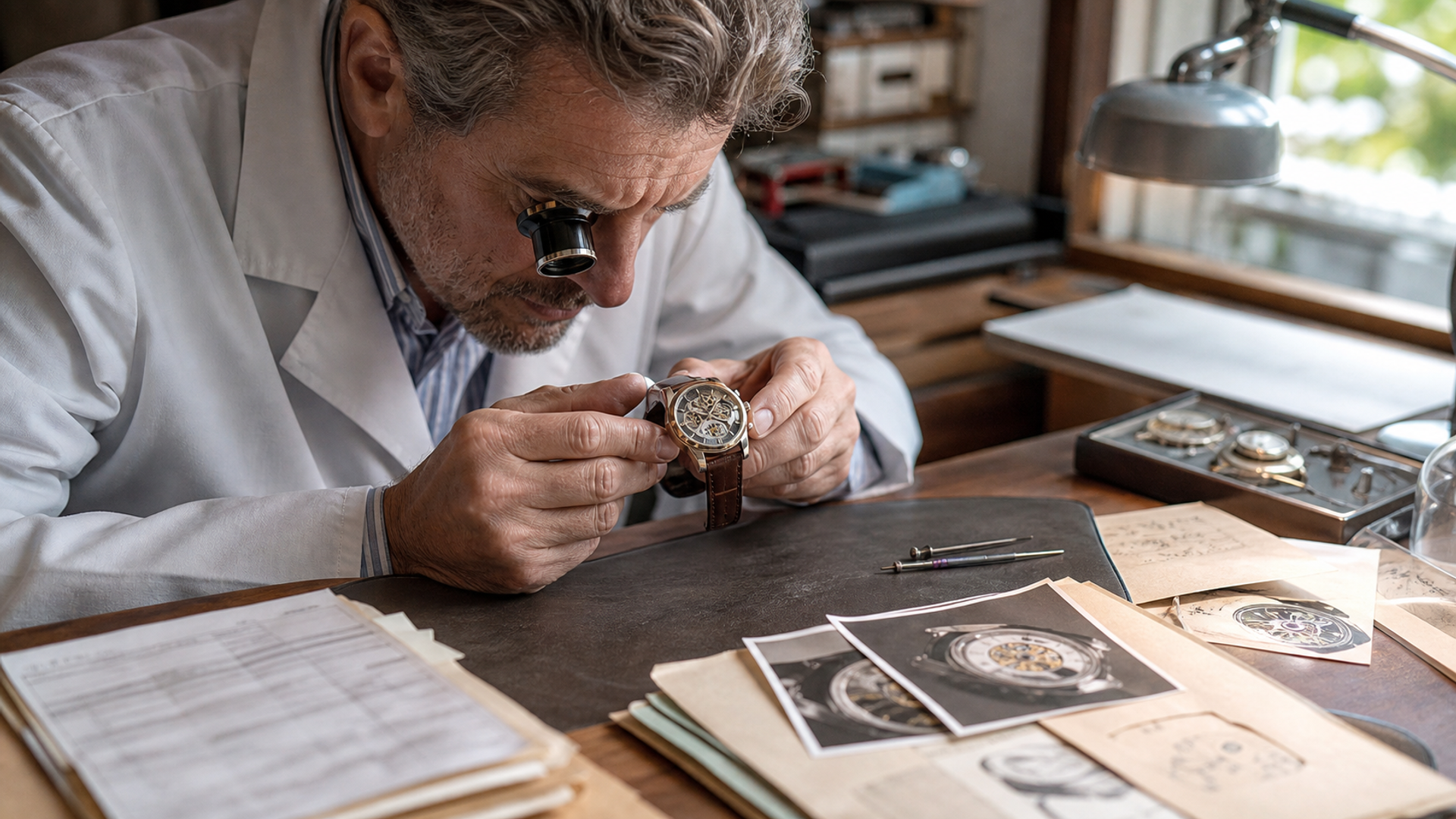
The most useful service record is not the most impressive-looking folder. It is a document that connects the exact watch to a named service provider, a date, a defined scope of work and disclosed parts. A recent manufacturer service card can be strong evidence of authorised work; an itemised independent invoice can also be valuable. A vague “just serviced” statement without the watch reference, work performed or provider identity should carry little weight.
Service history does not prove authenticity or future reliability by itself. It reduces uncertainty. The buyer still needs to verify the watch, seller, condition and provenance as a connected evidence set.
Evidence hierarchy
| Record | What it can establish | What it cannot establish alone | Buyer action |
|---|---|---|---|
| Manufacturer/authorised service card | Authorised service event and applicable service guarantee | Complete ownership history or untouched originality | Verify reference, date and provider channel |
| Itemised service invoice | Work authorised, parts, labour and provider | That every listed part remains fitted later | Match serial/reference and inspect current watch |
| Pre-service estimate | Condition and proposed work at intake | That the work was approved or completed | Ask for final invoice and return report |
| Timing/water-resistance test | Measured result at a point in time | Long-term performance | Check test date and conditions |
| Movement/case photographs | Visible state during service | Hidden work not photographed | Compare identifiers and current condition |
| Seller statement | A lead for further verification | Independent proof | Request supporting documents |
Rolex states that a watch returned after a full authorised service receives a Rolex Service Card, which confirms service to its procedures and carries a two-year international guarantee. Patek Philippe describes a service intake that checks the watch against historical archives, photographs it and records its serial number as part of its service process. Those examples show why identifiers and process matter more than the phrase “full overhaul”.
Start with identity
Before reading the repair detail, confirm that the record belongs to the watch. Look for the reference, case or serial identifier as appropriate to the brand and age. Some documents deliberately mask part of an identifier for privacy; the seller should still be able to demonstrate a match without circulating a full serial publicly.
Check dates, client name where relevant, service location and invoice number. Contact the service provider through an independently found channel if verification is available. Do not use a telephone number printed on a suspicious invoice without checking it against the provider’s current official site.
Read the scope line by line
“Serviced” can mean anything from a battery change to complete movement disassembly. A useful invoice distinguishes diagnosis, movement work, case/bracelet work, seals, crystal, crown, pushers, dial, hands and testing.
Ask five questions:
Was the movement completely serviced or only regulated?
Were water-resistance components replaced and was pressure testing performed?
Were visible parts refinished, polished or replaced?
Which original parts were returned, if any?
Is there a service warranty, and is it transferable?
Rolex’s servicing procedure describes assessment, estimate and a multi-stage process. Patek gives a similar view of reception, diagnosis and work adapted to complexity. Use brand descriptions as context, not as proof that a particular watch received every possible operation.
Replaced parts: neither automatically good nor bad
A replaced seal, worn gear or damaged crystal can be appropriate maintenance. A replaced dial, bezel, hands or case component can materially affect a collector’s view of originality. The effect depends on the model, period, condition and buyer’s priorities.
Treat replacements as disclosure questions:
What was removed?
Why was it removed?
Was the replacement period-correct and authorised?
Is the original part included?
Does the current watch match the invoice description?
A buyer seeking daily reliability may value recent authorised replacements. A collector prioritising original surfaces may prefer a watch needing careful work over one aggressively restored. Neither objective is universally correct, but the invoice should let the buyer see the trade-off.
Polishing and surface history
Polishing is often emotional because photographs can hide its extent. Service records may state refinishing, but inspection is still required. Look at case geometry, lug shape, edges, engravings and bracelet fit. Compare with reliable references for the exact model and production era.
Rolex notes in its care and service FAQ that professional polishing should be performed by an official service centre. That is brand guidance, not a promise that every authorised polish preserves the collector value a particular buyer wants. Decide whether your priority is factory presentation, untouched wear or a balanced restoration.
The date matters, but not alone
A service completed last month is not automatically better than one completed five years ago. Ask what happened after the service. Was the watch stored, worn daily, exposed to water, dropped or opened again? A current timing and condition assessment may be more informative than an old invoice.
Conversely, no recent service is not automatically a defect. Some brands recommend long intervals depending on model and real use. Rolex says approximately ten years for many models, while Cartier’s care recommendations discuss periodic functional checks. Always use the maker’s guidance for the specific watch.
Build a pre-purchase evidence pack
Request and retain:
seller identity and authority to sell;
high-resolution current photographs;
reference and protected identifier match;
original sale papers if represented as included;
all service cards, estimates and final invoices;
replaced-part disclosure;
recent timing and water-resistance information where relevant;
return terms and authenticity commitment;
independent inspection route.
Do not transmit full identity documents or watch serials casually. Share only what the legitimate transaction and verifier require through a controlled channel.
A practical scoring method
Score each evidence area from zero to two:
| Area | 0 | 1 | 2 |
|---|---|---|---|
| Watch-to-record match | No identifier | Partial match | Clear protected match |
| Provider | Unknown | Identifiable independent provider | Verifiable authorised/specialist provider |
| Scope | “Serviced” only | Some work listed | Itemised work and parts |
| Completion | Estimate only | Receipt without report | Final invoice/card and tests |
| Current condition | No assessment | Seller test | Independent current inspection |
A high score does not set the price; it shows where uncertainty has been reduced. A low score is not proof of wrongdoing, but the offer should not be priced as if the missing evidence exists.
For broader collection planning, the three-watch collection framework helps prevent role duplication, while the watch storage guide covers care after purchase.
The collector’s conclusion
Buy the watch in front of you, not the story around it. Strong service records identify the watch, provider, date, work and parts. They should agree with the current object and an independent inspection. When the paperwork is vague, treat it as a claim to verify—not a premium to pay.
Questions for the seller, verbatim
Ask concise questions that produce evidence rather than a long narrative: “Which service provider completed the last work?”, “Does the final invoice identify this watch?”, “Which visible parts were replaced or refinished?”, “Is the service guarantee transferable?”, and “May my chosen specialist inspect the watch during the return period?”
Record the answers in the sales agreement when they affect value. If the seller says a dial, bezel or movement is original, ask what supports that representation. A credible seller should be comfortable distinguishing what is documented, what is professional opinion and what remains unknown.