The safest luxury watch to travel with is the one you can document, insure appropriately, wear discreetly and report accurately if it disappears. Value alone does not determine risk. A modest-looking vintage piece with weak records can create more customs and claims friction than a more expensive watch supported by a complete ownership file. This analysis is supported by Chubb guidance for travelling with luxury watches.
Before crossing a border, prepare a travel dossier, confirm the policy territory and conditions, check the departure and arrival customs rules, and decide how the watch will be carried when it is not on the wrist.
This is practical ownership guidance, not legal, customs or insurance advice. Requirements vary by jurisdiction and route; verify them with the relevant authority and insurer before travel.
The one-page checklist
| Before departure | In transit | If something goes wrong |
|---|---|---|
| Photograph watch and identifying details | Keep watch on person or in cabin baggage, subject to security rules | Prioritise personal safety |
| Store invoice, service and insurance records securely | Avoid unnecessary display and discussion | Notify local police/security where appropriate |
| Confirm geographic cover and exclusions | Use a dedicated travel case when removed | Contact insurer within required timeframe |
| Check route-specific customs procedures | Do not place the ownership dossier only in the same bag | Record time, place, circumstances and identifiers |
| Record insurer, dealer and service contacts | Follow hotel safe and custody policy deliberately | Suspend related digital access if a connected watch is involved |
Build the travel dossier
The dossier should establish what the watch is, why you possess it and what condition it was in before departure.
Include:
brand, model and reference;
serial number where safe and appropriate;
dated invoice or other proof of legitimate ownership;
clear photographs of dial, case, caseback, bracelet and distinctive marks;
recent service documentation;
current insurance schedule or policy reference;
current valuation if the insurer requires one;
emergency contact details for insurer and authorised service;
customs registration or temporary-export documents where applicable.
Keep an encrypted digital copy accessible from a second trusted device or approved account. Do not publish serial numbers or travel dates publicly. The aim is evidence, not exposure.
Customs: ownership and import are different questions
Wearing a watch does not automatically answer where it was purchased, whether it was previously imported correctly or whether a new purchase must be declared. Customs rules concern the movement and status of goods, not merely whether the object is on the wrist.
Japan provides a clear example of route-specific preparation. Japan Customs guidance says residents carrying foreign-made goods such as watches out of Japan can register them with Customs before departure and retain the confirmed form for return. Without prior confirmation, the goods may be difficult to distinguish from items bought abroad and may be dutiable in some cases.
That procedure should not be generalised to every country. Instead, use it to understand the problem: a border official may need evidence that the watch was already legitimately in your possession before the trip.
Ask the customs authority for your route:
Is pre-departure registration available or required for high-value personal goods?
What evidence of prior ownership or import status is accepted?
Are there thresholds or declaration rules on return?
What applies if a watch is purchased, exchanged or serviced abroad?
Does shipping the box separately change any obligation? Do not assume it does.
If you buy a watch abroad, obtain an accurate invoice and follow the arrival country’s declaration process. Concealing packaging or wearing the watch does not erase a purchase.
Insurance questions that matter
“Worldwide cover” is a starting phrase, not a complete answer. Ask the insurer or broker to confirm in writing:
countries and trip durations covered;
whether the watch must be individually scheduled;
whether the settlement basis is agreed value, replacement, market value or another method;
theft-from-hotel, vehicle and unattended-baggage exclusions;
requirements for a safe or secure storage;
cover while the watch is worn, shipped or left with a service centre;
mysterious disappearance terms;
notification deadlines and required police reports;
whether straps, accessories, taxes and appreciation are included;
whether business travel changes the policy.
A high headline limit can coexist with restrictive sub-limits. Read the watch/jewellery section, territorial definitions and exclusions rather than relying on a sales summary.
If the watch’s market value has moved materially since the last valuation, ask whether the schedule should be updated. Do not assume an auction result for another reference establishes the insured value of yours.
Carrying the watch
On the wrist
The wrist keeps the watch under direct control but can attract attention. Choose clothing and behaviour appropriate to the destination. Avoid broadcasting hotel, route and collection details on social media.
In cabin baggage
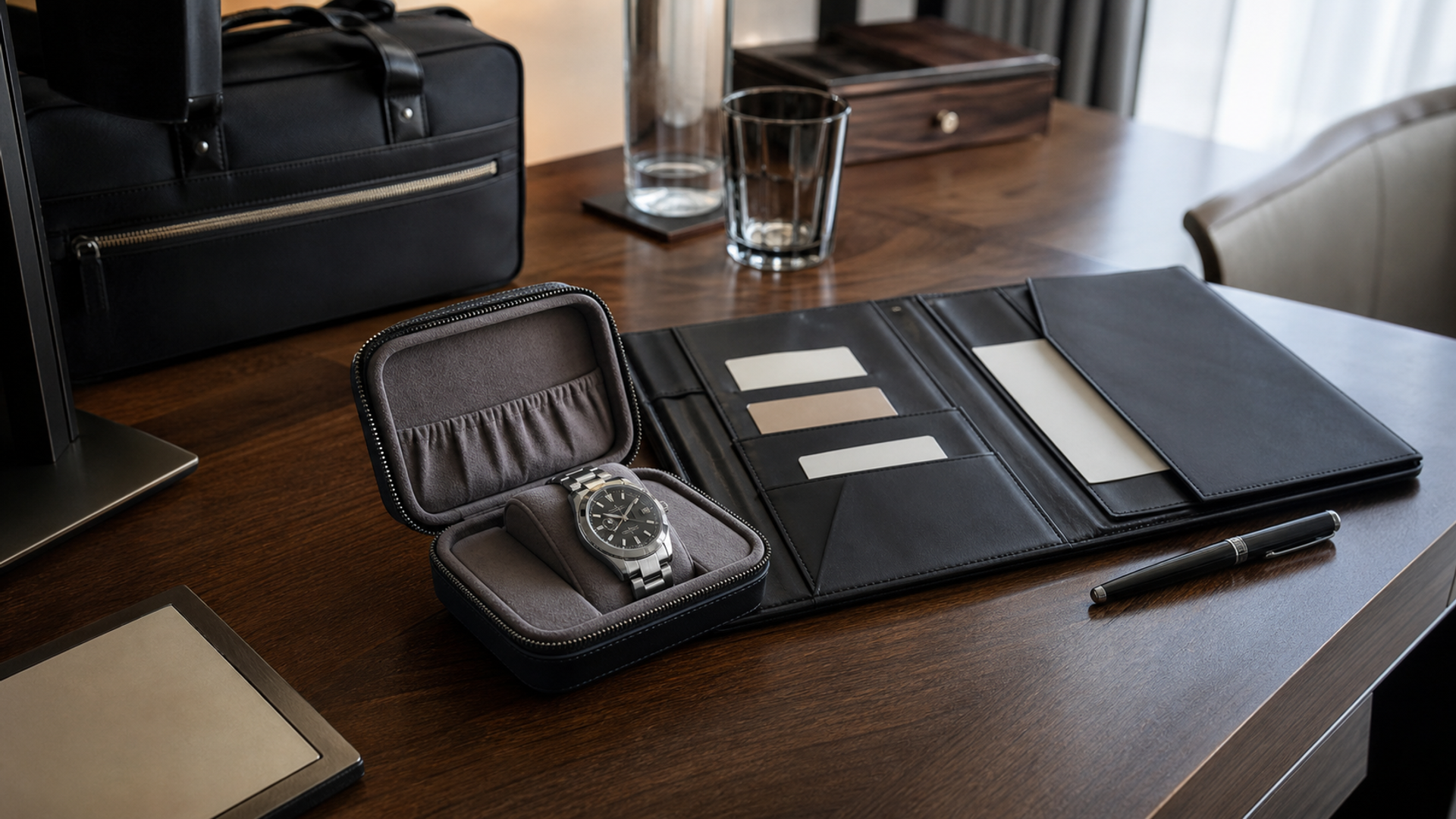
A dedicated, low-profile case protects the watch when it must be removed. Keep it inside a bag that remains under your control. Security screening rules vary; follow staff instructions and visually track the tray where possible.
In checked baggage
Checked baggage creates loss, delay and custody risks and may conflict with insurance conditions. Avoid it unless a specific rule or circumstance requires otherwise and your cover is clear. Japan Customs, for example, notes that confirmation for relevant foreign-made goods should be obtained before checking baggage.
In a hotel
A room safe is a tool, not an absolute guarantee. Understand the hotel’s terms, safe dimensions and access process. For a very valuable piece, ask the insurer what storage standard it expects and consider whether carrying the watch is justified at all.
The one-watch rule
Travelling with one watch reduces decisions, documentation and opportunities for loss. It also makes the choice more consequential.
Choose a piece that:
is appropriate for the destination and activities;
can tolerate expected weather and water exposure within its current tested condition;
works with the required dress settings;
does not need its original presentation box;
can be identified clearly from your records;
will not make you anxious throughout the trip.
The most prestigious watch in the collection is not automatically the right travel watch. Peace of mind is part of fit.
What to leave at home
Unless needed for a sale, service or event, leave the original box and unnecessary papers in secure storage. They add bulk and can increase the consequences of baggage loss. Carry copies of documents, not the only originals.
Avoid carrying several straps, tools and valuable accessories without a clear reason. Each component expands the inventory you must track and potentially declare or claim.
A loss-response card
Prepare this before departure and store it separately from the watch.
Immediate actions
Protect personal safety; do not pursue a thief.
Record the last confirmed time and place you had the watch.
Notify local police, hotel security, airline or venue as appropriate.
Obtain a report or reference number.
Contact the insurer within the policy deadline.
Notify the dealer, manufacturer or relevant watch-register service if advised.
Preserve tickets, access logs, photographs and correspondence.
Information to provide
model, reference and serial;
recent photographs;
proof of ownership;
description of circumstances;
police/security report details;
travel and location evidence requested by the insurer.
Do not embellish uncertainty. A precise statement of what is known, what is estimated and what remains unknown is more credible than a confident story assembled after the event.
Connected watches add a digital task
If the lost watch stores payment credentials, messages or account access, follow the platform’s lost-device and remote-removal procedure. Removing a digital wallet token does not replace a police or insurance report, and remotely wiping a device may affect location or evidence. Follow the relevant platform and organisational policy.
Before travel, confirm that:
a screen lock is enabled;
payment cards can be suspended from another device;
the watch can be marked lost where supported;
account recovery does not depend solely on the missing phone and watch;
sensitive notifications are limited on the lock screen.
The route review
Run this review for every country on the itinerary, including transit points if goods may enter customs control.
| Question | Record |
|---|---|
| Customs authority and official URL | |
| Pre-departure registration required/available | |
| Return declaration threshold/process | |
| Insurer confirms territory | |
| Hotel/storage condition | |
| Local emergency number | |
| Police report process | |
| Authorised service contact |
Official advice can change. Date the review and retain the links used.
Buying or servicing a watch during the trip
A purchase, exchange or service movement is not the same as carrying your existing personal watch. Before buying abroad, ask the arrival customs authority what must be declared and what taxes or duties may apply. Obtain an accurate commercial invoice showing the seller, watch, price and date; retain payment evidence and any export paperwork.
If the watch is sent to a foreign service centre, document the outbound serial number, declared purpose and temporary movement. Ask the carrier, customs authority and service centre which procedure prevents a returning repaired watch from being treated as a new purchase, and how charges for parts or service are handled. Do this before shipping, not after the parcel is held.
Do not alter an invoice, split a genuine purchase into misleading documents or ask a seller to declare an artificial value. Apart from legal risk, inaccurate paperwork can undermine an insurance claim and future provenance.
The final decision
Travel with the watch only when three conditions are met:
you can prove what it is and that you legitimately possess it;
you understand the relevant customs and insurance conditions;
you have a realistic plan for custody and loss.
If any condition is unresolved, leave the watch in secure storage and take another. Luxury should expand a journey, not turn every border, restaurant and hotel room into a risk calculation.
If the collection itself is still taking shape, begin with VERTU Signals’ guide to established Swiss luxury watch brands before building the travel dossier for a specific reference.