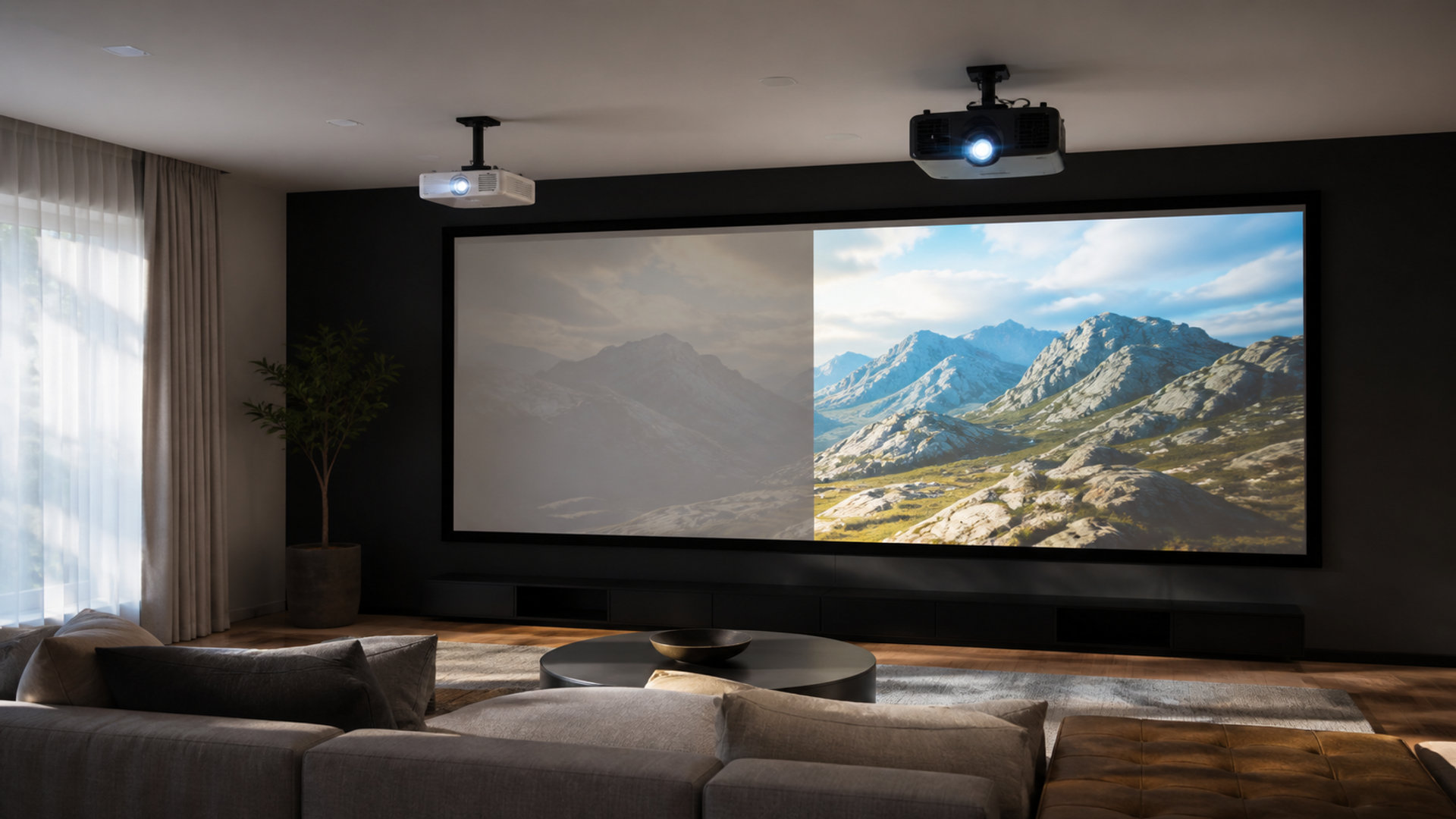
Laser and LED projectors both replace traditional lamps with solid-state light sources, promising long service life and consistent operation. A laser system can support very high brightness and large installed images; an LED system can enable compact, quiet and efficient portable designs. But the light source does not determine contrast, lens quality, colour accuracy, processing, throw ratio or screen performance. A dim laser projector can lose to a better LED model in one room, and a portable LED unit can be unsuitable for a large bright screen. Start with image size, ambient light, placement and measured brightness, then evaluate the complete projector.
Light-source labels do not set image quality
Choose laser when the room needs sustained high output, a larger screen, fixed installation or demanding ambient-light performance. Choose LED when compactness, portability, lower heat and moderate dark-room output fit the use. Choose by measured room need when lens, contrast, screen, noise, input lag and installation geometry matter more than the light-source badge.
| Decision factor | Laser projector | LED projector | Choose by measured room need |
|---|---|---|---|
| Brightness | Scales well into high-output installation | Often optimised for modest efficient output | Use measured, not marketing, lumens |
| Size | Can require larger optics and cooling | Supports compact portable designs | Check the exact chassis |
| Colour | Phosphor and multi-laser designs vary | LED spectral design also varies | Review calibrated measurements |
| Lifetime | Long rated light-source life | Also offers long rated life | Read output-decay conditions |
| Installation | Strong fit for fixed large images | Strong fit for flexible small rooms | Calculate throw and lens offset |
| Cost | Higher output and optics can raise price | Portable value can be attractive | Price screen, mount and audio |
This laser projector vs led projector matrix is the article's working value object. Read the laser projector vs led projector rows together: the decisive failure mode depends on this topic's evidence, operating context and reader objective.
Brightness must survive the room
Evidence 1. Solid-state light-source lifetime is normally a rated decline point under stated modes, not a promise of unchanged brightness forever.
Evidence 2. ANSI-lumen or recognised measured output is more useful than unqualified brightness numbers, especially for portable projectors.
Evidence 3. Ambient light and screen size determine how much illumination reaches each unit of image area.
Evidence 4. Throw ratio, lens shift, focus uniformity, fan noise and input lag can decide suitability independently of laser or LED.
Reader-visible sources checked for this article:
epson.com — reader-visible current or official evidence
corporate.epson — reader-visible current or official evidence
For laser projector vs led projector, these sources establish only the claims inside their documented scope. Recheck every changeable specification, availability condition, price, policy or service term in the relevant market before acting.
Match optical design to installation
The brightness row exposes a practical boundary. Route one assumes scales well into high-output installation, while route two is defensible only when often optimised for modest efficient output. Route three depends on use measured, not marketing, lumens. If that evidence is absent, keep the more reversible option.
Read size as a stop/go test: can require larger optics and cooling supports the first option; supports compact portable designs supports the second; and check the exact chassis supports the third. Record which source proves the condition and when it was checked.
A buyer can resolve colour without starting from a brand preference. Ask whether phosphor and multi-laser designs vary; compare that with whether lED spectral design also varies; then use review calibrated measurements as the third route's safeguard. An unknown condition stays unknown.
On lifetime, popularity is not enough. The evidence for option one is that long rated light-source life. Option two means also offers long rated life. Option three is rational where read output-decay conditions. Recheck any changeable term immediately before commitment.
The decision changes at installation. Choose the first path only if strong fit for fixed large images; move to the second when strong fit for flexible small rooms; use the third when calculate throw and lens offset. Save the downside that would make this row fail.
For cost, the first route works when higher output and optics can raise price; the second requires portable value can be attractive. The control for the third is price screen, mount and audio. Verify this row against the exact product, property, account or environment before it can reverse the decision.
Facts that would reverse the current choice
Reversal control 1 — Brightness. Before choosing Laser projector, write down how the decision changes if “Scales well into high-output installation” proves false. Do the same for LED projector and “Often optimised for modest efficient output”. Keep the Choose by measured room need route available until “Use measured, not marketing, lumens” is verified. This control belongs to laser projector vs led projector; update it from the cited source or exact supplier rather than copying a generic checklist.
Reversal control 2 — Size. Before choosing Laser projector, write down how the decision changes if “Can require larger optics and cooling” proves false. Do the same for LED projector and “Supports compact portable designs”. Keep the Choose by measured room need route available until “Check the exact chassis” is verified. This control belongs to laser projector vs led projector; update it from the cited source or exact supplier rather than copying a generic checklist.
Reversal control 3 — Colour. Before choosing Laser projector, write down how the decision changes if “Phosphor and multi-laser designs vary” proves false. Do the same for LED projector and “LED spectral design also varies”. Keep the Choose by measured room need route available until “Review calibrated measurements” is verified. This control belongs to laser projector vs led projector; update it from the cited source or exact supplier rather than copying a generic checklist.
Reversal control 4 — Lifetime. Before choosing Laser projector, write down how the decision changes if “Long rated light-source life” proves false. Do the same for LED projector and “Also offers long rated life”. Keep the Choose by measured room need route available until “Read output-decay conditions” is verified. This control belongs to laser projector vs led projector; update it from the cited source or exact supplier rather than copying a generic checklist.
Reversal control 5 — Installation. Before choosing Laser projector, write down how the decision changes if “Strong fit for fixed large images” proves false. Do the same for LED projector and “Strong fit for flexible small rooms”. Keep the Choose by measured room need route available until “Calculate throw and lens offset” is verified. This control belongs to laser projector vs led projector; update it from the cited source or exact supplier rather than copying a generic checklist.
Reversal control 6 — Cost. Before choosing Laser projector, write down how the decision changes if “Higher output and optics can raise price” proves false. Do the same for LED projector and “Portable value can be attractive”. Keep the Choose by measured room need route available until “Price screen, mount and audio” is verified. This control belongs to laser projector vs led projector; update it from the cited source or exact supplier rather than copying a generic checklist.
Calculate image geometry
Measure throw distance, desired diagonal, ceiling height, seating and obstruction. Use the exact model's throw range and lens offset rather than a generic calculator. For this laser versus LED projector decision, record the exact item, environment, date, measurement and source in an evidence log. Separate observed behaviour from category shorthand, repeat the check under the conditions that matter, and price the downside of a wrong choice. If digital correction is required to make the image fit, choose a better optical match. When that condition appears, reopen the choice instead of defending the original preference.
Measure ambient light
Observe the room at the exact viewing times with curtains and normal task lights. Compare projected black level and colour on the intended screen size. For this laser versus LED projector decision, record the exact item, environment, date, measurement and source in an evidence log. Separate observed behaviour from category shorthand, repeat the check under the conditions that matter, and price the downside of a wrong choice. If daytime use is central, increase controlled light output or change display type. When that condition appears, reopen the choice instead of defending the original preference.
Check calibrated output
Read independent measurements in accurate picture modes, not only maximum dynamic mode. Compare brightness after calibration and across zoom positions. For this laser versus LED projector decision, record the exact item, environment, date, measurement and source in an evidence log. Separate observed behaviour from category shorthand, repeat the check under the conditions that matter, and price the downside of a wrong choice. If usable output misses the room target, reject the light-source story. When that condition appears, reopen the choice instead of defending the original preference.
Listen and interact
Sit at the viewing position and measure fan perception, input latency and operating transitions. Test films, sport, games and subtitles separately. For this laser versus LED projector decision, record the exact item, environment, date, measurement and source in an evidence log. Separate observed behaviour from category shorthand, repeat the check under the conditions that matter, and price the downside of a wrong choice. If noise or lag breaks the main use, choose the quieter or faster system. When that condition appears, reopen the choice instead of defending the original preference.
Price the installation
Include screen, mount, cable, power, control, blackout, audio, alignment and maintenance access. Decide who can service a sealed light engine after warranty. For this laser versus LED projector decision, record the exact item, environment, date, measurement and source in an evidence log. Separate observed behaviour from category shorthand, repeat the check under the conditions that matter, and price the downside of a wrong choice. If installation consumes the value advantage, compare a large television. When that condition appears, reopen the choice instead of defending the original preference.
Four rooms favour different projectors
Dedicated dark cinema
Contrast, lens and calibration may outrank raw laser brightness. Define the fact that would reverse this recommendation before committing.
Bright multipurpose room
A higher-output laser with an appropriate screen can be easier to defend. Define the fact that would reverse this recommendation before committing.
Portable bedroom viewing
A compact LED projector may fit if honest brightness and focus are sufficient. Define the fact that would reverse this recommendation before committing.
Large event image
Fixed laser projection can supply the output and duty cycle the brief demands. Define the fact that would reverse this recommendation before committing.
Action checklist
Measure throw distance.
Choose image diagonal.
Observe ambient light.
Read measured lumens.
Check contrast.
Check colour calibration.
Calculate lens offset.
Avoid digital keystone.
Listen for fan noise.
Test input lag.
Price the screen.
Plan service access.
Continue the decision
The linked VERTU articles expand adjacent parts of the laser projector vs led projector decision. They do not substitute for the external evidence above.
The solid-state projection verdict
Choose laser when the room needs sustained high output, a larger screen, fixed installation or demanding ambient-light performance. Choose LED when compactness, portability, lower heat and moderate dark-room output fit the use. Choose by measured room need when lens, contrast, screen, noise, input lag and installation geometry matter more than the light-source badge.
Keep the laser projector vs led projector decision reversible until its material cost, safety, access, privacy and compatibility facts are verified. Unknown evidence stays unknown; it is never silently scored as favourable.