

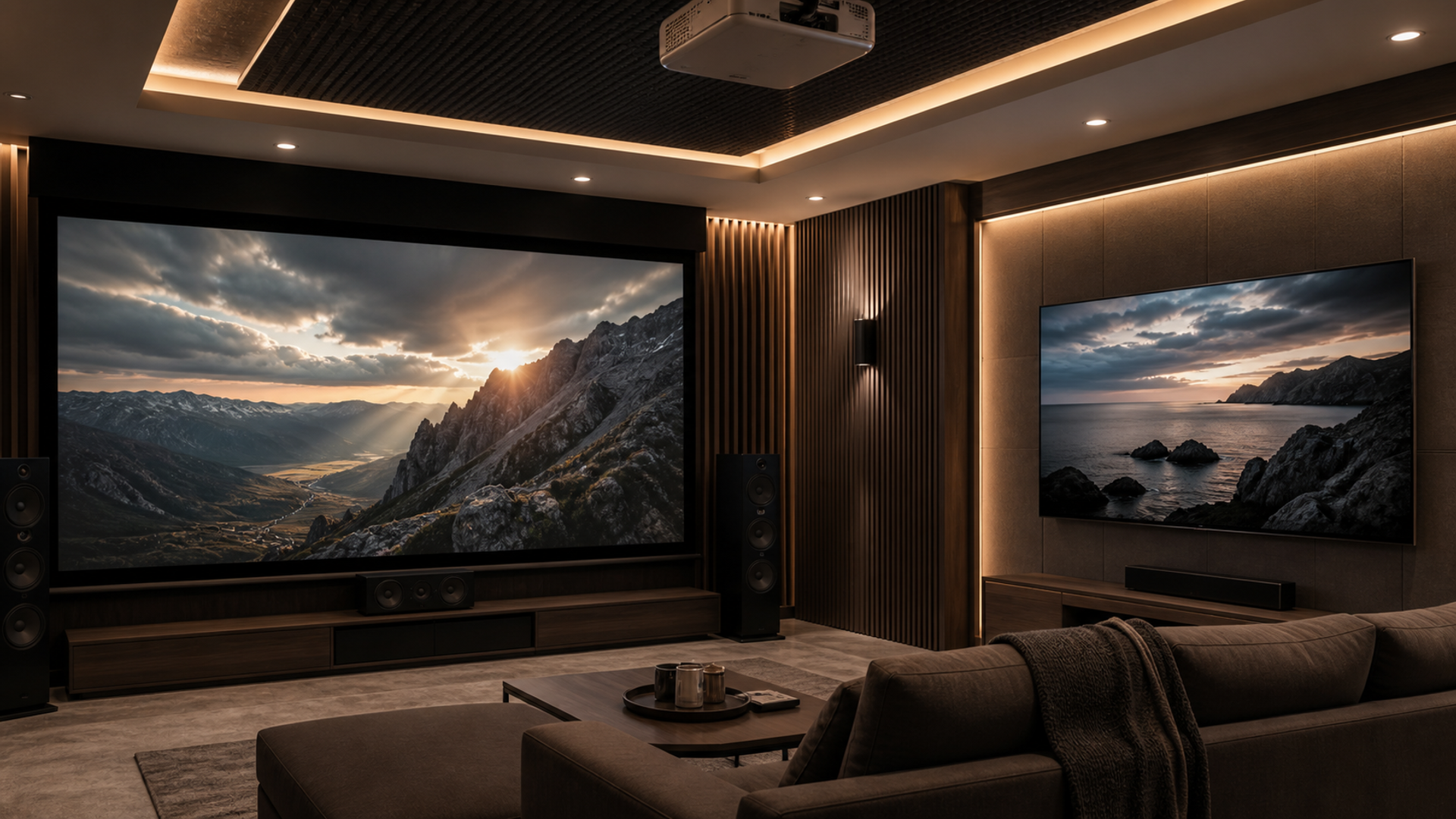
A projector and an OLED television can both create a premium cinema, but they solve different room problems. Projection makes very large images possible and can disappear into a dedicated room; OLED gives consistent contrast, fast start-up and fewer installation dependencies. The right choice is determined by light, screen size, seating distance, sound, control and how often the room is actually used—not by the prestige of either technology.
Choose the room before the display
Choose a projector when the room can be darkened, the screen should be substantially larger than a television and a planned installation is acceptable. Choose OLED when contrast in mixed light, low maintenance and predictable everyday use matter more. Choose a flexible room only when the equipment, screen, blackout and sound plan are designed together rather than added one component at a time.
| Decision factor | Projector-led room | OLED-led room | Hybrid or flexible room |
|---|---|---|---|
| Room light | Blackout or strong light control is possible | Windows remain in use and consistent contrast matters | Light varies and both modes have a genuine role |
| Desired image size | A very large image is the priority | A conventional wall-sized image is enough | The room changes between cinema and daily viewing |
| Installation | Mount, throw distance and cable routes can be planned | A simple wall or console installation is preferred | Furniture and screen position can change |
| Image behaviour | Cinema scale matters more than perfect daytime black | Pixel-level contrast and instant image matter | Different viewers want different compromises |
| Sound | A separate speaker and acoustic plan is budgeted | Built-in or simple external audio is sufficient | An AV system already supports both use cases |
| Ownership | Filter, laser or lamp and alignment checks are acceptable | Low-intervention ownership is the priority | Service access is planned for either route |
This projector vs oled matrix is the article's working value object. Read the projector vs oled rows together: the decisive failure mode depends on this topic's evidence, operating context and reader objective.
What the picture chain actually proves
Evidence 1. Sony’s projector guidance treats throw distance, image size and room conditions as installation variables rather than universal specifications.
Evidence 2. LG’s OLED information describes self-lit pixels and the contrast behaviour associated with independently controlled pixels; the current model specification remains the authority for brightness and features.
Evidence 3. A projector image is formed by the projector, lens, screen and room light together, so a headline brightness number cannot be transferred directly to every room.
Evidence 4. A large image does not remove the need for a sound plan: speaker placement, room reflections and seating position still determine whether a cinema feels coherent.
Reader-visible sources checked for this article:
sony.com — reader-visible current or official evidence
lg.com — reader-visible current or official evidence
projectorcentral.com — reader-visible current or official evidence
thx.com — reader-visible current or official evidence
For projector vs oled, these sources establish only the claims inside their documented scope. Recheck every changeable specification, availability condition, price, policy or service term in the relevant market before acting.
Build the cinema around viewing conditions
The room light row exposes a practical boundary. Route one assumes blackout or strong light control is possible, while route two is defensible only when windows remain in use and consistent contrast matters. Route three depends on light varies and both modes have a genuine role. If that evidence is absent, keep the more reversible option.
Read desired image size as a stop/go test: a very large image is the priority supports the first option; a conventional wall-sized image is enough supports the second; and the room changes between cinema and daily viewing supports the third. Record which source proves the condition and when it was checked.
A buyer can resolve installation without starting from a brand preference. Ask whether mount, throw distance and cable routes can be planned; compare that with whether a simple wall or console installation is preferred; then use furniture and screen position can change as the third route's safeguard. An unknown condition stays unknown.
On image behaviour, popularity is not enough. The evidence for option one is that cinema scale matters more than perfect daytime black. Option two means pixel-level contrast and instant image matter. Option three is rational where different viewers want different compromises. Recheck any changeable term immediately before commitment.
The decision changes at sound. Choose the first path only if a separate speaker and acoustic plan is budgeted; move to the second when built-in or simple external audio is sufficient; use the third when an AV system already supports both use cases. Save the downside that would make this row fail.
For ownership, the first route works when filter, laser or lamp and alignment checks are acceptable; the second requires low-intervention ownership is the priority. The control for the third is service access is planned for either route. Verify this row against the exact product, property, account or environment before it can reverse the decision.
Facts that would reverse the current choice
Reversal control 1 — Room light. Before choosing Projector-led room, write down how the decision changes if “Blackout or strong light control is possible” proves false. Do the same for OLED-led room and “Windows remain in use and consistent contrast matters”. Keep the Hybrid or flexible room route available until “Light varies and both modes have a genuine role” is verified. This control belongs to projector vs oled; update it from the cited source or exact supplier rather than copying a generic checklist.
Reversal control 2 — Desired image size. Before choosing Projector-led room, write down how the decision changes if “A very large image is the priority” proves false. Do the same for OLED-led room and “A conventional wall-sized image is enough”. Keep the Hybrid or flexible room route available until “The room changes between cinema and daily viewing” is verified. This control belongs to projector vs oled; update it from the cited source or exact supplier rather than copying a generic checklist.
Reversal control 3 — Installation. Before choosing Projector-led room, write down how the decision changes if “Mount, throw distance and cable routes can be planned” proves false. Do the same for OLED-led room and “A simple wall or console installation is preferred”. Keep the Hybrid or flexible room route available until “Furniture and screen position can change” is verified. This control belongs to projector vs oled; update it from the cited source or exact supplier rather than copying a generic checklist.
Reversal control 4 — Image behaviour. Before choosing Projector-led room, write down how the decision changes if “Cinema scale matters more than perfect daytime black” proves false. Do the same for OLED-led room and “Pixel-level contrast and instant image matter”. Keep the Hybrid or flexible room route available until “Different viewers want different compromises” is verified. This control belongs to projector vs oled; update it from the cited source or exact supplier rather than copying a generic checklist.
Reversal control 5 — Sound. Before choosing Projector-led room, write down how the decision changes if “A separate speaker and acoustic plan is budgeted” proves false. Do the same for OLED-led room and “Built-in or simple external audio is sufficient”. Keep the Hybrid or flexible room route available until “An AV system already supports both use cases” is verified. This control belongs to projector vs oled; update it from the cited source or exact supplier rather than copying a generic checklist.
Reversal control 6 — Ownership. Before choosing Projector-led room, write down how the decision changes if “Filter, laser or lamp and alignment checks are acceptable” proves false. Do the same for OLED-led room and “Low-intervention ownership is the priority”. Keep the Hybrid or flexible room route available until “Service access is planned for either route” is verified. This control belongs to projector vs oled; update it from the cited source or exact supplier rather than copying a generic checklist.
Start with the room, not the panel or chassis
Measure seating distance, ceiling height, wall width, window area and power locations. A projector requires a throw plan and often a screen plan; an OLED requires a suitable wall, viewing height and glare control. Mark the image before buying. If the proposed screen blocks a door, sits above the correct eye line or competes with daylight, the purchase decision is already wrong.
Treat brightness and black level as room-dependent
OLED’s contrast advantage is easiest to appreciate in dark scenes and mixed content, while projection quality depends heavily on screen gain, ambient light and calibration. Ask what the room looks like at the time the household actually watches. A dark dedicated room may reward scale; a lounge used at noon may reward consistency. Do not compare showroom images without matching viewing conditions.
Build sound and control into the budget
A premium picture can still feel ordinary when voices are thin, the centre channel is misplaced or the remote workflow is awkward. Plan speakers, amplification, acoustic treatment, source switching and lighting scenes before finalising the image device. A motorised screen, blackout system or AV receiver can be a material cost, not a decorative extra.
Use serviceability as a luxury criterion
Check installation access, warranty terms, replacement parts, calibration support and the cost of moving the system. OLED is simpler to deploy but still needs careful handling; a projector may need more alignment, filter or service attention depending on the design. A system that can be maintained locally is often more valuable than a marginal specification gain.
Three room-first cinema decisions
Dedicated dark cinema
A projector is persuasive when the room can stay dark, the screen can be very large and the owner accepts an installation and calibration plan. Define the fact that would reverse this recommendation before committing.
Multi-use living room
OLED is usually easier when television, sport, games and films share a room with daylight and no permanent blackout. Define the fact that would reverse this recommendation before committing.
Flexible entertaining room
A hybrid route can work when the room has a real projection mode and a separate everyday display plan; it is not a shortcut around poor layout. Define the fact that would reverse this recommendation before committing.
Action checklist
Measure seating distance and wall width.
Record daylight and blackout conditions.
Draw the projector throw or OLED mounting position.
Plan speakers and cable routes.
Check source and gaming requirements.
Budget for screen, mount and installation.
Confirm current warranty and service terms.
Test the remote and source-switching workflow.
Evaluate daytime and night viewing separately.
Keep a reversible upgrade path.
Continue the decision
The linked VERTU articles expand adjacent parts of the projector vs oled decision. They do not substitute for the external evidence above.
The display verdict
Choose a projector when the room can be darkened, the screen should be substantially larger than a television and a planned installation is acceptable. Choose OLED when contrast in mixed light, low maintenance and predictable everyday use matter more. Choose a flexible room only when the equipment, screen, blackout and sound plan are designed together rather than added one component at a time.
Keep the projector vs oled decision reversible until its material cost, safety, access, privacy and compatibility facts are verified. Unknown evidence stays unknown; it is never silently scored as favourable.
![How to Scan Receipts and Documents with Your Phone [Full Guide]](https://cdn.sanity.io/images/e0gp1l2g/production/0db13feec1d5e72b8a8a5f976d1f3e86619c9228-3840x1860.webp?w=180&h=180&q=78&auto=format&fit=crop)
![How to Scan Receipts and Documents with Your Phone [Full Guide]](https://cdn.sanity.io/images/e0gp1l2g/production/0db13feec1d5e72b8a8a5f976d1f3e86619c9228-3840x1860.webp?w=800&h=450&q=82&auto=format&fit=crop)
![Top 10 Two-Tone Carbon-Fibre Watches for Men [2026 List]](https://cdn.sanity.io/images/e0gp1l2g/production/18870799ba33fab0e038968359cd5772d7d7db30-1024x576.webp?w=800&h=450&q=82&auto=format&fit=crop)
![Top 10 Luxury Watches with Digital Complication Displays for Men [Latest]](https://cdn.sanity.io/images/e0gp1l2g/production/c4f6bf8c080f291c39f7cc85c7344ecff2fd3799-1024x553.webp?w=800&h=450&q=82&auto=format&fit=crop)