Choosing the right magnetic power bank in 2026 is no longer just about capacity. The charging standards behind it — MagSafe, Qi2, and the newer Qi2.2 — now decide how fast your phone refills, whether the bank snaps on cleanly, and how well it works across the iPhone and Android worlds.
You'll see how these standards shape speed and compatibility, get clear iPhone-versus-Android guidance, and finish with the travel-safe details that keep a power bank legal on a plane. If you carry two devices or travel often, the right pick is the difference between a five-minute top-up and a frustrating afternoon near an outlet.
Standards and compatibility
Three magnetic charging standards dominate 2026. Understanding which one your phone supports is the fastest shortcut to a power bank that actually performs.
MagSafe vs Qi2 vs Qi2.2
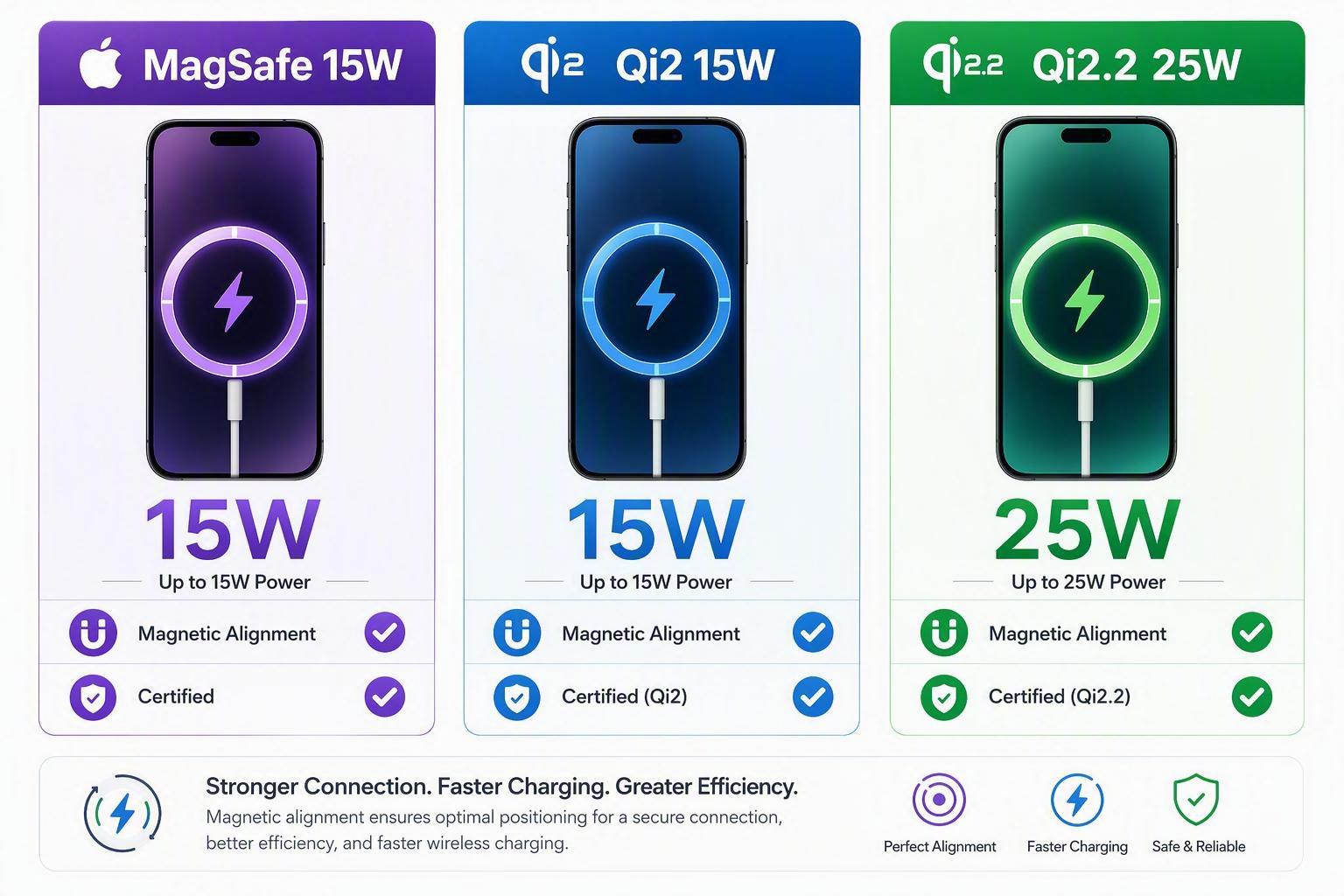
MagSafe is Apple's proprietary magnetic system, introduced with the iPhone 12 and refined in 2024 to reach 25W on the newest models. Qi2 is the open wireless standard that adopted MagSafe's magnetic-alignment idea, so a Qi2 charger snaps onto an iPhone much like a MagSafe one. Qi2.2, also called Qi2 25W, is the Wireless Power Consortium's faster update: it keeps the magnets and raises certified wireless power to about 25W while tightening alignment tolerance, as detailed in Anker's MagSafe, Qi2, and Qi2.2 explainer.
Standard | Max wireless power | Magnetic alignment | Who benefits |
|---|---|---|---|
MagSafe | 15W (classic) / up to 25W (newer + 30W adapter) | Yes, Apple-proprietary ring | iPhone 12 onward |
Qi2 | 15W | Yes, open MPP standard | iPhone + Android (with magnets or case) |
Qi2.2 (Qi2 25W) | up to 25W | Yes, tightened MPP 2.0 | iPhone 16/17 + Qi2.2 Android flagships |
The practical takeaway: a Qi2-certified bank is the safe, cross-ecosystem default at 15W, while a Qi2.2 bank caps the speed you get on recent flagship phones. Legacy Qi charging without magnets still exists but tops out around 7.5W, which is why "magnetic" matters.
Key Takeaway: Buy a Qi2 or Qi2.2 certified bank, not a plain Qi one. Magnets do two jobs at once — they align the coil for efficient power delivery and they hold the battery to the back of your phone.
This short explainer walks through the MagSafe-versus-Qi2 difference visually if you prefer seeing the alignment in action:
iPhone charge tiers and negotiation
Every iPhone from the 12 onward charges wirelessly at up to 15W over MagSafe or Qi2. That is the tier you get from a standard Qi2 bank, regardless of which iPhone model you own.
The exceptions are the iPhone 16 and 17 families. Paired with a Qi2.2 (Qi2 25W) charger or an updated MagSafe puck plus a 30W wall adapter, these recent models can negotiate up to 25W wirelessly. Older iPhones still cap at 15W even when attached to a 25W bank — the phone, not the battery, sets the ceiling.
This negotiation is handled by the magnetic handshake inside Qi2.2. When a compatible bank and phone agree on power through the MPP 2.0 protocol, the bank charges at full speed and manages heat. When they cannot agree, both fall back to a safer 7.5W baseline. In practice, a Qi2.2 bank is future-proof: it serves your current 15W iPhone at full speed today and unlocks 25W if you upgrade.
Android magnets and case requirements
Android support for magnetic charging finally went mainstream in 2026, but it is split into two very different situations.
A small but growing list of phones now ships with magnets built in. Google's Pixel 10 family — including the Pixel 10 Pro and Pro XL — uses built-in "Pixelsnap" magnets for native Qi2 alignment, alongside the HMD Skyline and Motorola's newer Edge flagships. On these, a magnetic power bank snaps on with no extra hardware, as Android Central's Qi2 coverage confirms.
Most other Android flagships are "Qi2 Ready," meaning they charge at Qi2 speeds but lack built-in magnets. Samsung's Galaxy S25 and S26 lines, and the OnePlus 13, need a Qi2-certified magnetic case to add the alignment ring, a distinction 9to5Google has covered in depth. Without that case, charging falls back to a manually aligned 5–7.5W trickle. The rule of thumb: any Android phone with wireless charging can use a Qi2 bank with a magnetic case, but only the phones above get the snap-on experience out of the box.
Buyer picks and selection
These picks are chosen by capacity band, matching how most people actually use a magnetic power bank. Carry two phones on a long day? Read both sections.
Slim 5,000mAh daily-carry picks
Answer 5,000mAh magnetic bank is the everyday companion — roughly one full iPhone refill, thin enough to live on the back of your phone without turning it into a brick.
Anker Nano Power Bank 5K (MagGo, Slim) — Qi2-certified 15W wireless in an ultra-slim, premium build. This is the refined default for a pocket-size bank that feels like it belongs with a modern flagship.
Vonmählen Evergreen Mag 5K — a slim, elegant 19Wh option with Qi2 charging and a design-conscious finish, good for carrying on the phone all day.
Energizer Slim Metal 5K — the budget pick at roughly $16, with Qi2 certification for anyone who wants the standard without the premium price.
Answer 5,000mAh bank is best as a top-up layer. If you need to refill your phone from near-empty multiple times a day, step up to a 10,000mAh bank instead.
10,000mAh performance picks (wireless vs wired PD)
At 10,000mAh (about 37Wh), you get roughly two full iPhone charges or a full day of heavy Android use — plus room to charge two devices. The decision here is wireless speed versus wired power delivery.
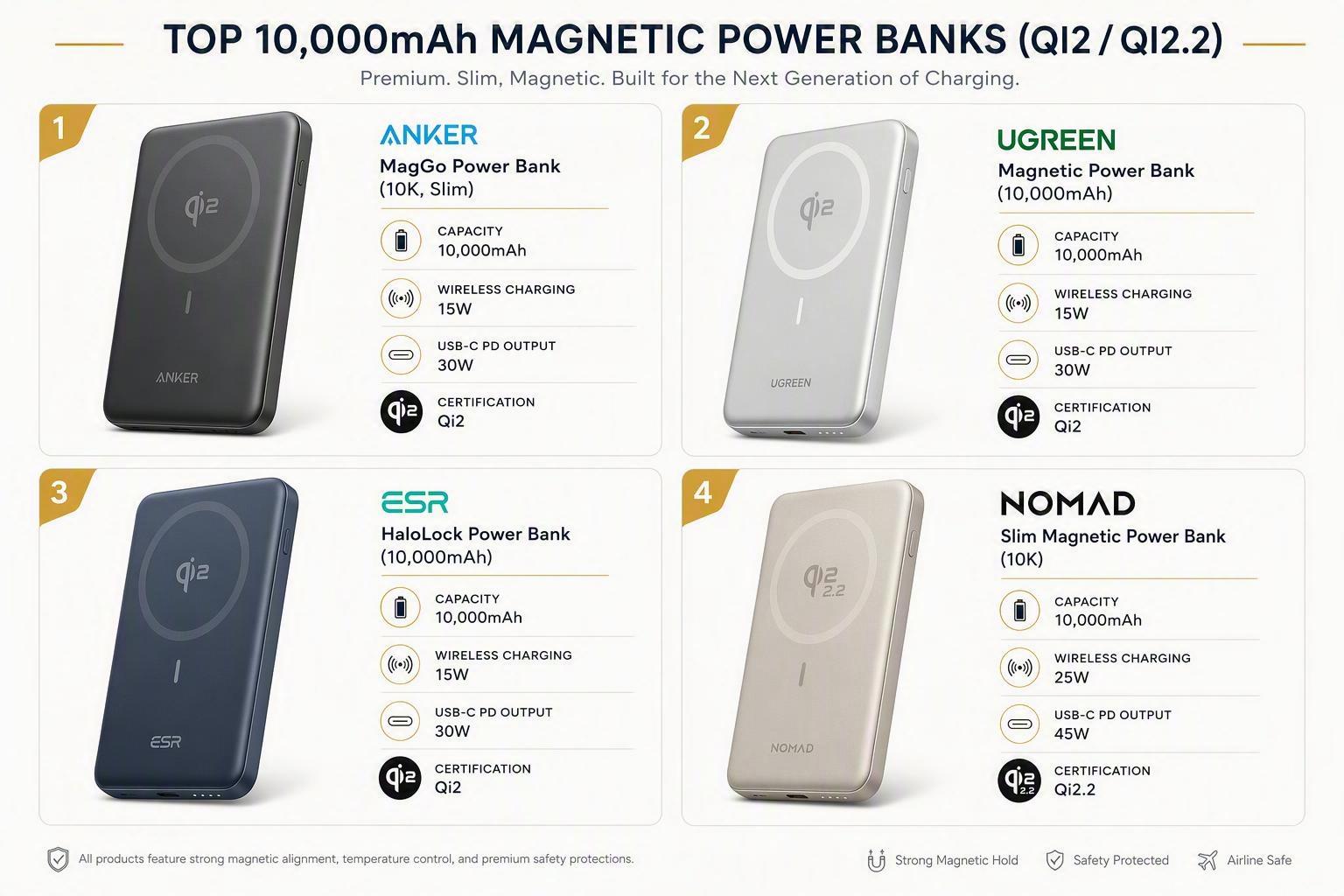
Baseus PicoGo AM52 — the fastest all-around pick. It is Qi2.2-certified at 25W wireless, packs a 45W USB-C output, and runs noticeably cool thanks to its graphene and aluminum cooling. The Verge's Qi2 battery testing puts it among the top 25W wireless picks for both iPhone and Pixel.
UGREEN MagFlow Qi2 25W — a speed-focused option with Qi2.2 25W wireless and a built-in USB-C cable, for travelers who want fast wireless refills without carrying extra cables.
INIU MagSafe 25W / Slimest 10K — the value pick, pairing 25W Qi2-class wireless with a strong 45W wired output in a strikingly thin profile.
Anker MagGo 10K Slim — the trusted-brand fallback at 15W Qi2 with 30W USB-C. It forgoes 25W speed but keeps Anker's reliability and a genuinely slim design.
For most buyers, a 10,000mAh bank is the sweet spot: enough capacity for a full day, still small enough to fly with no approval, and large enough to carry both best-in-class 25W wireless and fast wired PD.
How to choose for iPhone vs Android in 2026
Start with your phone's capabilities, not the marketing on the box.
If you own an iPhone 16 or 17, a Qi2.2 bank unlocks the full 25W wireless speed. If you carry an older iPhone 12 through 15, a 15W Qi2 bank gives you everything your phone can accept, so you need not pay extra for speed you cannot use yet.
On the Android side, check for built-in magnets first. A Pixel 10 owner gets the cleanest snap-on experience with any Qi2 or Qi2.2 bank. If you have a Samsung Galaxy S25 or S26, budget for a Qi2-certified magnetic case so the bank can align properly — without it, you lose most of the benefit.
Then think about how you travel and work. For a discerning traveler, a magnetic power bank is part of a broader ecosystem: the phone, the case, the bank, and the services that keep you powered and connected on the road. Premium mobile ecosystems, including VERTU's handcrafted devices and its 24/7 global concierge, treat travel-ready accessories as one layer of a larger, well-orchestrated experience. The principle holds across brands: choose certified hardware that matches your device, keep it airline-safe, and you remove the small frictions that disrupt an otherwise unbroken, well-run journey.
Pro Tip: If you juggle an iPhone and an Android phone, one Qi2-certified 10,000mAh bank handles both. Pick a bank with both wireless and a USB-C PD port — the wired 30–45W output tops up faster and covers tablets too.
Disclosure: This article references VERTU and certified charging standards. Editorial judgment remains the priority.
Travel safety and legality
A magnetic power bank is a lithium battery, and air travel treats it as one by design. Getting this right matters more than the wattage on the box.
FAA/TSA rules and Wh limits
Under the FAA's PackSafe guidance for lithium batteries, power banks are spare lithium-ion cells: they must ride in your carry-on and are prohibited in checked luggage. The energy limit that matters is watt-hours, not milliamp-hours. Anything at or under 100Wh needs no approval, most airlines allow 101–160Wh only with prior airline approval (capped at two spares), and anything over 160Wh cannot fly with you as passenger baggage.
Converting mAh to Wh and packing tips
Convert capacity with a simple formula: Wh equals milliamp-hours multiplied by voltage, divided by 1,000, per the FAA's own passenger-battery guidance. Most power banks use a 3.7V nominal cell, so estimate with Wh ≈ mAh × 3.7 / 1,000.
That math is reassuring at these sizes: a 5,000mAh bank is about 18.5Wh, a 10,000mAh bank about 37Wh, and a 20,000mAh bank about 74Wh — all comfortably under the 100Wh line. If your bank prints its Wh rating, use that number instead and skip the calculation.
For packing, keep the bank in your carry-on with the charging port protected, disable its output if you can, and avoid packing a damaged or swollen unit — the TSA keeps portable chargers on the carry-on list. A few airlines now cap passengers at a single power bank regardless of capacity, so a quick check of your carrier's policy before a long-haul trip is worth the 30 seconds.
Heat management and certification notes
Certification is the quiet layer that keeps a fast bank safe. Qi2.2 specifically requires certified modules to hold surface temperature under roughly 40°C at 25W output, a thermal requirement Ugreen's Qi2 25W explainer spells out, which is why the better banks run cool even at full speed. For air travel, look for safety and transport certifications such as UN38.3 (lithium transport), UL 2056 (power bank safety), and an intact IEC 62133 rating. A bank carrying these marks has been tested for the heat and fault conditions you actually care about, and it is the certification, not the sticker wattage, that earns the peace of mind.
Conclusion
You now know how standards, magnets, and capacity come together to shape the best magnetic power bank for your phone. The standard sets your top speed, the magnet decides how cleanly it attaches, and the capacity determines how long it lasts between charges.
Choose a bank that matches your phone's capabilities and your travel needs — a Qi2.2 25W model if you hold an iPhone 16 or 17, a Qi2-certified 10,000mAh option for two-phone carry and cross-platform use, and certified hardware under 100Wh so it flies with you anywhere. Match the technology to the device, keep it travel-safe, and the right magnetic power bank stops being an accessory and starts being the last thing you think about before your phone runs low.