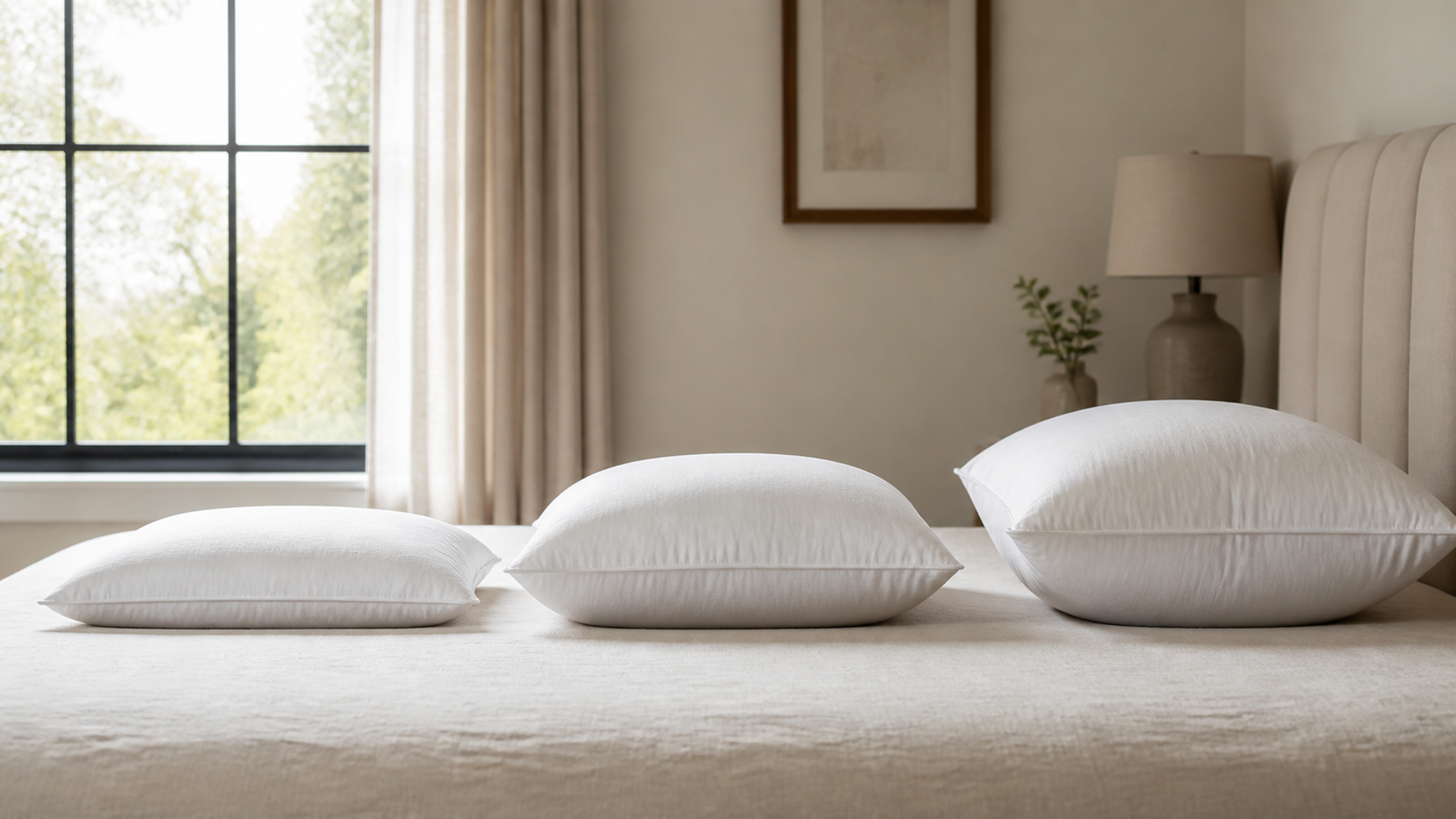
A pillow cannot diagnose or cure neck pain, but it can change how the head and neck are supported for hours at a time. The useful question is therefore not which pillow has the strongest medical-sounding label. It is whether its effective loft, shape and resilience suit the sleeper's position, body proportions and mattress. This guide builds that decision from measurable fit and keeps clinical claims inside the limits of the evidence.
Set the support target before choosing a fill
Start with sleeping position and the gap between the head and mattress, then account for shoulder width, mattress sink and how much the fill compresses overnight. Side sleepers usually need more effective height than back sleepers; front sleepers often need much less. Prefer adjustable fill or a credible return window when fit is uncertain, and seek clinical advice for severe, persistent or neurological symptoms rather than treating a bedding purchase as healthcare.
| Decision factor | Side-sleeper support | Back-sleeper support | Front or mixed-position compromise |
|---|---|---|---|
| Effective loft | Fills the shoulder-to-head gap after sink | Supports the neck curve without chin flexion | Stays low enough to limit rotation and extension |
| Mattress interaction | Firm surface may require more pillow height | Surface sink and head weight remain balanced | Soft surface does not make the pillow effectively taller |
| Fill behaviour | Edge remains resilient through the night | Centre supports without a hard pressure point | Fill compresses easily and can be reshaped |
| Adjustability | Fill can be added for shoulder clearance | Small height changes can be tested | Fill can be removed to reduce height |
| Trial evidence | Head line looks neutral and waking symptoms do not worsen | Neck curve feels supported across several nights | Rotation and morning stiffness do not increase |
| Return protection | Opened-product trial is long enough to test | Exchange terms allow a height correction | Low-risk exit exists if the compromise fails |
| Stop condition | Arm symptoms, weakness or worsening pain trigger review | Headache or neurological change is not ignored | Persistent or severe symptoms leave the shopping workflow |
This best pillow for neck pain matrix is the article's working value object. Read the best pillow for neck pain rows together: the decisive failure mode depends on this topic's evidence, operating context and reader objective.
What the evidence can and cannot establish
Evidence 1. A 2025 systematic review indexed by PubMed evaluated pillow interventions for chronic neck pain and found that the available studies differed in pillow design, comparison and outcome measurement, so no universal pillow prescription follows from the literature.
Evidence 2. The NHS advises seeking urgent or clinical help for neck pain accompanied by concerning symptoms and describes self-care as only one part of management; a pillow should not delay appropriate assessment.
Evidence 3. Effective loft is the compressed height under the sleeper, not the uncompressed height printed on a listing, and it changes with fill density, head weight, temperature and mattress sink.
Evidence 4. A trial is informative only when the sleeper keeps the mattress and usual position stable, records symptoms over several nights and stops if the new setup makes pain or neurological symptoms worse.
Reader-visible sources checked for this article:
pubmed.ncbi.nlm.nih.gov — reader-visible current or official evidence
nhs.uk — reader-visible current or official evidence
For best pillow for neck pain, these sources establish only the claims inside their documented scope. Recheck every changeable specification, availability condition, price, policy or service term in the relevant market before acting.
Match effective loft to the whole sleep system
The effective loft row exposes a practical boundary. Route one assumes fills the shoulder-to-head gap after sink, while route two is defensible only when supports the neck curve without chin flexion. Route three depends on stays low enough to limit rotation and extension. If that evidence is absent, keep the more reversible option.
Read mattress interaction as a stop/go test: firm surface may require more pillow height supports the first option; surface sink and head weight remain balanced supports the second; and soft surface does not make the pillow effectively taller supports the third. Record which source proves the condition and when it was checked.
A buyer can resolve fill behaviour without starting from a brand preference. Ask whether edge remains resilient through the night; compare that with whether centre supports without a hard pressure point; then use fill compresses easily and can be reshaped as the third route's safeguard. An unknown condition stays unknown.
On adjustability, popularity is not enough. The evidence for option one is that fill can be added for shoulder clearance. Option two means small height changes can be tested. Option three is rational where fill can be removed to reduce height. Recheck any changeable term immediately before commitment.
The decision changes at trial evidence. Choose the first path only if head line looks neutral and waking symptoms do not worsen; move to the second when neck curve feels supported across several nights; use the third when rotation and morning stiffness do not increase. Save the downside that would make this row fail.
For return protection, the first route works when opened-product trial is long enough to test; the second requires exchange terms allow a height correction. The control for the third is low-risk exit exists if the compromise fails. Verify this row against the exact product, property, account or environment before it can reverse the decision.
The stop condition row exposes a practical boundary. Route one assumes arm symptoms, weakness or worsening pain trigger review, while route two is defensible only when headache or neurological change is not ignored. Route three depends on persistent or severe symptoms leave the shopping workflow. If that evidence is absent, keep the more reversible option.
Facts that would reverse the current choice
Reversal control 1 — Effective loft. Before choosing Side-sleeper support, write down how the decision changes if “Fills the shoulder-to-head gap after sink” proves false. Do the same for Back-sleeper support and “Supports the neck curve without chin flexion”. Keep the Front or mixed-position compromise route available until “Stays low enough to limit rotation and extension” is verified. This control belongs to best pillow for neck pain; update it from the cited source or exact supplier rather than copying a generic checklist.
Reversal control 2 — Mattress interaction. Before choosing Side-sleeper support, write down how the decision changes if “Firm surface may require more pillow height” proves false. Do the same for Back-sleeper support and “Surface sink and head weight remain balanced”. Keep the Front or mixed-position compromise route available until “Soft surface does not make the pillow effectively taller” is verified. This control belongs to best pillow for neck pain; update it from the cited source or exact supplier rather than copying a generic checklist.
Reversal control 3 — Fill behaviour. Before choosing Side-sleeper support, write down how the decision changes if “Edge remains resilient through the night” proves false. Do the same for Back-sleeper support and “Centre supports without a hard pressure point”. Keep the Front or mixed-position compromise route available until “Fill compresses easily and can be reshaped” is verified. This control belongs to best pillow for neck pain; update it from the cited source or exact supplier rather than copying a generic checklist.
Reversal control 4 — Adjustability. Before choosing Side-sleeper support, write down how the decision changes if “Fill can be added for shoulder clearance” proves false. Do the same for Back-sleeper support and “Small height changes can be tested”. Keep the Front or mixed-position compromise route available until “Fill can be removed to reduce height” is verified. This control belongs to best pillow for neck pain; update it from the cited source or exact supplier rather than copying a generic checklist.
Reversal control 5 — Trial evidence. Before choosing Side-sleeper support, write down how the decision changes if “Head line looks neutral and waking symptoms do not worsen” proves false. Do the same for Back-sleeper support and “Neck curve feels supported across several nights”. Keep the Front or mixed-position compromise route available until “Rotation and morning stiffness do not increase” is verified. This control belongs to best pillow for neck pain; update it from the cited source or exact supplier rather than copying a generic checklist.
Reversal control 6 — Return protection. Before choosing Side-sleeper support, write down how the decision changes if “Opened-product trial is long enough to test” proves false. Do the same for Back-sleeper support and “Exchange terms allow a height correction”. Keep the Front or mixed-position compromise route available until “Low-risk exit exists if the compromise fails” is verified. This control belongs to best pillow for neck pain; update it from the cited source or exact supplier rather than copying a generic checklist.
Reversal control 7 — Stop condition. Before choosing Side-sleeper support, write down how the decision changes if “Arm symptoms, weakness or worsening pain trigger review” proves false. Do the same for Back-sleeper support and “Headache or neurological change is not ignored”. Keep the Front or mixed-position compromise route available until “Persistent or severe symptoms leave the shopping workflow” is verified. This control belongs to best pillow for neck pain; update it from the cited source or exact supplier rather than copying a generic checklist.
Measure the gap instead of shopping by label
For side sleeping, estimate the space from the side of the head to the mattress after the shoulder has sunk into the surface. For back sleeping, look for support that fills the neck curve without pushing the chin towards the chest. Front sleeping creates a different constraint because a tall pillow can increase rotation and extension. These are starting measurements, not medical prescriptions. Photograph the head-and-neck line from the side, use a folded towel to test small height changes and record what happens before buying a fixed-shape product.
Treat mattress sink as part of pillow height
A firm mattress keeps the shoulder higher, which can make the same pillow feel lower to a side sleeper. A soft comfort layer allows more shoulder sink, reducing the necessary loft. This is why a pillow that worked in a hotel may fail at home and why changing mattress and pillow together makes attribution difficult. When replacing only the pillow, test it on the actual mattress, with the usual protector and bedding, rather than on a showroom surface or the floor.
Compare resilience, contour and adjustability
Memory foam can hold a contour but varies in heat response and rebound. Latex often feels more buoyant. Fibre, feather and down blends can be reshaped but may migrate or compress. Water- or air-adjustable designs change the support mechanism again. The material name alone does not decide fit: inspect how quickly the pillow rebounds, whether the centre collapses, how the edge supports side sleeping and whether fill can be added or removed without creating lumps.
Use a controlled trial
Keep a brief log of position, waking stiffness, headache, arm symptoms and whether the pillow was moved during the night. Change one variable at a time. Three nights can reveal an obvious mismatch, but a longer return window is more useful when symptoms naturally fluctuate. Packaging rules matter: a nominal trial that becomes non-returnable after opening provides little protection. Confirm hygiene, exchange and refund terms before purchase rather than after the first uncomfortable night.
Know when the purchase question must stop
New weakness, numbness, loss of coordination, severe headache, fever, major trauma or pain that is worsening or not settling deserves appropriate clinical attention. The NHS source provides a public starting point, but local healthcare advice and individual history govern. Do not infer that a product is safer because it uses anatomical graphics, carries a wellness label or receives testimonials from users whose diagnosis, mattress and sleep position are unknown.
Three pillow-fit situations
Side sleeper on a firm mattress
Begin with a higher, resilient or adjustable design that fills the shoulder-to-head gap without tilting the face upward. Check edge support because the head may roll towards the perimeter. Define the fact that would reverse this recommendation before committing.
Back sleeper who changes position
A medium effective loft with a supportive neck contour and lower centre can work, but the side-sleeping portion must still have enough height. Adjustable fill is useful when the two positions conflict. Define the fact that would reverse this recommendation before committing.
Persistent pain with uncertain cause
Use a conservative, reversible bedding trial only alongside appropriate assessment. Avoid a rigid or expensive prescription-style pillow until the symptom pattern and red flags have been considered. Define the fact that would reverse this recommendation before committing.
Action checklist
Identify primary and secondary sleep positions.
Estimate compressed loft on the real mattress.
Account for shoulder width and mattress sink.
Choose fixed contour or adjustable fill deliberately.
Check rebound after several minutes of compression.
Confirm care and allergen information.
Read the opened-product return terms.
Change only one sleep-system variable.
Record symptoms and stop-use conditions.
Seek care when symptoms are severe, persistent or concerning.
Continue the decision
The linked VERTU articles expand adjacent parts of the best pillow for neck pain decision. They do not substitute for the external evidence above.
The practical neck-pain pillow verdict
Start with sleeping position and the gap between the head and mattress, then account for shoulder width, mattress sink and how much the fill compresses overnight. Side sleepers usually need more effective height than back sleepers; front sleepers often need much less. Prefer adjustable fill or a credible return window when fit is uncertain, and seek clinical advice for severe, persistent or neurological symptoms rather than treating a bedding purchase as healthcare.
Keep the best pillow for neck pain decision reversible until its material cost, safety, access, privacy and compatibility facts are verified. Unknown evidence stays unknown; it is never silently scored as favourable.