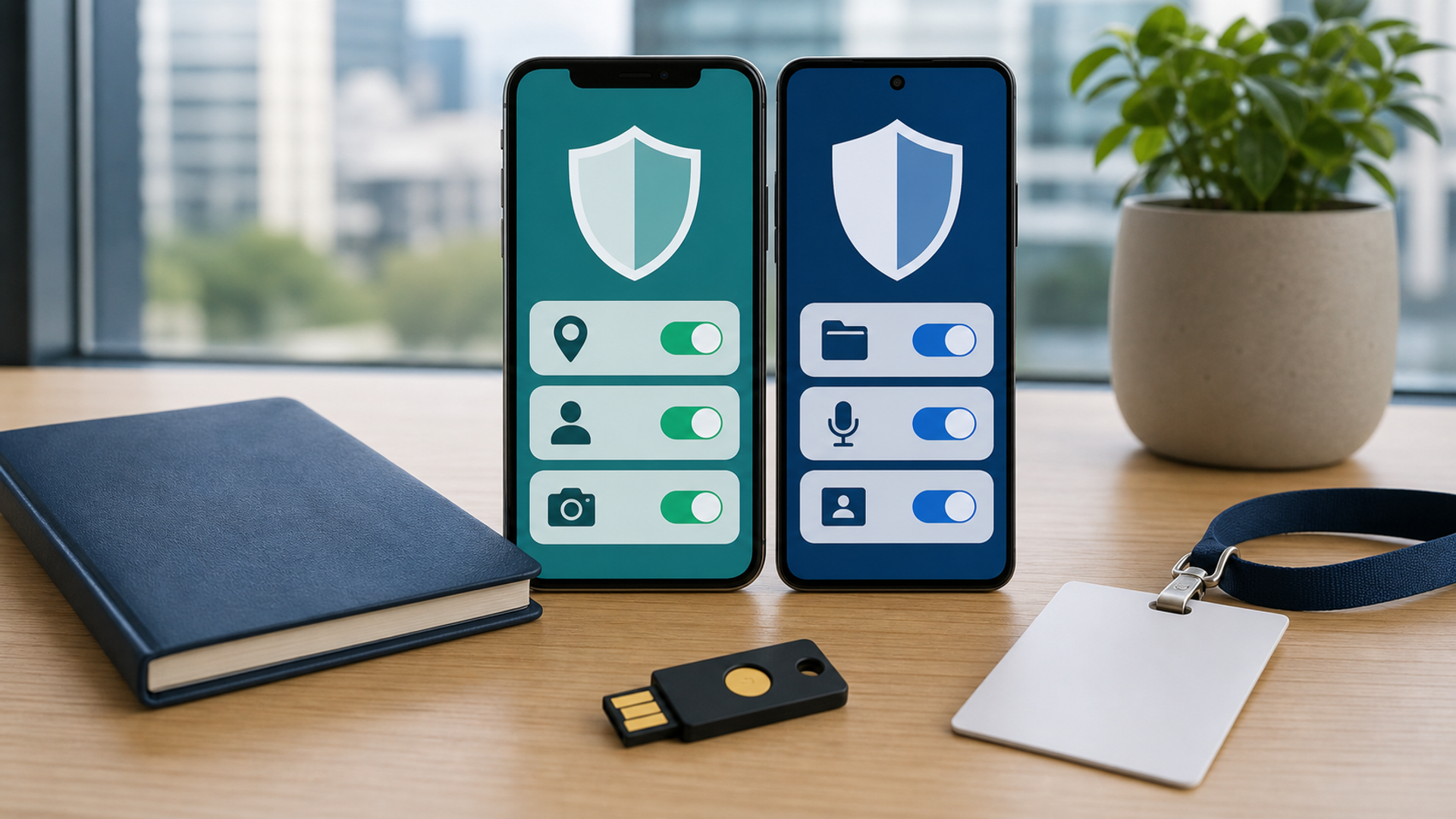
Asking whether iPhone or Android is more private produces poor answers unless the user first defines the threat. Advertising tracking, a stolen handset, malicious apps, account takeover, employer administration and targeted spyware are different problems. The operating system is one layer; device vendor, update policy, installed apps, cloud account and user behaviour often decide the outcome.
iPhone offers a comparatively controlled hardware-software ecosystem and visible features such as App Tracking Transparency, Safety Check and App Privacy Report. Android offers strong platform controls, a privacy dashboard and broad hardware choice, but update support and preinstalled software can vary by manufacturer. The executive decision should compare a specific supported Android device with a specific iPhone, not two abstract brands.
Quick answer
For a user who wants predictable updates and fewer vendor variables, a current supported iPhone is often the simpler privacy baseline. A well-supported Android device can be equally appropriate when the organisation values device choice, management flexibility or specific security hardware. Neither platform protects a poorly secured cloud account or an over-permissioned app.
Decision matrix
| Decision factor | Option A | Option B | Practical edge |
|---|---|---|---|
| Update control | Centralised by Apple | Varies by device maker and model | Check support term |
| App permissions | Privacy & Security controls | Privacy dashboard and permissions | Both capable |
| Tracking controls | App Tracking Transparency | Ad privacy controls and app settings | Different models |
| Hardware choice | Limited, consistent range | Broad range and vendor variance | Android for choice |
| Cloud dependence | Apple account and iCloud choices | Google/vendor account choices | Configure carefully |
| High-risk mode | Lockdown Mode on supported systems | Device/vendor and programme dependent | Threat-specific |
| Enterprise management | Mature MDM controls | Android Enterprise plus OEM choices | Policy-dependent |
| Best fit | Low-variance governance | Controlled flexibility | Organisation-specific |
Define the threat model first
Privacy from ad tracking is not the same as protection from targeted exploitation.
An executive travelling through sensitive jurisdictions may prioritise account separation, rapid update access and minimal local data. A consumer may focus on app tracking and location.
Use this test: Write down the adversary, valuable data and likely attack path before comparing features.
Update duration is a buying feature
A device without timely security updates becomes a governance exception regardless of platform.
Apple controls iPhone updates centrally. Android support depends on the chosen manufacturer, model, region and carrier, although leading devices now publish longer commitments.
Use this test: Verify the exact support end date and deployment route before procurement.
Permissions require active review
Both systems let users control access to camera, microphone, location, contacts and other data.
Apple's privacy settings and App Privacy Report expose access patterns; Android's privacy dashboard shows which apps used permissions and when.
Use this test: Remove permissions that are not necessary and revisit them after major app or operating-system updates.
The app supply chain is decisive
A private operating system cannot neutralise every risky app.
App stores apply screening, but developer practices, embedded analytics and account permissions still vary. Sideloading or alternative stores change the risk boundary.
Use this test: Use an approved app catalogue for sensitive roles and remove applications that lack a legitimate business purpose.
Cloud configuration can erase device advantages
Photos, messages, documents and backups may leave the handset under account-controlled cloud rules.
Encryption scope, recovery contacts, shared albums and web access matter. A compromised account can expose data even when the phone remains locked.
Use this test: Review cloud categories, recovery methods and connected devices as part of the handset setup.
Vendor variation is Android's strength and risk
Android allows organisations to select specialised hardware and management features.
The same flexibility produces uneven update schedules, preinstalled apps and privacy interfaces. A generic Android verdict therefore has little operational meaning.
Use this test: Approve exact device models and firmware channels rather than an operating-system label.
iPhone consistency simplifies policy
A narrower device family can reduce testing and documentation overhead.
Consistency does not remove risk: users can grant broad permissions, install unsuitable apps or weaken account recovery. Central control is useful only when configured.
Use this test: Pair the handset with enforced passcodes, account protection and managed app policy.
High-risk users need reduced attack surface
Executives facing targeted threats should carry less data and disable unnecessary services.
Apple provides Lockdown Mode for extreme cases; Android options depend on device and security programme. Both require operational planning because restrictions affect usability.
Use this test: Use specialist assessment before enabling an emergency mode, and test business-critical communications.
Travel creates a separate profile
Border crossings, temporary networks, SIM changes and device inspection alter the threat model.
A clean travel device, limited local history, separate accounts and a documented loss procedure may matter more than platform preference.
Use this test: Prepare the device before departure and avoid making improvised security changes under pressure.
The organisation is part of the system
Mobile privacy depends on MDM policy, identity controls, support staff and incident response.
An unmanaged personal device may be harder to protect than either platform under a mature enterprise programme. Conversely, intrusive management can collect additional data.
Use this test: Document what administrators can see and ensure the control level matches the role.
Who should choose what
| Traveller or owner | Better fit | Why |
|---|---|---|
| Executive wanting the fewest vendor variables | Current supported iPhone | Central update and consistent configuration path. |
| Enterprise needing specialised rugged hardware | Approved Android model | Broader device choice under managed policy. |
| High-risk travel | Hardened temporary device on either platform | Data minimisation outweighs brand. |
| Privacy-conscious personal user | Either, well configured | App and account choices dominate daily tracking. |
Common mistakes
Comparing operating systems without naming the Android device and support term.
Assuming app-store approval means an app collects no data.
Ignoring cloud backups and account recovery.
Treating biometrics, passcodes and encryption as interchangeable controls.
How to measure personal value
The useful value of iPhone vs Android Privacy is the change it produces in a repeated, observable situation. Start with the article's value object—the data-flow, update, app, identity, travel and high-risk-user matrix—and mark which rows affect your own behaviour. In the iPhone vs Android Privacy decision, a feature that never changes a journey, security decision or ownership routine has little practical value even when technically impressive.
Use update control as the first controlled comparison: one side is centralised by apple, while the other is varies by device maker and model. Then add the frequency of the relevant trip or use, the cost of iPhone vs Android Privacy mistakes, and the friction introduced by the more demanding option. For a iPhone vs Android Privacy purchase, divide the meaningful premium by expected uses rather than calendar years; for privacy, include the time and support required to keep controls correctly configured.
Create a minimum-success condition for iPhone vs Android Privacy. For this iPhone vs Android Privacy decision, success might be a full night's sleep, a watch still running on Monday, a phone policy that survives travel, or a bag carrying the real daily load without distortion. If neither iPhone vs Android Privacy option meets that condition, defer the purchase, choose another configuration or redesign the trip.
How to verify a changing specification
Facts surrounding iPhone vs Android Privacy can change after publication: airlines swap aircraft, manufacturers update references, software support terms move, and pre-owned condition differs from a catalogue description. Treat the current operator or manufacturer page as the iPhone vs Android Privacy starting point, not as a guarantee that every individual booking or object matches the general description.
Capture the exact date, model, route, configuration, material, firmware or fare family used for iPhone vs Android Privacy. Save the official iPhone vs Android Privacy specification and ask the seller or operator to resolve contradictions in writing. If a material iPhone vs Android Privacy feature is not identified at transaction level, assign it zero value until confirmed rather than assuming the best possible version.
For iPhone vs Android Privacy, repeat the check immediately before the cancellation, return or change window closes. That second iPhone vs Android Privacy check protects against substitutions and reveals whether the original decision relied on a benefit that is no longer available. Where iPhone vs Android Privacy involves authenticity, law, safety or security, independent specialist verification remains more important than an editorial comparison.
Keep an evidence-backed decision record
A short decision record makes iPhone vs Android Privacy auditable. Write the selected iPhone vs Android Privacy option, the rejected alternative, the three decisive facts, the sources checked and the condition that would reverse the choice. Attach a iPhone vs Android Privacy seat map, reference number, support policy, condition report or packing photograph where relevant. A iPhone vs Android Privacy record is especially useful when an assistant, travel coordinator, buyer or family member must act later without reconstructing the reasoning.
Separate measured iPhone vs Android Privacy facts from estimates. For iPhone vs Android Privacy, published dimensions, official benefits and documented support dates are facts for the referenced configuration; predicted sleep, resale, comfort and future availability are estimates. Label iPhone vs Android Privacy uncertainty openly and avoid converting one reviewer's experience into a universal claim.
The decision record for iPhone vs Android Privacy should also name an exit path: cancellation, return, service inspection, account suspension or resale review. A iPhone vs Android Privacy option with a clear, affordable correction path can be safer than a theoretically superior option whose failure is difficult to reverse.
Review the outcome after real use
Review iPhone vs Android Privacy after one representative trip or 30 days of ownership. Record which iPhone vs Android Privacy benefits were used, what created friction, what failed to matter and what new constraint appeared. Do not ask only whether iPhone vs Android Privacy felt premium; ask whether it solved the problem named in the decision record.
For the iPhone vs Android Privacy review, travel decisions should note sleep, delays, connection effort and useful hours after arrival; watch decisions should note comfort, timing, reserve and frequency of wear. For iPhone vs Android Privacy mobile privacy, review updates, permissions, account events and recovery readiness; for bags, inspect load, access, shape, marks and how often the object stayed at home.
That review turns iPhone vs Android Privacy into evidence for the next decision instead of an isolated opinion. If the iPhone vs Android Privacy outcome was weak, change one variable at a time—route, configuration, size, material, policy or use pattern—so the next comparison produces a clear lesson.
A verification checklist before you commit
For iPhone vs Android Privacy, confirm the exact reference, aircraft, fare, leather, device or service configuration rather than relying on a category label. Read the current iPhone vs Android Privacy manufacturer or operator page, preserve the quoted specification, and identify which facts can change before delivery or departure. Where iPhone vs Android Privacy involves money, safety or a high-value object, use a qualified seller, carrier, security team or specialist to verify the individual transaction.
Write the iPhone vs Android Privacy decision in one sentence: the option, the problem it solves and the condition that would change the choice. This keeps prestige, scarcity or one iPhone vs Android Privacy headline feature from replacing the actual use case. After iPhone vs Android Privacy ownership or travel, record what happened so the next decision uses evidence rather than memory.
Where VERTU can be relevant
VERTU is relevant only where the owner needs a combined device, service and secure-communications operating model. Selected VERTU devices and services may provide privacy-oriented capabilities, but no handset guarantees absolute protection. Buyers should verify the live software version, update policy, supported services and organisational controls. The VERTU Privacy & Security Desk's guidance should complement, not replace, qualified enterprise security assessment.