
Introduction
Enterprises in 2026 are dealing with a simple reality: mobile is now a primary channel for executive approvals, deal flow, incident response, and regulated communications. That makes the phone an endpoint, a communications node, and a record-creation system—often all at once.
A confidential mobile communication solution is not just “a secure chat app.” It is a layered system that protects message content and reduces the operational and compliance risk created by identity compromise, device compromise, and uncontrolled retention.
This guide is written for U.S. enterprise security and compliance leaders. Use it as a requirements baseline: define your threat model, choose the architecture patterns that match it, then translate those into RFP prompts and pilot metrics.
Key terms used in this guide:
- E2EEEnd-to-end encryption (content protected so intermediaries can’t read it)
- Zero trustcontinuous verification of user, device, and context (not network location)
- MLSMessaging Layer Security, an IETF standard for E2EE group messaging
- WORM archivingWrite Once, Read Many retention (or an equivalent audit-trail integrity model)
- PQCPost-quantum cryptography
Architecture Essentials
End-to-end and metadata protection
E2EE is table stakes, not a strategy. Recent federal guidance continues to emphasize using end-to-end encrypted communications for mobile security at high threat levels (see CISA’s mobile communications best practice guidance (2024)).
For enterprise architecture, separate content confidentiality from metadata exposure:
- Contentwhat was said/sent.
- Metadatawho talked to whom, when, from where, in which group, and often on which device.
Key TakeawayA solution can meet “E2EE” marketing language and still leak meaningful operational intelligence through metadata. Treat metadata minimization as an explicit requirement, not a bonus.
Practical requirements to specify:
Minimal server-side logging by design (and an admin posture that avoids expanding logs “for convenience”).
Clear statement of what identifiers are required (phone number, email, device identifier) and how they’re stored.
Network-layer options that reduce linkability (e.g., relay/proxy designs) where your threat model requires it.
Identity-first zero trust access
Most mobile compromises are identity events long before they are “crypto failures.” Build the communications solution around identity, not around a perimeter.
Identity-first, zero trust access typically means:
Phishing-resistant authentication for primary and privileged accounts.
Conditional access decisions that include device posture, OS version, and risk signals.
Least-privilege administration: separate “compliance admin,” “security admin,” and “platform admin” roles.
Map these requirements to control language early (so you can test them): for example, account management and access control expectations in NIST SP 800-53 Rev. 5 security and privacy controls.
Secure containers, DLP, and UEM
If you cannot govern data movement, you do not have a confidential system—you have “encrypted leakage.” For most enterprises, this is where mobile programs succeed or fail.
A workable pattern is:
Containerize enterprise communications and files (policy boundary) rather than trying to harden every personal app.
Enforce DLP controls at the point of action: copy/paste, share targets, downloads, screen capture (where allowed), and file export.
Manage the device fleet with UEM/MDM (baseline posture, certificate deployment, per-app VPN, compliance checks, remote wipe for the container).
A useful mental model: encryption protects secrets in motion; containers + DLP protect secrets in use; UEM makes protections repeatable.
Standards and Crypto Roadmap
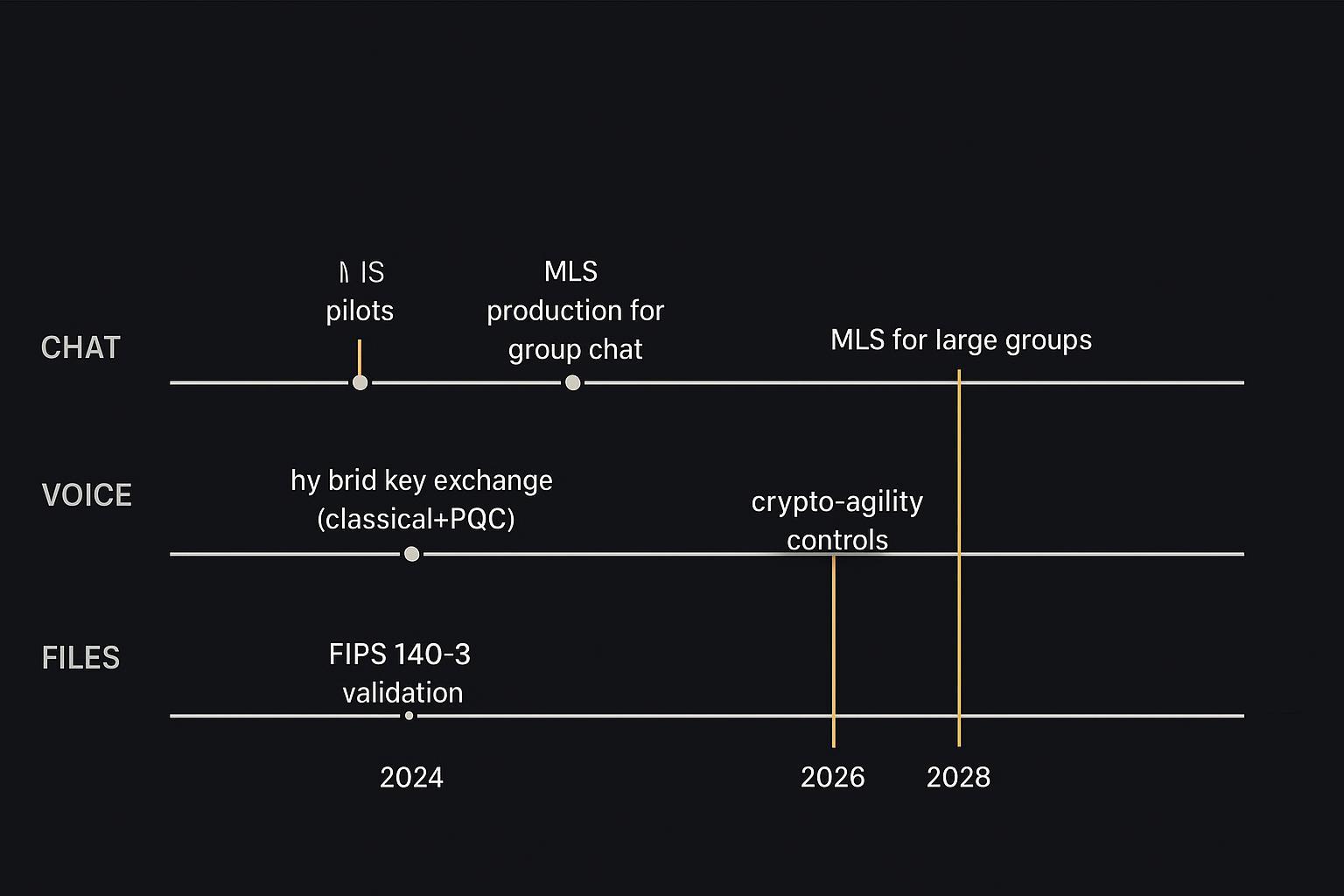
Messaging Layer Security (MLS) adoption
MLS matters because enterprise communication is rarely one-to-one. Group communications create complexity: membership changes, large groups, and operational recovery after compromise.
MLS is standardized by the IETF and designed to provide properties enterprises should demand in group messaging, including forward secrecy and post-compromise security (see IETF RFC 9750 (MLS Architecture)).
When you evaluate MLS adoption, distinguish:
“MLS-inspired” implementations vs. standards-track implementations.
Support for group scaling and membership changes without operational fragility.
Interoperability strategy (particularly if you need cross-organization secure collaboration).
Post-quantum hybrid key exchange
PQC planning is not a one-quarter project. Enterprises should expect a staged migration where hybrid key establishment runs classical and post-quantum mechanisms in parallel during the transition.
The planning anchor should be NIST’s standardization program and timelines (see NIST Post-Quantum Cryptography project). In practice, this impacts mobile communications in three areas:
Session establishment for chat and voice (key exchange and re-key cadence).
File encryption and long-term confidentiality (especially when retention periods are multi-year).
Identity credentials and device attestation, which will also need a post-quantum roadmap.
FIPS 140-3 and crypto-agility
In regulated and government-adjacent environments, crypto assurance often becomes procurement language. FIPS 140-3 is the baseline U.S. standard for cryptographic module validation (CMVP), and it affects what “approved cryptography” means for the modules you rely on.
Just as important as the certificate is the operational requirement: crypto-agility. Your solution must be able to rotate algorithms, update libraries, and re-validate components without requiring a full rip-and-replace.
⚠️ WarningCrypto plans fail when the architecture hard-codes a single protocol stack. Specify upgrade and re-key mechanics as requirements, not implementation details.
Compliance Mapping for U.S. Enterprises
NIST CSF 2.0 and SP 800-53 alignment
A pragmatic way to keep mobile communications requirements defensible is to use NIST CSF as the organizing layer and map to specific controls in SP 800-53.
Start with NIST CSF 2.0 for the governance-to-operations structure (identify, protect, detect, respond, recover), then map implementation-level requirements to NIST SP 800-53 Rev. 5 for control language and testing criteria.
For mobile communications programs, the controls usually cluster around:
Identity and access management (account lifecycle, authentication strength, least privilege)
Audit and logging (what is logged, integrity of logs, access to logs)
System and communications protection (encryption, key management, boundary protections)
Incident response and eDiscovery readiness
Sector rules: SEC/FINRA 17a-4, HIPAA, CJIS, PCI, FERPA
The fastest way to break a secure communications rollout is to treat “security” and “recordkeeping” as separate projects.
Financial services:
If business communications occur on mobile messaging channels, retention and supervision rules still apply.
The SEC’s recordkeeping amendments provide useful clarity on modern approaches to electronic records, including an audit-trail alternative.
Healthcare:
When mobile communications handle PHI, the controls and administrative safeguards required under the HIPAA Security Rule become non-negotiable.
Public sector / law enforcement:
CJIS environments impose strict requirements around access control, encryption, and auditing.
Payments:
If cardholder data ever enters mobile workflows, align requirements to PCI DSS expectations.
Education:
Student records accessed or transmitted via mobile channels should be governed under FERPA expectations.
Privacy laws: CCPA/CPRA, GDPR, TCPA
Privacy law affects more than marketing databases; it affects the data exhaust created by communications systems.
Key implications for mobile communications programs:
Document what personal data is collected by the communications layer (identifiers, logs, message content retention policies).
Define retention and deletion behavior for different data classes.
Ensure consent and notice models are compatible with your deployment model.
Useful references include:
California DOJ CCPA guidance
GDPR (Regulation (EU) 2016/679)
Deployment and Best Practices
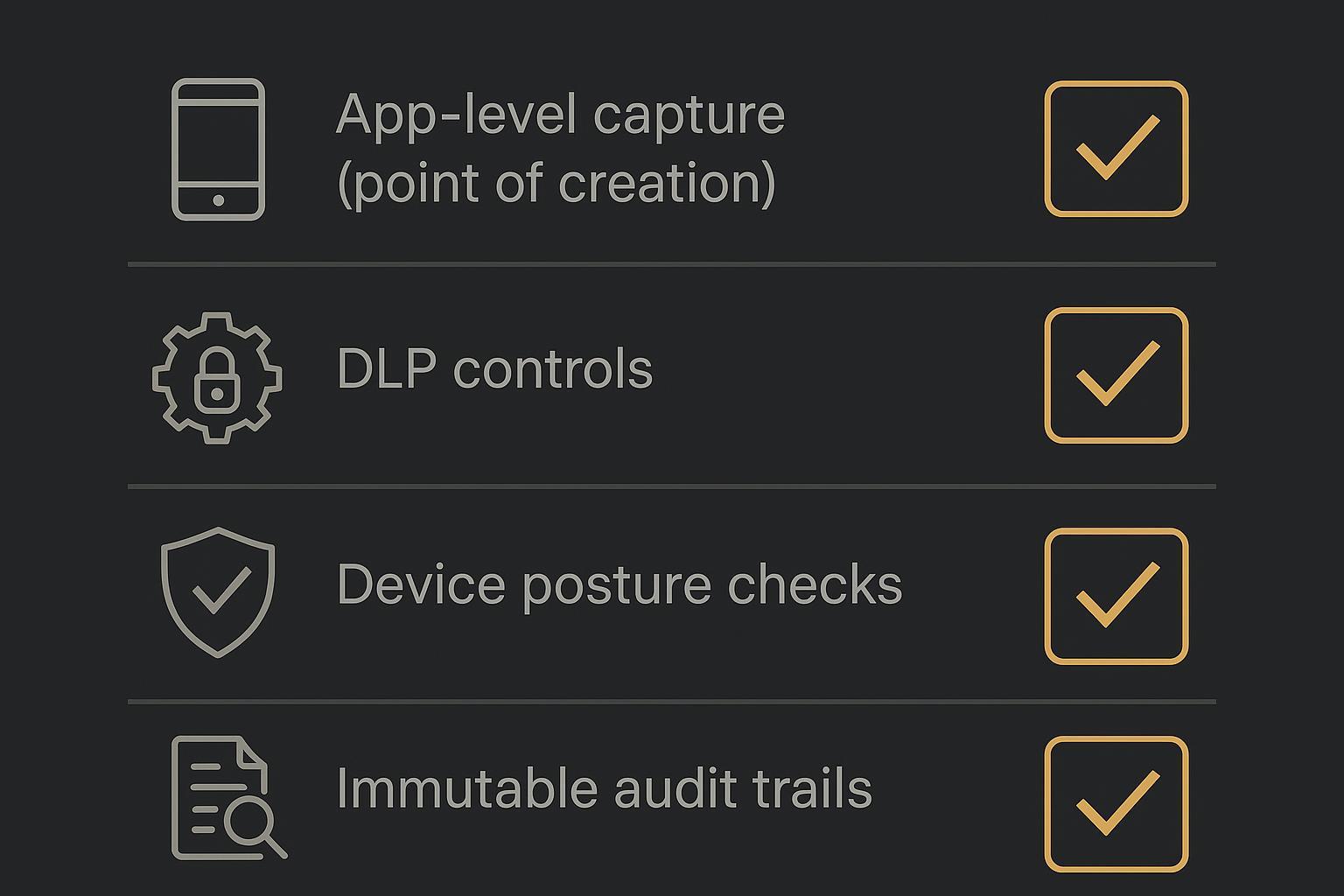
Archive at point of creation
If your regulated communications are created on mobile, capture must happen where the messages are created—before they can be forwarded, deleted, or fragmented across unmanaged apps.
Design requirements:
Capture both content and context (participants, timestamps, approvals/workflows) in a way that preserves integrity.
Use immutability (WORM or audit-trail integrity) as a property of the record store, not a promise.
Make retrieval time-bounded and testable (eDiscovery drills), not theoretical.
BYOD with containerization and posture
BYOD programs fail when they rely on policy documents alone. The enforceable boundary is technical:
Use a managed container for enterprise communications and files.
Bind access to device posture: OS patch level, encryption state, jailbreak/root status, screen lock, and approved configuration.
Make “exit” clean: revocation should remove enterprise data without taking personal data.
This is where executive-grade secure devices matter. Some organizations choose to issue a separate, tightly managed device to executive cohorts who handle the most sensitive communications—reducing ambiguity around posture, updates, and support expectations. VERTU’s guidance on executive device baselines is a useful reference point for how these cohorts are often treated differently from general BYOD populations (see 2026 Guide: Secure Devices for Corporate Executives).
SIEM/SOAR, immutable audit, and e-discovery
Treat mobile communications as part of your detection and response surface:
Forward security-relevant events (auth changes, device posture changes, admin actions, policy violations) into SIEM.
Ensure audit logs have strong integrity guarantees and role-separated access.
Operationalize eDiscovery: define search, legal hold, export formats, and chain-of-custody.
A practical rollout pattern is “concierge-enabled” at the enterprise level: security, IT, legal/compliance, and executive support functions agree on a playbook for onboarding, lost-device response, incident escalation, and travel security. In practice, this is less about a brand and more about service design—but it’s often the difference between a secure design and a secure outcome. For a neutral example of how executive communications programs treat service as part of security operations, see VERTU’s discussion of service expectations alongside security in its executive device buyer’s criteria (see Secure Luxury Smartphone for Executives: Buyer’s Guide).
Evaluation Checklist and Next Steps
A confidential mobile communication solution should be evaluated as a system: content confidentiality, metadata minimization, identity assurance, device posture, and record integrity.
Capability checklist and RFP prompts
A confidential mobile communication solution should be evaluated as a system. Example RFP prompts:
- E2EE scopeWhich data types are end-to-end encrypted (chat, voice, files)? What is not?
- MetadataWhat metadata is collected, retained, and accessible to admins or the provider?
- IdentityDo you support phishing-resistant auth and conditional access tied to device posture?
- GovernanceWhat admin roles exist, and how is role separation enforced?
- RecordsCan you archive at the point of creation? What’s the immutable/audit-trail model?
- InteropCan you securely communicate across organizations without collapsing to consumer accounts?
- Crypto roadmapDo you have an MLS and PQC migration plan with explicit milestones?
Pilot design and success metrics
A pilot should prove outcomes that matter to security and compliance, not just “users like it.” Examples:
Time-to-onboard an executive cohort with the required policies and certificates.
Percentage of communications that remain in approved channels (no shadow tools).
Audit-log completeness and integrity verification success.
eDiscovery retrieval time under realistic constraints.
Incident response readiness: lost device, credential compromise, admin key rotation.
Building a crypto-agility plan
Crypto-agility is a program, not a checkbox.
Minimum elements:
A supported cipher-suite and protocol version strategy (documented and testable).
Key rotation cadence and emergency re-key procedures.
Validation and procurement plan for crypto modules (including FIPS requirements where applicable).
A staged PQC transition plan that starts with hybrid key establishment and expands by workload.
Disclosure: This article references VERTU pages. Editorial judgment remains the priority.
Conclusion
A confidential mobile communication solution is an architecture: content protection, metadata minimization, identity assurance, device posture, and compliance-grade record integrity working together.
In 2026, standards and assurance requirements are moving targets. MLS adoption and PQC migration planning should be treated as roadmap items with explicit milestones, while crypto-agility ensures the program stays viable as algorithms and guidance evolve.
Immediate actions are straightforward: define the threat model, map requirements to NIST CSF 2.0 and SP 800-53, confirm recordkeeping obligations by sector, and run a pilot that measures auditability and operational recovery—not just encryption claims.