

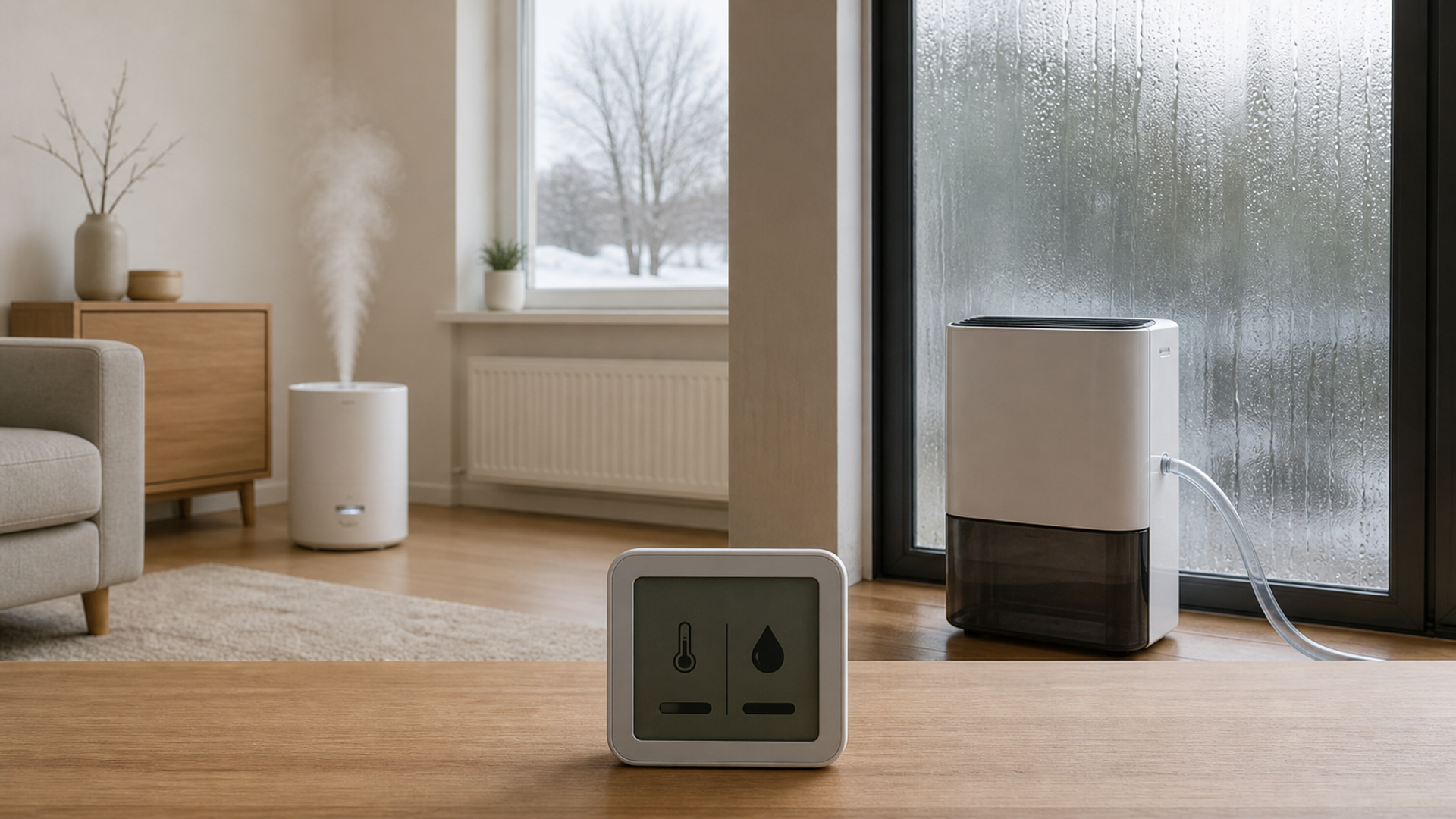
Humidifiers and dehumidifiers are opposites, yet both are often bought from the same vague complaint: a room feels uncomfortable. A humidifier adds water vapour when indoor air is too dry; a dehumidifier removes water when humidity, condensation or dampness is excessive. Neither device repairs a roof leak, cold bridge, plumbing fault or badly balanced ventilation system. Because comfort is subjective and moisture problems migrate through a building, the decision starts with repeated relative-humidity readings, visible evidence and the season in which the problem occurs.
Measure moisture before treating symptoms
Choose a humidifier only when repeated measurements confirm persistently dry air and a cleaning routine can prevent microbial growth. Choose a dehumidifier when excess humidity is measured and the unit can drain, circulate air and address the affected volume. Fix the source first when water intrusion, cold surfaces, inadequate extraction or a mechanical fault is driving the reading; appliances should not conceal a building defect.
| Decision factor | Humidifier | Dehumidifier | Fix the building source first |
|---|---|---|---|
| Measured condition | Repeated low relative humidity | Repeated high relative humidity or condensation | Investigate fluctuating or localised readings |
| Primary consequence | Dry-air discomfort and material shrinkage | Mould risk, odour and damp surfaces | Repair leaks and thermal bridges |
| Capacity | Output must not overshoot the room | Extraction rating must match temperature and volume | Use whole-home control where loads are distributed |
| Water handling | Fill with suitable water and clean the reservoir | Drain tank or hose without leaks | Correct plumbing and drainage first |
| Energy and noise | Fan and mist can disturb sleep | Compressor or desiccant operation adds noise and heat | Locate the source rather than treating every room |
| Verification | Track humidity and clean surfaces | Track humidity, condensate and odour | Escalate persistent dampness professionally |
This humidifier vs dehumidifier matrix is the article's working value object. Read the humidifier vs dehumidifier rows together: the decisive failure mode depends on this topic's evidence, operating context and reader objective.
Adding and removing water create opposite risks
Evidence 1. EPA guidance links moisture control with mould prevention and emphasises correcting water or humidity sources rather than relying on surface treatment.
Evidence 2. ENERGY STAR rates dehumidifiers by capacity and efficiency, but room temperature and airflow still affect extraction performance.
Evidence 3. Home humidifiers require regular cleaning because stagnant water, mineral deposits and contaminated mist can create new indoor-air problems.
Evidence 4. A single sensor beside a window, vent or appliance can misrepresent the occupied zone; several timed readings provide a better decision base.
Reader-visible sources checked for this article:
epa.gov — reader-visible current or official evidence
energystar.gov — reader-visible current or official evidence
For humidifier vs dehumidifier, these sources establish only the claims inside their documented scope. Recheck every changeable specification, availability condition, price, policy or service term in the relevant market before acting.
Match capacity to the room and season
A buyer can resolve measured condition without starting from a brand preference. Ask whether repeated low relative humidity; compare that with whether repeated high relative humidity or condensation; then use investigate fluctuating or localised readings as the third route's safeguard. An unknown condition stays unknown.
On primary consequence, popularity is not enough. The evidence for option one is that dry-air discomfort and material shrinkage. Option two means mould risk, odour and damp surfaces. Option three is rational where repair leaks and thermal bridges. Recheck any changeable term immediately before commitment.
The decision changes at capacity. Choose the first path only if output must not overshoot the room; move to the second when extraction rating must match temperature and volume; use the third when use whole-home control where loads are distributed. Save the downside that would make this row fail.
For water handling, the first route works when fill with suitable water and clean the reservoir; the second requires drain tank or hose without leaks. The control for the third is correct plumbing and drainage first. Verify this row against the exact product, property, account or environment before it can reverse the decision.
The energy and noise row exposes a practical boundary. Route one assumes fan and mist can disturb sleep, while route two is defensible only when compressor or desiccant operation adds noise and heat. Route three depends on locate the source rather than treating every room. If that evidence is absent, keep the more reversible option.
Read verification as a stop/go test: track humidity and clean surfaces supports the first option; track humidity, condensate and odour supports the second; and escalate persistent dampness professionally supports the third. Record which source proves the condition and when it was checked.
Facts that would reverse the current choice
Reversal control 1 — Measured condition. Before choosing Humidifier, write down how the decision changes if “Repeated low relative humidity” proves false. Do the same for Dehumidifier and “Repeated high relative humidity or condensation”. Keep the Fix the building source first route available until “Investigate fluctuating or localised readings” is verified. This control belongs to humidifier vs dehumidifier; update it from the cited source or exact supplier rather than copying a generic checklist.
Reversal control 2 — Primary consequence. Before choosing Humidifier, write down how the decision changes if “Dry-air discomfort and material shrinkage” proves false. Do the same for Dehumidifier and “Mould risk, odour and damp surfaces”. Keep the Fix the building source first route available until “Repair leaks and thermal bridges” is verified. This control belongs to humidifier vs dehumidifier; update it from the cited source or exact supplier rather than copying a generic checklist.
Reversal control 3 — Capacity. Before choosing Humidifier, write down how the decision changes if “Output must not overshoot the room” proves false. Do the same for Dehumidifier and “Extraction rating must match temperature and volume”. Keep the Fix the building source first route available until “Use whole-home control where loads are distributed” is verified. This control belongs to humidifier vs dehumidifier; update it from the cited source or exact supplier rather than copying a generic checklist.
Reversal control 4 — Water handling. Before choosing Humidifier, write down how the decision changes if “Fill with suitable water and clean the reservoir” proves false. Do the same for Dehumidifier and “Drain tank or hose without leaks”. Keep the Fix the building source first route available until “Correct plumbing and drainage first” is verified. This control belongs to humidifier vs dehumidifier; update it from the cited source or exact supplier rather than copying a generic checklist.
Reversal control 5 — Energy and noise. Before choosing Humidifier, write down how the decision changes if “Fan and mist can disturb sleep” proves false. Do the same for Dehumidifier and “Compressor or desiccant operation adds noise and heat”. Keep the Fix the building source first route available until “Locate the source rather than treating every room” is verified. This control belongs to humidifier vs dehumidifier; update it from the cited source or exact supplier rather than copying a generic checklist.
Reversal control 6 — Verification. Before choosing Humidifier, write down how the decision changes if “Track humidity and clean surfaces” proves false. Do the same for Dehumidifier and “Track humidity, condensate and odour”. Keep the Fix the building source first route available until “Escalate persistent dampness professionally” is verified. This control belongs to humidifier vs dehumidifier; update it from the cited source or exact supplier rather than copying a generic checklist.
Map humidity across the day
Place calibrated sensors in the occupied zone, not directly beside glass, supply air or the appliance. Log morning, afternoon and overnight readings for at least a week in the problem season. For this humidifier versus dehumidifier decision, record the exact room, garment, vehicle, drink, device or configuration and the time of the check. Separate measured behaviour from category shorthand, then repeat the comparison in the intended setting rather than an ideal demonstration. If the pattern is local rather than room-wide, investigate the surface or airflow before adding equipment. Preserve the evidence that would reverse the choice: a material change in fit, specification, maintenance, safety, cost or environment must reopen the decision rather than inherit an old conclusion.
Trace the moisture source
Inspect bathrooms, cooking, drying laundry, plants, basements, exterior walls, pipes and roof penetrations. Compare readings before and after known moisture events and ventilation changes. For this humidifier versus dehumidifier decision, record the exact room, garment, vehicle, drink, device or configuration and the time of the check. Separate measured behaviour from category shorthand, then repeat the comparison in the intended setting rather than an ideal demonstration. If a leak or extraction failure explains the peak, repair it first. Preserve the evidence that would reverse the choice: a material change in fit, specification, maintenance, safety, cost or environment must reopen the decision rather than inherit an old conclusion.
Size and place the unit
Use the manufacturer's rated room and capacity data as a starting point. Test doors open and closed, measure sound at the bed or desk and confirm safe clearances. For this humidifier versus dehumidifier decision, record the exact room, garment, vehicle, drink, device or configuration and the time of the check. Separate measured behaviour from category shorthand, then repeat the comparison in the intended setting rather than an ideal demonstration. If one portable unit cannot serve the moisture zone, redesign the control strategy. Preserve the evidence that would reverse the choice: a material change in fit, specification, maintenance, safety, cost or environment must reopen the decision rather than inherit an old conclusion.
Create a hygiene routine
For humidifiers, schedule water changes, scale removal and disinfection exactly as instructed. For dehumidifiers, clean filters, inspect coils and drain condensate without standing water. For this humidifier versus dehumidifier decision, record the exact room, garment, vehicle, drink, device or configuration and the time of the check. Separate measured behaviour from category shorthand, then repeat the comparison in the intended setting rather than an ideal demonstration. If the household will not maintain the device, passive or central measures may be safer. Preserve the evidence that would reverse the choice: a material change in fit, specification, maintenance, safety, cost or environment must reopen the decision rather than inherit an old conclusion.
Verify the outcome
Repeat the same sensor schedule after installation and photograph condensation or surface change. Track comfort separately from measured humidity so placebo and weather shifts are visible. For this humidifier versus dehumidifier decision, record the exact room, garment, vehicle, drink, device or configuration and the time of the check. Separate measured behaviour from category shorthand, then repeat the comparison in the intended setting rather than an ideal demonstration. If readings improve but symptoms persist, reassess the underlying assumption. Preserve the evidence that would reverse the choice: a material change in fit, specification, maintenance, safety, cost or environment must reopen the decision rather than inherit an old conclusion.
Four moisture patterns, four answers
Heated winter bedroom with stable low readings
A carefully maintained humidifier may improve the environment without overshooting. Define the fact that would reverse this recommendation before committing.
Warm basement with musty odour and high readings
A drained dehumidifier plus source control is more plausible. Define the fact that would reverse this recommendation before committing.
Condensation on one cold wall
Insulation, airflow and thermal bridging need investigation before a portable appliance. Define the fact that would reverse this recommendation before committing.
Mixed seasons in a coastal home
The answer may switch across the year and require different set points. Define the fact that would reverse this recommendation before committing.
Action checklist
Calibrate sensors.
Log seven days.
Inspect leaks.
Check extraction.
Measure room volume.
Read capacity rating.
Plan drainage.
Measure noise.
Write cleaning schedule.
Check mineral deposits.
Repeat measurements.
Escalate persistent damp.
Continue the decision
The linked VERTU articles expand adjacent parts of the humidifier vs dehumidifier decision. They do not substitute for the external evidence above.
The humidifier-versus-dehumidifier verdict
Choose a humidifier only when repeated measurements confirm persistently dry air and a cleaning routine can prevent microbial growth. Choose a dehumidifier when excess humidity is measured and the unit can drain, circulate air and address the affected volume. Fix the source first when water intrusion, cold surfaces, inadequate extraction or a mechanical fault is driving the reading; appliances should not conceal a building defect.
Keep the humidifier vs dehumidifier decision reversible until its material cost, safety, access, privacy and compatibility facts are verified. Unknown evidence stays unknown; it is never silently scored as favourable.
![How to Scan Receipts and Documents with Your Phone [Full Guide]](https://cdn.sanity.io/images/e0gp1l2g/production/0db13feec1d5e72b8a8a5f976d1f3e86619c9228-3840x1860.webp?w=180&h=180&q=78&auto=format&fit=crop)
![How to Scan Receipts and Documents with Your Phone [Full Guide]](https://cdn.sanity.io/images/e0gp1l2g/production/0db13feec1d5e72b8a8a5f976d1f3e86619c9228-3840x1860.webp?w=800&h=450&q=82&auto=format&fit=crop)
![Top 10 Two-Tone Carbon-Fibre Watches for Men [2026 List]](https://cdn.sanity.io/images/e0gp1l2g/production/18870799ba33fab0e038968359cd5772d7d7db30-1024x576.webp?w=800&h=450&q=82&auto=format&fit=crop)
![Top 10 Luxury Watches with Digital Complication Displays for Men [Latest]](https://cdn.sanity.io/images/e0gp1l2g/production/c4f6bf8c080f291c39f7cc85c7344ecff2fd3799-1024x553.webp?w=800&h=450&q=82&auto=format&fit=crop)