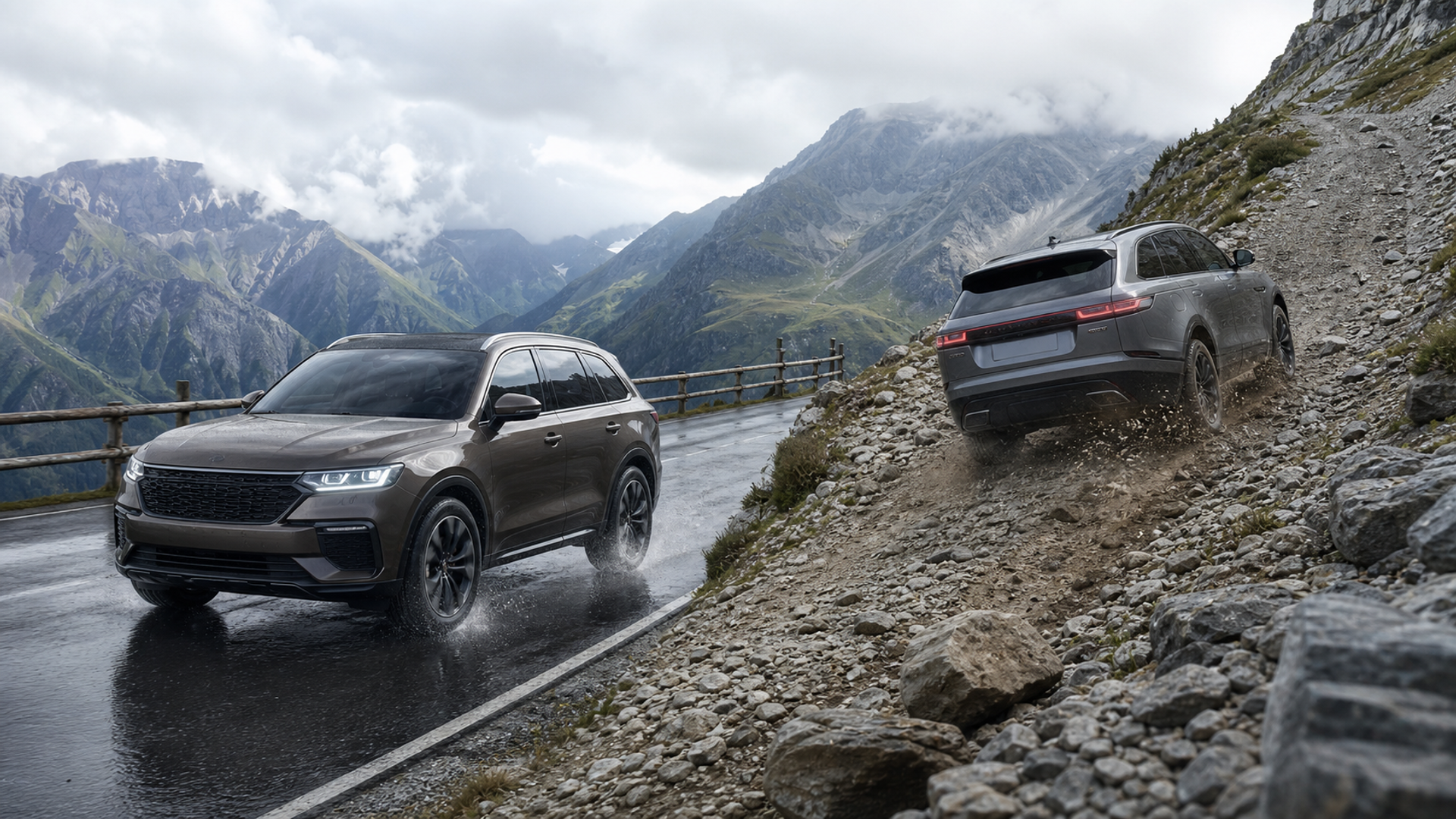
All-wheel drive and four-wheel drive can both send torque to four wheels, but the labels do not describe one universal mechanism. Some systems act automatically through clutches and software; others add driver-selectable modes, a locking centre connection or low-range gearing. Neither label creates braking grip, ground clearance or suitable tyres. The useful choice starts with the roads actually driven, the weather actually encountered, the load carried and the exact vehicle manual—not with an assumption that more driven wheels solve every hazard.
Start with roads and tyres, not the badge
Choose all-wheel drive when variable paved-road traction and automatic intervention dominate the brief. Choose four-wheel drive when repeated loose-surface work, controlled low-speed progress, towing or low-range capability is verified on the exact vehicle. Change the vehicle or tyre plan when clearance, tyres, recovery points, braking or route judgement—not torque distribution—is the real limiting factor.
| Decision factor | All-wheel drive | Four-wheel drive | Change vehicle or tyre plan |
|---|---|---|---|
| Normal road | Automatic torque variation suits mixed tarmac | Part-time modes may be unnecessary on dry high-grip roads | Prioritise tyres and stability systems |
| Deep snow and mud | Capability varies by calibration and clearance | Low range and locked modes can help at low speed | Check route, recovery and tyre rating |
| Tyres | Four driven wheels cannot replace winter or terrain tyres | The same limitation applies to 4WD | Fit four matched tyres for the task |
| Driver workload | Usually manages engagement automatically | May require correct mode selection | Read and practise the exact controls |
| Efficiency | Extra mass and friction vary by model | Low-range hardware can add mass and complexity | Compare exact official consumption |
| Recovery | Road-biased systems may lack rated points | Purpose-built vehicles may offer better recovery provisions | Do not exceed manual limits |
This all wheel drive vs four wheel drive matrix is the article's working value object. Read the all wheel drive vs four wheel drive rows together: the decisive failure mode depends on this topic's evidence, operating context and reader objective.
Drivetrain labels hide different hardware
Evidence 1. GMC's direct AWD-versus-4WD guidance distinguishes road-biased automatic torque distribution from selectable four-wheel-drive modes and low-speed terrain use.
Evidence 2. Honda documents one specific real-time AWD system using sensors and variable front-to-rear torque, illustrating why the category label does not define every implementation.
Evidence 3. FuelEconomy.gov compares model-specific energy use, so drivetrain fuel penalties must be checked on exact configurations rather than assumed from the badge.
Evidence 4. Traction for acceleration is not the same as braking or cornering grip; tyres, speed, surface and stability systems remain decisive.
Reader-visible sources checked for this article:
gmc.com — reader-visible current or official evidence
global.honda — reader-visible current or official evidence
fueleconomy.gov — reader-visible current or official evidence
For all wheel drive vs four wheel drive, these sources establish only the claims inside their documented scope. Recheck every changeable specification, availability condition, price, policy or service term in the relevant market before acting.
Test traction and control on a repeatable route
The normal road row exposes a practical boundary. Route one assumes automatic torque variation suits mixed tarmac, while route two is defensible only when part-time modes may be unnecessary on dry high-grip roads. Route three depends on prioritise tyres and stability systems. If that evidence is absent, keep the more reversible option.
Read deep snow and mud as a stop/go test: capability varies by calibration and clearance supports the first option; low range and locked modes can help at low speed supports the second; and check route, recovery and tyre rating supports the third. Record which source proves the condition and when it was checked.
A buyer can resolve tyres without starting from a brand preference. Ask whether four driven wheels cannot replace winter or terrain tyres; compare that with whether the same limitation applies to 4WD; then use fit four matched tyres for the task as the third route's safeguard. An unknown condition stays unknown.
On driver workload, popularity is not enough. The evidence for option one is that usually manages engagement automatically. Option two means may require correct mode selection. Option three is rational where read and practise the exact controls. Recheck any changeable term immediately before commitment.
The decision changes at efficiency. Choose the first path only if extra mass and friction vary by model; move to the second when low-range hardware can add mass and complexity; use the third when compare exact official consumption. Save the downside that would make this row fail.
For recovery, the first route works when road-biased systems may lack rated points; the second requires purpose-built vehicles may offer better recovery provisions. The control for the third is do not exceed manual limits. Verify this row against the exact product, property, account or environment before it can reverse the decision.
Facts that would reverse the current choice
Reversal control 1 — Normal road. Before choosing All-wheel drive, write down how the decision changes if “Automatic torque variation suits mixed tarmac” proves false. Do the same for Four-wheel drive and “Part-time modes may be unnecessary on dry high-grip roads”. Keep the Change vehicle or tyre plan route available until “Prioritise tyres and stability systems” is verified. This control belongs to all wheel drive vs four wheel drive; update it from the cited source or exact supplier rather than copying a generic checklist.
Reversal control 2 — Deep snow and mud. Before choosing All-wheel drive, write down how the decision changes if “Capability varies by calibration and clearance” proves false. Do the same for Four-wheel drive and “Low range and locked modes can help at low speed”. Keep the Change vehicle or tyre plan route available until “Check route, recovery and tyre rating” is verified. This control belongs to all wheel drive vs four wheel drive; update it from the cited source or exact supplier rather than copying a generic checklist.
Reversal control 3 — Tyres. Before choosing All-wheel drive, write down how the decision changes if “Four driven wheels cannot replace winter or terrain tyres” proves false. Do the same for Four-wheel drive and “The same limitation applies to 4WD”. Keep the Change vehicle or tyre plan route available until “Fit four matched tyres for the task” is verified. This control belongs to all wheel drive vs four wheel drive; update it from the cited source or exact supplier rather than copying a generic checklist.
Reversal control 4 — Driver workload. Before choosing All-wheel drive, write down how the decision changes if “Usually manages engagement automatically” proves false. Do the same for Four-wheel drive and “May require correct mode selection”. Keep the Change vehicle or tyre plan route available until “Read and practise the exact controls” is verified. This control belongs to all wheel drive vs four wheel drive; update it from the cited source or exact supplier rather than copying a generic checklist.
Reversal control 5 — Efficiency. Before choosing All-wheel drive, write down how the decision changes if “Extra mass and friction vary by model” proves false. Do the same for Four-wheel drive and “Low-range hardware can add mass and complexity”. Keep the Change vehicle or tyre plan route available until “Compare exact official consumption” is verified. This control belongs to all wheel drive vs four wheel drive; update it from the cited source or exact supplier rather than copying a generic checklist.
Reversal control 6 — Recovery. Before choosing All-wheel drive, write down how the decision changes if “Road-biased systems may lack rated points” proves false. Do the same for Four-wheel drive and “Purpose-built vehicles may offer better recovery provisions”. Keep the Change vehicle or tyre plan route available until “Do not exceed manual limits” is verified. This control belongs to all wheel drive vs four wheel drive; update it from the cited source or exact supplier rather than copying a generic checklist.
Write a road and weather ledger
List weekly paved, gravel, snow, sand, mud, ramp and towing use. Attach frequency, gradient, surface depth and consequence of getting stuck. For this all-wheel drive versus four-wheel drive decision, keep the exact item, setting, date and test condition in one evidence log. Separate a measured result from category shorthand and repeat the check in the intended environment. If severe terrain is only hypothetical, do not buy permanent complexity for an imagined trip. If that reversal condition appears, reopen the decision instead of defending the earlier preference.
Decode the exact system
Read the manual for torque split, selectable modes, low range, locks, speed limits and tyre rules. Confirm whether marketing names describe hardware or software behaviour. For this all-wheel drive versus four-wheel drive decision, keep the exact item, setting, date and test condition in one evidence log. Separate a measured result from category shorthand and repeat the check in the intended environment. If the required capability is absent from the manual, treat it as absent. If that reversal condition appears, reopen the decision instead of defending the earlier preference.
Control the tyre variable
Record tyre model, size, load rating, age, tread, pressure and seasonal suitability. Compare vehicles on equivalent tyres before judging drivetrain. For this all-wheel drive versus four-wheel drive decision, keep the exact item, setting, date and test condition in one evidence log. Separate a measured result from category shorthand and repeat the check in the intended environment. If tyre differences explain the result, reverse the drivetrain conclusion. If that reversal condition appears, reopen the decision instead of defending the earlier preference.
Run a low-risk route test
Use the same wet incline, tight turn, parking ramp and rough access road with a trained driver. Score launch, steering, intervention, visibility and mode recovery without provoking loss of control. For this all-wheel drive versus four-wheel drive decision, keep the exact item, setting, date and test condition in one evidence log. Separate a measured result from category shorthand and repeat the check in the intended environment. If a system surprises the driver or needs unavailable practice, reduce its suitability. If that reversal condition appears, reopen the decision instead of defending the earlier preference.
Model ownership burden
Price tyres in matched sets, fluids, servicing, fuel, recovery equipment and resale. Include the cost of a wrong mode or mismatched replacement tyre. For this all-wheel drive versus four-wheel drive decision, keep the exact item, setting, date and test condition in one evidence log. Separate a measured result from category shorthand and repeat the check in the intended environment. If daily cost overwhelms rare capability, choose a simpler plan. If that reversal condition appears, reopen the decision instead of defending the earlier preference.
Four road lives, four rational answers
Wet urban and motorway use
A well-calibrated AWD vehicle on suitable tyres can reduce driver workload. Define the fact that would reverse this recommendation before committing.
Remote rocky access road
Verified low range, clearance, protection and recovery provision can favour 4WD. Define the fact that would reverse this recommendation before committing.
Alpine winter commute
Tyres and route discipline may matter more than the drivetrain label. Define the fact that would reverse this recommendation before committing.
Occasional campsite on maintained gravel
A two-wheel-drive vehicle with correct tyres may remain sufficient. Define the fact that would reverse this recommendation before committing.
Action checklist
Map real routes.
Count severe-weather days.
Read the owner manual.
Verify low range.
Verify lock behaviour.
Record ground clearance.
Compare matched tyres.
Check spare-tyre rules.
Price fuel and service.
Locate recovery points.
Run a safe route test.
Write the reversal condition.
Continue the decision
The linked VERTU articles expand adjacent parts of the all wheel drive vs four wheel drive decision. They do not substitute for the external evidence above.
The AWD-versus-4WD verdict
Choose all-wheel drive when variable paved-road traction and automatic intervention dominate the brief. Choose four-wheel drive when repeated loose-surface work, controlled low-speed progress, towing or low-range capability is verified on the exact vehicle. Change the vehicle or tyre plan when clearance, tyres, recovery points, braking or route judgement—not torque distribution—is the real limiting factor.
Keep the all wheel drive vs four wheel drive decision reversible until its material cost, safety, access, privacy and compatibility facts are verified. Unknown evidence stays unknown; it is never silently scored as favourable.