-1b75cftp.webp)
- Primary Spec AnchorLook for USB-C PD 3.1 Extended Power Range (EPR) offering at least 65W–140W single-port output to power both flagship phones and laptops.
- Android Fast ChargingEnsure the power bank explicitly supports Programmable Power Supply (PPS) with 3.3V–11V dynamic negotiation for Galaxy S25 and Pixel 9 devices.
- Wireless ConvenienceTarget Qi2 or Qi2.2 certification for 15W–25W magnetic snap-on alignment with iPhone 16 and modern magnetic cases.
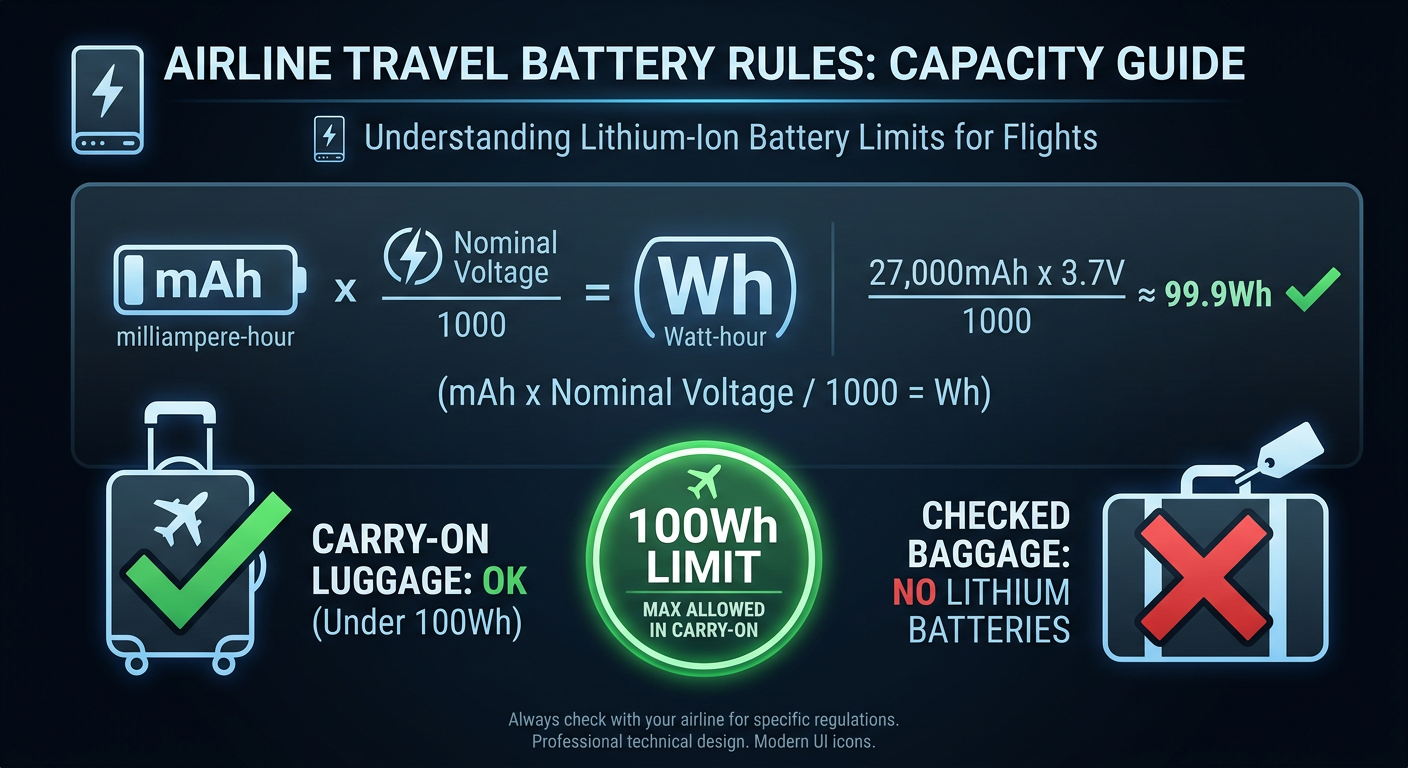
- Airline ComplianceKeep total capacity under 100 watt-hours (~27,000mAh at 3.7V) to pass TSA and FAA carry-on security checks without hassle.
Introduction
Why a future-proof backup battery for phone matters in 2026
Mobile hardware in 2026 demands more power than ever before. Flagship smartphones now feature high-brightness displays, real-time AI background processing, and high-resolution video capture systems that drain batteries rapidly. Simultaneously, battery chemistry and charging protocols have advanced. Relying on an outdated portable charger from a few years ago often results in slow charging, excessive heat, or total incompatibility with newer fast-charging standards.
A future-proof backup battery ensures that your phone, tablet, and travel tech stay operational wherever your day takes you. Investing in the right technology now prevents the frustration of carrying dead weight during critical business trips or international travel.
How this guide helps you decide quickly and confidently
Navigating technical jargon like EPR, AVS, PPS, and Qi2 can feel overwhelming. This buyer's guide cuts through marketing noise to give you clear, actionable criteria. We evaluate portable power banks based on real-world power delivery, device compatibility, travel compliance, and structural reliability.
Whether you need a slim magnetic battery for daily city commutes or a high-capacity power bank for long-haul flights, this guide provides the exact benchmarks needed to make an informed choice.
What’s new: PD 3.1, PPS, Qi2/Qi2.2, and airline 100Wh rules
Four key technology shifts define the 2026 portable battery market:
- USB PD 3.1 Extended Power Range (EPR)Pushes single-cable charging ceilings beyond 100W up to 240W, enabling ultra-fast recharges for laptops and phones simultaneously.
- Programmable Power Supply (PPS)Real-time voltage scaling that reduces conversion heat and unlocks maximum charging speeds on flagship Android phones.
- Qi2 and Qi2.2 Magnetic Wireless StandardsStandardized magnetic alignment delivering 15W to 25W wireless power with lower thermal loss.
- Strict Airline 100Wh Carry-On EnforcementGlobal airport security agencies rigorously enforce the 100 watt-hour maximum threshold for lithium-ion batteries in carry-on luggage.
What matters in 2026
Key specs at a glance
To quickly evaluate any portable charger in 2026, compare its core specifications against modern standards:
Feature | Minimum Recommended Spec | Premium / Future-Proof Target |
|---|---|---|
Wired Output | USB-C PD 3.0 (30W) | USB-C PD 3.1 EPR (100W–140W) |
Android Protocol | Standard USB-PD | USB-PD with PPS (3.3V–11V @ 5A) |
Wireless Standard | Qi 5W–7.5W | Qi2 (15W) / Qi2.2 (25W) Magnetic |
Capacity | 10,000mAh (~37Wh) | 20,000mAh–27,000mAh (74Wh–99.9Wh) |
Airline Compliance | Under 100Wh limit | Exactly ≤99.9Wh with clear flight label |
Display / Interface | Simple LED indicators | Real-time smart LCD (wattage, temp, % remaining) |
Your use cases
Choosing the best backup battery depends heavily on your daily routine and travel habits:
- The Daily CommuterRequires a lightweight 5,000mAh to 10,000mAh magnetic pack that snaps onto the back of the phone without adding unnecessary bulk to pockets or jackets.
- The Business TravelerNeeds a 20,000mAh power bank with high-wattage PD 3.1 (100W+) to fast-charge a laptop at an airport terminal while keeping a smartphone topped up.
- The Off-Grid ExplorerPrioritizes ruggedized outer casing, IP-rated dust and water resistance, multi-port output, and high thermal stability.
Budget vs value
While budget power banks under $30 may seem appealing, they frequently compromise on thermal safety, voltage regulation, and long-term cell health. Premium power banks feature high-density lithium-polymer or 21700 battery cells, active temperature monitoring chips, and flame-retardant enclosures.
Paying a premium for verified safety certifications, e-marked cables, and real-time power distribution chips protects your multi-thousand-dollar mobile devices from voltage spikes and degradation.
Wired charging
PD 3.1 basics
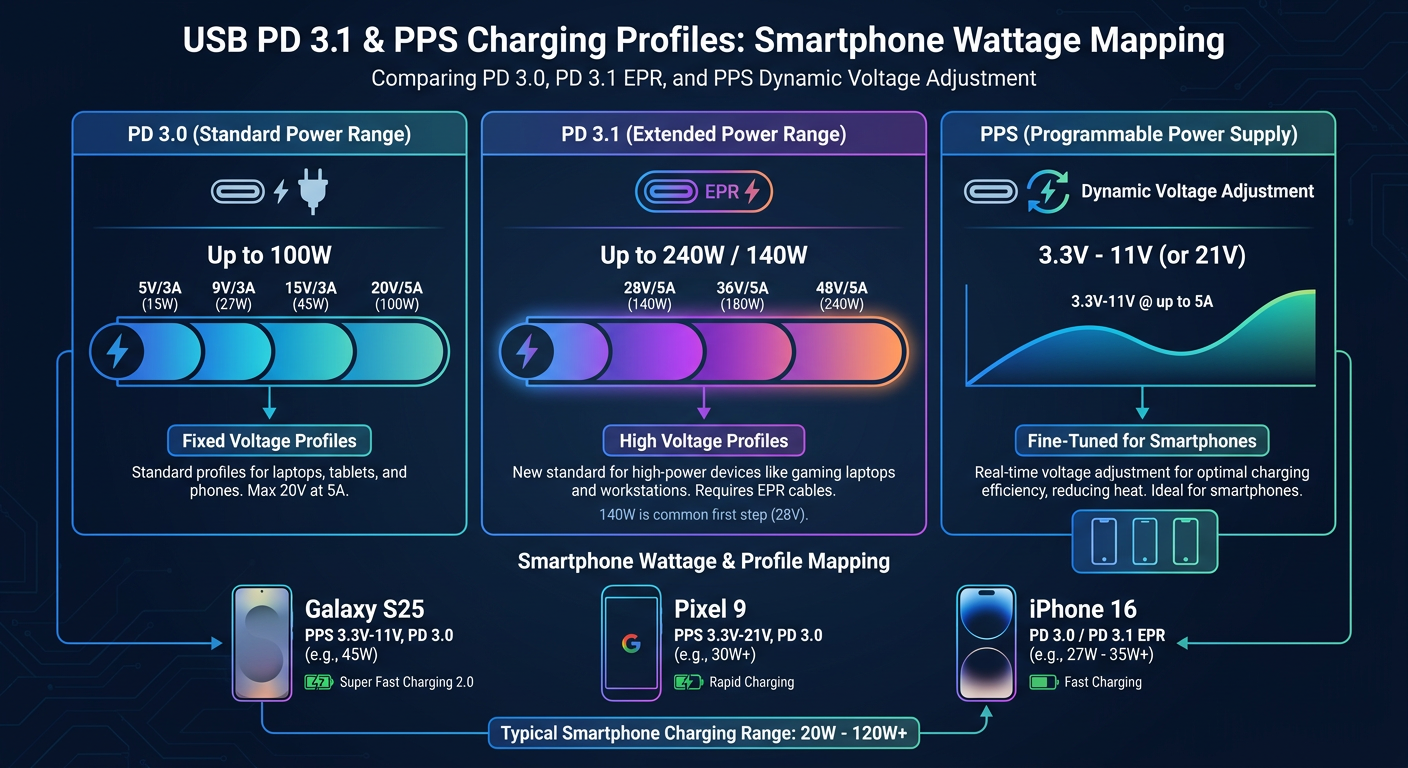
The USB Power Delivery 3.1 specification expanded power delivery capabilities beyond the older 100W ceiling. By introducing Extended Power Range (EPR), USB PD 3.1 adds higher fixed voltage profiles at 28V, 36V, and 48V.
In consumer power banks, the most common PD 3.1 tier provides 140W output (28V at 5A) over a single USB-C port. This allows a portable battery to charge high-performance laptops like a 16-inch MacBook Pro or workstation PC at full speed, while retaining enough dynamic power headroom to fast-charge a connected phone on a second port.
PPS for Android
Fixed voltage profiles (5V, 9V, 15V, 20V) are insufficient for modern Android fast charging. Samsung Galaxy and Google Pixel devices require Programmable Power Supply (PPS).
PPS allows the phone and power bank to negotiate small voltage adjustments—as precise as 20 millivolts—every few seconds during charging. By matching the battery cell's real-time voltage state, PPS minimizes energy wasted as internal heat, allowing the phone to maintain peak charging speeds (such as 45W) without thermal throttling.
Cable and wattage fit
A high-wattage power bank is only as effective as the cable connecting it to your phone. To draw more than 60W or 3A of current, you must use a USB-C cable equipped with an internal E-Marker microchip.
Without an E-marked cable, smart power banks automatically cap power output to 60W for safety reasons. Always check that your charging cables match the power bank's maximum rated wattage output.
Wireless charging
Qi2 alignment
Developed by the Wireless Power Consortium, the Qi2 Magnetic Power Profile standard brings magnetic snap-on charging to the broader mobile industry. Built around a ring of calibrated magnets, Qi2 ensures exact coil-to-coil alignment between the power bank and the phone.
Precise alignment eliminates the power loss and excess heat caused by misaligned traditional Qi charging pads. Qi2 delivers a reliable 15W wireless charge to compatible devices, doubling the speed of older 7.5W wireless chargers.
Qi2.2 at 25W
The Qi2.2 revision advances wireless charging further by increasing maximum power transfer to 25W. This higher speed tier approaches traditional wired charging rates while maintaining wireless convenience.
Power banks supporting Qi2.2 incorporate active cooling channels or thermal dissipation plates behind the wireless coil to handle the extra heat generated by 25W power transfer, protecting phone battery longevity.
Efficiency trade-offs
While wireless charging offers unmatched convenience, it remains less efficient than a direct cable connection:
- Energy LossWireless charging loses roughly 20% to 30% of energy as heat during induction transfer. A 10,000mAh wireless pack will yield fewer total phone recharges wirelessly than it would over USB-C.
- Thermal BuildupHeat accelerates battery aging. For rapid top-ups or heavy gaming during charging, a wired USB-C connection with PPS remains the superior choice.
Capacity and travel
mAh vs Wh
Power bank capacity is typically advertised in milliamp-hours (mAh), but aviation regulators and electrical engineers measure energy in watt-hours (Wh).
Because lithium battery cells operate at a nominal voltage (usually 3.7V or 3.85V), converting between mAh and Wh requires a simple formula:
Wh = mAh × Nominal Voltage/1000
For example, a standard 20,000mAh battery cell operating at 3.7V provides:
20000 × 3.7/1000 = 74 Wh
TSA/FAA rules
Under TSA 100 watt-hour battery limits and international ICAO regulations:
- Carry-On LuggagePower banks rated at 100Wh or less are permitted in carry-on bags without prior airline approval. Most 27,000mAh portable batteries sit at exactly 99.9Wh to maximize capacity while staying fully compliant.
- Checked BagsPower banks are strictly prohibited in checked baggage due to fire safety rules regarding unmonitored lithium-ion cells.
- Labeling RequirementThe watt-hour rating must be clearly printed on the power bank's exterior casing. If the text wears off or is unreadable, security agents may confiscate the device.
Safety certification
Never buy a backup battery that lacks verified independent safety labels. Look for the following international safety marks on the device casing:
- UL 2056 / UL 1642Standards specifically testing power bank electrical safety, overcharge protection, and cell stability.
- CE / FCC / RoHSVerifies electromagnetic compatibility and the absence of hazardous materials.
- IEC 62133Global safety standard for rechargeable lithium cells used in portable electronics.
Fit and compatibility
iPhone 16 and Qi2
Apple's iPhone 16 lineup features native magnetic alignment fully compatible with Qi2 and Qi2.2 power banks.
- Wired Fast ChargingSupports USB PD fast charging, reaching 50% charge in approximately 30 minutes when paired with a 30W+ USB-C power bank.
- Wireless MatchingSnaps cleanly onto Qi2 magnetic power banks for 15W wireless charging without requiring extra magnetic rings or special cases.
Galaxy S25 and PPS
Samsung's Galaxy S25 series relies on Super Fast Charging 2.0 (45W), which requires specific power bank profiles:
- PPS RequirementThe power bank must supply 11V at 4.05A or 5A over PPS. Standard 45W PD chargers lacking PPS will default to 15W–25W charging.
- Wireless MatchingUses standard Qi and Qi2 magnetic cases for wireless topping-up.
Pixel 9 and PPS
Google's Pixel 9 series also utilizes USB PD with PPS for peak fast charging:
- Dynamic NegotiationPixel phones actively limit charging speeds if thermal thresholds are reached. A power bank with fine-grained PPS voltage stepping ensures cool, efficient charging.
- Cable FitPair with an e-marked USB-C to USB-C cable for stable power delivery.
VERTU and luxury mobile integration
For discerning executives and high-net-worth travelers using handcrafted smartphones like VERTU luxury phones, hardware compatibility extends beyond basic electrical specs.
Devices crafted from grade-5 titanium, sapphire crystal, and exotic leathers require accessories that match their physical durability and thermal properties:
- Material AlignmentHigh-end smartphones benefit from power banks built with anodized aluminum, titanium frames, or soft-touch ballistic nylon shielding that avoids scratching rare metal housing or leather backing.
- Uninterrupted Concierge ConnectivityExecutives relying on 24/7 dedicated concierge services and secure Web3 communications cannot afford unexpected power outages during global transit. Carrying a certified 20,000mAh PD 3.1 battery guarantees continuous uptime across multi-time-zone flights.
- Security Ecosystem FitAdvanced mobile platforms with hardware-encrypted storage and Web3 enclave chips draw consistent baseline power. Using a UL-certified power bank with clean DC output prevents electrical noise and voltage fluctuations from interfering with sensitive onboard security hardware.
Conclusion
Your quick checklist: ports, PPS, Qi2, ≤100Wh, safety labels
Before purchasing your next portable power bank in 2026, verify these five essentials:
- Dual USB-C PortsAt least one port supporting PD 3.1 (65W to 140W) for multi-device flexibility.
- PPS SupportExplicitly listed PPS voltage profiles (3.3V–11V @ 4A+) for Android fast charging.
- Qi2 / Qi2.2 Magnetic WirelessBuilt-in magnetic ring providing 15W–25W wireless snap alignment.
- Airline Legal (≤100Wh)Printed rating showing 99.9Wh or lower for hassle-free carry-on travel.
- Safety LabelsLegible UL, CE, FCC, and IEC safety certification marks printed on the chassis.
Final tip: pick 20,000mAh with PD 3.1 and PPS for balance
If you need a single power bank that excels across all scenarios, choose a 20,000mAh model with 100W–140W USB-C PD 3.1, PPS support, and Qi2 wireless capabilities.
This capacity hits the sweet spot: large enough to recharge a smartphone four to five times or power a laptop on a transcontinental flight, yet compact enough to slide into a carry-on bag while remaining well under strict airline security limits.