Introduction
A sports fan with taste doesn’t need their phone to shout.
You already have the jersey. The seat. The travel itinerary. What you don’t have, most of the time, is an everyday object that carries your allegiance with the same restraint as a good watch.
That’s why craftsmanship tends to matter more than specs at the very top of the market. A flagship chip becomes last year’s chip quickly. A sapphire element that stays clear, a leather panel that patinas, a serial plate you can verify, and service that stays available when you’re crossing time zones. Those details age differently.
Artisanal builds also solve a quiet problem: how to make fandom personal without making it merch. When the materials and finishing do the talking, your sports identity reads as a private signature, not a billboard.
In this guide, you’ll learn what to look for in materials, how to personalize with taste (and without unlicensed logos), how limited editions and provenance work, and what the white-glove journey should look like from brief to aftercare.
Materials that signal true craft (for a handmade luxury phone)
Craft shows up in places mass manufacturing can’t justify: edge finishing you can feel, stitching you can count, and materials chosen for how they wear over years.
For a quick calibration on what “handcrafted” should mean in this category (beyond marketing language), see VERTU’s legacy of handcrafted excellence.
Sapphire, titanium, and carbon fiber
Sapphire is a classic luxury cue for a reason. In a phone, you’re not just buying a hard surface, you’re buying the likelihood that the phone still looks precise after thousands of small contacts: pockets, desks, travel bags, and the occasional bump against a metal rail. Many sources note sapphire’s hardness is about 9 on the Mohs scale, which explains its reputation for scratch resistance in premium applications (with the trade-off that it can still crack under the wrong kind of impact). According to an explainer by Interelectronix on sapphire crystal glass, that hardness is the core reason it stays visually clean.
Titanium earns its place in luxury because it changes the feel of ownership. It can deliver strength without the dead weight, and it resists the sort of corrosion and wear that makes a device look tired. Carbon fiber, when used well, signals a different instinct: stiffness and lightness, with an engineered, motorsport-adjacent texture that can be subtle or pronounced.
If you’re commissioning, ask one simple question that filters out posturing: where exactly is each material used, and why there. A “sapphire phone” that uses sapphire only as a decorative sliver is a different object than one that places it where abrasion actually happens.
Hand-stitched exotic leathers
Leather is where craft becomes tactile.
A well-executed leather wrap improves grip, changes temperature feel in the hand, and ages in a way anodized glass never will. The tell isn’t the name of the hide. It’s the work: clean saddle stitching, consistent tension, corners that don’t pucker, and edge finishing that doesn’t fray when the phone lives in and out of a pocket.
If the maker offers exotic leathers, treat that as a sourcing and ethics conversation as much as a design choice. Ask what documentation they provide and what care guidance comes with the piece. A luxury object should come with a clear maintenance ritual, not vague reassurance.
Engraving, numbering, certificates
Engraving is meaningful when it’s treated like identification, not decoration.
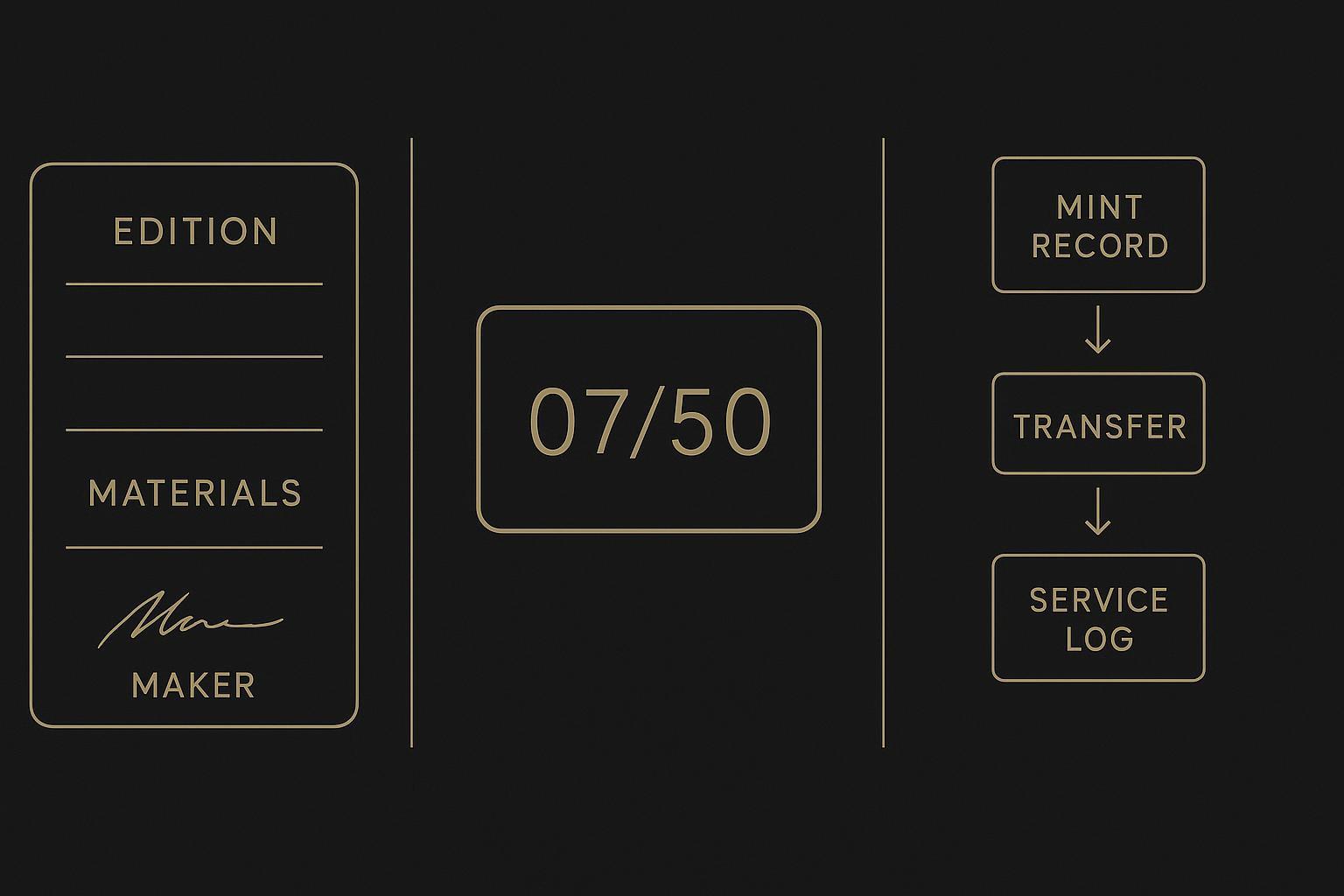
Look for engraving that is crisp under light, placed with intention, and tied to a documentation system. Numbering is a practical collector signal because it gives you a fixed reference: the piece can be described, logged, insured, and verified.
Certificates matter when they contain verifiable specifics, not just a flourish. For a grounding example outside phones, Jackson’s Art explains what a certificate of authenticity typically includes for limited-edition works: identification details, edition information, and issuer credibility. The same logic applies here.
Key TakeawayIn a handmade luxury phone, “value” is often visible: stitching discipline, edge geometry, serial discipline, and paperwork that can survive resale.
Personalization for sports identity (done right)
Tasteful sports personalization is less about making your phone resemble a jersey, and more about encoding meaning that another fan would recognize, and everyone else would simply read as good design.
Team-inspired palettes, trims, and textures
Start with color the way a collector starts with a dial.
A deep navy or burgundy can be a team reference without becoming a replica. Racing green can read as heritage. A subtle contrast stitch can echo a home kit stripe without copying it.
The best commissions use two or three cues at most. One dominant tone. One trim. One accent. Everything else stays calm.
Numbers, dates, coordinates—not unlicensed logos
If you care about taste and legality, this is the rule to internalize: don’t use team logos, names, slogans, or any artwork that implies affiliation unless you have a license.
Trademarks exist specifically to prevent confusion about what is official. Even “close enough” designs can be risky if they look like they’re meant to be official. A practical overview of how sports marks are protected and commonly licensed is covered in UpCounsel’s primer on sports trademarks and licensing rules.
The good news is you don’t need logos to make it personal:
A player number that matters to you, rendered in a discreet typographic style.
A date: first match attended, a title-clinching day, or a personal milestone tied to the club.
Coordinates: the stadium, the city where you became a fan, or the place you watched the decisive match.
These cues are meaningful, personal, and far less likely to create licensing problems.
Discreet emblems and UI themes
Hardware is only half the story. The best personalization extends into how the device behaves.
A UI theme can be as restrained as a lock-screen palette, a set of icons in team-adjacent tones, or a wallpaper system that changes on match day. A discreet emblem can be a geometric motif that references a team’s visual language without copying protected marks.
This is also where service becomes part of personalization. For UHNW owners, the real luxury is not just how the phone looks in a suite or at a post-match dinner, it’s how it reduces friction: setup, travel continuity, and support that answers when you’re moving.
VERTU has long positioned luxury phones as a blend of artisanal heritage and ownership experience, including 24/7 concierge access for task orchestration and lifestyle logistics. If you want a practical framework for what “bespoke” should mean in a phone (beyond surface customization), VERTU’s guide to custom luxury phone design offers a useful set of verification questions to borrow for any commission.
Limited editions and provenance
Rarity is easy to claim and hard to prove. Provenance is how you separate the two.
Micro-serials aligned to iconic numbers
Limited editions work best when the scarcity logic is coherent. Micro-serials that align to iconic numbers can feel earned: a run of 23, 7, 10, or 12 carries meaning without needing a logo.
What you want as a collector is consistency:
A serial that exists on the device (not just on a card).
A numbering format that can’t be “reinterpreted” later.
Documentation that matches the physical engraving exactly.
Certificates and blockchain anchoring
A certificate of authenticity is the paper layer. A digital record can be an additional layer.
Some makers use blockchain to anchor provenance: a record is created for a specific item, then events like transfer of ownership or service can be logged over time. The Aura Blockchain Consortium describes how blockchain is used to authenticate luxury goods as a way to create tamper-evident records.
The important nuance is also simple: a blockchain record is only as trustworthy as the first registration and the physical link between the item and its record. In other words, it can strengthen provenance. It doesn’t magically make counterfeits impossible.
The white-glove journey
A handmade phone is commissioned, not purchased off a shelf. The process should feel more like a private order than an online checkout.
Design consult to insured delivery
A credible journey usually starts with a brief, not a color picker.
Expect a design consult that covers how you live: travel cadence, how you carry the phone, whether you want it to disappear into black tie or show a hint of identity on match day. From there, you should see material options, finishing samples, and an explanation of what is truly made-to-order.
For delivery, insured logistics are the baseline. The handoff should include the documentation you need for ownership confidence: serial confirmation, certificate, care notes, and any digital provenance access details if offered.
Setup, care, and annual refresh
High-end ownership is a maintenance story.
Setup should be guided so the phone is ready in the way you actually use it: accounts, secure authentication habits, and travel-ready configurations. Care should be specific: what to avoid, what to condition, and what “normal aging” looks like on leather and metal.
An annual refresh is the detail that separates luxury from expensive. It can be as practical as reconditioning leather, inspecting seals, replacing wear-prone components, and verifying that identification markers remain crisp.
Discreet after-sales and upgrade paths
After-sales support should be quiet, fast, and predictable.
For owners who move across regions, the question is not “Do they have support?” but “How does support behave when you’re in a different time zone, on a different network, with a tight schedule?”
If you want a reference point for what a service layer can look like, VERTU describes the Ruby Key-accessed VERTU 24/7 concierge service as a global assistance system that connects you to human support on demand. Even if you’re commissioning elsewhere, the principle is worth keeping: luxury is the ability to keep moving without friction.
Conclusion
Commissioning a handmade luxury phone with a sports identity is an exercise in restraint.
Choose materials that age well and show their work. Personalize with meaning instead of trademarks. Demand provenance that can be verified by a third party. And treat service as part of the object, not an add-on.
If you’re moving from concept to your first build, write a one-page brief before you talk to anyone: your palette, your numbers/dates/coordinates, the materials you care about, and the provenance proof you expect to receive at delivery.
Disclosure: This article references VERTU pages. Editorial judgment remains the priority.
![Top 10 Tourbillon Watches for Men [2026 Latest]](https://cdn.sanity.io/images/e0gp1l2g/production/8cb6bc45133cf9453382fc7d074465af588bb610-1800x1080.webp?w=800&h=450&q=82&auto=format&fit=crop)