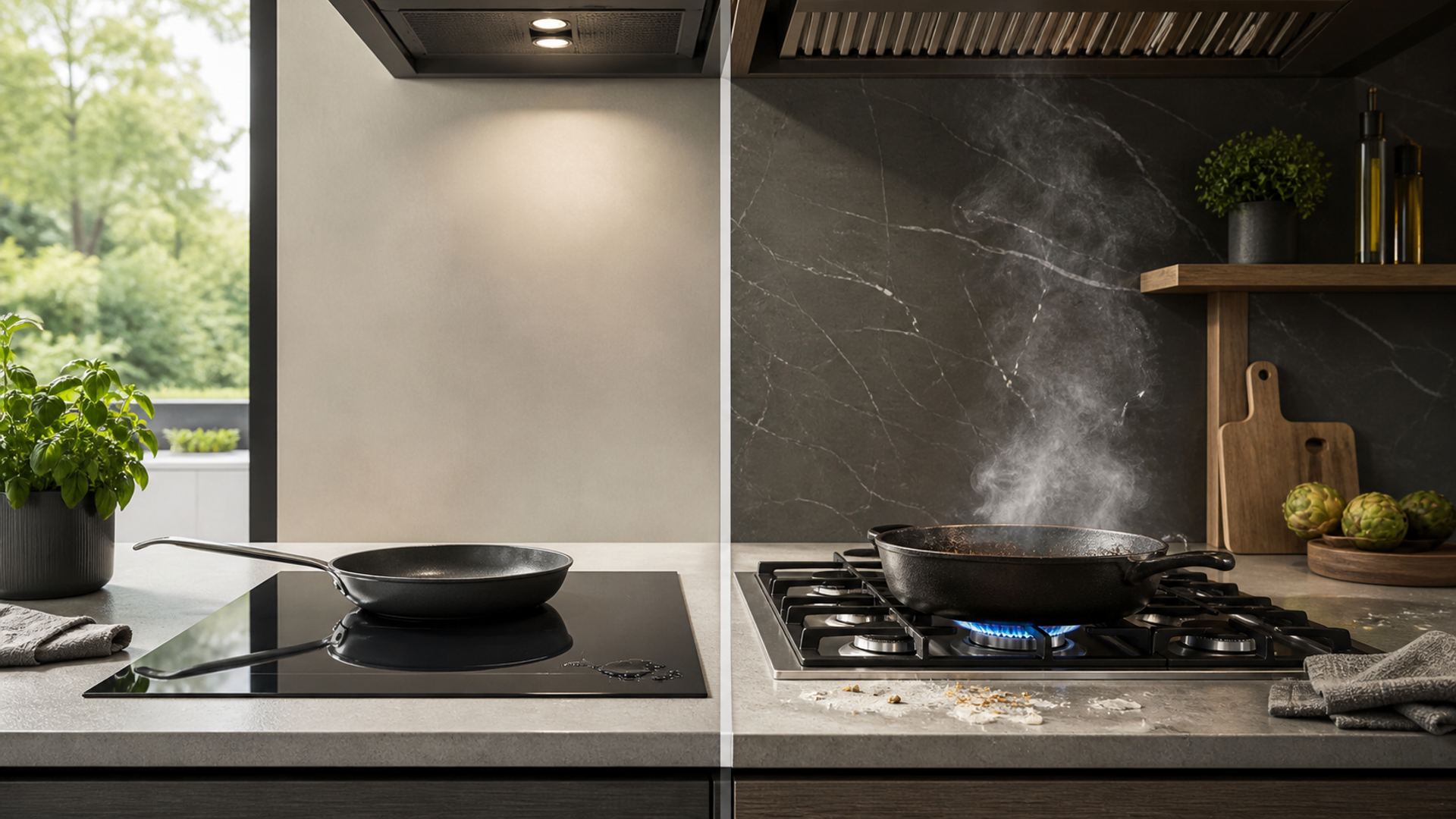
Induction and gas create heat by different paths. Induction energises compatible cookware directly through a magnetic field; gas burns fuel beneath the pan and adds combustion heat and moisture to the room. Control, ventilation, electrical capacity, cookware and power resilience can each decide before culinary identity does.
Start with cooking tasks and the room
Choose induction when fast controllable heating, easier surface cleaning and an electrified kitchen fit the cookware and supply. Choose gas when the exact installation, ventilation and local conditions support a flame-based workflow that the cook truly uses. Keep the current system when a costly service upgrade, unsuitable pans or unresolved safety work prevents a complete installation.
| Decision factor | Induction cooktop | Gas cooktop | Keep the current system |
|---|---|---|---|
| Heat control | Responsive compatible pans support the technique | Visible flame and existing habits are essential | Test the current cooktop before replacing it |
| Ventilation | Cooking effluent is captured with a suitable hood | Combustion and cooking effluent are fully addressed | Upgrade extraction before changing fuel |
| Supply | Electrical circuit and service are certified | Gas line, shutoff and combustion setup are certified | Infrastructure cost blocks the project |
| Cookware | The everyday pan set passes a magnet and flatness test | Existing cookware works safely on the grate | Replace only the pans that fail real tasks |
| Cleaning | A flat glass surface fits the routine | Grates and burners are maintained willingly | Current cleaning burden is acceptable |
| Resilience | Local power reliability and backup plan are acceptable | Gas use remains lawful and safely operable | A portable contingency covers rare outages |
This induction vs gas cooktop matrix is the article's working value object. Read the induction vs gas cooktop rows together: the decisive failure mode depends on this topic's evidence, operating context and reader objective.
What heat control and installation change
Evidence 1. The US Department of Energy describes induction as transferring energy through compatible cookware rather than first heating a burner surface.
Evidence 2. The US Department of Energy defines conventional cooking tops across gas, electric-resistance and electric-induction technologies; exact performance still depends on model, pan and task.
Evidence 3. Gas combustion produces indoor pollutants and moisture, while cooking itself produces particles under either fuel; effective ventilation remains relevant for both.
Evidence 4. Not every stainless-steel pan is induction compatible, and warped bases can reduce contact and control even when a magnet sticks.
Reader-visible sources checked for this article:
energy.gov — reader-visible current or official evidence
energy.gov — reader-visible current or official evidence
For induction vs gas cooktop, these sources establish only the claims inside their documented scope. Recheck every changeable specification, availability condition, price, policy or service term in the relevant market before acting.
Run a pan-by-pan kitchen trial
The heat control row exposes a practical boundary. Route one assumes responsive compatible pans support the technique, while route two is defensible only when visible flame and existing habits are essential. Route three depends on test the current cooktop before replacing it. If that evidence is absent, keep the more reversible option.
Read ventilation as a stop/go test: cooking effluent is captured with a suitable hood supports the first option; combustion and cooking effluent are fully addressed supports the second; and upgrade extraction before changing fuel supports the third. Record which source proves the condition and when it was checked.
A buyer can resolve supply without starting from a brand preference. Ask whether electrical circuit and service are certified; compare that with whether gas line, shutoff and combustion setup are certified; then use infrastructure cost blocks the project as the third route's safeguard. An unknown condition stays unknown.
On cookware, popularity is not enough. The evidence for option one is that the everyday pan set passes a magnet and flatness test. Option two means existing cookware works safely on the grate. Option three is rational where replace only the pans that fail real tasks. Recheck any changeable term immediately before commitment.
The decision changes at cleaning. Choose the first path only if a flat glass surface fits the routine; move to the second when grates and burners are maintained willingly; use the third when current cleaning burden is acceptable. Save the downside that would make this row fail.
For resilience, the first route works when local power reliability and backup plan are acceptable; the second requires gas use remains lawful and safely operable. The control for the third is a portable contingency covers rare outages. Verify this row against the exact product, property, account or environment before it can reverse the decision.
Facts that would reverse the current choice
Reversal control 1 — Heat control. Before choosing Induction cooktop, write down how the decision changes if “Responsive compatible pans support the technique” proves false. Do the same for Gas cooktop and “Visible flame and existing habits are essential”. Keep the Keep the current system route available until “Test the current cooktop before replacing it” is verified. This control belongs to induction vs gas cooktop; update it from the cited source or exact supplier rather than copying a generic checklist.
Reversal control 2 — Ventilation. Before choosing Induction cooktop, write down how the decision changes if “Cooking effluent is captured with a suitable hood” proves false. Do the same for Gas cooktop and “Combustion and cooking effluent are fully addressed”. Keep the Keep the current system route available until “Upgrade extraction before changing fuel” is verified. This control belongs to induction vs gas cooktop; update it from the cited source or exact supplier rather than copying a generic checklist.
Reversal control 3 — Supply. Before choosing Induction cooktop, write down how the decision changes if “Electrical circuit and service are certified” proves false. Do the same for Gas cooktop and “Gas line, shutoff and combustion setup are certified”. Keep the Keep the current system route available until “Infrastructure cost blocks the project” is verified. This control belongs to induction vs gas cooktop; update it from the cited source or exact supplier rather than copying a generic checklist.
Reversal control 4 — Cookware. Before choosing Induction cooktop, write down how the decision changes if “The everyday pan set passes a magnet and flatness test” proves false. Do the same for Gas cooktop and “Existing cookware works safely on the grate”. Keep the Keep the current system route available until “Replace only the pans that fail real tasks” is verified. This control belongs to induction vs gas cooktop; update it from the cited source or exact supplier rather than copying a generic checklist.
Reversal control 5 — Cleaning. Before choosing Induction cooktop, write down how the decision changes if “A flat glass surface fits the routine” proves false. Do the same for Gas cooktop and “Grates and burners are maintained willingly”. Keep the Keep the current system route available until “Current cleaning burden is acceptable” is verified. This control belongs to induction vs gas cooktop; update it from the cited source or exact supplier rather than copying a generic checklist.
Reversal control 6 — Resilience. Before choosing Induction cooktop, write down how the decision changes if “Local power reliability and backup plan are acceptable” proves false. Do the same for Gas cooktop and “Gas use remains lawful and safely operable”. Keep the Keep the current system route available until “A portable contingency covers rare outages” is verified. This control belongs to induction vs gas cooktop; update it from the cited source or exact supplier rather than copying a generic checklist.
List the recurring cooking tasks
Record boiling, low simmer, wok use, griddling, pressure cooking and large gatherings. Time representative tasks and note the exact pan diameter and weight.
Commission the infrastructure
Have qualified professionals verify electrical service, circuit, cable, ventilation, gas isolation, clearances and local requirements before ordering a cut-out-specific appliance.
Audit the pan set
Use a magnet, inspect flatness and test each daily pan. Price only necessary replacements and confirm that small and oversized bases fall within the model's detection zones.
Model outage and service risk
Record local interruption history, repair access, glass replacement, ignition behaviour and the household's safe no-cook or portable contingency.
Three cooking households
Apartment electrification renovation
Induction can reduce room heat and simplify cleaning when power and ventilation are properly designed. Define the fact that would reverse this recommendation before committing.
Cook with established flame-dependent techniques
Gas may remain practical only when those tasks are frequent and the complete installation is safe and permitted. Define the fact that would reverse this recommendation before committing.
Home with marginal electrical capacity
Keeping the present system can be rational until the wider service upgrade is planned. Define the fact that would reverse this recommendation before committing.
Action checklist
List real cooking tasks.
Test every pan.
Measure cut-out.
Verify electrical service.
Inspect gas isolation.
Size the hood.
Price cookware changes.
Test low simmer.
Plan outage meals.
Confirm service access.
Continue the decision
The linked VERTU articles expand adjacent parts of the induction vs gas cooktop decision. They do not substitute for the external evidence above.
The induction-gas verdict
Choose induction when fast controllable heating, easier surface cleaning and an electrified kitchen fit the cookware and supply. Choose gas when the exact installation, ventilation and local conditions support a flame-based workflow that the cook truly uses. Keep the current system when a costly service upgrade, unsuitable pans or unresolved safety work prevents a complete installation.
Keep the induction vs gas cooktop decision reversible until its material cost, safety, access, privacy and compatibility facts are verified. Unknown evidence stays unknown; it is never silently scored as favourable.