

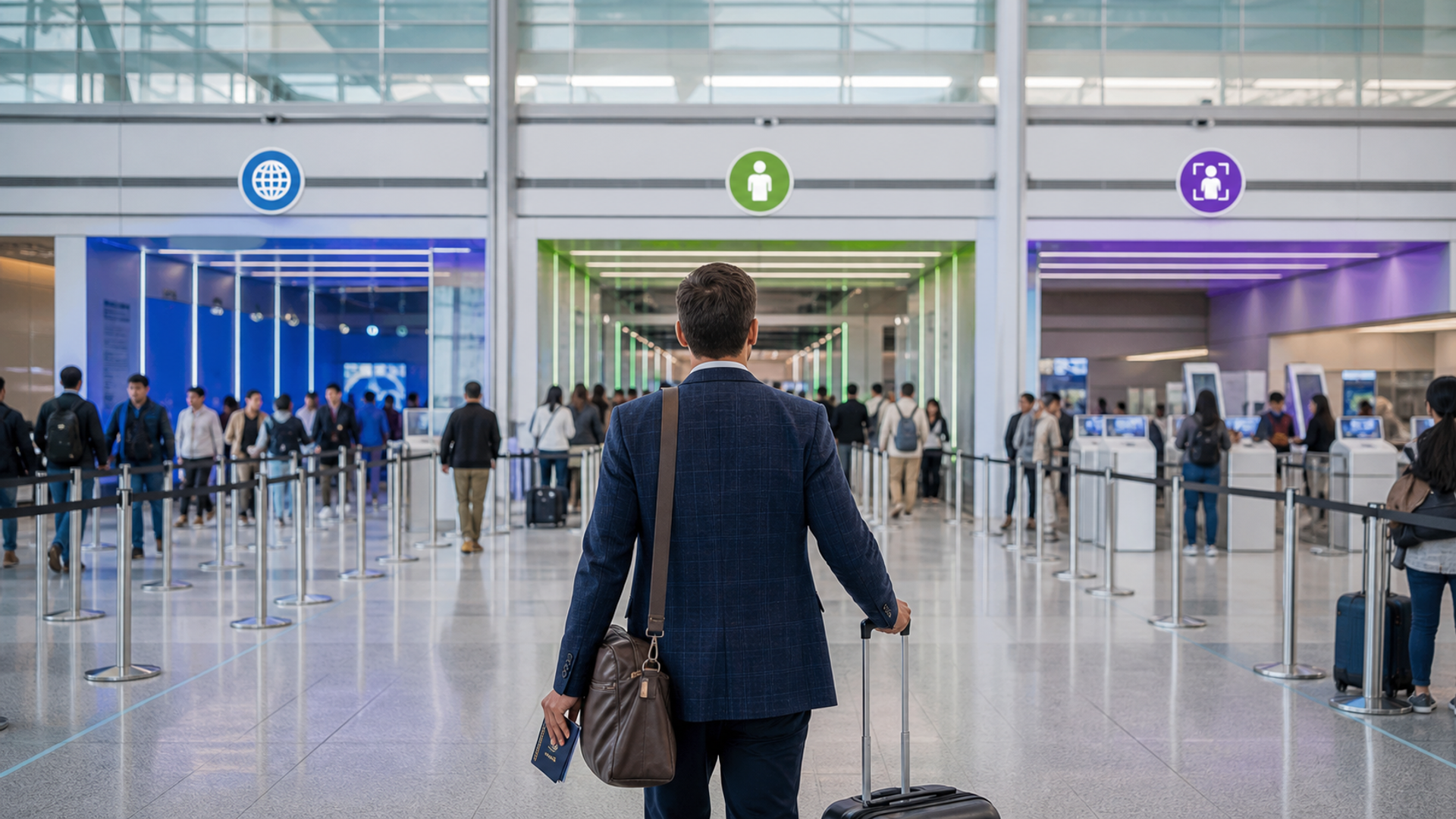
Global Entry, TSA PreCheck and CLEAR solve different queues. Global Entry is a US Customs and Border Protection programme for expedited arrival into the United States and includes eligibility for TSA PreCheck benefits. TSA PreCheck is an expedited security-screening programme for eligible travellers at participating US airport checkpoints. CLEAR+ is a private annual membership that uses identity verification at participating locations to bring members to the physical security-screening stage. It does not replace TSA screening.
The best choice follows the part of the journey that repeatedly costs you time. International arrivals point towards Global Entry. Frequent US departures point towards TSA PreCheck. Travellers who use CLEAR airports and value a shorter identity-check queue may add CLEAR+. Some frequent travellers combine Global Entry and CLEAR because the benefits operate at different points; many others need only one government programme.
Quick verdict:** Choose Global Entry if you are eligible and regularly return to the US from abroad. Choose TSA PreCheck if your recurring problem is US departure security and you do not need international-arrival processing. Add CLEAR+ only after confirming that your airports, terminals and travel frequency justify a separate annual membership.
At-a-glance comparison
| Feature | Global Entry | TSA PreCheck | CLEAR+ |
|---|---|---|---|
| Main job | Expedited entry into the US | Expedited airport security screening | Identity verification and escort to physical screening |
| Operator | US Customs and Border Protection | Transportation Security Administration | CLEAR, a private company |
| Typical journey stage | International arrival; PreCheck eligibility for departures | US departure checkpoint | Participating departure checkpoints and other CLEAR locations |
| Current headline price | US$120 non-refundable application fee | Varies by authorised enrolment provider | US$209 annually on CLEAR’s current public page |
| Membership period | Five years if approved | Commonly five years; provider terms apply | Annual renewal |
| Interview/identity step | Application, vetting and interview | Application, enrolment and vetting | Enrolment with identity and biometric verification |
| Children | Own Global Entry membership; fee waiver conditions for under-18s | Children may use lanes under current TSA family rules; verify age conditions | CLEAR advertises family arrangements; verify current terms |
| Best for | Eligible international travellers | Domestic or US-departure travellers | Frequent users of participating airports with a recurring ID-line problem |
Prices and access details can change. Use this as a decision structure, then verify the official page at application time.
Global Entry: solve the international-arrival queue
Global Entry is designed for pre-approved, low-risk travellers entering the United States. CBP’s current benefit page lists reduced wait times, no paperwork, availability at major US airports and TSA PreCheck eligibility among the benefits. The programme is not a way to skip customs obligations: members still have to follow declaration rules and may be referred for further inspection.
As of 17 July 2026, CBP’s current eligibility help page lists a US$120 non-refundable application fee. If approved, membership lasts five years. Applicants create a Trusted Traveler Programs account, complete an application, undergo vetting and attend an interview after conditional approval. Processing time is unpredictable: a current CBP application page says many applications move quickly while some take 12 months or longer. Do not buy a non-refundable flight plan around an assumed approval date.
Global Entry is strongest when all three statements are true:
you are eligible under CBP’s current citizenship and admissibility rules;
you make enough international arrivals to care about the return queue;
you are willing to complete the vetting and interview process.
It can still make sense for an international traveller who also wants PreCheck on US departures because approved Global Entry members are eligible for TSA PreCheck benefits. The Known Traveler Number must be entered correctly in the airline reservation, and the name on the booking needs to match the traveller’s programme record.
Global Entry is less compelling for someone who rarely leaves the United States, cannot conveniently complete the interview or needs a benefit next week. In that case, direct TSA PreCheck enrolment may better match the actual problem.
TSA PreCheck: solve routine US departure screening
TSA PreCheck provides a modified screening process at participating airports and with participating airlines. The traveller still passes through security, but eligible lane procedures are designed to reduce friction. The benefit is tied to the traveller and the reservation, not to possession of a generic card. Enter the Known Traveler Number and verify that the boarding pass shows the appropriate indicator.
TSA now works with multiple authorised enrolment providers. The agency tells applicants to compare provider pricing, locations and processes; the exact fee is therefore not one timeless figure. This is important when an old comparison article quotes a single national price. Check the TSA enrolment page and the selected provider on the day you apply.
TSA PreCheck is usually the cleanest answer when:
most trips are domestic or depart from US airports;
the traveller values the screening lane but does not need international-arrival processing;
the traveller wants a lower-commitment route than Global Entry’s customs programme;
the regular airports and airlines participate.
It is not guaranteed on every boarding pass, and lane availability can vary by airport and hour. Keep normal security timing in the plan. A programme intended to reduce routine friction should not become the reason you miss a flight when a lane is closed.
CLEAR+: solve the identity-check queue, where available
CLEAR+ is not a government trusted-traveller programme. At participating airports, members verify identity at a CLEAR location and are escorted towards the physical screening point. A member with TSA PreCheck may be directed to the PreCheck screening lane; a member without it still completes the applicable standard screening. That distinction is the core of the product.
CLEAR’s public page currently lists US$209 per year. It also advertises family-member pricing and discounts for some groups, but offers and partner rates can change. Before paying, check whether the exact terminal and usual operating times are supported. An airport being listed does not mean every terminal, airline checkpoint or hour offers the same practical path.
CLEAR+ is most rational when:
you repeatedly depart from participating checkpoints;
identity-document queues are a measurable part of the delay;
you travel often enough for an annual fee to make sense;
you accept the identity and biometric enrolment model after reading the privacy notice;
your card or loyalty status does not already provide a credit or discount you would otherwise ignore.
It is weak value when the local CLEAR line is often as long as the standard identity queue, when the traveller visits unsupported terminals or when only one or two trips are planned. Measure real journeys rather than relying on a broad airport count.
Which combination should you choose?
International executive based in the United States
Start with Global Entry if eligible. It addresses the arrival process and provides TSA PreCheck eligibility. Add CLEAR+ only after reviewing several months of departure experience at the airports actually used. If the PreCheck identity line is rarely a problem, the extra membership may add administration without meaningful time value.
Mostly domestic traveller
Start with TSA PreCheck. Global Entry adds an application path and arrival benefit that may not be used. CLEAR+ can be evaluated as a second layer if the regular airport supports it and identity queues remain the bottleneck.
Occasional holiday traveller
None may be the honest answer. Arrive with enough time, use the standard process and keep US$120 or US$209 for the trip. A premium label is not evidence of positive value.
Family travelling together
Do not extrapolate one adult’s programme to the whole group. Global Entry requires each traveller, including children, to have the required membership for Global Entry processing; CBP currently waives the fee for qualifying under-18 applications linked to an enrolled or applying parent or guardian. TSA’s family-lane rules and CLEAR’s child/family terms are different. Map every traveller by age and programme before choosing a lane.
Non-US citizen or globally mobile resident
Check eligibility first. Global Entry is available to US citizens, US lawful permanent residents and certain citizens of partner countries under current arrangements, but requirements vary. TSA PreCheck’s application eligibility is narrower than simply taking a US flight. CLEAR membership does not create immigration status or eligibility for a government programme.
The time-and-cost break-even worksheet
Use your own trips, not a marketing average.
Count expected US departures in the next 12 months.
Count expected international arrivals into the US over five years.
Identify the top three airports and terminals.
Record observed identity, screening and immigration waits on three representative trips.
Divide the effective annual cost by credible uses—not all flights.
Value saved time conservatively and exclude times when the relevant lane was closed.
Example: a traveller expects 20 eligible CLEAR uses a year at airports where it consistently removes eight minutes from the identity queue. A US$209 annual fee is roughly US$10.45 per expected use before discounts. Whether 160 minutes of possible annual savings is worth that fee is a personal decision. If only six uses are credible, the cost rises to nearly US$34.84 per use. The calculation forces network and behaviour to meet.
For Global Entry, spread US$120 across five years only if you expect to remain eligible and complete the interview. Twelve international arrivals over five years imply a headline application cost of US$10 per arrival, before counting the PreCheck departure benefit. The application fee is non-refundable, so rejected or abandoned applications do not have that economics.
Privacy and data questions to ask
All three options exchange data for convenience, but the operator, purpose and retention framework differ. Read the current privacy notices rather than treating “biometric” as one uniform system.
Ask:
Which organisation is collecting the data?
Is participation voluntary, and what is the ordinary alternative?
What identity or biometric information is required?
How can records be corrected or the membership cancelled?
Which partners receive transaction or eligibility information?
What happens at renewal and after expiry?
For travellers who want a deeper practical assessment, VERTU’s TSA PreCheck Touchless ID privacy guide explains why a programme membership and a particular biometric checkpoint experience should be evaluated separately. The travel-phone data-minimisation plan covers the adjacent device question.
Application and airport checklist
Before applying:
Confirm current eligibility on the official operator’s site.
Compare the journey stage each programme addresses.
Check airport, terminal and airline participation.
Verify current fees, renewal terms and credit-card reimbursements.
Read the privacy notice and interview/enrolment requirements.
Avoid unofficial application services that imitate government branding.
Before each flight:
Put the correct Known Traveler Number in the reservation.
Match the booking name to the programme record.
Check the boarding pass for the expected indicator.
Bring accepted identification and allow normal contingency time.
Verify the lane and CLEAR location are operating.
Follow officer instructions; membership never prevents additional screening.
Sources and verification
Sources were checked on 22 July 2026. Fees, eligibility, enrolment providers, processing times, participating locations, family rules and lane operations can change. Use the official application site and avoid third-party services that charge for forms or imitate programme branding.
Final decision
Choose by queue, not prestige. Global Entry serves the eligible international return journey and brings PreCheck eligibility. TSA PreCheck serves the recurring US departure-screening journey. CLEAR+ can reduce the identity-verification step at participating airports but remains an optional private layer. Once the problem is named, the comparison becomes simple: pay only for the lane you will genuinely use, keep ordinary airport timing as the fallback and re-evaluate when routes change.
![Top 10 Tourbillon Watches for Men [2026 Latest]](https://cdn.sanity.io/images/e0gp1l2g/production/8cb6bc45133cf9453382fc7d074465af588bb610-1800x1080.webp?w=180&h=180&q=78&auto=format&fit=crop)
![Top 10 Tourbillon Watches for Men [2026 Latest]](https://cdn.sanity.io/images/e0gp1l2g/production/8cb6bc45133cf9453382fc7d074465af588bb610-1800x1080.webp?w=800&h=450&q=82&auto=format&fit=crop)

![Top 10 Anniversary Gift Watches for Men [Full Guide]](https://cdn.sanity.io/images/e0gp1l2g/production/00dfa030a876edbe6ea7b146f6b1d8197c7656b0-3840x1860.webp?w=800&h=450&q=82&auto=format&fit=crop)