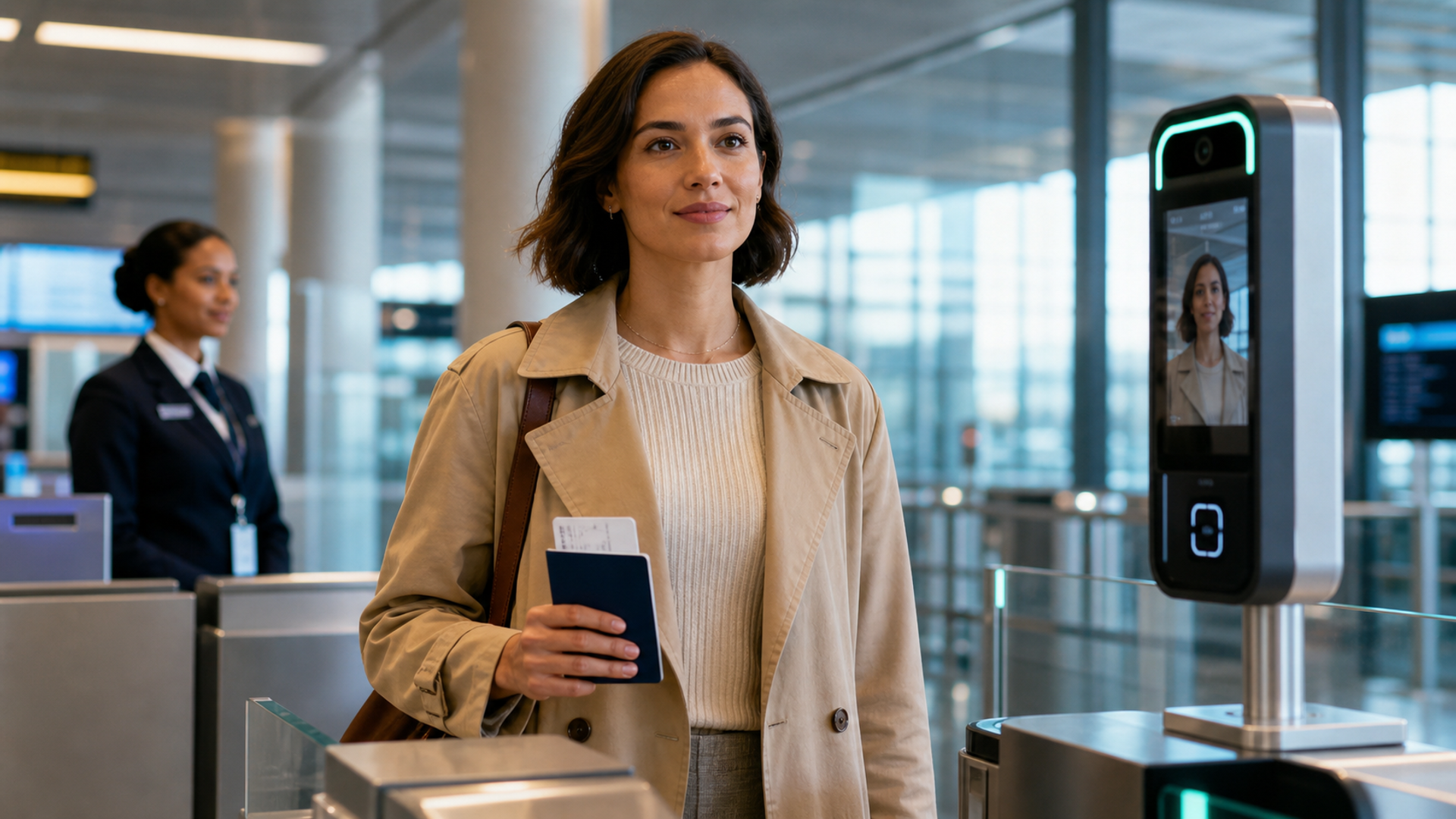
American Airlines and the US Transportation Security Administration have expanded TSA PreCheck Touchless ID to all of American’s hub airports. Eligible travellers can use facial comparison at participating checkpoints instead of presenting a physical ID to the officer in the ordinary way. That can reduce document handling, but it does not remove the need to carry acceptable identification or understand what happens when the biometric match fails.
The practical rule is simple: opt in only after reading the current programme terms, keep the same physical documents you would carry without it, and treat the biometric lane as a convenience—not the sole path to the aircraft.
Touchless ID travel card
| Moment | Primary action | Fallback |
|---|---|---|
| Before check-in | Confirm TSA PreCheck eligibility and opt-in status | Use standard PreCheck or security process |
| Airline profile | Verify name, date of birth and known traveller number | Correct mismatches before travel |
| At checkpoint | Follow signage for participating lane | Present physical ID and boarding pass |
| Failed facial match | Stay calm and follow officer instructions | Manual identity verification |
| Phone unavailable | Use physical document and airline assistance | Printed or desk-issued boarding credential where available |
| Privacy concern | Decline or change programme preference if supported | Use the standard document process |
American’s expansion announcement describes the participating hubs and eligibility flow. TSA’s Touchless ID information explains the federal programme, participating airlines and privacy statements. Airport availability, lanes and operating hours can change; check both sources before the trip.
What “touchless” changes
The visible change is the checkpoint interaction. The traveller approaches a camera, the system compares the live image with an identity source available to the programme, and the officer receives a result. The boarding pass and identity relationship can be confirmed without the normal handover of documents in participating flows.
What does not change is the traveller’s responsibility to be correctly ticketed, eligible for the lane and able to complete security screening. Facial comparison is not immunity from random screening, document checks or operational outages.
Opt-in is a decision, not a default assumption
Read the current airline and TSA enrolment screens rather than relying on a prior trip. Confirm which profile data is used, how consent is expressed, how to opt out and what retention statement applies. A programme can be voluntary while still appearing prominently in a check-in flow; slow down enough to understand the selection.
For corporate travel, decide whether the organisation has a policy on biometric programmes. The traveller may be comfortable with the convenience while the employer has separate requirements for protected personnel, jurisdictions or itinerary data. Personal eligibility does not override company policy.
Carry the physical fallback
Phones fail, profiles contain mismatches and cameras encounter real-world conditions. Carry the acceptable physical ID required for the journey, even if the programme markets a document-light experience. Keep it accessible rather than buried in checked luggage.
Also preserve access to the booking outside the airline app: itinerary number, flight details and a contact route. A screenshot can help with logistics but is not a substitute for a live boarding credential where the airline requires one. The passkey, authenticator and hardware-key travel plan provides a broader method for avoiding a phone-shaped single point of failure.
Reduce avoidable match problems
Use the same legal name across the airline profile, TSA PreCheck record and identity document. Check the known traveller number before check-in. If a profile has recently changed, allow time for correction. At the camera, follow officer and signage instructions rather than improvising with the phone in hand.
Do not assume a failed match says anything meaningful about identity or risk. Lighting, image quality, profile discrepancies and operational issues can all trigger a fallback. The correct response is manual verification, not repeated attempts that delay the queue.
Privacy questions worth asking
Before opting in, look for concrete answers to five questions:
Which organisation operates each step of the comparison?
What source image and passenger data are used?
How long are live images and derived data retained?
Can the traveller use the ordinary lane without penalty?
Where can an incorrect record or consent preference be corrected?
Use TSA and airline privacy statements for these answers. Avoid viral summaries that treat all airport facial recognition systems as one programme; rules can differ by agency, airport, airline and border process.
Add the programme to the travel brief
For assisted travel, record whether the traveller has opted in, which airport lane is expected and where the physical ID is carried. A coordinator should not enrol or change consent on another person’s behalf without an authorised process. The traveller should still be able to explain the choice and use the ordinary route.
After the trip, note whether the lane was open, whether a manual fallback occurred and whether profile data needed correction. Operational evidence is more useful than assuming an expansion announcement guarantees identical availability at every terminal and hour.
Walk the whole journey, not one camera
A traveller may encounter several identity processes during one trip: airline check-in, TSA security, lounge access, international boarding and border control. Similar cameras do not mean the same programme, operator or consent. Treat each notice as a separate decision.
Before leaving home, confirm the airline profile, TSA PreCheck status and physical identification. At online check-in, read the Touchless ID option and save the itinerary without copying more identity data than necessary. At the airport, follow signs for the participating TSA lane, but keep the document accessible. After security, do not assume the same opt-in governs an airline boarding camera or arrival-country border system.
For a connection, identify whether the traveller will reclear security and whether the participating lane is in the relevant terminal. A programme available at an airport may not be available for every checkpoint or operating period. Build enough time for the ordinary lane; biometric convenience should be a potential saving, not the assumption that makes the itinerary possible.
Decide who should use the standard route
Touchless ID may be a poor fit when the traveller is uncomfortable with the current privacy terms, cannot correct a profile mismatch before departure, is following an employer restriction or is assisting someone who cannot meaningfully review the consent flow. The standard process is not a failure state.
Travellers wearing medical or religious face coverings should follow current officer guidance and avoid relying on second-hand claims about how a particular lane will operate. Families should verify eligibility for each person rather than assuming one adult’s enrolment covers the group. Protected travellers and security teams should evaluate whether the convenience aligns with their exposure policy.
Choose the ordinary route when uncertainty itself would create stress or delay. A voluntary programme has value only when declining it remains a practical option. If signage or staff instructions differ from the pre-trip understanding, ask for the standard document process without attempting to resolve policy questions in the queue.
Record an exception without collecting identity data
If the lane fails, note the airport, terminal, approximate time, airline, stage of the journey and whether manual verification succeeded. Do not photograph officer screens, identity documents or other travellers. The useful operational fact is the failure mode and recovery time, not a new archive of sensitive imagery.
Report profile inaccuracies through the official airline or TSA channel. For corporate travel, tell the appropriate coordinator whether the issue was eligibility, lane availability, profile mismatch, device access or facial comparison. These categories support better planning without pretending to diagnose the biometric system.
Keep the record only as long as the organisation’s travel or security policy requires. A concise exception log can improve future itineraries; an uncontrolled folder of screenshots can create a larger privacy problem than the one being investigated.
Include the fallback in disruption planning. If the traveller misses a connection, changes terminal or is rebooked on another airline, the expected Touchless ID flow may no longer apply. The travel brief should revert automatically to the physical-document route rather than asking a tired passenger to reconstruct enrolment rules during the disruption. Convenience features are most dependable when the underlying journey remains possible without them.
The executive recommendation
Travellers connecting to an international departure should distinguish the TSA checkpoint programme from airline boarding biometrics and border-control systems. They may use different authorities, notices and retention terms even when the cameras look similar. Read the notice at each stage and do not treat consent given during airline check-in as a blanket decision for every subsequent identity process.
Parents, assistants and security teams should also avoid photographing screens that expose known traveller numbers or identity details merely to document the flow. Record the operational outcome without creating a new copy of sensitive data.
Delete temporary screenshots and travel-brief copies under the organisation’s retention policy after the journey.
Touchless ID can be a useful time-and-friction reduction for an eligible frequent traveller. The responsible setup is layered: accurate profile, informed opt-in, physical ID, accessible itinerary and enough time for a manual fallback. If privacy terms are unacceptable or unclear, use the standard process.
The mark of a mature travel system is not that it never asks for a document. It is that a failed camera, flat phone or changed lane does not change the outcome of the journey.