

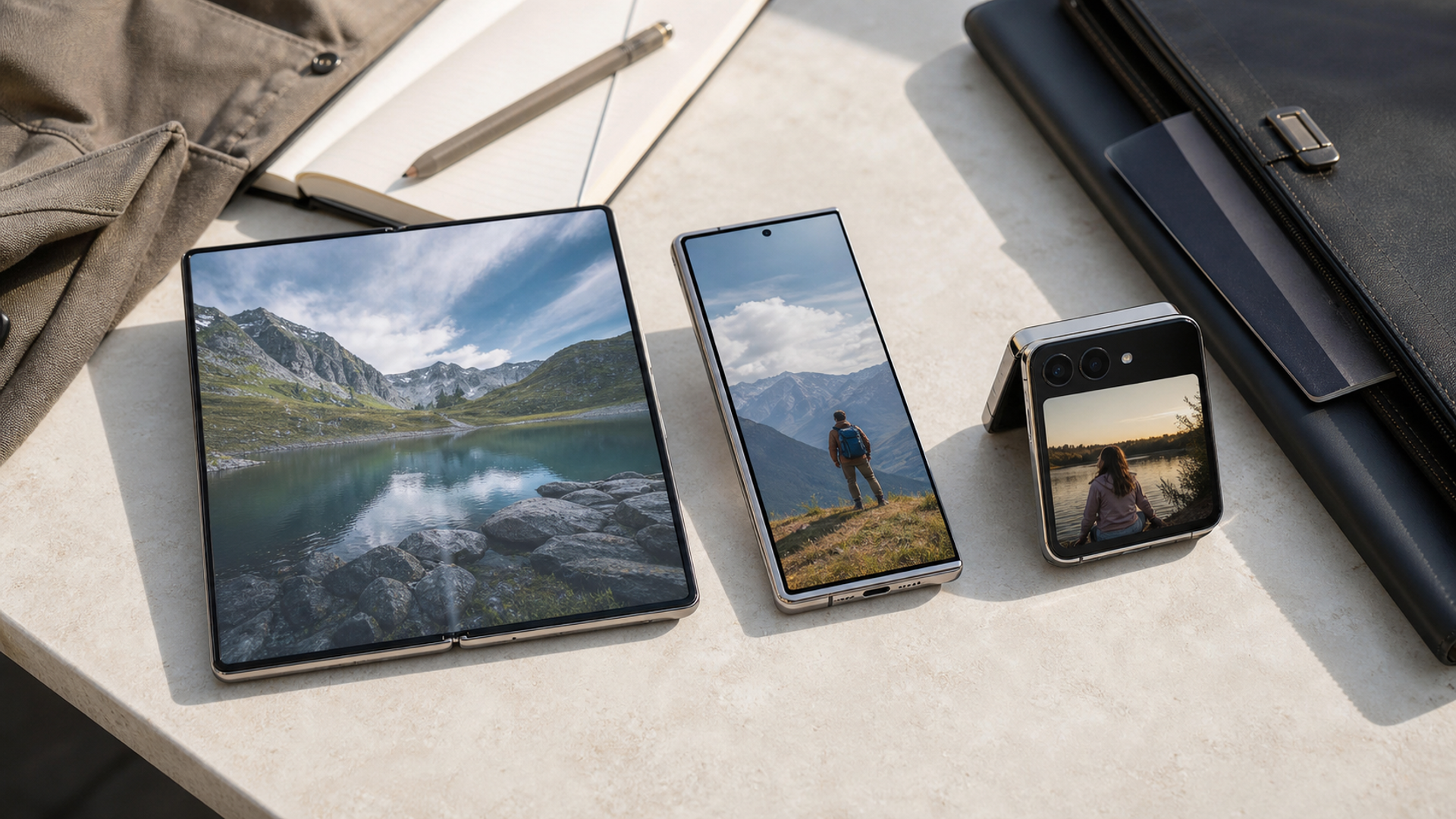
Samsung has turned one foldable decision into three. The Galaxy Z Fold8 Ultra is the large-screen performance model, the Galaxy Z Fold8 is the lighter book-style alternative with unusual new proportions, and the Galaxy Z Flip8 is the pocketable option built around doing more from its cover screen. They share a launch stage and a family name, but they are not three price steps towards the same experience.
The short answer is straightforward. Buy the Fold8 Ultra if an 8-inch work surface, the largest battery and heavy multitasking will change what you can do away from a laptop. Buy the Fold8 if you want a book fold that weighs about as much as a conventional flagship and your priority is reading, video and everyday two-app work. Buy the Flip8 if portability, one-handed video and quick tasks without opening the phone matter more than tablet-like workspace.
That answer comes with an important limit. Samsung announced the devices on 22 July 2026, so official specifications and demonstrations are available, but long-term hinge wear, crease behaviour, sustained battery life and camera consistency still need independent testing. This guide separates what Samsung has confirmed from what buyers should wait to see.
Fold8 Ultra vs Fold8 vs Flip8 at a glance
| Decision point | Galaxy Z Fold8 Ultra | Galaxy Z Fold8 | Galaxy Z Flip8 |
|---|---|---|---|
| Core job | Maximum foldable workspace and AI multitasking | Lighter book fold for media, reading and balanced productivity | Pocketable communication, self-recording and cover-screen tasks |
| Main display | 8.0-inch foldable display | 7.6-inch foldable display with adaptable 4:3 or 3:4 use | Compact clamshell main screen; exact buying value depends on your tolerance for unfolding |
| Weight | 215g | 201g | 180g |
| Thickness unfolded | 4.1mm | Not the headline specification in Samsung’s first-look material | 6.1mm |
| Battery | 5,000mAh | 4,800mAh; Samsung claims more than 26 hours of video playback | Confirm the market specification before ordering |
| Standout workflow | Multi Window, Gemini Notebook and Now Nudge on the largest canvas | Content-friendly proportions, My FanCam and background agent tasks | Now Brief, messages, Gallery and more from FlexWindow; Camcorder Grip and Dual Recording |
| Best buyer | Mobile professional who will genuinely use a small-tablet workspace | Reader, traveller or creator wanting a lighter book fold | Buyer who values pocketability and fast, glanceable interaction |
| Main risk to test | Whether the Ultra premium produces daily value rather than occasional spectacle | Whether the narrower cover proportions suit typing and navigation | Battery, thermals and how often a task still forces you to unfold |
Specifications are based on Samsung’s official first look. Prices, colours, memory configurations and network support vary by market, so compare the exact regional product page rather than importing a headline price from another country.
Choose Fold8 Ultra only if the large screen has a job
The Fold8 Ultra has the clearest hardware proposition. Samsung says it opens to an 8-inch display, measures 4.1mm when unfolded and weighs 215g. A Snapdragon 8 Elite Gen 5 for Galaxy and a 5,000mAh battery support the company’s largest foldable canvas. Those figures make it unusually thin for the category, but thinness is not the reason to buy it. The reason is usable surface area.
Write down three tasks you expect to perform every week. Examples include reviewing a document while attending a call, moving details from a message into a calendar, comparing two reports, annotating a PDF or monitoring a dashboard beside a communication app. If the 8-inch display lets you complete those tasks without reaching for a laptop, the Ultra can earn its size and likely price premium. If your list contains only streaming, browsing and occasional split-screen use, the standard Fold8 may provide nearly all the benefit with less weight.
Samsung’s most interesting Ultra demonstrations are workflow demonstrations rather than decorative AI. Gemini Notebook can turn uploaded meeting material into summaries and other formats. Now Nudge can suggest Multi Window when a task crosses apps. Those are useful ideas, but buyers should test the approval boundary: which actions happen automatically, what data leaves the device, whether the feature supports your work account and how easily you can inspect or undo an action. “Agentic” is not a substitute for control.
The Ultra also uses Samsung’s Flex Titanium display construction. Samsung says it reduces the visible crease and improves durability. That is a manufacturer claim, not a completed durability test. Examine the crease under white pages, dark video and angled daylight; open and close a retail unit repeatedly; and read the warranty exclusions before treating a material name as an ownership guarantee. Our earlier foldable ownership test explains why hinge service, inner-screen protection and insurance can matter more than launch-day thinness.
Fold8 is the rational book fold for more people
At 201g, the Fold8 is 14g lighter than the Ultra and close enough to ordinary flagship-phone weight that it should be easier to carry every day. It opens to 7.6 inches and uses proportions that change character with orientation: Samsung describes a 4:3 layout for video and games, a 3:4 orientation for reading and web pages, and a 10:16 cover screen for familiar vertical content.
The proportions are more important than the diagonal measurement. A tall, narrow cover screen can make a foldable feel compromised whenever it is closed; an internal display can be large but waste space around common video ratios. The Fold8 tries to make rotation part of the answer. Before buying, type a long reply on the cover screen, open a spreadsheet inside, read a portrait document and watch a widescreen clip. A model that feels natural in your most common orientation is more valuable than one that wins a size table.
Samsung gives the Fold8 a 4,800mAh battery and claims more than 26 hours of video playback. That figure is useful for comparison within Samsung’s test method, not a promise of your mixed-use endurance. Split-screen work, navigation, mobile data, high brightness, background AI and camera use create a very different load. A sensible early buyer should look for independent tests that include closed-screen and open-screen use rather than a single looping-video result.
The Fold8 also receives My FanCam, which can reframe footage around a selected person, and an agent example that finds hotels from a shared Eiffel Tower photograph while the user continues working. These features make the standard Fold more than a reduced Ultra. It is likely the best balance if you want a book fold primarily for content and practical multitasking rather than maximum workspace.
Flip8 wins when closed-phone usefulness matters
The Flip8 weighs 180g and measures 6.1mm unfolded. Its purchase logic is the opposite of the Fold models: the value comes from reducing pocket volume and completing small tasks before opening the main display. Samsung says FlexWindow can show Now Brief cards, weather, schedules, exchange rates and market information, while also supporting Gallery, messaging and quick actions.
Do not judge the cover screen by the number of widgets. Test your five highest-frequency actions: reading a complete message, sending a considered reply, approving a two-factor prompt, changing navigation, controlling audio and checking a boarding pass are better measures. If three or four work well, the clamshell can feel deliberately compact. If every action ends with “open phone to continue”, it may add a hinge without reducing friction.
The camera ergonomics are more distinctive. Camcorder Grip supports one-handed recording, Super Steady adds a horizontal lock, and Dual Recording can show the creator and subject simultaneously with a cover-screen preview. Those tools give the Flip8 a credible advantage for self-recording, interviews and social video. They do not establish camera superiority. Sensor performance, processing, low-light consistency, microphone quality and heat during long recording need testing.
Portability also creates different compromises. A smaller chassis generally leaves less room for battery and heat dissipation than a book fold. Samsung’s first-look article does not make battery capacity the Flip8 headline, so buyers should verify the exact specification and wait for mixed-use endurance results. The right Flip buyer accepts that trade for pocketability and cover-screen convenience.
The AI question is really a control question
All three devices are presented as agentic-AI phones. The practical difference is where the AI sits in the interaction. On the Ultra, it can coordinate information across a large Multi Window layout. On the Fold8, it can continue a task while the user works elsewhere. On the Flip8, it can compress useful information into the cover screen.
Before assigning value, test five controls:
Permission: does the feature request access only when needed, or require broad permanent access?
Confirmation: which bookings, messages or calendar changes require an explicit final tap?
Provenance: can you see which source or app produced a recommendation?
Account boundary: does it work with managed work accounts as well as personal services?
Exit: can you disable the feature or delete its history without breaking ordinary phone functions?
These questions matter more for a professional buyer than a generated demo. A phone used for sensitive travel, client communication or financial approvals should never turn convenience into invisible authority. For a broader decision framework, compare the launch claims with the questions we said foldable buyers should ask before Unpacked.
A five-minute retail test
Take the same checklist to all three models. First, hold each phone closed for two minutes and type a real paragraph. Second, open the book folds and place two apps side by side; check whether the keyboard leaves enough working area. Third, view a white page and dark video at several angles to inspect the crease and reflections. Fourth, rotate the Fold8 between its advertised content orientations. Fifth, record a short walking clip on the Flip8 and repeat it on a Fold model. Finally, put each device into the pocket or bag you actually use.
Then price ownership rather than hardware alone. Include storage, care plan or insurance, inner-screen repair terms, accessories, trade-in value and any early-order benefit you would genuinely use. A large headline discount tied to a high trade-in estimate is not the same as a lower total cost.
The verdict
The Fold8 Ultra is the best choice when its 8-inch display replaces meaningful laptop time and you will use Multi Window or document-heavy AI workflows every week. The Fold8 is the safer book-fold recommendation for most buyers because it keeps a large internal display and 4,800mAh battery while reducing weight to 201g. The Flip8 is the specialist: choose it for pocketability, cover-screen efficiency and creator-friendly handling, not because it is a cheaper route to the Fold experience.
Do not buy any of them solely from the launch label. The strongest decision combines confirmed specifications with a hands-on test of proportions, crease, cover-screen typing, heat, battery and permission controls. Samsung has made the three models meaningfully different; the buyer’s job is to choose the difference that will still matter after the first week.
![How to Scan Receipts and Documents with Your Phone [Full Guide]](https://cdn.sanity.io/images/e0gp1l2g/production/0db13feec1d5e72b8a8a5f976d1f3e86619c9228-3840x1860.webp?w=180&h=180&q=78&auto=format&fit=crop)
![How to Scan Receipts and Documents with Your Phone [Full Guide]](https://cdn.sanity.io/images/e0gp1l2g/production/0db13feec1d5e72b8a8a5f976d1f3e86619c9228-3840x1860.webp?w=800&h=450&q=82&auto=format&fit=crop)
![Top 10 Two-Tone Carbon-Fibre Watches for Men [2026 List]](https://cdn.sanity.io/images/e0gp1l2g/production/18870799ba33fab0e038968359cd5772d7d7db30-1024x576.webp?w=800&h=450&q=82&auto=format&fit=crop)
![Top 10 Luxury Watches with Digital Complication Displays for Men [Latest]](https://cdn.sanity.io/images/e0gp1l2g/production/c4f6bf8c080f291c39f7cc85c7344ecff2fd3799-1024x553.webp?w=800&h=450&q=82&auto=format&fit=crop)