For most daylight flights, Emirates Premium Economy is the better-value upgrade: it buys a wider cradle seat, more legroom and an elevated meal without asking you to pay for a flat bed and the full premium ground journey. Emirates Business Class is worth the larger fare gap when sleep, direct aisle access, lounge time or arriving ready to work has a clear value—especially on an overnight long-haul sector.
That is the direct answer to Emirates Premium Economy vs Business Class, but a full cabin changes how it should be applied. Compare the two cabins on the exact flight you can book, not as abstract products. Emirates operates mixed A380, A350 and Boeing 777 configurations, and it warns that products can vary by route and aircraft or change at short notice. A sold-out Premium Economy cabin can make Business the only premium option; a full Business cabin makes a speculative upgrade strategy worthless.
The disciplined approach is to verify the aircraft, seat map, fare rules and bookable inventory for every sector, then divide the real fare gap by the hours and benefits that matter to you. Cabin prestige is not the calculation.
The Emirates cabin decision matrix
Use this matrix after opening the exact itinerary in Emirates' booking flow. “Better” means better for the stated decision, not universally superior.
| Decision factor | Premium Economy | Business Class | When the Business premium is easier to justify | What to verify before paying |
|---|---|---|---|---|
| Route length | Strong value on daytime and medium-to-long sectors where a supportive seat matters but sleep is optional | Strongest on overnight long-haul sectors where a flat bed can convert travel time into meaningful rest | The sector is long enough to sleep for several hours after meal service, or arrival-day performance matters | Scheduled duration, local departure and arrival times, connection length and whether the sector is actually overnight for your body clock |
| Fare gap | Usually the price-disciplined choice when the jump to Business is large | Rational when the incremental cost is lower than the value of rest, ground time and flexibility you will actually use | A sale, corporate fare, points redemption or unusual inventory pattern compresses the gap | Compare like-for-like dates, baggage, change terms and total journey—not headline “from” fares |
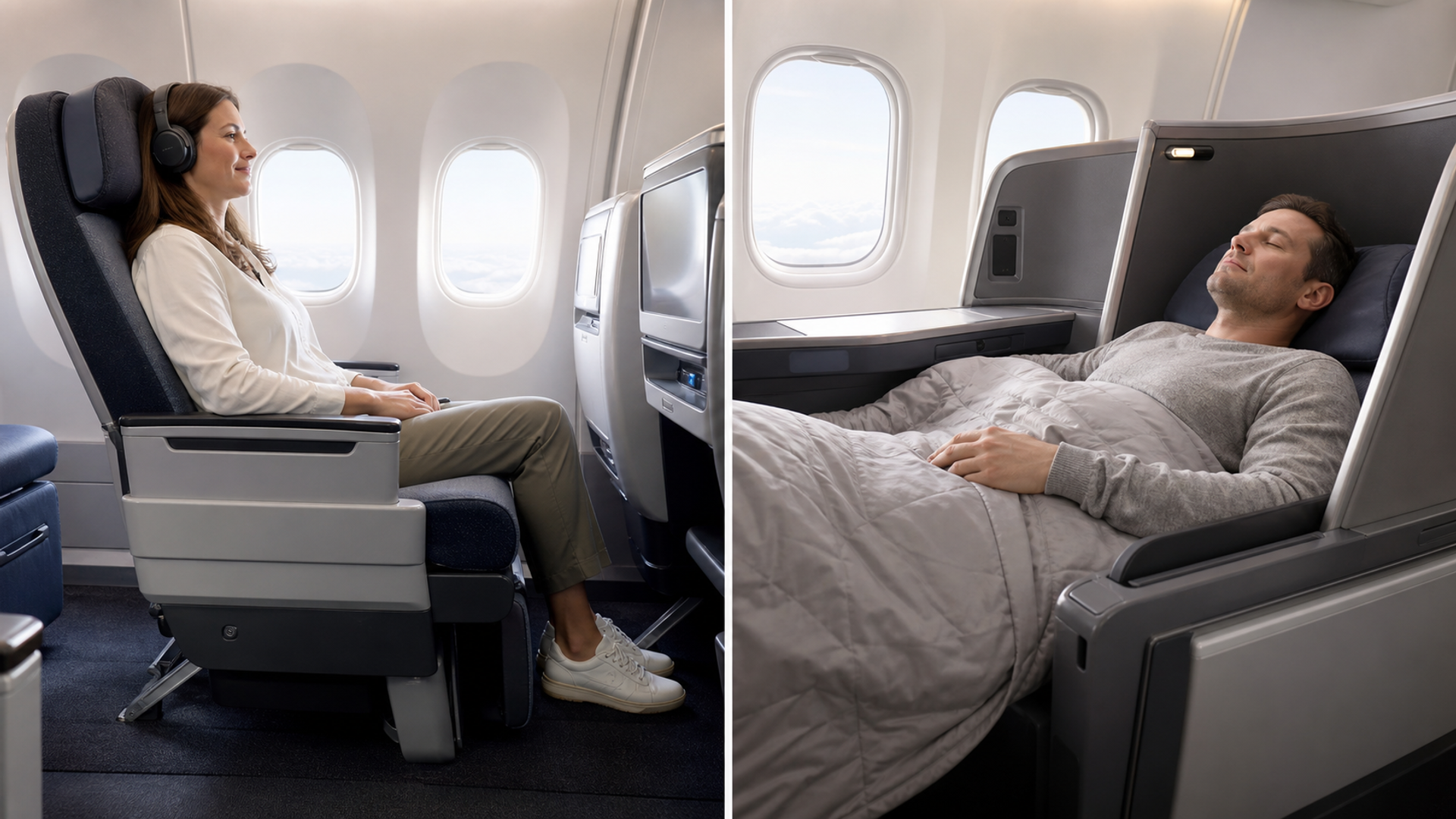
| Seat | A wide reclining cradle-style experience with leg and foot support; it does not become a bed | Flat-bed product on the current A380, A350 and redesigned 777 experiences, with configuration differences by aircraft | You need horizontal sleep, direct aisle access or a larger personal work surface | Aircraft type, current seat map, direct-aisle access and the airline's “what's on your flight” page shortly before departure |
| Lounge | No automatic complimentary lounge access from cabin alone; paid access or status may apply | Complimentary Business lounge access depends on fare brand; Business Special is listed with paid access | A long connection or early airport arrival gives the lounge several useful hours | Departure airport, fare brand, status, guest eligibility, operating lounge and current capacity restrictions |
| Flexibility | The cabin label does not guarantee a flexible ticket | Business can still be restrictive; the lowest fare brand is not the same as Flex Plus | The compared Business fare genuinely has better change, refund or upgrade terms | Penalties, fare difference, no-show rules, partially used ticket terms and conditions for each sector |
| Upgrade path | A sensible destination cabin, but a poor choice if bought only as a waiting room for Business | Confirmed at booking; no need to gamble on later inventory | The Business seat is available now and the journey matters enough to secure it | Fare eligibility, required Miles or cash, seat availability and whether original fare conditions continue after an upgrade |
The matrix exposes an important asymmetry. Premium Economy improves the seat and service while leaving much of the journey structurally similar to Economy. Business changes both the flight and the airport experience. Whether that wider bundle is valuable depends on the itinerary rather than the cabin name.
Why Emirates' 2026 retrofit changes availability, not certainty
Emirates is putting far more Premium Economy capacity into the market. In its 14 July 2026 retrofit update, the airline said it had refurbished 100 aircraft—47 Airbus A380s and 53 Boeing 777s—and installed more than 3,800 Premium Economy seats. It expects to complete about 20 more aircraft by the end of December 2026, moving beyond the halfway point of a programme covering 219 aircraft.
That makes Premium Economy easier to encounter than it was at launch, but it does not make the cabin universal. All Emirates A350 aircraft offer Premium Economy, according to the airline's current cabin page, while retrofitted A380s and 777s add the cabin route by route. The same programme changes Business Class too: newer or refurbished aircraft can carry a materially different Business seat from an earlier configuration.
This is why a route list is a weak buying tool. A city pair may have several daily flights operated by different aircraft, and an operational substitution can alter the product after booking. Emirates' own Premium Economy description and Business Class description both carry a mixed-fleet warning. Treat the flight number and date as the unit of comparison.
A full cabin adds another layer. Availability can disappear independently in each direction, leaving Premium Economy outbound and Business inbound—or the reverse. Price the sectors separately before accepting a return-fare bundle that hides where the real premium sits.
Seat comfort: a cradle versus a bed
Emirates describes its Premium Economy seat as up to 40 inches in pitch, 19.5 inches wide and able to recline eight inches, with a six-way adjustable headrest, calf rest and footrest. Those measurements come from the airline's Premium Economy launch specification and remain a useful description of the intended product. They should not replace the live seat map or aircraft check.
The seat is designed for better upright rest. It gives the knees more room, supports the lower legs and makes dining or working less compressed. On a daytime flight, that can capture much of the comfort a traveller actually uses. It is also a less radical social environment than Business: families and companions can remain in adjacent pairs or groups depending on configuration.
Business Class solves a different problem. The Emirates A380 Business Class page describes a seat that becomes a fully flat bed and includes the A380 onboard lounge on eligible aircraft. Emirates' first A350 specification documents a lie-flat 1-2-1 layout with no middle seat, while Emirates' redesigned 777 Business product also lies flat. These are meaningful advantages for sleep and personal space.
Do not reduce the decision to “recline versus lie-flat”, however. A flat bed only earns its premium if the timetable allows it to be used. Boarding, taxi, two meal services and preparation for landing can consume a large share of a shorter overnight sector. A ten-hour published flight is not ten hours of sleep. If you intend to dine fully, watch a film and work, the bed may receive less use than the marketing image suggests.
Conversely, a traveller who needs four uninterrupted hours of sleep before a meeting may obtain more value from Business than a leisure passenger on a longer daylight flight. The relevant unit is not miles flown; it is useful rest or productive time recovered.
Calculate the fare gap per useful hour
Airline pricing can produce counter-intuitive results. Premium Economy may be almost full while Business has promotional inventory, narrowing the gap. On another date, the jump can be several times the Premium Economy fare. A rule such as “Business is worth twice as much” ignores this variation.
Use a simple calculation for each sector:
Record the total Business fare B and Premium Economy fare P on the same flight and fare conditions.
Calculate the cabin gap: G = B − P.
Divide by scheduled sector hours H: gap per flight hour = G ÷ H.
Estimate how many hours of sleep, work or ground time Business would genuinely recover for you: R.
Compare G ÷ R with the value you place on one recovered hour, then add any lounge access, chauffeur eligibility, baggage or flexibility you would otherwise buy.
For illustration only, a US$2,800 gap on a 14-hour sector is US$200 per scheduled flight hour. The same gap on a seven-hour sector is US$400. If meal timing means you would use the bed for only three hours, the relevant figure is roughly US$933 per recoverable rest hour—not US$200. This is not an Emirates fare quote; it shows why duration alone can flatter the Business case.
Run the calculation in both directions. An overnight outbound and daylight return often deserve different cabins. A mixed-cabin itinerary can be more rational than paying for two Business sectors to preserve symmetry.
Lounge access is a fare-rule question
Premium Economy does not include complimentary Emirates lounge access simply because it is a premium cabin. Eligible status can change that, and paid access may be available. Emirates' current paid-lounge table groups Economy, Premium Economy and Business Special under paid access, while Business Saver, Flex and Flex Plus receive Business lounge access. Airport, membership tier, guest rules, taxes and capacity still matter.
This distinction can change the value calculation more than a meal or amenity kit. A four-hour Dubai connection gives lounge access time to earn its keep through a quieter workspace, food, showers or rest. A 70-minute connection may leave only a brief visit after security and walking to the gate.
If Premium Economy is otherwise the right cabin, compare the incremental price of paid lounge access with the full Business fare gap. Buying the seat you need and the ground service separately can be cheaper. It can also be worse: paid lounge entry is subject to availability, and separate purchases may have narrower refund terms. Verify before relying on it.
For the flight itself, comfort equipment still matters in either cabin. The published VERTU guide to noise-cancelling headphones versus open-ear earbuds on a long flight is a useful companion decision because a premium seat does not remove cabin noise, fit problems or battery limits.
Flexibility belongs to the ticket, not the seat
A common mistake is comparing a restrictive Premium Economy fare with a flexible Business fare and attributing the entire difference to the cabin. The reverse mistake also occurs: assuming every expensive Business ticket is freely refundable.
Emirates describes Special as its lowest, restricted fare; Saver as slightly more flexible; Flex as changeable or cancellable for a fee; and Flex Plus as the fully flexible tier. The exact brands presented depend on cabin, market and itinerary. The conditions shown during booking are authoritative.
When plans are uncertain, record five items for both options: change penalty, refund penalty, fare difference, no-show consequence and upgrade eligibility. Emirates' booking-change guidance notes that charges depend on the ticket's fare conditions and that a higher replacement fare must also be paid. Flexibility is therefore not just the visible fee.
For a traveller attending an event, joining a ship or connecting to a separate ticket, a better fare rule can be worth more than a better seat. But pay for the rule deliberately. Do not assume the more luxurious cabin automatically contains it.
Why full cabins make upgrade plans fragile
An upgrade is inventory, not an entitlement. Emirates permits upgrades only for eligible fares and subject to seat availability and restrictions; its current Skywards upgrade guidance describes the fare and availability conditions. Even when a ticket can technically be upgraded, a full Business cabin leaves nothing to confirm.
This creates three distinct strategies:
Secure Business now when the trip is time-critical and Business is worth the confirmed price.
Book Premium Economy as the final acceptable outcome and treat any later Business upgrade as a bonus.
Move to another flight when schedule flexibility is high and the cabin matters more than the departure time.
The dangerous strategy is buying a fare you would dislike in the belief that points, airport offers or status will solve it later. High-demand periods, major events and school holidays can fill premium cabins early. The more important the bed is, the less sensible it is to leave that bed unconfirmed.
If an upgrade does clear, check what does and does not transfer. Emirates' Business Rewards upgrade guidance states that original ticket conditions continue to apply in relevant upgrade scenarios, while services such as chauffeur-drive can depend on fare type, how the upgrade was obtained and advance notice. Read the confirmation rather than importing assumptions from a fully paid Business ticket.
Choose by journey, not by traveller stereotype
Choose Premium Economy when the journey is primarily daytime; you value space but expect to remain seated; you are paying personally; or the Business gap remains high after accounting for lounge and fare rules. It is also compelling for two people travelling together when doubling the Business premium would displace more valuable spending elsewhere in the trip.
Choose Business Class when the flight crosses your normal sleep window; arrival-day work has real consequences; you need direct aisle access; a long connection makes the lounge useful; or the live fare gap has compressed. It can also be the more rational accessible journey for someone whose mobility or rest needs make the larger personal space materially useful, though specific assistance should be arranged with the airline rather than inferred from a cabin label.
Choose different cabins by sector when the timetable is asymmetric. Sleep on the overnight leg and save on the daylight leg. That decision can preserve the highest-value Business benefit while avoiding a premium paid mostly for symmetry.
The five-minute pre-payment check
Before entering card details or transferring points:
Confirm the operating aircraft and open its current seat map.
Check whether Premium Economy and Business are available on every sector, including connections.
Compare total fares with equivalent flexibility, not the cheapest label in each cabin.
Calculate the gap per scheduled hour and per realistic rest hour.
Confirm lounge eligibility from the exact fare brand and status combination.
Treat an upgrade as unavailable until it is confirmed.
Screenshot the product and fare conditions that matter, while accepting that operational aircraft changes remain possible.
The verdict
Emirates Premium Economy is the stronger default value for travellers who want a markedly better seated journey. Business Class is the stronger outcome for travellers buying sleep, direct aisle access and a more complete ground-to-air experience. Neither answer survives contact with the wrong flight number, fare brand or departure time.
In 2026, Emirates' retrofit programme is expanding both the opportunity and the variation. Full cabins make the decision more practical, not more glamorous: compare the seats actually for sale, price each direction independently and buy Business only when its recoverable time and confirmed benefits justify the live gap.
Sources and verification
Emirates retrofit milestone, 14 July 2026 — current retrofit scale and Premium Economy expansion.
Emirates Premium Economy cabin features — product, aircraft and mixed-fleet caveats.
Emirates Premium Economy launch specification — seat dimensions and intended product specification.
Emirates Business Class cabin features — current A380, A350 and redesigned 777 positioning.
Emirates A350 unveiling — A350 Business Class layout and seat specification.
Emirates paid lounge access — access by cabin, fare brand and status.
Emirates change and cancellation guidance — ticket-specific fees and fare differences.
Emirates Skywards guidance — upgrade eligibility and availability conditions.
Emirates Business Rewards guidance — original ticket conditions after eligible upgrades.
Verification note: Sources and the internal link were checked on 22 July 2026. Aircraft assignment, route availability, fares, lounge operation and upgrade inventory are volatile; confirm the exact flight and ticket immediately before purchase.