

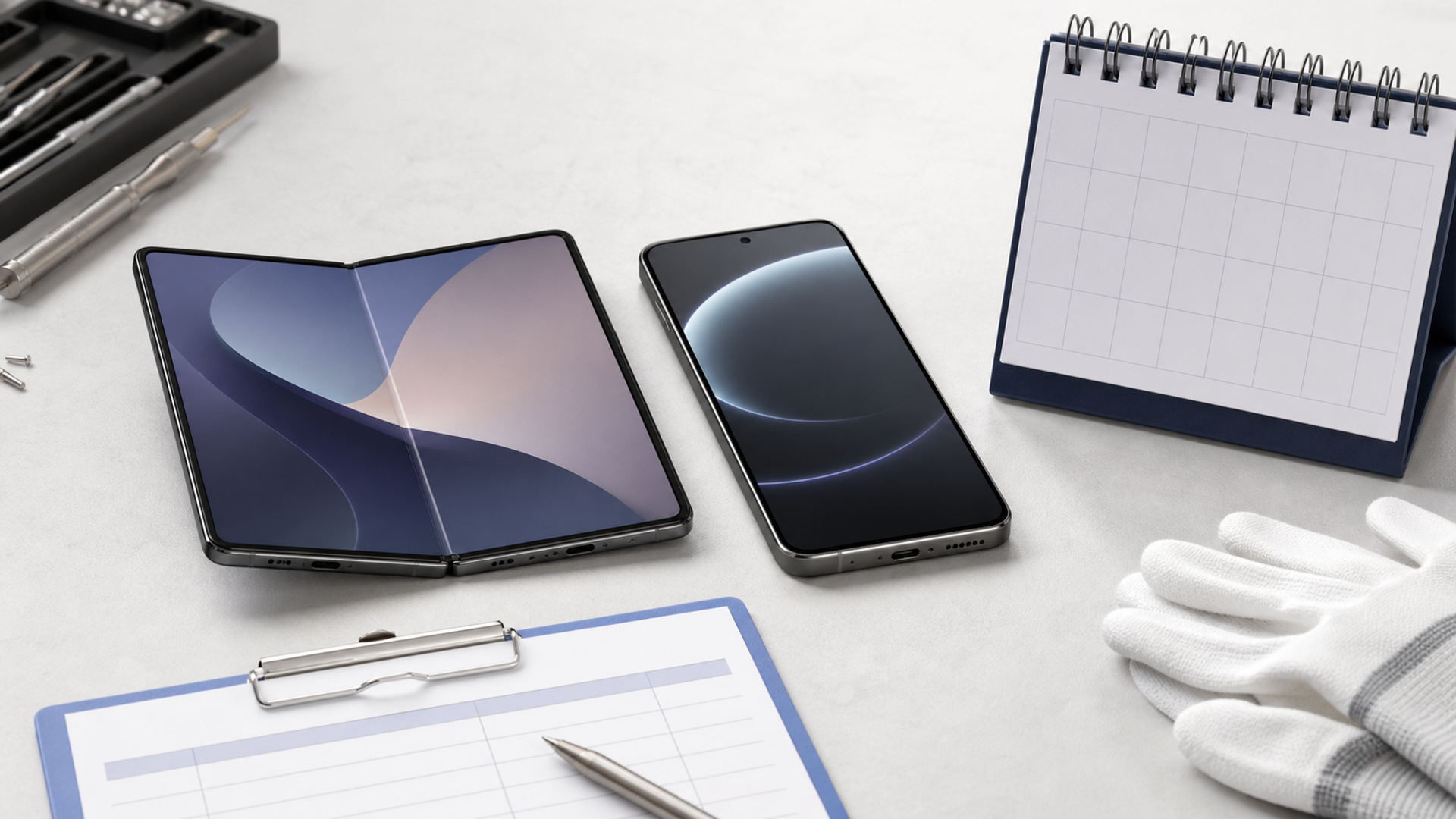
A foldable phone can replace a small tablet for reading, split-screen work and travel. It can also introduce a second display, a hinge, a flexible inner panel and a more specialised repair path. A conventional slab flagship is less theatrical but often simpler to protect, service and use one-handed.
The purchase should not be decided by a five-minute shop demo. Decide which form removes friction from real weekly tasks, then model the ownership cost and failure consequences across three years. A foldable that saves ten minutes every working day can justify complexity. One that is opened only to impress friends is an expensive way to carry more moving parts.
The three-year decision matrix
| Ownership question | Book-style foldable | Flip-style foldable | Slab flagship |
|---|---|---|---|
| Main advantage | Tablet-like canvas and multitasking | Smaller pocket footprint and intentional cover-screen use | Simplicity, mature protection and broad repair access |
| Main compromise | Width, weight, hinge and inner-screen care | Battery and camera trade-offs can be sharper | No larger internal canvas |
| One-handed use | Outer screen may be narrow or thick | Good when closed; full use requires opening | Usually predictable |
| Reading and documents | Excellent when layout adapts | Similar to a normal phone when open | Adequate, but less context visible |
| Durability architecture | More interfaces and moving parts | More interfaces and moving parts | Fewer mechanical transitions |
| Repair consequence | Inner display or hinge can be costly | Inner display or hinge can be costly | Screen repairs are more standardised |
| Case choice | Specialised; hinge coverage varies | Specialised; can add bulk | Broad choice and easier fit |
| Resale uncertainty | Higher model-generation sensitivity | Fashion and battery condition matter | Usually easier to benchmark |
First test: name the task that needs a fold
Book-style foldables earn their place when the larger inner screen changes work:
compare a document and email side by side;
review a spreadsheet without constant zooming;
read long reports with more natural line length;
show a client images or plans without carrying a tablet;
keep a map visible while managing a booking;
use a compact keyboard with a more spacious canvas.
Flip-style devices solve a different problem. They reduce pocket footprint and can make the cover display a deliberate filter for quick actions. They do not become tablets.
Run a task diary for one week on your current phone. Mark every moment when more screen space or a smaller folded body would materially help. If the list consists mainly of streaming video, compare aspect ratios carefully: a large square-ish display can still show substantial black bars for wide content.
Second test: count transitions, not laboratory folds
Manufacturers may publish fold-cycle and durability claims under controlled tests. Your ownership pattern includes grit, pocket pressure, temperature change, drops, fingernails, cases and accidental twisting. A laboratory number is one input, not a personal warranty.
Estimate how often you will open the phone. Fifty transitions a day is more than 54,000 over three years. The arithmetic does not predict failure, but it reminds you that the hinge and inner display are working components, not static decoration.
Watch for details that affect daily confidence:
Does the device wobble when half open?
Is the inner-screen protector treated as a user-removable accessory or part of the display system?
Can the hinge collect visible debris?
Is water resistance stated? What about dust resistance?
Does the case protect the hinge or leave it exposed?
Can the phone be opened with one hand without pressing the flexible screen?
Do not peel a factory-fitted inner protector or apply a third-party film unless the manufacturer explicitly permits it.
Third test: compare the repair system before the camera
Ask for current, out-of-warranty prices for the outer display, inner display and hinge-related repair. Check whether accidental-damage cover is available in your country, what the excess is, how many claims are allowed and whether service requires shipping.
Service geography can differ even within one brand. Google’s current Pixel repair guidance, for example, separates mail-in and walk-in availability by country and warranty status. Check the exact model and destination rather than assuming a global repair network.
Then model downtime. A conventional flagship may have more local parts and technicians because its design is common. A foldable repair may require a full module and a specialised centre. Premium support can reverse that disadvantage if it provides a loan device, collection and competent data handling—but verify the service rather than assuming it from the retail price.
Use this three-year cost model:
| Cost element | Year 1 | Year 2 | Year 3 |
|---|---|---|---|
| Purchase price after realistic discount | |||
| Protection plan and excess | |||
| Case and replacement protector | |||
| Expected repair reserve | |||
| Battery or service allowance | |||
| Resale value estimate | |||
| Cost of downtime or temporary device |
Avoid pretending that an uncertain repair will definitely occur. Use three scenarios: no incident, one screen incident and early replacement. The range is more honest than a single total.
Screen quality: judge the crease in the conditions you use
Crease visibility depends on angle, brightness and reflections. It can be almost invisible head-on and obvious under overhead lighting. Touch sensation is separate from visual appearance. Test white documents, dark video, a scrolling webpage and a stylus if supported.
On 15 July 2026, Samsung announced a new “Flex Titanium” structure for its next generation of foldables, saying titanium-based film and plate components improve support, durability and crease visibility. That is interesting engineering, but it does not yet answer buyer questions about drop survival, dust, repair price or long-term protector behaviour. Our Flex Titanium buyer test separates the announced claims from evidence to seek after devices ship.
For any model, inspect the crease after the demo unit has been used, not only a pristine review sample. Ask whether display brightness, colour or touch response changes near the fold. A less visible crease is pleasant; reliable service and predictable durability are more important.
Battery: two screens do not create two days
A foldable’s larger canvas encourages longer use and can demand more power. The physical design may also divide the battery across two halves. Compare endurance in the tasks that justify the device: split-screen work, navigation, video calls and document review.
Do not assume a larger chassis guarantees a larger usable battery. Check charging speed, heat during multitasking and whether the cover screen can complete quick tasks without opening the main display. A flip phone that lets you reply, pay and navigate briefly from the cover can reduce unnecessary openings and screen-on time.
At three years, battery health matters more than day-one benchmarks. Ask whether battery service requires replacing other modules and whether the repair route preserves water resistance.
Software is part of the hinge
The larger display is valuable only when applications reflow, preserve state and use the space. Test your actual banking, messaging, document and travel apps. Look for:
continuity when moving from outer to inner screen;
sensible split-screen ratios;
keyboard placement and pointer support;
camera preview on the cover screen;
video-call layout in a half-open posture;
app state after repeated folding;
security updates and remaining support period.
A hardware design can last physically while software support or app optimisation declines. Confirm the exact update commitment. If you are tempted to wait for a network generation instead, our 6G phone reality check explains why radio branding should not override present utility.
Protection without ruining the reason you bought it
Foldable cases can add hinge flaps, adhesive strips and substantial thickness. A case that makes the phone unpleasant to open may lead the owner to remove it. Compare three states in person: naked, minimal case and hinge-protecting case.
For a slab flagship, case selection is broader and screen protectors are more conventional. Yet a poorly designed case can still trap grit, interfere with gestures or make heat worse. Our rugged phone versus flagship-plus-case guide helps match protection to exposure.
The 30-minute shop test
Bring a sanitised sample document, a spreadsheet, a web page and a photo folder. Then:
Type a 150-word email on both screens.
Place a video call and take notes beside it.
Open and close the device 20 times at normal speed.
Read under direct overhead light and near a window.
Put it in the pocket and bag you actually use.
Fit the case you would buy.
Ask for written repair prices and service turnaround.
Check the current security patch and support promise.
Score utility, comfort, confidence and service separately. Do not let the first dramatic unfolding erase a weak repair answer.
Verdict
Choose a book-style foldable when the inner screen replaces a real tablet or laptop-adjacent task several times a week. Choose a flip-style foldable when pocketability and a deliberate cover-screen workflow matter. Choose a slab flagship when camera consistency, one-handed use, mature protection and simpler repair outweigh a larger canvas.
The fold is not the product. The product is the three-year system of screen, hinge, software, service and daily behaviour. If that system removes more friction than it creates, the foldable has earned its complexity.
Keep the completed scorecard and repair quotation. They create a rational baseline for the return-window decision and for comparing the next generation without being reset by launch-day novelty.
![How to Scan Receipts and Documents with Your Phone [Full Guide]](https://cdn.sanity.io/images/e0gp1l2g/production/0db13feec1d5e72b8a8a5f976d1f3e86619c9228-3840x1860.webp?w=180&h=180&q=78&auto=format&fit=crop)
![How to Scan Receipts and Documents with Your Phone [Full Guide]](https://cdn.sanity.io/images/e0gp1l2g/production/0db13feec1d5e72b8a8a5f976d1f3e86619c9228-3840x1860.webp?w=800&h=450&q=82&auto=format&fit=crop)
![Top 10 Two-Tone Carbon-Fibre Watches for Men [2026 List]](https://cdn.sanity.io/images/e0gp1l2g/production/18870799ba33fab0e038968359cd5772d7d7db30-1024x576.webp?w=800&h=450&q=82&auto=format&fit=crop)
![Top 10 Luxury Watches with Digital Complication Displays for Men [Latest]](https://cdn.sanity.io/images/e0gp1l2g/production/c4f6bf8c080f291c39f7cc85c7344ecff2fd3799-1024x553.webp?w=800&h=450&q=82&auto=format&fit=crop)