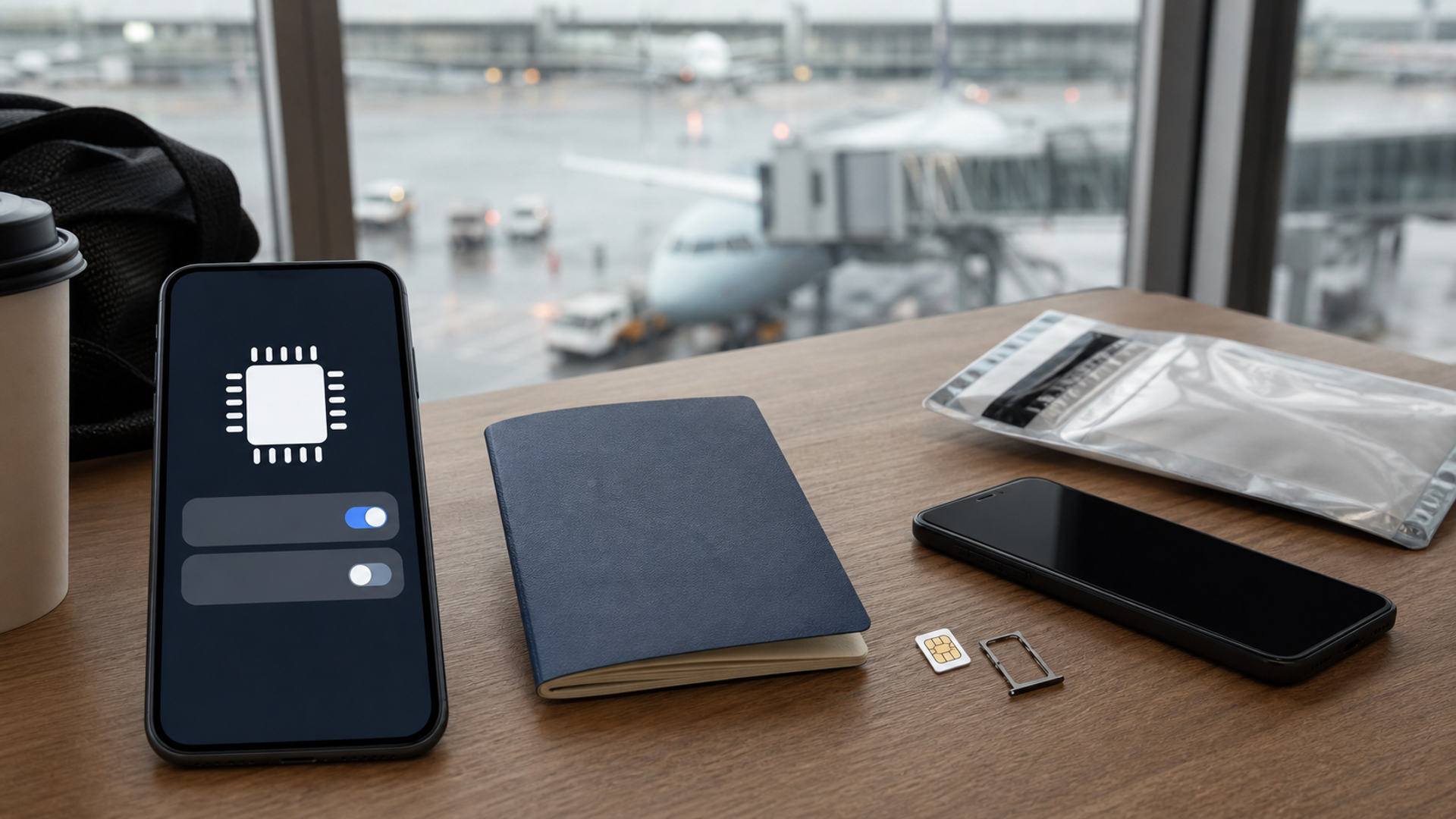
An eSIM is not automatically more secure than a removable SIM, and a physical SIM is not automatically safer because it can be held in the hand. The GSMA describes eSIM as providing an equivalent level of security and protection to a removable SIM. The practical difference appears in provisioning, theft, switching, recovery and the carrier account that controls both formats.
For international travellers, eSIM reduces the need to handle tiny cards and lets a device retain multiple profiles. A physical SIM can be removed, stored or moved into a backup handset without waiting for a digital transfer. The safer choice depends on the threat model and a tested recovery plan.
Quick answer
eSIM is usually the cleaner primary option for international travel because it cannot be casually removed from a stolen phone and profiles can be managed without exposing a card. A physical SIM remains useful as a backup that can move to another compatible handset. In both cases, carrier account takeover and SIM-swap fraud are controlled mainly by identity verification, account PINs and recovery procedures.
Decision matrix
| Decision factor | Option A | Option B | Practical edge |
|---|---|---|---|
| Casual removal after theft | Not removable as a card | Card can be removed | eSIM |
| Move to backup handset | Requires supported transfer/carrier process | Physical movement can be immediate | Physical SIM |
| Profile acquisition | Remote provisioning | Retail or carrier-issued card | Context-dependent |
| Multiple travel lines | Several stored profiles on supported devices | Limited by slots/cards | eSIM |
| SIM-swap exposure | Carrier account process | Carrier account process | Tie |
| Border inspection | Profile visible in device settings | Card can be separated | Threat-specific |
| Loss recovery | Depends on account and transfer path | Requires replacement or spare card | Plan-dependent |
| Best pattern | Primary travel connectivity | Independent backup | Hybrid |
The secure element is only one layer
Both eSIM and physical SIM implementations rely on protected credentials used to authenticate to a mobile network.
The eSIM adds remote provisioning infrastructure; the removable SIM adds a physical handoff. Neither format fixes weak carrier identity checks.
Use this test: Assess the full system from carrier account to device unlock and recovery.
Theft changes physical access
A thief can remove a physical SIM and place it in another device unless the SIM is PIN-protected and carrier controls intervene.
An eSIM profile remains embedded in the stolen handset, although an unlocked device or compromised account creates other risks.
Use this test: Use a device passcode, enable an appropriate SIM PIN where supported and know how to suspend the line.
SIM-swap fraud is account fraud
An attacker may persuade a carrier to move a number to a new SIM or eSIM.
The attack targets the account process, not the shape of the subscriber module. SMS-based recovery can then expose additional services.
Use this test: Set a carrier account PIN, use port-out protection and prefer phishing-resistant account authentication.
Travel eSIM vendors introduce another trust decision
A convenient data profile may be issued by an intermediary rather than the home carrier.
The provider's privacy policy, network partners, support quality and installation process matter. Cheap data does not prove secure operations.
Use this test: Buy from a verifiable provider and avoid installing profiles from unsolicited links or QR codes.
Physical SIM supports simple hardware fallback
A removable card can move into a spare unlocked handset when the primary phone fails.
That can be valuable in a region where carrier support is difficult. The card must be stored securely and the backup handset tested.
Use this test: Carry a SIM tool and document the APN or activation steps without storing account secrets beside the card.
eSIM supports cleaner multi-line separation
Supported phones can store several profiles and activate the appropriate line for a destination.
The traveller can keep the home number available for identity while using a local data profile. Misconfigured data roaming can still create cost or privacy issues.
Use this test: Label profiles clearly and set voice, data and roaming defaults before departure.
Number-based authentication remains fragile
Possession of a phone number is weaker than a hardware-bound passkey or security key.
A secure SIM format cannot prevent phishing, carrier impersonation or account-recovery abuse. Sensitive services should not depend solely on SMS.
Use this test: Move important accounts to stronger authentication and keep recovery codes offline.
Border and legal context can change the choice
Some travellers need a temporary number, minimal account linkage or a line that can be removed.
Others need the home number for work and continuity. Regulations, registration and lawful-access rules vary by country.
Use this test: Obtain legal and organisational guidance for sensitive travel rather than improvising at immigration.
Recovery must be rehearsed
A line that cannot be restored during device loss can strand the traveller even if it was secure before the incident.
eSIM transfer may require the old device, carrier app, email or identity verification. Physical replacement may require a shop or courier.
Use this test: Write a device-loss sequence with carrier contacts, backup connectivity and authorised support.
A hybrid design often wins
Use eSIM for the primary or destination line and retain a separate physical or secondary eSIM option.
Independence is more valuable than stacking two plans that depend on the same account and network. The backup should be funded and tested.
Use this test: Simulate primary-device loss before a high-stakes trip.
Who should choose what
| Traveller or owner | Better fit | Why |
|---|---|---|
| Frequent multi-country traveller | Primary eSIM plus independent backup | Fast switching without handling cards. |
| Remote region with weak carrier support | Physical SIM backup | Can move directly to a spare handset. |
| High-risk executive | Organisation-approved profile and hardened account | Carrier process matters more than format. |
| Short leisure trip | Reputable travel eSIM | Convenience with controlled roaming. |
Common mistakes
Calling eSIM immune to SIM-swap fraud.
Scanning an eSIM QR code from an unverified message.
Relying on SMS as the only recovery factor for critical accounts.
Carrying a backup SIM that has never been activated or tested.
How to measure personal value
The useful value of eSIM vs Physical SIM Security is the change it produces in a repeated, observable situation. Start with the article's value object—the theft, swapping, provisioning, recovery and border-travel threat matrix—and mark which rows affect your own behaviour. In the eSIM vs Physical SIM Security decision, a feature that never changes a journey, security decision or ownership routine has little practical value even when technically impressive.
Use casual removal after theft as the first controlled comparison: one side is not removable as a card, while the other is card can be removed. Then add the frequency of the relevant trip or use, the cost of eSIM vs Physical SIM Security mistakes, and the friction introduced by the more demanding option. For a eSIM vs Physical SIM Security purchase, divide the meaningful premium by expected uses rather than calendar years; for privacy, include the time and support required to keep controls correctly configured.
Create a minimum-success condition for eSIM vs Physical SIM Security. For this eSIM vs Physical SIM Security decision, success might be a full night's sleep, a watch still running on Monday, a phone policy that survives travel, or a bag carrying the real daily load without distortion. If neither eSIM vs Physical SIM Security option meets that condition, defer the purchase, choose another configuration or redesign the trip.
How to verify a changing specification
Facts surrounding eSIM vs Physical SIM Security can change after publication: airlines swap aircraft, manufacturers update references, software support terms move, and pre-owned condition differs from a catalogue description. Treat the current operator or manufacturer page as the eSIM vs Physical SIM Security starting point, not as a guarantee that every individual booking or object matches the general description.
Capture the exact date, model, route, configuration, material, firmware or fare family used for eSIM vs Physical SIM Security. Save the official eSIM vs Physical SIM Security specification and ask the seller or operator to resolve contradictions in writing. If a material eSIM vs Physical SIM Security feature is not identified at transaction level, assign it zero value until confirmed rather than assuming the best possible version.
For eSIM vs Physical SIM Security, repeat the check immediately before the cancellation, return or change window closes. That second eSIM vs Physical SIM Security check protects against substitutions and reveals whether the original decision relied on a benefit that is no longer available. Where eSIM vs Physical SIM Security involves authenticity, law, safety or security, independent specialist verification remains more important than an editorial comparison.
Keep an evidence-backed decision record
A short decision record makes eSIM vs Physical SIM Security auditable. Write the selected eSIM vs Physical SIM Security option, the rejected alternative, the three decisive facts, the sources checked and the condition that would reverse the choice. Attach a eSIM vs Physical SIM Security seat map, reference number, support policy, condition report or packing photograph where relevant. A eSIM vs Physical SIM Security record is especially useful when an assistant, travel coordinator, buyer or family member must act later without reconstructing the reasoning.
Separate measured eSIM vs Physical SIM Security facts from estimates. For eSIM vs Physical SIM Security, published dimensions, official benefits and documented support dates are facts for the referenced configuration; predicted sleep, resale, comfort and future availability are estimates. Label eSIM vs Physical SIM Security uncertainty openly and avoid converting one reviewer's experience into a universal claim.
The decision record for eSIM vs Physical SIM Security should also name an exit path: cancellation, return, service inspection, account suspension or resale review. A eSIM vs Physical SIM Security option with a clear, affordable correction path can be safer than a theoretically superior option whose failure is difficult to reverse.
Review the outcome after real use
Review eSIM vs Physical SIM Security after one representative trip or 30 days of ownership. Record which eSIM vs Physical SIM Security benefits were used, what created friction, what failed to matter and what new constraint appeared. Do not ask only whether eSIM vs Physical SIM Security felt premium; ask whether it solved the problem named in the decision record.
For the eSIM vs Physical SIM Security review, travel decisions should note sleep, delays, connection effort and useful hours after arrival; watch decisions should note comfort, timing, reserve and frequency of wear. For eSIM vs Physical SIM Security mobile privacy, review updates, permissions, account events and recovery readiness; for bags, inspect load, access, shape, marks and how often the object stayed at home.
That review turns eSIM vs Physical SIM Security into evidence for the next decision instead of an isolated opinion. If the eSIM vs Physical SIM Security outcome was weak, change one variable at a time—route, configuration, size, material, policy or use pattern—so the next comparison produces a clear lesson.
A verification checklist before you commit
For eSIM vs Physical SIM Security, confirm the exact reference, aircraft, fare, leather, device or service configuration rather than relying on a category label. Read the current eSIM vs Physical SIM Security manufacturer or operator page, preserve the quoted specification, and identify which facts can change before delivery or departure. Where eSIM vs Physical SIM Security involves money, safety or a high-value object, use a qualified seller, carrier, security team or specialist to verify the individual transaction.
Write the eSIM vs Physical SIM Security decision in one sentence: the option, the problem it solves and the condition that would change the choice. This keeps prestige, scarcity or one eSIM vs Physical SIM Security headline feature from replacing the actual use case. After eSIM vs Physical SIM Security ownership or travel, record what happened so the next decision uses evidence rather than memory.
Where VERTU can be relevant
Eligible VERTU owners may use Concierge for authorised travel coordination where the service is available, but Concierge is not a mobile carrier and cannot guarantee activation, network coverage or account recovery. For sensitive roles, the useful VERTU context is a documented communications plan across device, profile, identity and human support. Security claims must be verified against the live device and carrier configuration.