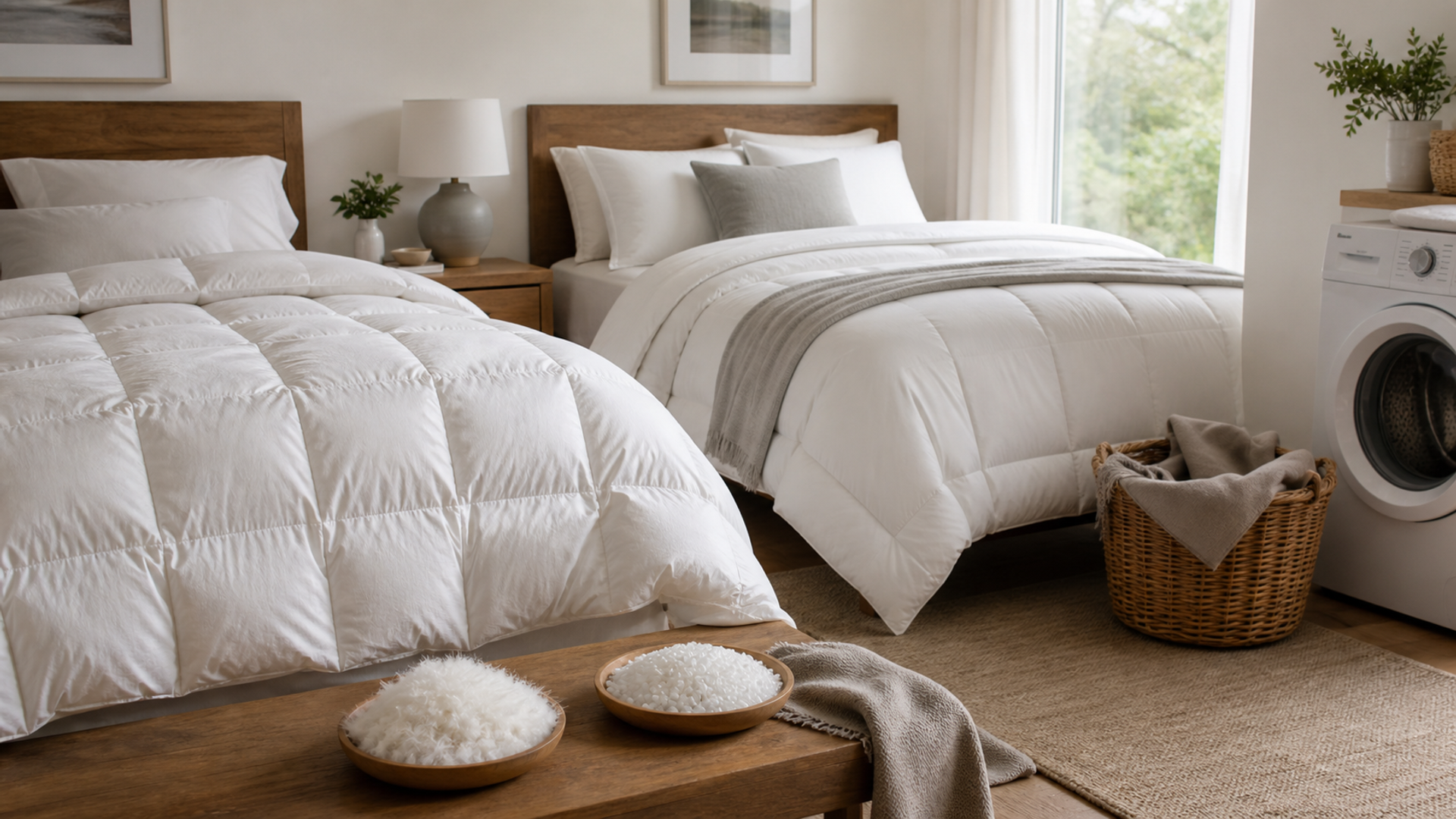
Down can provide high loft with relatively low weight; synthetic fillings can offer predictable construction, easier care and lower entry cost. Neither label guarantees a warm, breathable or allergy-friendly night. Fill power, fill weight, chamber design, shell fabric, size, room temperature, humidity, sleeper metabolism and washing method all influence performance. Animal-welfare and fibre claims also require certification or traceable documentation. The useful decision compares an exact duvet in the bedroom where it will be used.
Start with warmth and room climate
Choose down when warmth-to-weight, loft and long-term care justify the price and the sourcing evidence meets your standard. Choose synthetic when washing access, budget, moisture exposure or a known material preference matters more. Choose by climate and care when bedroom temperature, night sweating, allergies and laundry capacity can reverse a showroom preference.
| Decision factor | Down duvet | Synthetic duvet | Choose by climate and care |
|---|---|---|---|
| Warmth-to-weight | High-quality down can deliver loft at low weight | Depends on fibre and construction | Compare exact ratings and fill mass |
| Moisture | Performance depends on keeping fill dry | Some fibres recover predictably after washing | Test in the real climate |
| Allergy | Clean fill and encasement matter | Synthetic is not automatically allergen-free | Address the actual trigger |
| Care | May require specialist washing and thorough drying | Often machine washable by model | Check drum size and label |
| Sourcing | Welfare certification can support traceability | Fibre and recycled claims need evidence | Verify the certification scope |
| Longevity | Good down can regain loft with care | Fill can compress by construction and use | Track cost per comfortable year |
This down vs synthetic duvet matrix is the article's working value object. Read the down vs synthetic duvet rows together: the decisive failure mode depends on this topic's evidence, operating context and reader objective.
Fill labels need evidence
Evidence 1. Responsible Down Standard certification addresses animal-welfare and chain-of-custody requirements; it does not grade warmth or guarantee a specific sleep result.
Evidence 2. United States guidance for down and feather products addresses truthful filling descriptions and percentage claims.
Evidence 3. Fill power and fill weight describe different properties and must be read with chamber design and duvet size.
Evidence 4. Synthetic is a broad category containing different fibres and constructions, so one product cannot represent the whole family.
Reader-visible sources checked for this article:
textileexchange.org — reader-visible current or official evidence
ftc.gov — reader-visible current or official evidence
iso.org — reader-visible current or official evidence
For down vs synthetic duvet, these sources establish only the claims inside their documented scope. Recheck every changeable specification, availability condition, price, policy or service term in the relevant market before acting.
Run a one-week sleep and care trial
For warmth-to-weight, the first route works when high-quality down can deliver loft at low weight; the second requires depends on fibre and construction. The control for the third is compare exact ratings and fill mass. Verify this row against the exact product, property, account or environment before it can reverse the decision.
The moisture row exposes a practical boundary. Route one assumes performance depends on keeping fill dry, while route two is defensible only when some fibres recover predictably after washing. Route three depends on test in the real climate. If that evidence is absent, keep the more reversible option.
Read allergy as a stop/go test: clean fill and encasement matter supports the first option; synthetic is not automatically allergen-free supports the second; and address the actual trigger supports the third. Record which source proves the condition and when it was checked.
A buyer can resolve care without starting from a brand preference. Ask whether may require specialist washing and thorough drying; compare that with whether often machine washable by model; then use check drum size and label as the third route's safeguard. An unknown condition stays unknown.
On sourcing, popularity is not enough. The evidence for option one is that welfare certification can support traceability. Option two means fibre and recycled claims need evidence. Option three is rational where verify the certification scope. Recheck any changeable term immediately before commitment.
The decision changes at longevity. Choose the first path only if good down can regain loft with care; move to the second when fill can compress by construction and use; use the third when track cost per comfortable year. Save the downside that would make this row fail.
Facts that would reverse the current choice
Reversal control 1 — Warmth-to-weight. Before choosing Down duvet, write down how the decision changes if “High-quality down can deliver loft at low weight” proves false. Do the same for Synthetic duvet and “Depends on fibre and construction”. Keep the Choose by climate and care route available until “Compare exact ratings and fill mass” is verified. This control belongs to down vs synthetic duvet; update it from the cited source or exact supplier rather than copying a generic checklist.
Reversal control 2 — Moisture. Before choosing Down duvet, write down how the decision changes if “Performance depends on keeping fill dry” proves false. Do the same for Synthetic duvet and “Some fibres recover predictably after washing”. Keep the Choose by climate and care route available until “Test in the real climate” is verified. This control belongs to down vs synthetic duvet; update it from the cited source or exact supplier rather than copying a generic checklist.
Reversal control 3 — Allergy. Before choosing Down duvet, write down how the decision changes if “Clean fill and encasement matter” proves false. Do the same for Synthetic duvet and “Synthetic is not automatically allergen-free”. Keep the Choose by climate and care route available until “Address the actual trigger” is verified. This control belongs to down vs synthetic duvet; update it from the cited source or exact supplier rather than copying a generic checklist.
Reversal control 4 — Care. Before choosing Down duvet, write down how the decision changes if “May require specialist washing and thorough drying” proves false. Do the same for Synthetic duvet and “Often machine washable by model”. Keep the Choose by climate and care route available until “Check drum size and label” is verified. This control belongs to down vs synthetic duvet; update it from the cited source or exact supplier rather than copying a generic checklist.
Reversal control 5 — Sourcing. Before choosing Down duvet, write down how the decision changes if “Welfare certification can support traceability” proves false. Do the same for Synthetic duvet and “Fibre and recycled claims need evidence”. Keep the Choose by climate and care route available until “Verify the certification scope” is verified. This control belongs to down vs synthetic duvet; update it from the cited source or exact supplier rather than copying a generic checklist.
Reversal control 6 — Longevity. Before choosing Down duvet, write down how the decision changes if “Good down can regain loft with care” proves false. Do the same for Synthetic duvet and “Fill can compress by construction and use”. Keep the Choose by climate and care route available until “Track cost per comfortable year” is verified. This control belongs to down vs synthetic duvet; update it from the cited source or exact supplier rather than copying a generic checklist.
Measure the bedroom
Log overnight temperature and humidity for at least a week and note heating, ventilation and seasonal change. Record whether the sleeper feels cold, neutral or overheated at several points. For this down versus synthetic duvet decision, record the exact item, place, date, measurement and source in the evidence log. Keep observations separate from category shorthand, repeat the check in the environment that matters, and price the downside of a wrong choice. If the room is warmer than assumed, reduce warmth before changing fill family. When that condition appears, reopen the choice instead of defending the original preference.
Decode the construction
Record fill material, fill weight, fill power where relevant, shell, baffles, stitching and size. Compare warmth ratings only within a transparent method. For this down versus synthetic duvet decision, record the exact item, place, date, measurement and source in the evidence log. Keep observations separate from category shorthand, repeat the check in the environment that matters, and price the downside of a wrong choice. If the seller cannot explain the rating, treat it as marketing rather than measurement. When that condition appears, reopen the choice instead of defending the original preference.
Verify sourcing claims
Check certification number, scope, chain of custody and whether the finished product is covered. Separate welfare, recycled-content and chemical claims. For this down versus synthetic duvet decision, record the exact item, place, date, measurement and source in the evidence log. Keep observations separate from category shorthand, repeat the check in the environment that matters, and price the downside of a wrong choice. If the claim cannot be verified, remove it from the value calculation. When that condition appears, reopen the choice instead of defending the original preference.
Test laundering
Read the care label, washer capacity, detergent, rinse, drying temperature and drying time before purchase. Confirm the filling dries completely without clumps. For this down versus synthetic duvet decision, record the exact item, place, date, measurement and source in the evidence log. Keep observations separate from category shorthand, repeat the check in the environment that matters, and price the downside of a wrong choice. If safe drying is impractical, choose a product with a workable care path. When that condition appears, reopen the choice instead of defending the original preference.
Run a return-window trial
Use consistent sheets, sleepwear and room settings and log warmth, weight, noise and shifting. Inspect loft each morning and corners after making the bed. For this down versus synthetic duvet decision, record the exact item, place, date, measurement and source in the evidence log. Keep observations separate from category shorthand, repeat the check in the environment that matters, and price the downside of a wrong choice. If comfort is unstable across normal nights, use the return terms. When that condition appears, reopen the choice instead of defending the original preference.
Four sleepers, four answers
Cold dry bedroom
A suitable down duvet can provide warmth without a very heavy load. Define the fact that would reverse this recommendation before committing.
Humid climate and frequent washing
A washable synthetic design may be easier to keep consistent. Define the fact that would reverse this recommendation before committing.
Allergy concern
Identify the actual allergen and verify cleaning and encasement rather than relying on the word synthetic. Define the fact that would reverse this recommendation before committing.
Guest room
Simple care, broad comfort and replacement cost may favour a durable synthetic option. Define the fact that would reverse this recommendation before committing.
Action checklist
Measure room temperature.
Measure humidity.
Record sleeper warmth.
Read fill weight.
Read fill power.
Inspect chamber design.
Verify sourcing.
Read care label.
Check washer capacity.
Check drying path.
Review trial terms.
Calculate cost per year.
Continue the decision
The linked VERTU articles expand adjacent parts of the down vs synthetic duvet decision. They do not substitute for the external evidence above.
The down-versus-synthetic duvet verdict
Choose down when warmth-to-weight, loft and long-term care justify the price and the sourcing evidence meets your standard. Choose synthetic when washing access, budget, moisture exposure or a known material preference matters more. Choose by climate and care when bedroom temperature, night sweating, allergies and laundry capacity can reverse a showroom preference.
Keep the down vs synthetic duvet decision reversible until its material cost, safety, access, privacy and compatibility facts are verified. Unknown evidence stays unknown; it is never silently scored as favourable.