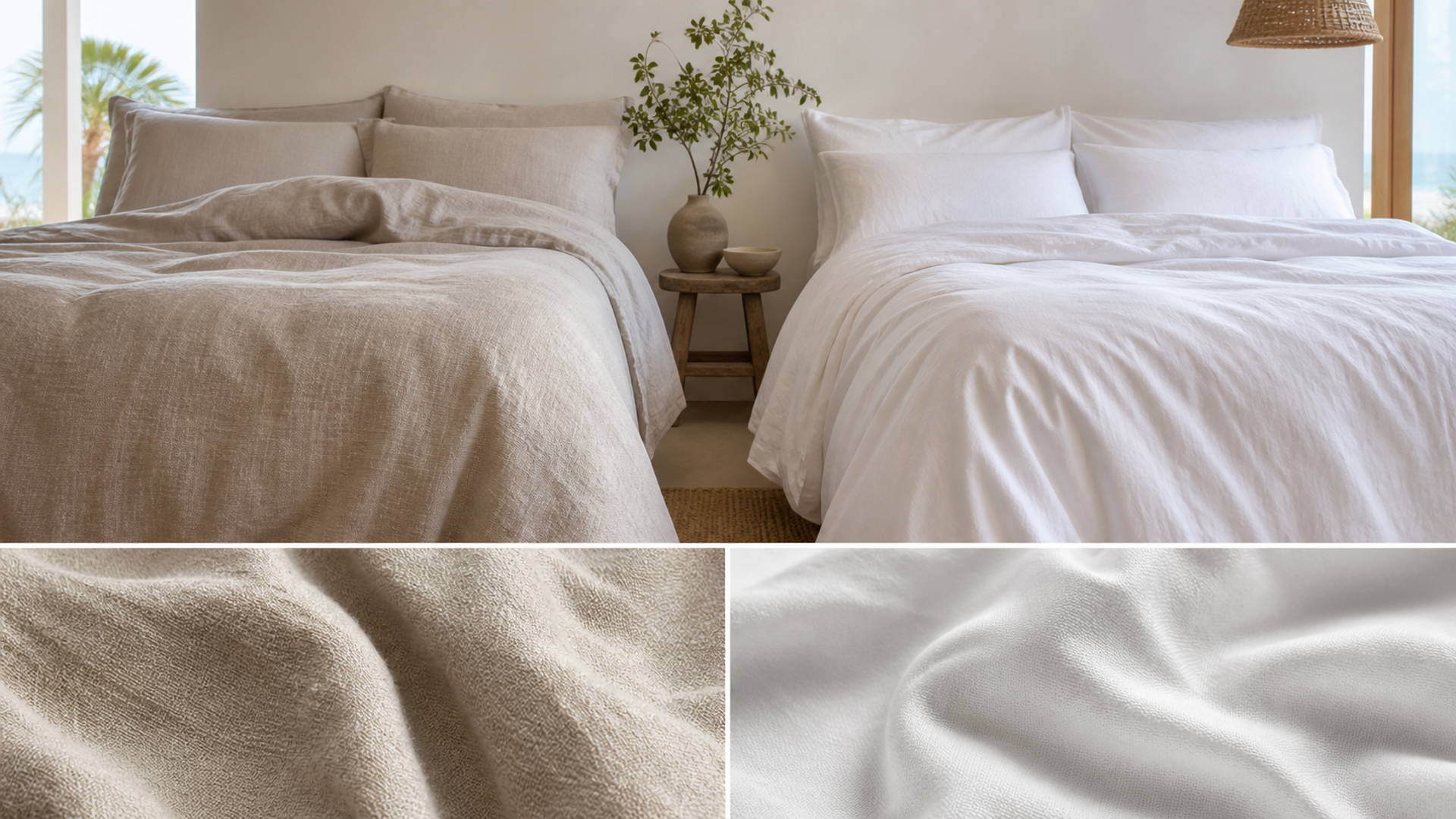
Linen and cotton are fibre families, not guarantees of coolness or quality. Linen is made from flax and often begins with a textured, airy hand that changes through washing; cotton ranges from crisp percale to dense sateen and many blended constructions. The exact cloth, finish, weight and laundering routine decide the experience.
Start with climate and hand feel
Choose linen when airflow, textured drape and gradual softening fit the room and the owner accepts wrinkles and careful buying. Choose cotton when a particular weave delivers the preferred smoothness, crispness and easier replacement. Sample first when chemical finish, weight, shrinkage or skin feel could reverse the choice.
| Decision factor | Linen sheets | Cotton sheets | Sample and keep the current set |
|---|---|---|---|
| Climate | An airy textured cloth suits heat and humidity | The selected cotton weave manages the room well | Measure the bedroom before changing fibre |
| Skin feel | Slub and texture remain comfortable | A smoother or crisper cotton hand is preferred | A washed swatch settles sensitivity |
| Laundering | The owner accepts gradual softening and visible wrinkles | The exact cotton care routine fits the household | Keep the current set until shrinkage is tested |
| Drying | Line or low-heat drying is practical | Machine care follows the maker's label | Laundry capacity or energy use blocks replacement |
| Fit | Post-wash dimensions fit mattress depth and movement | Elastic, pocket and shrinkage are verified | One pillowcase trial comes first |
| Ownership | Higher initial cost earns years of real use | Broader availability and replacement win | No purchase on thread count or fibre name alone |
This linen vs cotton sheets matrix is the article's working value object. Read the linen vs cotton sheets rows together: the decisive failure mode depends on this topic's evidence, operating context and reader objective.
What fibre and construction establish
Evidence 1. Linen is produced from flax fibre, and its natural variation and softening with use are material characteristics rather than automatic defects.
Evidence 2. Cotton sheet performance changes with staple, yarn, weave, weight and finish; fibre name and thread count alone do not prove comfort or durability.
Evidence 3. Both fibres can shrink or change hand after laundering, so the maker's care instructions and post-wash dimensions are purchase evidence.
Evidence 4. Bedroom humidity, mattress protector, duvet and sleeper physiology can influence perceived heat more than a fibre comparison conducted outside the full sleep system.
Reader-visible sources checked for this article:
linen.eu — reader-visible current or official evidence
sleepfoundation.org — reader-visible current or official evidence
For linen vs cotton sheets, these sources establish only the claims inside their documented scope. Recheck every changeable specification, availability condition, price, policy or service term in the relevant market before acting.
Wash before judging luxury
On climate, popularity is not enough. The evidence for option one is that an airy textured cloth suits heat and humidity. Option two means the selected cotton weave manages the room well. Option three is rational where measure the bedroom before changing fibre. Recheck any changeable term immediately before commitment.
The decision changes at skin feel. Choose the first path only if slub and texture remain comfortable; move to the second when a smoother or crisper cotton hand is preferred; use the third when a washed swatch settles sensitivity. Save the downside that would make this row fail.
For laundering, the first route works when the owner accepts gradual softening and visible wrinkles; the second requires the exact cotton care routine fits the household. The control for the third is keep the current set until shrinkage is tested. Verify this row against the exact product, property, account or environment before it can reverse the decision.
The drying row exposes a practical boundary. Route one assumes line or low-heat drying is practical, while route two is defensible only when machine care follows the maker's label. Route three depends on laundry capacity or energy use blocks replacement. If that evidence is absent, keep the more reversible option.
Read fit as a stop/go test: post-wash dimensions fit mattress depth and movement supports the first option; elastic, pocket and shrinkage are verified supports the second; and one pillowcase trial comes first supports the third. Record which source proves the condition and when it was checked.
A buyer can resolve ownership without starting from a brand preference. Ask whether higher initial cost earns years of real use; compare that with whether broader availability and replacement win; then use no purchase on thread count or fibre name alone as the third route's safeguard. An unknown condition stays unknown.
Facts that would reverse the current choice
Reversal control 1 — Climate. Before choosing Linen sheets, write down how the decision changes if “An airy textured cloth suits heat and humidity” proves false. Do the same for Cotton sheets and “The selected cotton weave manages the room well”. Keep the Sample and keep the current set route available until “Measure the bedroom before changing fibre” is verified. This control belongs to linen vs cotton sheets; update it from the cited source or exact supplier rather than copying a generic checklist.
Reversal control 2 — Skin feel. Before choosing Linen sheets, write down how the decision changes if “Slub and texture remain comfortable” proves false. Do the same for Cotton sheets and “A smoother or crisper cotton hand is preferred”. Keep the Sample and keep the current set route available until “A washed swatch settles sensitivity” is verified. This control belongs to linen vs cotton sheets; update it from the cited source or exact supplier rather than copying a generic checklist.
Reversal control 3 — Laundering. Before choosing Linen sheets, write down how the decision changes if “The owner accepts gradual softening and visible wrinkles” proves false. Do the same for Cotton sheets and “The exact cotton care routine fits the household”. Keep the Sample and keep the current set route available until “Keep the current set until shrinkage is tested” is verified. This control belongs to linen vs cotton sheets; update it from the cited source or exact supplier rather than copying a generic checklist.
Reversal control 4 — Drying. Before choosing Linen sheets, write down how the decision changes if “Line or low-heat drying is practical” proves false. Do the same for Cotton sheets and “Machine care follows the maker's label”. Keep the Sample and keep the current set route available until “Laundry capacity or energy use blocks replacement” is verified. This control belongs to linen vs cotton sheets; update it from the cited source or exact supplier rather than copying a generic checklist.
Reversal control 5 — Fit. Before choosing Linen sheets, write down how the decision changes if “Post-wash dimensions fit mattress depth and movement” proves false. Do the same for Cotton sheets and “Elastic, pocket and shrinkage are verified”. Keep the Sample and keep the current set route available until “One pillowcase trial comes first” is verified. This control belongs to linen vs cotton sheets; update it from the cited source or exact supplier rather than copying a generic checklist.
Reversal control 6 — Ownership. Before choosing Linen sheets, write down how the decision changes if “Higher initial cost earns years of real use” proves false. Do the same for Cotton sheets and “Broader availability and replacement win”. Keep the Sample and keep the current set route available until “No purchase on thread count or fibre name alone” is verified. This control belongs to linen vs cotton sheets; update it from the cited source or exact supplier rather than copying a generic checklist.
Control the construction variables
Compare similar weights, colours and finishing where possible. Record weave, yarn, certification and whether softeners or resins affect the first-touch impression.
Run a wash protocol
Measure a pillowcase before washing, follow the label twice, then record shrinkage, drying time, wrinkles, surface feel and odour retention.
Log the room
Track overnight temperature and humidity with the same mattress layers. Note wake-ups, clamminess and tactile irritation rather than relying on morning memory.
Inspect long-term wear
Check fitted corners, foot area, seams and pillow friction. Ask how individual pieces can be replaced so one damaged component does not retire a full set.
Three sleep environments
Warm humid bedroom
A well-made linen or airy cotton percale can work; the washed test should decide rather than fibre mythology. Define the fact that would reverse this recommendation before committing.
Cool room and smooth-hand preference
Cotton sateen or another dense weave may feel more comfortable than textured linen. Define the fact that would reverse this recommendation before committing.
Sensitive sleeper buying online
A returnable pillowcase or swatch test is more valuable than a high thread-count headline. Define the fact that would reverse this recommendation before committing.
Action checklist
Record room humidity.
Identify weave and weight.
Order a washed sample.
Measure shrinkage.
Time drying.
Avoid unapproved softener.
Check mattress depth.
Inspect seam quality.
Read opened-return terms.
Plan piece-by-piece replacement.
Continue the decision
The linked VERTU articles expand adjacent parts of the linen vs cotton sheets decision. They do not substitute for the external evidence above.
The linen-cotton verdict
Choose linen when airflow, textured drape and gradual softening fit the room and the owner accepts wrinkles and careful buying. Choose cotton when a particular weave delivers the preferred smoothness, crispness and easier replacement. Sample first when chemical finish, weight, shrinkage or skin feel could reverse the choice.
Keep the linen vs cotton sheets decision reversible until its material cost, safety, access, privacy and compatibility facts are verified. Unknown evidence stays unknown; it is never silently scored as favourable.