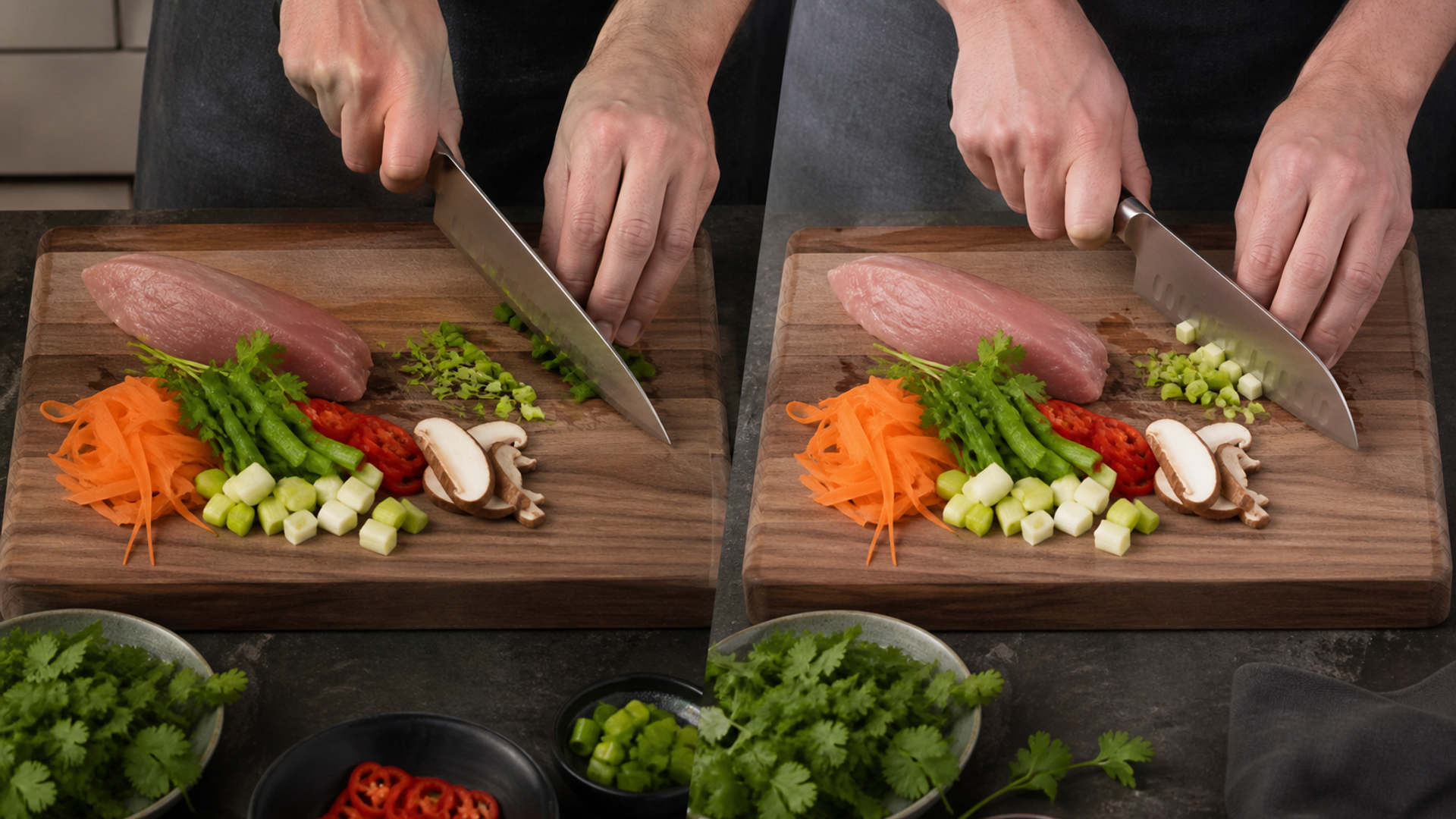
A chef's knife and a Santoku overlap across vegetables, herbs and boneless proteins, but their typical profiles encourage different motions. A Western chef's knife often has a longer, more curved edge that supports rocking; many Santoku knives are shorter, lighter and flatter through the edge for push cuts and chopping. Exact length, grind, handle, steel, thickness and balance vary, so the name cannot decide fit for the cook's hand, board or prep list.
Cutting motion leads the choice
Choose a chef's knife when a longer edge, rocking motion and broad general-purpose range fit the cook and board. Choose a Santoku when a shorter, lighter blade and straighter push-cut rhythm feel more controlled. Choose another knife or a two-knife kit when neither safely handles bones, bread, fine paring or the full workload without compromise.
| Decision factor | Chef's knife | Santoku | Choose another knife or a two-knife kit |
|---|---|---|---|
| Edge profile | More curve often supports rocking | Flatter edge often supports push cuts | Inspect the exact blade |
| Length | Commonly longer with more slicing travel | Often shorter in standard ranges | Match hand and board space |
| Weight | Can add momentum for dense prep | Can feel lighter and agile | Balance matters more than a label |
| Food | Broad general prep and long slicing | Vegetables and boneless prep suit many users | Use purpose tools for bones and bread |
| Sharpening | Edge angle and steel vary by maker | Edge angle and steel also vary | Follow the exact maker's guidance |
| Safety | Control depends on grip and board | Control depends on grip and board | Reject a handle or length that feels unstable |
This chef knife vs santoku matrix is the article's working value object. Read the chef knife vs santoku rows together: the decisive failure mode depends on this topic's evidence, operating context and reader objective.
Blade profile and fit matter more than prestige
Evidence 1. Wüsthof distinguishes the Santoku's flatter profile and chopping or push-cut use from the curved chef's-knife profile often used for rocking.
Evidence 2. Zwilling's knife-type guidance shows that blade geometry and task are linked, while exact products vary in size, steel and handle design.
Evidence 3. A knife category does not establish edge angle, hardness, corrosion resistance or ease of sharpening; verify the exact model.
Evidence 4. Neither knife is intended to replace a cleaver, bread knife or purpose-built boning tool where the task exceeds its design.
Reader-visible sources checked for this article:
wusthof.com — reader-visible current or official evidence
zwilling.com — reader-visible current or official evidence
zwilling.com — reader-visible current or official evidence
For chef knife vs santoku, these sources establish only the claims inside their documented scope. Recheck every changeable specification, availability condition, price, policy or service term in the relevant market before acting.
Test on the same board and ingredients
The decision changes at edge profile. Choose the first path only if more curve often supports rocking; move to the second when flatter edge often supports push cuts; use the third when inspect the exact blade. Save the downside that would make this row fail.
For length, the first route works when commonly longer with more slicing travel; the second requires often shorter in standard ranges. The control for the third is match hand and board space. Verify this row against the exact product, property, account or environment before it can reverse the decision.
The weight row exposes a practical boundary. Route one assumes can add momentum for dense prep, while route two is defensible only when can feel lighter and agile. Route three depends on balance matters more than a label. If that evidence is absent, keep the more reversible option.
Read food as a stop/go test: broad general prep and long slicing supports the first option; vegetables and boneless prep suit many users supports the second; and use purpose tools for bones and bread supports the third. Record which source proves the condition and when it was checked.
A buyer can resolve sharpening without starting from a brand preference. Ask whether edge angle and steel vary by maker; compare that with whether edge angle and steel also vary; then use follow the exact maker's guidance as the third route's safeguard. An unknown condition stays unknown.
On safety, popularity is not enough. The evidence for option one is that control depends on grip and board. Option two means control depends on grip and board. Option three is rational where reject a handle or length that feels unstable. Recheck any changeable term immediately before commitment.
Facts that would reverse the current choice
Reversal control 1 — Edge profile. Before choosing Chef's knife, write down how the decision changes if “More curve often supports rocking” proves false. Do the same for Santoku and “Flatter edge often supports push cuts”. Keep the Choose another knife or a two-knife kit route available until “Inspect the exact blade” is verified. This control belongs to chef knife vs santoku; update it from the cited source or exact supplier rather than copying a generic checklist.
Reversal control 2 — Length. Before choosing Chef's knife, write down how the decision changes if “Commonly longer with more slicing travel” proves false. Do the same for Santoku and “Often shorter in standard ranges”. Keep the Choose another knife or a two-knife kit route available until “Match hand and board space” is verified. This control belongs to chef knife vs santoku; update it from the cited source or exact supplier rather than copying a generic checklist.
Reversal control 3 — Weight. Before choosing Chef's knife, write down how the decision changes if “Can add momentum for dense prep” proves false. Do the same for Santoku and “Can feel lighter and agile”. Keep the Choose another knife or a two-knife kit route available until “Balance matters more than a label” is verified. This control belongs to chef knife vs santoku; update it from the cited source or exact supplier rather than copying a generic checklist.
Reversal control 4 — Food. Before choosing Chef's knife, write down how the decision changes if “Broad general prep and long slicing” proves false. Do the same for Santoku and “Vegetables and boneless prep suit many users”. Keep the Choose another knife or a two-knife kit route available until “Use purpose tools for bones and bread” is verified. This control belongs to chef knife vs santoku; update it from the cited source or exact supplier rather than copying a generic checklist.
Reversal control 5 — Sharpening. Before choosing Chef's knife, write down how the decision changes if “Edge angle and steel vary by maker” proves false. Do the same for Santoku and “Edge angle and steel also vary”. Keep the Choose another knife or a two-knife kit route available until “Follow the exact maker's guidance” is verified. This control belongs to chef knife vs santoku; update it from the cited source or exact supplier rather than copying a generic checklist.
Reversal control 6 — Safety. Before choosing Chef's knife, write down how the decision changes if “Control depends on grip and board” proves false. Do the same for Santoku and “Control depends on grip and board”. Keep the Choose another knife or a two-knife kit route available until “Reject a handle or length that feels unstable” is verified. This control belongs to chef knife vs santoku; update it from the cited source or exact supplier rather than copying a generic checklist.
Write the prep ledger
List vegetables, herbs, boneless meat, fish, fruit, bread and any hard or frozen foods prepared each week. Count repetitions and note the cutting motion already used safely. In this chef's knife versus Santoku comparison, preserve the exact item, setting, date and test condition in the evidence log. Keep measured results separate from category shorthand and repeat the check in the intended environment. If one specialist task dominates, choose the purpose-built blade instead of forcing either generalist. When that reversal condition appears, reopen the choice instead of defending the original preference.
Fit the hand
Use a safe pinch grip and check handle length, circumference, texture, spine comfort and knuckle clearance. Repeat when the hand is dry and slightly damp under supervised shop conditions. In this chef's knife versus Santoku comparison, preserve the exact item, setting, date and test condition in the evidence log. Keep measured results separate from category shorthand and repeat the check in the intended environment. If the grip twists or creates pressure, reject the knife regardless of reputation. When that reversal condition appears, reopen the choice instead of defending the original preference.
Control the board
Use the same stable wooden or suitable synthetic board and identical ingredients. Compare straight cuts, rocking, tip work and long slices without rushing. In this chef's knife versus Santoku comparison, preserve the exact item, setting, date and test condition in the evidence log. Keep measured results separate from category shorthand and repeat the check in the intended environment. If the board is too small for the blade, change the board or length before judging the category. When that reversal condition appears, reopen the choice instead of defending the original preference.
Inspect the edge path
Look for full contact through the cut, steering, wedging and food release. Use consistent sharpness or have both knives professionally prepared. In this chef's knife versus Santoku comparison, preserve the exact item, setting, date and test condition in the evidence log. Keep measured results separate from category shorthand and repeat the check in the intended environment. If one knife is simply sharper, restore comparable edges before deciding. When that reversal condition appears, reopen the choice instead of defending the original preference.
Plan sharpening and storage
Confirm whetstone, guided system or professional service access and a safe rack or sheath. Record steel guidance, honing limits and the cost of repair. In this chef's knife versus Santoku comparison, preserve the exact item, setting, date and test condition in the evidence log. Keep measured results separate from category shorthand and repeat the check in the intended environment. If maintenance cannot be performed reliably, choose the simpler ownership path. When that reversal condition appears, reopen the choice instead of defending the original preference.
Four prep routines, four answers
Large batches and long slicing
A well-fitted chef's knife can use its length and curved profile. Define the fact that would reverse this recommendation before committing.
Compact board and vegetable prep
A shorter Santoku may feel precise and manageable. Define the fact that would reverse this recommendation before committing.
Mixed household cooks
Two sizes or two patterns can be safer than one compromise for every hand. Define the fact that would reverse this recommendation before committing.
Bones, frozen food or bread
A purpose tool should replace both general-purpose options for that task. Define the fact that would reverse this recommendation before committing.
Action checklist
List weekly foods.
Record cutting motion.
Measure board space.
Try a pinch grip.
Check knuckle clearance.
Compare blade length.
Compare balance.
Use equal sharpness.
Avoid bones and frozen food.
Confirm sharpening.
Plan safe storage.
Write the rejection condition.
Continue the decision
The linked VERTU articles expand adjacent parts of the chef knife vs santoku decision. They do not substitute for the external evidence above.
The chef's-knife-versus-Santoku verdict
Choose a chef's knife when a longer edge, rocking motion and broad general-purpose range fit the cook and board. Choose a Santoku when a shorter, lighter blade and straighter push-cut rhythm feel more controlled. Choose another knife or a two-knife kit when neither safely handles bones, bread, fine paring or the full workload without compromise.
Keep the chef knife vs santoku decision reversible until its material cost, safety, access, privacy and compatibility facts are verified. Unknown evidence stays unknown; it is never silently scored as favourable.