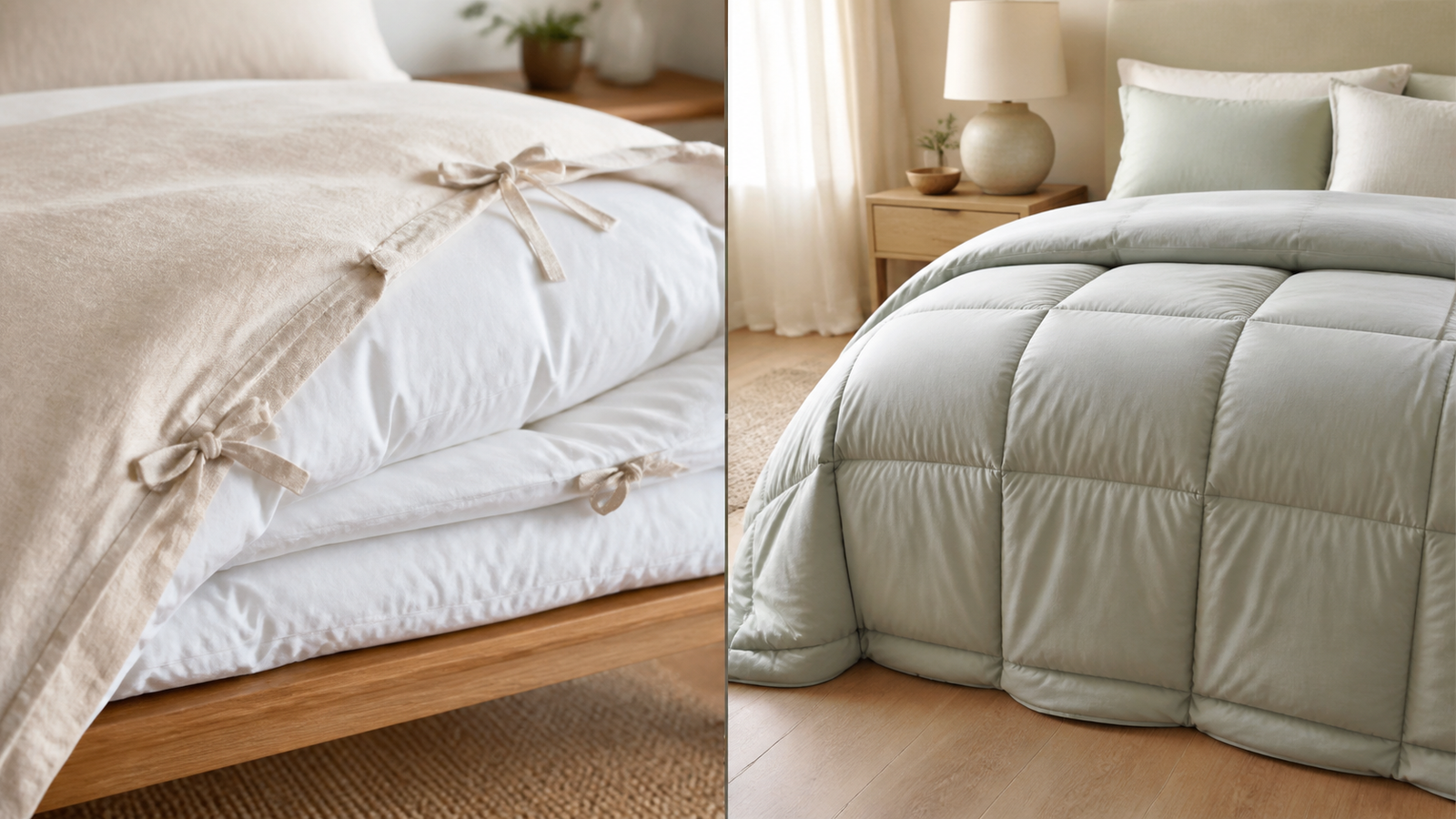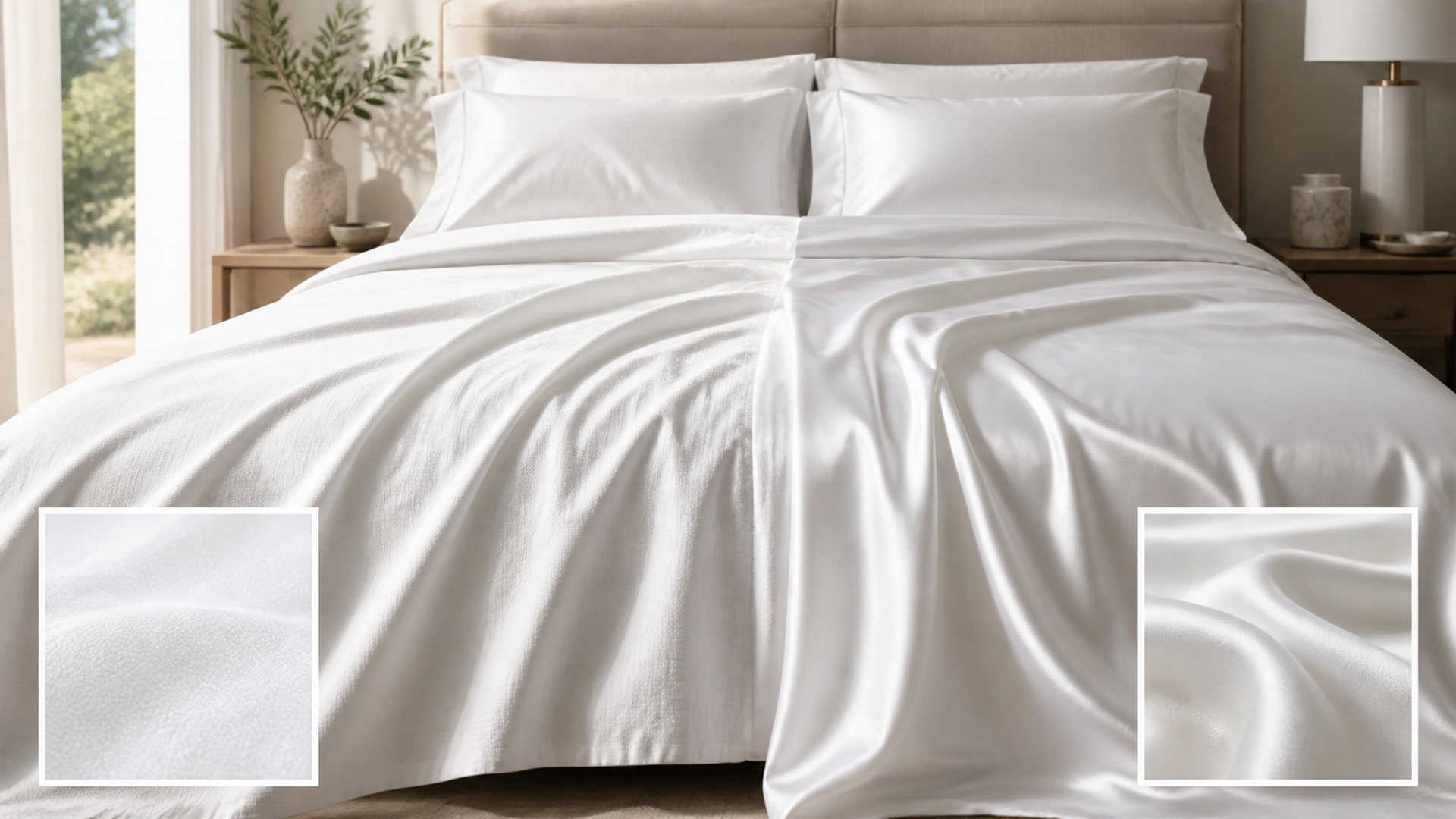
Percale and sateen describe weave structures, not cotton quality grades. Percale's balanced over-under construction commonly feels crisp, matte and breathable; sateen's longer surface floats commonly feel smoother, denser and more lustrous. Fibre, yarn, finishing, thread count and laundering can change either result, so weave should be tested with the exact sheet.
Choose the weave before the thread count
Choose percale when a cooler, crisp and matte bed suits the sleeper and climate. Choose sateen when a smoother, more draping and slightly warmer hand feels better. Sample before committing when fibre quality, chemical finish, return terms or laundering response could matter more than the weave label.
| Decision factor | Percale | Sateen | Sample before committing |
|---|---|---|---|
| Sleep temperature | A cooler and airier feel is preferred | A denser, warmer drape is comfortable | Sample both in the actual room climate |
| Hand feel | Crisp structure feels clean and comfortable | Smooth surface and drape feel luxurious | Skin sensitivity makes a swatch test decisive |
| Appearance | Matte and relaxed texture suits the room | Subtle lustre and fluid drape suit the room | Finish is viewed after washing |
| Care | Wrinkles and a gradual softening are accepted | Snag and sheen care are accepted | Follow the exact maker's instructions |
| Durability | Balanced weave and strong yarn meet use | Longer floats are protected from abrasion | Construction evidence beats thread-count marketing |
| Purchase risk | A trial or open-set return is clear | A trial or open-set return is clear | Buy pillowcases or a swatch first |
This percale vs sateen sheets matrix is the article's working value object. Read the percale vs sateen sheets rows together: the decisive failure mode depends on this topic's evidence, operating context and reader objective.
How percale and sateen feel different
Evidence 1. Homes & Gardens describes percale as a crisp matte weave and sateen as a smoother, more lustrous construction, while noting that sleep preference should guide the choice.
Evidence 2. Thread count alone does not establish fibre length, yarn quality, finishing or durability and should not replace construction evidence.
Evidence 3. Sateen's longer surface floats can create smoothness and sheen but may be more exposed to snagging or abrasion in some products.
Evidence 4. Percale often wrinkles more visibly and softens with laundering, which is a characteristic to evaluate rather than an automatic defect.
Reader-visible sources checked for this article:
homesandgardens.com — reader-visible current or official evidence
vertu.com — reader-visible current or official evidence
For percale vs sateen sheets, these sources establish only the claims inside their documented scope. Recheck every changeable specification, availability condition, price, policy or service term in the relevant market before acting.
Test climate, laundering and finish
A buyer can resolve sleep temperature without starting from a brand preference. Ask whether a cooler and airier feel is preferred; compare that with whether a denser, warmer drape is comfortable; then use sample both in the actual room climate as the third route's safeguard. An unknown condition stays unknown.
On hand feel, popularity is not enough. The evidence for option one is that crisp structure feels clean and comfortable. Option two means smooth surface and drape feel luxurious. Option three is rational where skin sensitivity makes a swatch test decisive. Recheck any changeable term immediately before commitment.
The decision changes at appearance. Choose the first path only if matte and relaxed texture suits the room; move to the second when subtle lustre and fluid drape suit the room; use the third when finish is viewed after washing. Save the downside that would make this row fail.
For care, the first route works when wrinkles and a gradual softening are accepted; the second requires snag and sheen care are accepted. The control for the third is follow the exact maker's instructions. Verify this row against the exact product, property, account or environment before it can reverse the decision.
The durability row exposes a practical boundary. Route one assumes balanced weave and strong yarn meet use, while route two is defensible only when longer floats are protected from abrasion. Route three depends on construction evidence beats thread-count marketing. If that evidence is absent, keep the more reversible option.
Read purchase risk as a stop/go test: a trial or open-set return is clear supports the first option; a trial or open-set return is clear supports the second; and buy pillowcases or a swatch first supports the third. Record which source proves the condition and when it was checked.
Facts that would reverse the current choice
Reversal control 1 — Sleep temperature. Before choosing Percale, write down how the decision changes if “A cooler and airier feel is preferred” proves false. Do the same for Sateen and “A denser, warmer drape is comfortable”. Keep the Sample before committing route available until “Sample both in the actual room climate” is verified. This control belongs to percale vs sateen sheets; update it from the cited source or exact supplier rather than copying a generic checklist.
Reversal control 2 — Hand feel. Before choosing Percale, write down how the decision changes if “Crisp structure feels clean and comfortable” proves false. Do the same for Sateen and “Smooth surface and drape feel luxurious”. Keep the Sample before committing route available until “Skin sensitivity makes a swatch test decisive” is verified. This control belongs to percale vs sateen sheets; update it from the cited source or exact supplier rather than copying a generic checklist.
Reversal control 3 — Appearance. Before choosing Percale, write down how the decision changes if “Matte and relaxed texture suits the room” proves false. Do the same for Sateen and “Subtle lustre and fluid drape suit the room”. Keep the Sample before committing route available until “Finish is viewed after washing” is verified. This control belongs to percale vs sateen sheets; update it from the cited source or exact supplier rather than copying a generic checklist.
Reversal control 4 — Care. Before choosing Percale, write down how the decision changes if “Wrinkles and a gradual softening are accepted” proves false. Do the same for Sateen and “Snag and sheen care are accepted”. Keep the Sample before committing route available until “Follow the exact maker's instructions” is verified. This control belongs to percale vs sateen sheets; update it from the cited source or exact supplier rather than copying a generic checklist.
Reversal control 5 — Durability. Before choosing Percale, write down how the decision changes if “Balanced weave and strong yarn meet use” proves false. Do the same for Sateen and “Longer floats are protected from abrasion”. Keep the Sample before committing route available until “Construction evidence beats thread-count marketing” is verified. This control belongs to percale vs sateen sheets; update it from the cited source or exact supplier rather than copying a generic checklist.
Reversal control 6 — Purchase risk. Before choosing Percale, write down how the decision changes if “A trial or open-set return is clear” proves false. Do the same for Sateen and “A trial or open-set return is clear”. Keep the Sample before committing route available until “Buy pillowcases or a swatch first” is verified. This control belongs to percale vs sateen sheets; update it from the cited source or exact supplier rather than copying a generic checklist.
Control the fibre variables
Compare the same fibre, cotton origin where substantiated, yarn type and approximate weight. Otherwise the test measures two entire products rather than the weave itself.
Wash before judging
Follow the label through at least two washes without unapproved softener, then record shrinkage, wrinkles, hand feel and fit on the mattress.
Match the climate
Record bedroom temperature, humidity, sleeper warmth and duvet. Sheets work as part of a sleep system, so do not blame the weave for an unsuitable room or topper.
Inspect high-wear points
Check fitted corners, foot area, partner friction, pet claws and laundry equipment. Photograph pilling, snagging or seam movement during the trial window.
Three sleep environments
Warm humid bedroom
Percale often fits the desire for crispness and airflow when the exact cloth is well made. Define the fact that would reverse this recommendation before committing.
Cool room and smooth-hand preference
Sateen can provide the desired drape and surface feel when snag risk is controlled. Define the fact that would reverse this recommendation before committing.
Sensitive sleeper buying online
A swatch or pillowcase test can prevent an expensive full-set mismatch. Define the fact that would reverse this recommendation before committing.
Action checklist
Check fibre and yarn.
Ignore thread count alone.
Order a swatch.
Wash to the label.
Measure shrinkage.
Test room temperature.
Inspect mattress fit.
Check snag exposure.
Read opened-return terms.
Keep a laundering log.
Continue the decision
The linked VERTU articles expand adjacent parts of the percale vs sateen sheets decision. They do not substitute for the external evidence above.
The percale-sateen verdict
Choose percale when a cooler, crisp and matte bed suits the sleeper and climate. Choose sateen when a smoother, more draping and slightly warmer hand feels better. Sample before committing when fibre quality, chemical finish, return terms or laundering response could matter more than the weave label.
Keep the percale vs sateen sheets decision reversible until its material cost, safety, access, privacy and compatibility facts are verified. Unknown evidence stays unknown; it is never silently scored as favourable.