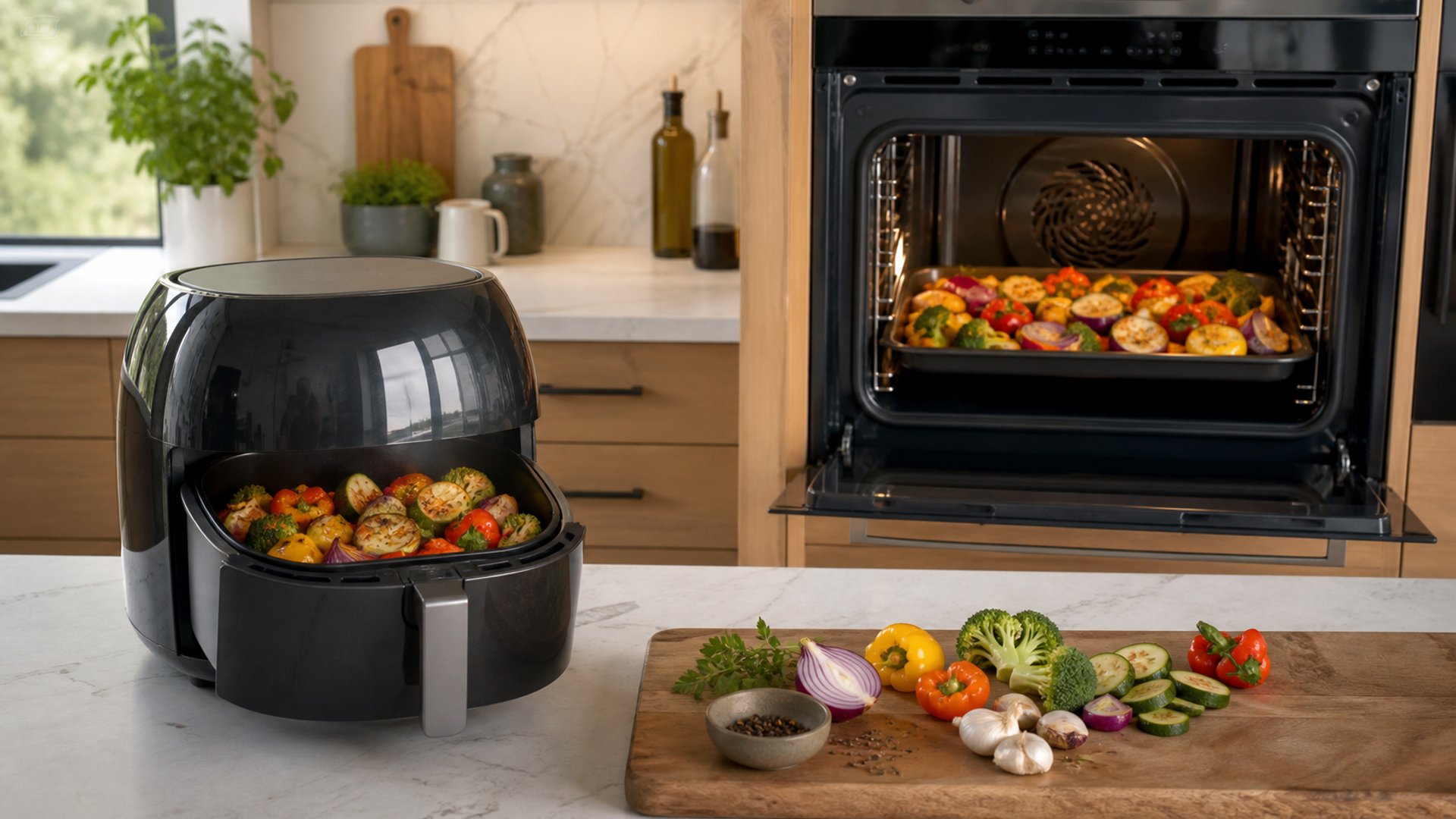
An air fryer is a compact convection appliance, while a convection oven moves heated air through a much larger cavity. The smaller chamber can preheat quickly and concentrate airflow around a modest batch; the larger oven can cook more food and accept different vessels. Capacity and meal pattern matter more than the word fry.
Map the meals before adding an appliance
Choose a full-size convection oven for large batches, multiple dishes and flexible cookware. Choose a basket air fryer for small portions, fast starts and concentrated crisping when counter space and cleaning are acceptable. Use the appliance already owned when another machine would duplicate the same meals without saving meaningful time or energy.
| Decision factor | Full-size convection oven | Basket air fryer | Use the appliance already owned |
|---|---|---|---|
| Batch size | Sheet-pan or family quantities dominate | One or two compact portions dominate | Existing capacity already fits |
| Speed | Longer preheat is offset by larger throughput | Small cavity shortens start-up | Schedule does not justify duplication |
| Crisping | Perforated trays and spacing work | Concentrated airflow suits the food | Technique fixes the result |
| Counter space | Built-in cavity uses no new counter area | Dedicated footprint is acceptable | Clear counter space is more valuable |
| Cleaning | Trays and oven surfaces fit the routine | Basket and drawer are easy to wash | Another greasy component is unwelcome |
| Safety | Ventilation and hot surfaces are managed | Clearance and basket handling are managed | Existing appliance is better understood |
This convection oven vs air fryer matrix is the article's working value object. Read the convection oven vs air fryer rows together: the decisive failure mode depends on this topic's evidence, operating context and reader objective.
How cavity size and moving air change cooking
Evidence 1. Air fryers cook by circulating hot air in a compact cavity; they do not reproduce deep frying simply because the label includes fry.
Evidence 2. A convection oven also circulates heated air, but usable volume, fan pattern, element position and controls vary by model.
Evidence 3. Crowding reduces airflow around food, so headline capacity and real crisping capacity are not the same measurement.
Evidence 4. Food-safety temperature, electrical load, clearances and manufacturer cleaning instructions remain appliance-specific requirements.
Reader-visible sources checked for this article:
whirlpool.com — reader-visible current or official evidence
fsis.usda.gov — reader-visible current or official evidence
For convection oven vs air fryer, these sources establish only the claims inside their documented scope. Recheck every changeable specification, availability condition, price, policy or service term in the relevant market before acting.
Test batches, ventilation and cleaning
For batch size, the first route works when sheet-pan or family quantities dominate; the second requires one or two compact portions dominate. The control for the third is existing capacity already fits. Verify this row against the exact product, property, account or environment before it can reverse the decision.
The speed row exposes a practical boundary. Route one assumes longer preheat is offset by larger throughput, while route two is defensible only when small cavity shortens start-up. Route three depends on schedule does not justify duplication. If that evidence is absent, keep the more reversible option.
Read crisping as a stop/go test: perforated trays and spacing work supports the first option; concentrated airflow suits the food supports the second; and technique fixes the result supports the third. Record which source proves the condition and when it was checked.
A buyer can resolve counter space without starting from a brand preference. Ask whether built-in cavity uses no new counter area; compare that with whether dedicated footprint is acceptable; then use clear counter space is more valuable as the third route's safeguard. An unknown condition stays unknown.
On cleaning, popularity is not enough. The evidence for option one is that trays and oven surfaces fit the routine. Option two means basket and drawer are easy to wash. Option three is rational where another greasy component is unwelcome. Recheck any changeable term immediately before commitment.
The decision changes at safety. Choose the first path only if ventilation and hot surfaces are managed; move to the second when clearance and basket handling are managed; use the third when existing appliance is better understood. Save the downside that would make this row fail.
Facts that would reverse the current choice
Reversal control 1 — Batch size. Before choosing Full-size convection oven, write down how the decision changes if “Sheet-pan or family quantities dominate” proves false. Do the same for Basket air fryer and “One or two compact portions dominate”. Keep the Use the appliance already owned route available until “Existing capacity already fits” is verified. This control belongs to convection oven vs air fryer; update it from the cited source or exact supplier rather than copying a generic checklist.
Reversal control 2 — Speed. Before choosing Full-size convection oven, write down how the decision changes if “Longer preheat is offset by larger throughput” proves false. Do the same for Basket air fryer and “Small cavity shortens start-up”. Keep the Use the appliance already owned route available until “Schedule does not justify duplication” is verified. This control belongs to convection oven vs air fryer; update it from the cited source or exact supplier rather than copying a generic checklist.
Reversal control 3 — Crisping. Before choosing Full-size convection oven, write down how the decision changes if “Perforated trays and spacing work” proves false. Do the same for Basket air fryer and “Concentrated airflow suits the food”. Keep the Use the appliance already owned route available until “Technique fixes the result” is verified. This control belongs to convection oven vs air fryer; update it from the cited source or exact supplier rather than copying a generic checklist.
Reversal control 4 — Counter space. Before choosing Full-size convection oven, write down how the decision changes if “Built-in cavity uses no new counter area” proves false. Do the same for Basket air fryer and “Dedicated footprint is acceptable”. Keep the Use the appliance already owned route available until “Clear counter space is more valuable” is verified. This control belongs to convection oven vs air fryer; update it from the cited source or exact supplier rather than copying a generic checklist.
Reversal control 5 — Cleaning. Before choosing Full-size convection oven, write down how the decision changes if “Trays and oven surfaces fit the routine” proves false. Do the same for Basket air fryer and “Basket and drawer are easy to wash”. Keep the Use the appliance already owned route available until “Another greasy component is unwelcome” is verified. This control belongs to convection oven vs air fryer; update it from the cited source or exact supplier rather than copying a generic checklist.
Reversal control 6 — Safety. Before choosing Full-size convection oven, write down how the decision changes if “Ventilation and hot surfaces are managed” proves false. Do the same for Basket air fryer and “Clearance and basket handling are managed”. Keep the Use the appliance already owned route available until “Existing appliance is better understood” is verified. This control belongs to convection oven vs air fryer; update it from the cited source or exact supplier rather than copying a generic checklist.
List ten recurring meals
Write portion count, vessel, temperature and timing for the meals actually cooked. Mark which would fit in one air-fryer layer and which need an oven.
Run an equal-food test
Cook the same weighed batch with comparable oil and spacing. Record preheat, active time, energy if measurable, texture and cleanup rather than relying on one photograph.
Inspect the physical workflow
Open drawers and doors, remove hot baskets, reach controls and locate the plug. Include ventilation and storage in the purchase, not after it.
Check duplication
A good convection setting and perforated tray may already solve the need. Buy a second appliance only when its small-cavity advantage is used often.
Three kitchen patterns
Family tray meals
The full-size convection oven usually wins on throughput and vessel flexibility. Define the fact that would reverse this recommendation before committing.
Quick meals for one or two
A basket air fryer can reduce start-up and deliver reliable crisping in small batches. Define the fact that would reverse this recommendation before committing.
Occasional frozen snacks
Using the existing oven may be rational when counter space and cleaning outweigh minutes saved. Define the fact that would reverse this recommendation before committing.
Action checklist
List recurring meals.
Measure usable basket area.
Check oven convection mode.
Compare one equal batch.
Record total cooking time.
Test cleanup.
Measure counter clearance.
Verify electrical load.
Read food-safety guidance.
Reject unused duplication.
Continue the decision
The linked VERTU articles expand adjacent parts of the convection oven vs air fryer decision. They do not substitute for the external evidence above.
The cooking-appliance verdict
Choose a full-size convection oven for large batches, multiple dishes and flexible cookware. Choose a basket air fryer for small portions, fast starts and concentrated crisping when counter space and cleaning are acceptable. Use the appliance already owned when another machine would duplicate the same meals without saving meaningful time or energy.
Keep the convection oven vs air fryer decision reversible until its material cost, safety, access, privacy and compatibility facts are verified. Unknown evidence stays unknown; it is never silently scored as favourable.