

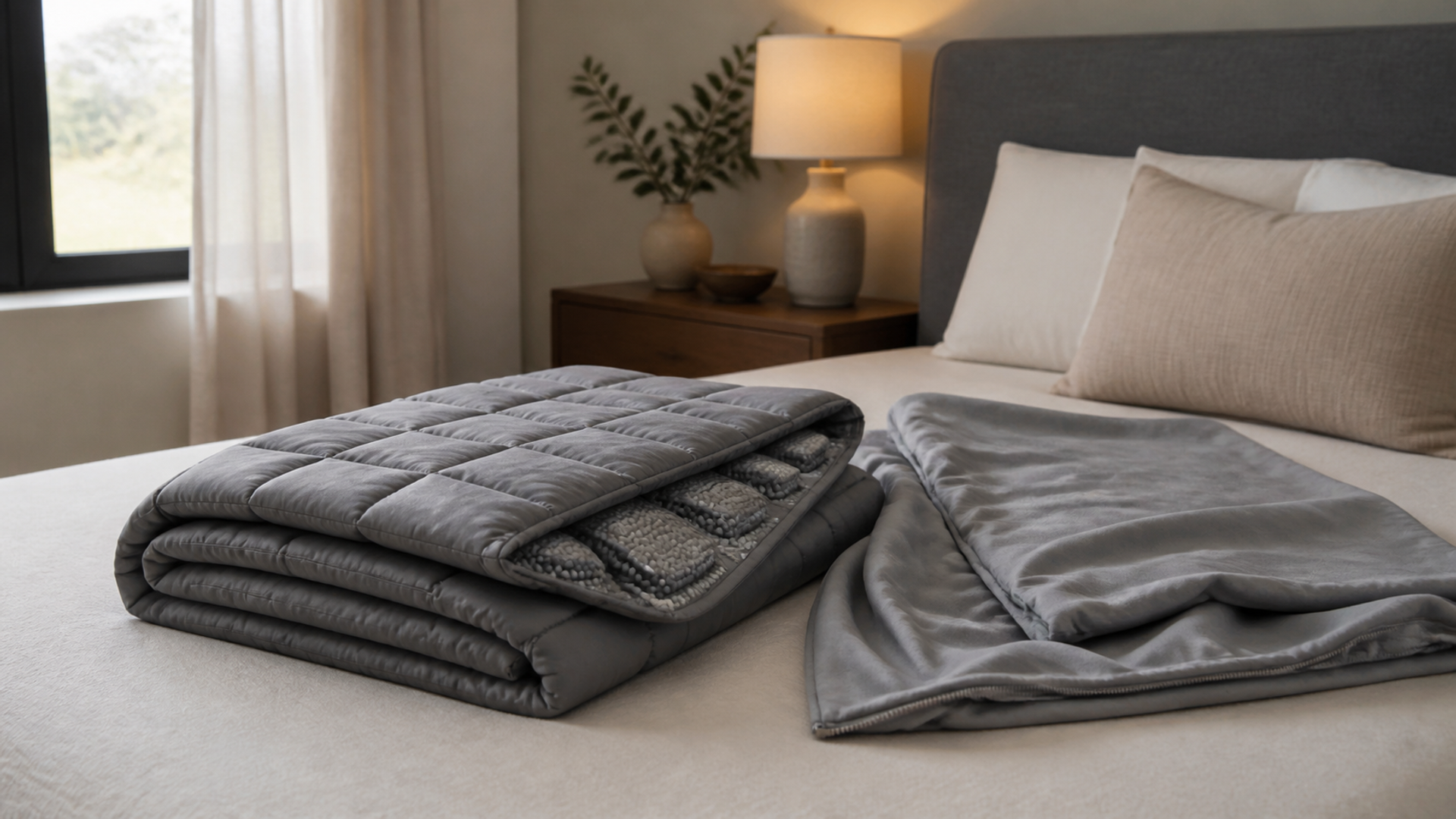
A weighted blanket is a physical load placed across a sleeping or resting person, so the decision should begin with independent movement and comfort—not a universal percentage rule. Reviews of the evidence suggest possible benefits in some groups and settings, but methods and outcomes vary. The blanket still has to distribute fill evenly, release heat, fit the bed without dragging to the floor and be washable in the equipment the household actually owns.
Start with mobility and the intended sensation
Choose the lightest blanket that provides the desired sensation while the intended adult can put it on, remove it and reposition it independently. Match dimensions to the user rather than covering the entire bed, inspect pocket size and seam strength, test heat and movement during a reversible trial, and follow current clinical or manufacturer guidance for anyone with respiratory, circulatory, mobility or other relevant health concerns.
| Decision factor | Conservative adult comfort trial | Heat-managed lightweight setup | Clinical-review-before-use route |
|---|---|---|---|
| Independent removal | User lifts and removes the load easily | Lower mass preserves movement in warm conditions | Uncertain mobility stops self-selection |
| Dimensions | Blanket covers the user without floor drag | Smaller footprint limits heat and pull | Individual assessment defines any safe route |
| Fill distribution | Small secure pockets stay even | Low-bulk construction avoids bunching | No product proceeds without reliable containment |
| Temperature | Room and bedding keep comfort stable | Breathability and lower load lead | Overheating or breathing concern vetoes use |
| Care | Washer and drying route support wet mass | Removable cover reduces routine burden | Caregiver and clinician constraints are resolved first |
| Evidence | Personal comfort is recorded without treatment claim | Heat and sleep effects remain individual | Condition-specific claims require appropriate advice |
| Stop condition | Distress, pain or impaired movement ends trial | Heat or numbness ends trial | No independent removal means no unsupervised route |
This best weighted blanket matrix is the article's working value object. Read the best weighted blanket rows together: the decisive failure mode depends on this topic's evidence, operating context and reader objective.
What the research reviews do and do not prove
Evidence 1. A 2024 systematic review indexed by PubMed assessed weighted-blanket evidence across populations and outcomes, and its scope should be read before turning findings into a universal sleep claim.
Evidence 2. A 2020 systematic review indexed by PubMed reported limited research and differentiated possible anxiety-related use from evidence for insomnia, underscoring the need for bounded claims.
Evidence 3. A simple body-weight percentage cannot capture blanket dimensions, pocket distribution, user strength, sleep position, heat, bedding friction or ability to remove the blanket.
Evidence 4. Machine washability depends on the finished blanket mass when wet and the appliance limit, not merely on whether a cover is removable.
Reader-visible sources checked for this article:
pubmed.ncbi.nlm.nih.gov — reader-visible current or official evidence
pubmed.ncbi.nlm.nih.gov — reader-visible current or official evidence
For best weighted blanket, these sources establish only the claims inside their documented scope. Recheck every changeable specification, availability condition, price, policy or service term in the relevant market before acting.
Evaluate load distribution, heat and care
On independent removal, popularity is not enough. The evidence for option one is that user lifts and removes the load easily. Option two means lower mass preserves movement in warm conditions. Option three is rational where uncertain mobility stops self-selection. Recheck any changeable term immediately before commitment.
The decision changes at dimensions. Choose the first path only if blanket covers the user without floor drag; move to the second when smaller footprint limits heat and pull; use the third when individual assessment defines any safe route. Save the downside that would make this row fail.
For fill distribution, the first route works when small secure pockets stay even; the second requires low-bulk construction avoids bunching. The control for the third is no product proceeds without reliable containment. Verify this row against the exact product, property, account or environment before it can reverse the decision.
The temperature row exposes a practical boundary. Route one assumes room and bedding keep comfort stable, while route two is defensible only when breathability and lower load lead. Route three depends on overheating or breathing concern vetoes use. If that evidence is absent, keep the more reversible option.
Read care as a stop/go test: washer and drying route support wet mass supports the first option; removable cover reduces routine burden supports the second; and caregiver and clinician constraints are resolved first supports the third. Record which source proves the condition and when it was checked.
A buyer can resolve evidence without starting from a brand preference. Ask whether personal comfort is recorded without treatment claim; compare that with whether heat and sleep effects remain individual; then use condition-specific claims require appropriate advice as the third route's safeguard. An unknown condition stays unknown.
On stop condition, popularity is not enough. The evidence for option one is that distress, pain or impaired movement ends trial. Option two means heat or numbness ends trial. Option three is rational where no independent removal means no unsupervised route. Recheck any changeable term immediately before commitment.
Facts that would reverse the current choice
Reversal control 1 — Independent removal. Before choosing Conservative adult comfort trial, write down how the decision changes if “User lifts and removes the load easily” proves false. Do the same for Heat-managed lightweight setup and “Lower mass preserves movement in warm conditions”. Keep the Clinical-review-before-use route route available until “Uncertain mobility stops self-selection” is verified. This control belongs to best weighted blanket; update it from the cited source or exact supplier rather than copying a generic checklist.
Reversal control 2 — Dimensions. Before choosing Conservative adult comfort trial, write down how the decision changes if “Blanket covers the user without floor drag” proves false. Do the same for Heat-managed lightweight setup and “Smaller footprint limits heat and pull”. Keep the Clinical-review-before-use route route available until “Individual assessment defines any safe route” is verified. This control belongs to best weighted blanket; update it from the cited source or exact supplier rather than copying a generic checklist.
Reversal control 3 — Fill distribution. Before choosing Conservative adult comfort trial, write down how the decision changes if “Small secure pockets stay even” proves false. Do the same for Heat-managed lightweight setup and “Low-bulk construction avoids bunching”. Keep the Clinical-review-before-use route route available until “No product proceeds without reliable containment” is verified. This control belongs to best weighted blanket; update it from the cited source or exact supplier rather than copying a generic checklist.
Reversal control 4 — Temperature. Before choosing Conservative adult comfort trial, write down how the decision changes if “Room and bedding keep comfort stable” proves false. Do the same for Heat-managed lightweight setup and “Breathability and lower load lead”. Keep the Clinical-review-before-use route route available until “Overheating or breathing concern vetoes use” is verified. This control belongs to best weighted blanket; update it from the cited source or exact supplier rather than copying a generic checklist.
Reversal control 5 — Care. Before choosing Conservative adult comfort trial, write down how the decision changes if “Washer and drying route support wet mass” proves false. Do the same for Heat-managed lightweight setup and “Removable cover reduces routine burden”. Keep the Clinical-review-before-use route route available until “Caregiver and clinician constraints are resolved first” is verified. This control belongs to best weighted blanket; update it from the cited source or exact supplier rather than copying a generic checklist.
Reversal control 6 — Evidence. Before choosing Conservative adult comfort trial, write down how the decision changes if “Personal comfort is recorded without treatment claim” proves false. Do the same for Heat-managed lightweight setup and “Heat and sleep effects remain individual”. Keep the Clinical-review-before-use route route available until “Condition-specific claims require appropriate advice” is verified. This control belongs to best weighted blanket; update it from the cited source or exact supplier rather than copying a generic checklist.
Reversal control 7 — Stop condition. Before choosing Conservative adult comfort trial, write down how the decision changes if “Distress, pain or impaired movement ends trial” proves false. Do the same for Heat-managed lightweight setup and “Heat or numbness ends trial”. Keep the Clinical-review-before-use route route available until “No independent removal means no unsupervised route” is verified. This control belongs to best weighted blanket; update it from the cited source or exact supplier rather than copying a generic checklist.
Use independent removal as the first gate
The intended user should be able to lift the edge, uncover the chest, turn and remove the blanket without assistance. Test this while lying in the normal position, not only while standing. Do not improvise for infants or people who cannot communicate distress or move the load independently. Health, disability and medication can change suitability, so individual professional advice outranks a retailer's percentage chart when relevant.
Separate total weight from pressure experience
A smaller blanket can concentrate the same mass over less area; a larger blanket may spread it beyond the user and pull over the bed edge. Pocket size and fill migration affect local pressure. Compare dimensions, number of compartments and whether stitching keeps the fill uniform after movement. Start conservatively. Adding a heavy duvet above the weighted blanket changes the load and heat and should not be ignored.
Treat temperature as a design variable
Glass beads, plastic pellets, fabric layers, cover material and quilt construction all influence heat and airflow. Marketing a fibre as cooling does not establish whole-blanket thermal comfort. Test in the actual room with the usual mattress and sleepwear. A removable cover simplifies surface washing but can add insulation and allow the inner blanket to bunch if attachment points are sparse.
Audit seams, loops and care
Inspect every pocket, perimeter seam, tie and zip. Small beads require secure containment; loose fill or torn stitching ends use. Read the washer and dryer capacity for the finished mass and follow the blanket instructions. Hand washing a large wet blanket may be unrealistic and unsafe to lift. A commercial laundry is not automatically appropriate unless its process matches the product care label.
Run an evidence-aware trial
Define the intended outcome—calmer resting, comfort during a routine or sleep—and record it without changing several variables at once. Note heat, breathing comfort, mobility, awakenings and whether the blanket stays positioned. Stop if there is distress, pain, numbness, overheating or difficulty moving. A personal preference can justify ownership, but it should not be advertised as treatment for an untested condition.
Three weighted-blanket situations
Mobile adult seeking a calming feel
A conservative weight with even pockets and a return window can be tested while preserving independent removal. Comfort is the outcome; medical claims remain separate. Define the fact that would reverse this recommendation before committing.
Hot sleeper
Prioritise lower mass, smaller user-sized dimensions, breathable layers and a removable cover only if it does not add too much heat. Test during the warmest normal conditions. Define the fact that would reverse this recommendation before committing.
User with health or mobility concerns
Pause the shopping decision and obtain appropriate individual guidance. A generic chart cannot evaluate respiratory, circulatory, neurological or movement risk. Define the fact that would reverse this recommendation before committing.
Action checklist
Confirm the user can remove the blanket independently.
Define the desired sensation and trial outcome.
Compare dimensions as well as total weight.
Inspect pocket size and fill migration.
Check perimeter seams, ties and zips.
Test heat in the real sleep system.
Confirm wet weight against appliance capacity.
Read return terms after opening.
Stop for distress, overheating or impaired movement.
Keep clinical claims inside the research scope.
Continue the decision
The linked VERTU articles expand adjacent parts of the best weighted blanket decision. They do not substitute for the external evidence above.
The weighted-blanket verdict
Choose the lightest blanket that provides the desired sensation while the intended adult can put it on, remove it and reposition it independently. Match dimensions to the user rather than covering the entire bed, inspect pocket size and seam strength, test heat and movement during a reversible trial, and follow current clinical or manufacturer guidance for anyone with respiratory, circulatory, mobility or other relevant health concerns.
Keep the best weighted blanket decision reversible until its material cost, safety, access, privacy and compatibility facts are verified. Unknown evidence stays unknown; it is never silently scored as favourable.
![How to Scan Receipts and Documents with Your Phone [Full Guide]](https://cdn.sanity.io/images/e0gp1l2g/production/0db13feec1d5e72b8a8a5f976d1f3e86619c9228-3840x1860.webp?w=180&h=180&q=78&auto=format&fit=crop)
![How to Scan Receipts and Documents with Your Phone [Full Guide]](https://cdn.sanity.io/images/e0gp1l2g/production/0db13feec1d5e72b8a8a5f976d1f3e86619c9228-3840x1860.webp?w=800&h=450&q=82&auto=format&fit=crop)
![Top 10 Two-Tone Carbon-Fibre Watches for Men [2026 List]](https://cdn.sanity.io/images/e0gp1l2g/production/18870799ba33fab0e038968359cd5772d7d7db30-1024x576.webp?w=800&h=450&q=82&auto=format&fit=crop)
![Top 10 Luxury Watches with Digital Complication Displays for Men [Latest]](https://cdn.sanity.io/images/e0gp1l2g/production/c4f6bf8c080f291c39f7cc85c7344ecff2fd3799-1024x553.webp?w=800&h=450&q=82&auto=format&fit=crop)