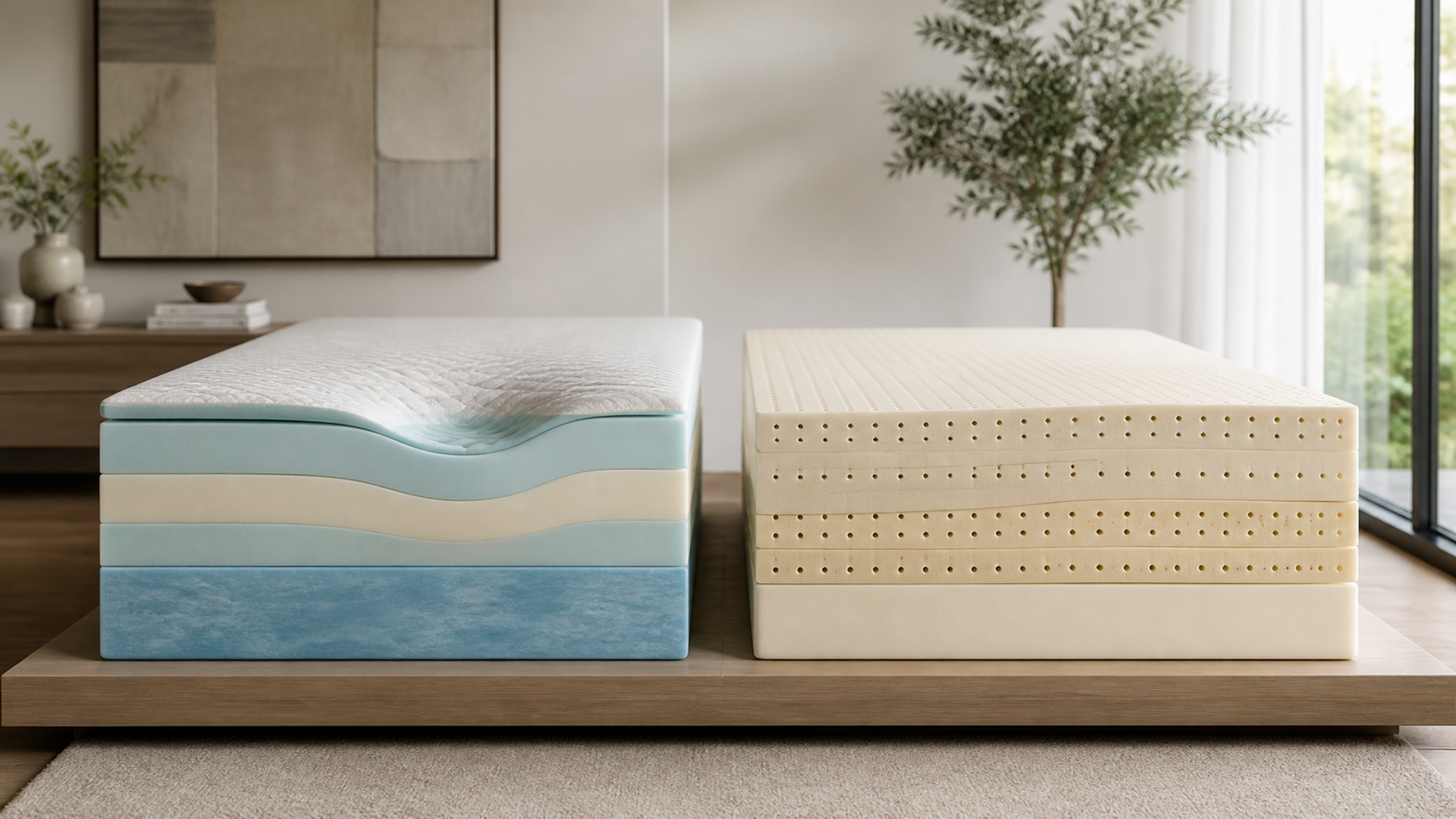
Memory foam is valued for slow contouring and pressure distribution; latex is valued for quicker resilience, buoyancy and easier movement. Those are useful tendencies, not universal outcomes. Density, firmness, layer thickness, perforation, cover, fire barrier, base, room temperature and body mass can make two mattresses in the same material family feel unrelated. Latex may be natural, synthetic or blended, and memory foam formulations vary widely. The sensible choice therefore relies on the exact layer specification, a realistic two-sleeper trial and return logistics, not a compressed handprint or a material badge.
Feel begins with response speed
Choose memory foam when deep contour, motion isolation and a slower, cradled feel support the sleeper without trapping unacceptable heat. Choose latex when resilient support, easier turning, edge usability and a more lifted feel are preferred. Choose by verified construction when layer thickness, density, firmness and trial terms explain more than the material label.
| Decision factor | Memory foam | Latex | Choose by verified construction |
|---|---|---|---|
| Response | Slow recovery can create a close contour | Fast resilience creates a buoyant feel | Test changing position |
| Pressure | Can spread load deeply | Can relieve pressure with more pushback | Map shoulder and hip comfort |
| Motion | Often isolates partner movement strongly | Can transmit more bounce by design | Run a two-person trial |
| Heat | Contour and formulation affect ventilation | Open-cell and perforated builds can feel airier | Test in the real climate |
| Edges | Soft contour can reduce usable perimeter | Resilience can support sitting and turning | Test the exact model |
| Weight and handling | Thick foam can be heavy and flexible | Latex can be very heavy | Audit delivery and rotation |
This memory foam vs latex mattress matrix is the article's working value object. Read the memory foam vs latex mattress rows together: the decisive failure mode depends on this topic's evidence, operating context and reader objective.
Material names hide different constructions
Evidence 1. Memory foam and latex are category terms covering multiple formulations, densities and layer systems.
Evidence 2. Temperature changes can affect the firmness and response of viscoelastic memory foam, so a brief showroom test may not reproduce the bedroom.
Evidence 3. Latex can be natural, synthetic or blended; percentage and certification claims should be read from current manufacturer documentation.
Evidence 4. Trial length, return handling, foundation requirements and body impressions are separate ownership facts from initial comfort.
Reader-visible sources checked for this article:
environment.ec.europa.eu — reader-visible current or official evidence
sleepproducts.org — reader-visible current or official evidence
For memory foam vs latex mattress, these sources establish only the claims inside their documented scope. Recheck every changeable specification, availability condition, price, policy or service term in the relevant market before acting.
Test temperature and movement together
For response, the first route works when slow recovery can create a close contour; the second requires fast resilience creates a buoyant feel. The control for the third is test changing position. Verify this row against the exact product, property, account or environment before it can reverse the decision.
The pressure row exposes a practical boundary. Route one assumes can spread load deeply, while route two is defensible only when can relieve pressure with more pushback. Route three depends on map shoulder and hip comfort. If that evidence is absent, keep the more reversible option.
Read motion as a stop/go test: often isolates partner movement strongly supports the first option; can transmit more bounce by design supports the second; and run a two-person trial supports the third. Record which source proves the condition and when it was checked.
A buyer can resolve heat without starting from a brand preference. Ask whether contour and formulation affect ventilation; compare that with whether open-cell and perforated builds can feel airier; then use test in the real climate as the third route's safeguard. An unknown condition stays unknown.
On edges, popularity is not enough. The evidence for option one is that soft contour can reduce usable perimeter. Option two means resilience can support sitting and turning. Option three is rational where test the exact model. Recheck any changeable term immediately before commitment.
The decision changes at weight and handling. Choose the first path only if thick foam can be heavy and flexible; move to the second when latex can be very heavy; use the third when audit delivery and rotation. Save the downside that would make this row fail.
Facts that would reverse the current choice
Reversal control 1 — Response. Before choosing Memory foam, write down how the decision changes if “Slow recovery can create a close contour” proves false. Do the same for Latex and “Fast resilience creates a buoyant feel”. Keep the Choose by verified construction route available until “Test changing position” is verified. This control belongs to memory foam vs latex mattress; update it from the cited source or exact supplier rather than copying a generic checklist.
Reversal control 2 — Pressure. Before choosing Memory foam, write down how the decision changes if “Can spread load deeply” proves false. Do the same for Latex and “Can relieve pressure with more pushback”. Keep the Choose by verified construction route available until “Map shoulder and hip comfort” is verified. This control belongs to memory foam vs latex mattress; update it from the cited source or exact supplier rather than copying a generic checklist.
Reversal control 3 — Motion. Before choosing Memory foam, write down how the decision changes if “Often isolates partner movement strongly” proves false. Do the same for Latex and “Can transmit more bounce by design”. Keep the Choose by verified construction route available until “Run a two-person trial” is verified. This control belongs to memory foam vs latex mattress; update it from the cited source or exact supplier rather than copying a generic checklist.
Reversal control 4 — Heat. Before choosing Memory foam, write down how the decision changes if “Contour and formulation affect ventilation” proves false. Do the same for Latex and “Open-cell and perforated builds can feel airier”. Keep the Choose by verified construction route available until “Test in the real climate” is verified. This control belongs to memory foam vs latex mattress; update it from the cited source or exact supplier rather than copying a generic checklist.
Reversal control 5 — Edges. Before choosing Memory foam, write down how the decision changes if “Soft contour can reduce usable perimeter” proves false. Do the same for Latex and “Resilience can support sitting and turning”. Keep the Choose by verified construction route available until “Test the exact model” is verified. This control belongs to memory foam vs latex mattress; update it from the cited source or exact supplier rather than copying a generic checklist.
Reversal control 6 — Weight and handling. Before choosing Memory foam, write down how the decision changes if “Thick foam can be heavy and flexible” proves false. Do the same for Latex and “Latex can be very heavy”. Keep the Choose by verified construction route available until “Audit delivery and rotation” is verified. This control belongs to memory foam vs latex mattress; update it from the cited source or exact supplier rather than copying a generic checklist.
Map pressure in sleep position
Spend at least fifteen minutes in each normal position with the usual pillow. Record shoulder, hip, lumbar and knee sensation after the body settles. For this memory foam versus latex mattress decision, record the exact item, environment, date, measurement and source in an evidence log. Separate observed behaviour from category shorthand, repeat the check under the conditions that matter, and price the downside of a wrong choice. If alignment fails despite pleasant softness, change firmness or construction. When that condition appears, reopen the choice instead of defending the original preference.
Measure movement effort
Turn, sit up and move to the edge repeatedly rather than lying still. Ask whether contour helps relaxation or creates resistance. For this memory foam versus latex mattress decision, record the exact item, environment, date, measurement and source in an evidence log. Separate observed behaviour from category shorthand, repeat the check under the conditions that matter, and price the downside of a wrong choice. If changing position wakes the sleeper, favour the more responsive surface. When that condition appears, reopen the choice instead of defending the original preference.
Run the partner test
Have the second sleeper enter, turn and leave while the first rests. Observe vibration, roll-together and usable width at both edges. For this memory foam versus latex mattress decision, record the exact item, environment, date, measurement and source in an evidence log. Separate observed behaviour from category shorthand, repeat the check under the conditions that matter, and price the downside of a wrong choice. If motion is the main disturbance, prioritise isolation over material preference. When that condition appears, reopen the choice instead of defending the original preference.
Recreate the climate
Use the normal protector, sheets, duvet, room temperature and ventilation. Repeat the trial after the mattress has warmed. For this memory foam versus latex mattress decision, record the exact item, environment, date, measurement and source in an evidence log. Separate observed behaviour from category shorthand, repeat the check under the conditions that matter, and price the downside of a wrong choice. If heat builds in the intended bedding system, revise the construction. When that condition appears, reopen the choice instead of defending the original preference.
Audit delivery and return
Measure stairs, turns, lift, frame and foundation, then read collection, compression and fee terms. Save the exact trial and body-impression threshold. For this memory foam versus latex mattress decision, record the exact item, environment, date, measurement and source in an evidence log. Separate observed behaviour from category shorthand, repeat the check under the conditions that matter, and price the downside of a wrong choice. If returning a heavy mattress is impractical, choose lower logistics risk. When that condition appears, reopen the choice instead of defending the original preference.
Four sleepers reverse the ranking
Side sleeper with sharp pressure
A suitable memory-foam build may provide deep contour, but alignment must remain stable. Define the fact that would reverse this recommendation before committing.
Combination sleeper
Latex resilience can make repeated turning easier. Define the fact that would reverse this recommendation before committing.
Light sleeper with active partner
Motion isolation may move memory foam ahead despite a warmer feel. Define the fact that would reverse this recommendation before committing.
Warm humid bedroom
Ventilation, protector and full construction need testing; the material label alone is insufficient. Define the fact that would reverse this recommendation before committing.
Action checklist
Read every layer.
Ask foam density.
Ask latex composition.
Verify firmness.
Use normal pillow.
Test all sleep positions.
Test turning.
Test the edge.
Run partner movement.
Recreate bedding.
Read return handling.
Verify foundation.
Continue the decision
The linked VERTU articles expand adjacent parts of the memory foam vs latex mattress decision. They do not substitute for the external evidence above.
The mattress-material verdict
Choose memory foam when deep contour, motion isolation and a slower, cradled feel support the sleeper without trapping unacceptable heat. Choose latex when resilient support, easier turning, edge usability and a more lifted feel are preferred. Choose by verified construction when layer thickness, density, firmness and trial terms explain more than the material label.
Keep the memory foam vs latex mattress decision reversible until its material cost, safety, access, privacy and compatibility facts are verified. Unknown evidence stays unknown; it is never silently scored as favourable.