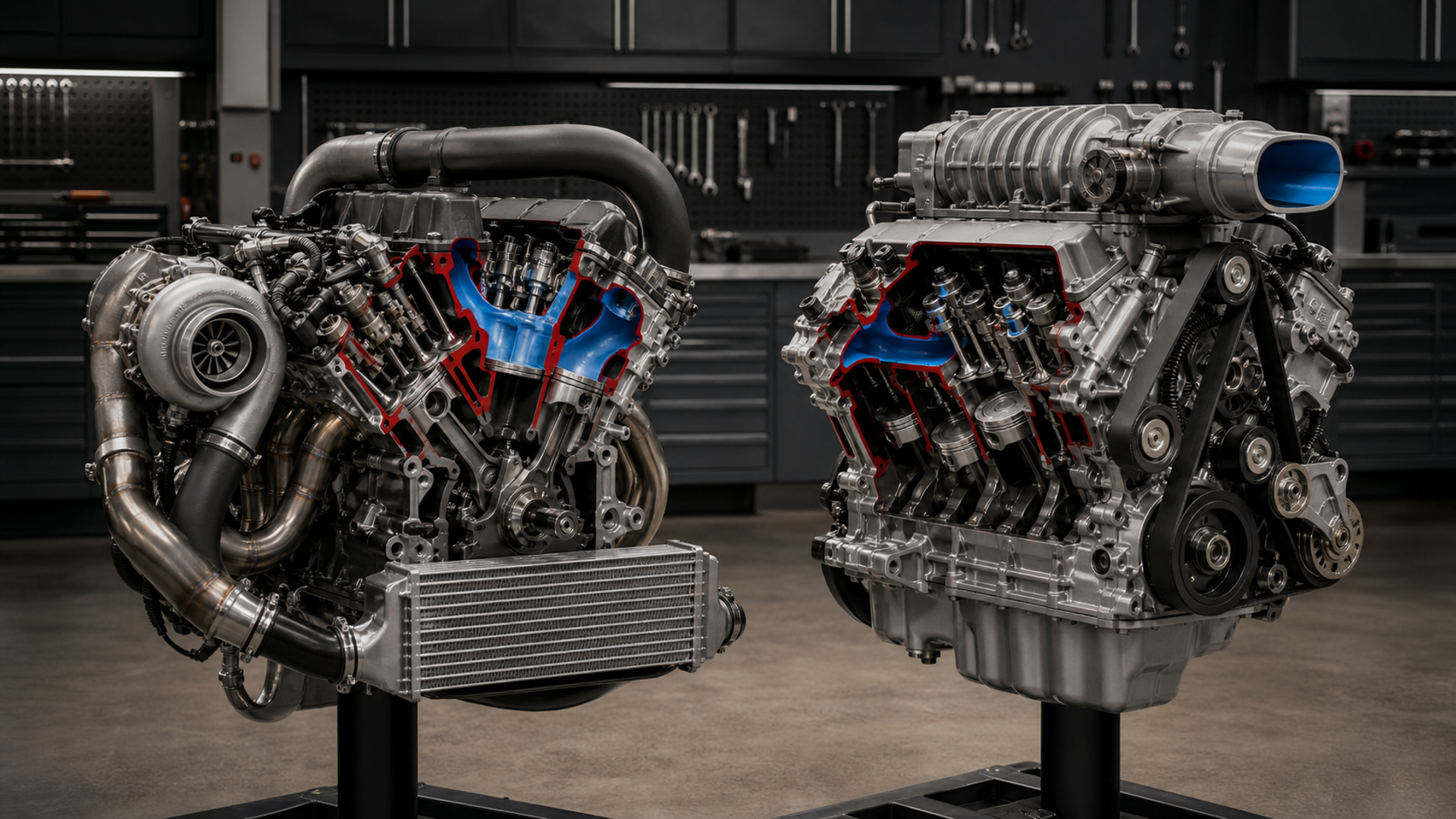
Turbochargers and superchargers both compress intake air, but they take the energy to do it from different places. A conventional turbo uses exhaust flow to drive a turbine; a conventional supercharger is mechanically driven by the engine. That distinction shapes response, efficiency, thermal management and packaging, yet it does not predict the character of every car. Electric assistance, variable geometry, twin-scroll housings, bypass control, gearing, hybrid motors and transmission calibration can narrow or reverse the stereotype. The useful choice is therefore not which component wins in isolation, but which complete powertrain delivers the response, durability and operating cost the driver values.
Begin with the energy path
Choose a turbocharged powertrain when broad efficiency, altitude resilience and strong mid-range torque are well integrated with cooling and transmission control. Choose a supercharged one when immediate, proportional response and a linear build of force matter enough to accept the mechanical load. Choose by the complete powertrain whenever electrification, calibration, vehicle mass or gearing changes the experience more than the compressor label.
| Decision factor | Turbocharger | Supercharger | Choose by full powertrain |
|---|---|---|---|
| Energy source | Recovers useful energy from exhaust flow | Takes mechanical power from the engine | Measure the complete system |
| Initial response | Depends on turbine, flow and control strategy | Can build boost directly with engine speed | Drive at low rpm in the real gear |
| Efficiency | Can improve downsized-engine load efficiency | Mechanical drive creates parasitic demand | Compare certified and real use |
| Heat | Adds concentrated exhaust-side heat | Adds charge heat and drive load | Inspect cooling architecture |
| Packaging | Needs exhaust routing, oil and charge plumbing | Needs drive, belt or gear space | Inspect service access |
| Character | Often builds a pronounced torque wave | Often feels proportional and immediate | Judge calibration, not mythology |
This turbo vs supercharger matrix is the article's working value object. Read the turbo vs supercharger rows together: the decisive failure mode depends on this topic's evidence, operating context and reader objective.
Boost hardware does not define the whole car
Evidence 1. A turbocharger couples an exhaust-driven turbine to a compressor, so turbine sizing, exhaust energy and control determine response.
Evidence 2. A mechanically driven supercharger can respond with engine speed but consumes crankshaft power and still needs charge-temperature control.
Evidence 3. Compressor type alone does not set reliability; lubrication, cooling, speed, materials, calibration, service history and operating temperature all matter.
Evidence 4. Modern hybrid assistance, electrically assisted boost and transmission logic can make category stereotypes unreliable.
Reader-visible sources checked for this article:
sae.org — reader-visible current or official evidence
garrettmotion.com — reader-visible current or official evidence
For turbo vs supercharger, these sources establish only the claims inside their documented scope. Recheck every changeable specification, availability condition, price, policy or service term in the relevant market before acting.
Trace response before peak output
The energy source row exposes a practical boundary. Route one assumes recovers useful energy from exhaust flow, while route two is defensible only when takes mechanical power from the engine. Route three depends on measure the complete system. If that evidence is absent, keep the more reversible option.
Read initial response as a stop/go test: depends on turbine, flow and control strategy supports the first option; can build boost directly with engine speed supports the second; and drive at low rpm in the real gear supports the third. Record which source proves the condition and when it was checked.
A buyer can resolve efficiency without starting from a brand preference. Ask whether can improve downsized-engine load efficiency; compare that with whether mechanical drive creates parasitic demand; then use compare certified and real use as the third route's safeguard. An unknown condition stays unknown.
On heat, popularity is not enough. The evidence for option one is that adds concentrated exhaust-side heat. Option two means adds charge heat and drive load. Option three is rational where inspect cooling architecture. Recheck any changeable term immediately before commitment.
The decision changes at packaging. Choose the first path only if needs exhaust routing, oil and charge plumbing; move to the second when needs drive, belt or gear space; use the third when inspect service access. Save the downside that would make this row fail.
For character, the first route works when often builds a pronounced torque wave; the second requires often feels proportional and immediate. The control for the third is judge calibration, not mythology. Verify this row against the exact product, property, account or environment before it can reverse the decision.
Facts that would reverse the current choice
Reversal control 1 — Energy source. Before choosing Turbocharger, write down how the decision changes if “Recovers useful energy from exhaust flow” proves false. Do the same for Supercharger and “Takes mechanical power from the engine”. Keep the Choose by full powertrain route available until “Measure the complete system” is verified. This control belongs to turbo vs supercharger; update it from the cited source or exact supplier rather than copying a generic checklist.
Reversal control 2 — Initial response. Before choosing Turbocharger, write down how the decision changes if “Depends on turbine, flow and control strategy” proves false. Do the same for Supercharger and “Can build boost directly with engine speed”. Keep the Choose by full powertrain route available until “Drive at low rpm in the real gear” is verified. This control belongs to turbo vs supercharger; update it from the cited source or exact supplier rather than copying a generic checklist.
Reversal control 3 — Efficiency. Before choosing Turbocharger, write down how the decision changes if “Can improve downsized-engine load efficiency” proves false. Do the same for Supercharger and “Mechanical drive creates parasitic demand”. Keep the Choose by full powertrain route available until “Compare certified and real use” is verified. This control belongs to turbo vs supercharger; update it from the cited source or exact supplier rather than copying a generic checklist.
Reversal control 4 — Heat. Before choosing Turbocharger, write down how the decision changes if “Adds concentrated exhaust-side heat” proves false. Do the same for Supercharger and “Adds charge heat and drive load”. Keep the Choose by full powertrain route available until “Inspect cooling architecture” is verified. This control belongs to turbo vs supercharger; update it from the cited source or exact supplier rather than copying a generic checklist.
Reversal control 5 — Packaging. Before choosing Turbocharger, write down how the decision changes if “Needs exhaust routing, oil and charge plumbing” proves false. Do the same for Supercharger and “Needs drive, belt or gear space”. Keep the Choose by full powertrain route available until “Inspect service access” is verified. This control belongs to turbo vs supercharger; update it from the cited source or exact supplier rather than copying a generic checklist.
Reversal control 6 — Character. Before choosing Turbocharger, write down how the decision changes if “Often builds a pronounced torque wave” proves false. Do the same for Supercharger and “Often feels proportional and immediate”. Keep the Choose by full powertrain route available until “Judge calibration, not mythology” is verified. This control belongs to turbo vs supercharger; update it from the cited source or exact supplier rather than copying a generic checklist.
Map the torque you actually use
Plot urban pull-away, motorway passing and sustained high-load driving rather than quoting peak horsepower. Test the same manoeuvres at matched speed, gear and temperature. For this turbo versus supercharger decision, record the exact item, environment, date, measurement and source in an evidence log. Separate observed behaviour from category shorthand, repeat the check under the conditions that matter, and price the downside of a wrong choice. If the preferred system only feels stronger after an unrealistic downshift, revise the judgement. When that condition appears, reopen the choice instead of defending the original preference.
Follow the heat
Locate turbine, intercooler, coolant circuits, oil feeds, shielding and intake path. Repeat a demanding drive and observe whether response fades after heat soak. For this turbo versus supercharger decision, record the exact item, environment, date, measurement and source in an evidence log. Separate observed behaviour from category shorthand, repeat the check under the conditions that matter, and price the downside of a wrong choice. If repeated performance changes materially, prioritise thermal capacity over the first acceleration. When that condition appears, reopen the choice instead of defending the original preference.
Price the service path
List oil specification, belt or drive service, hoses, intercooler access, labour and likely age-related seals. Request model-specific maintenance and failure evidence. For this turbo versus supercharger decision, record the exact item, environment, date, measurement and source in an evidence log. Separate observed behaviour from category shorthand, repeat the check under the conditions that matter, and price the downside of a wrong choice. If access turns a routine component into major labour, recalculate ownership cost. When that condition appears, reopen the choice instead of defending the original preference.
Use altitude and load honestly
Record passengers, towing, climate and elevation because air density and sustained load alter the brief. Compare the exact vehicle under the hardest normal condition. For this turbo versus supercharger decision, record the exact item, environment, date, measurement and source in an evidence log. Separate observed behaviour from category shorthand, repeat the check under the conditions that matter, and price the downside of a wrong choice. If cooling or response falls outside that condition, choose the better integrated powertrain. When that condition appears, reopen the choice instead of defending the original preference.
Separate sound from speed
Evaluate throttle response, noise, torque shape and objective acceleration as separate observations. Repeat blind passenger impressions where practical. For this turbo versus supercharger decision, record the exact item, environment, date, measurement and source in an evidence log. Separate observed behaviour from category shorthand, repeat the check under the conditions that matter, and price the downside of a wrong choice. If theatre is being mistaken for usable response, restate the priority. When that condition appears, reopen the choice instead of defending the original preference.
Four roads expose four answers
Dense urban traffic
Predictable low-speed response and transmission behaviour can matter more than headline output. Define the fact that would reverse this recommendation before committing.
High-altitude touring
Forced induction can preserve performance, but cooling and calibration still set the usable result. Define the fact that would reverse this recommendation before committing.
Repeated mountain passes
Thermal recovery and braking context reveal more than a single launch. Define the fact that would reverse this recommendation before committing.
Long-term ownership
Parts access, maintenance records and model-specific failure patterns can outweigh compressor preference. Define the fact that would reverse this recommendation before committing.
Action checklist
Identify compressor architecture.
Map torque by engine speed.
Test low-rpm response.
Repeat after heat soak.
Inspect cooling.
Inspect oil and drive service.
Check altitude use.
Check towing load.
Compare certified consumption.
Read model-specific maintenance.
Price likely labour.
Write the reversal condition.
Continue the decision
The linked VERTU articles expand adjacent parts of the turbo vs supercharger decision. They do not substitute for the external evidence above.
The forced-induction verdict
Choose a turbocharged powertrain when broad efficiency, altitude resilience and strong mid-range torque are well integrated with cooling and transmission control. Choose a supercharged one when immediate, proportional response and a linear build of force matter enough to accept the mechanical load. Choose by the complete powertrain whenever electrification, calibration, vehicle mass or gearing changes the experience more than the compressor label.
Keep the turbo vs supercharger decision reversible until its material cost, safety, access, privacy and compatibility facts are verified. Unknown evidence stays unknown; it is never silently scored as favourable.