

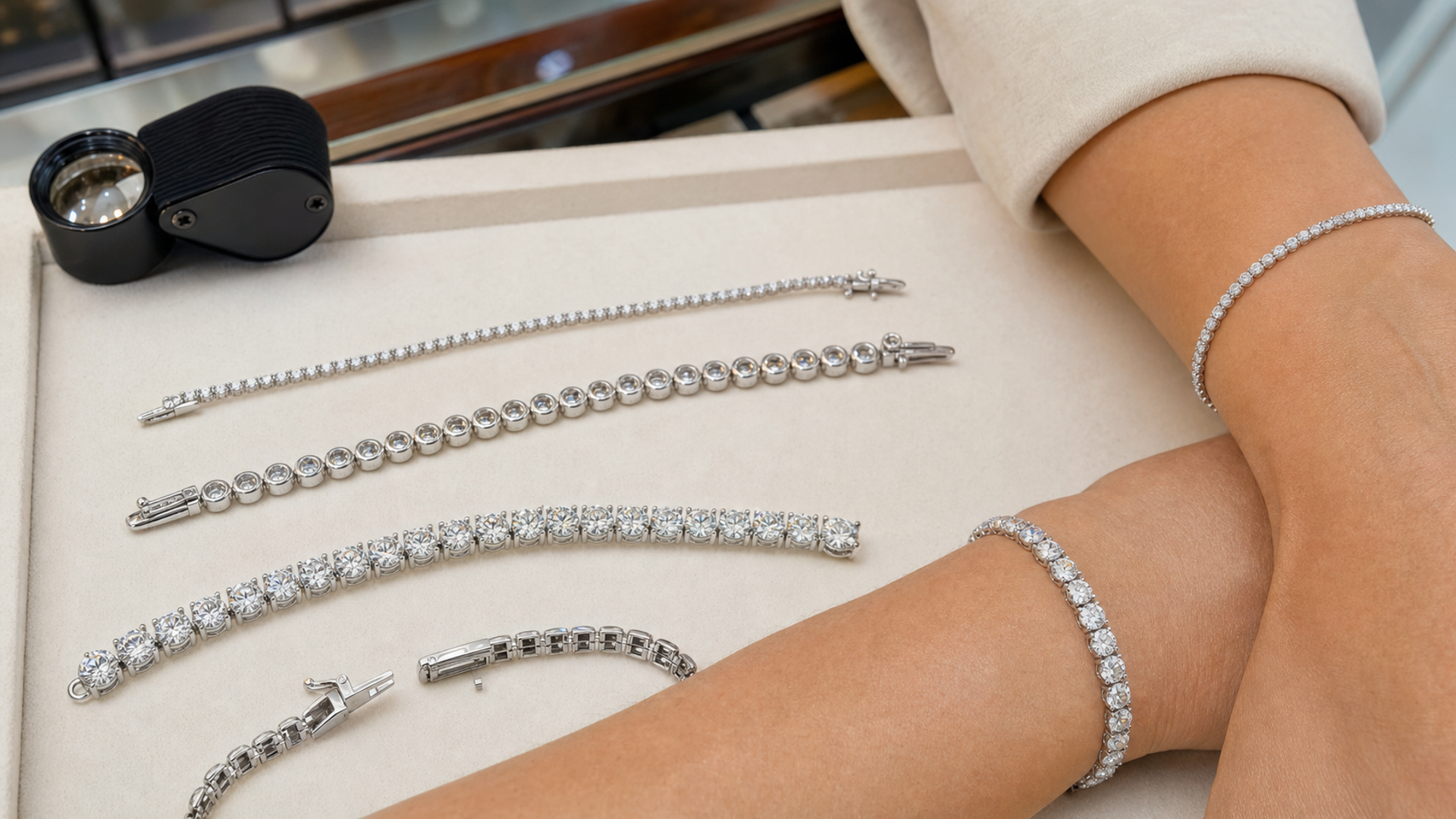
The best tennis bracelet is not automatically the one with the highest total carat weight. It is the bracelet whose diamonds look consistent, whose setting protects them, whose clasp and safety system suit your routine, and whose length moves without turning over. For most buyers, cut consistency, secure construction and correct fit create more visible and practical value than paying for colour or clarity grades that are difficult to distinguish at wrist distance.
This 2026 tennis-bracelet buying guide explains how to compare natural and laboratory-grown diamonds, total carat weight, settings, metal, clasp, certification and daily wear. It does not rank unverified products or invent price bands; jewellery prices change with diamond origin, grade, metal, craftsmanship and seller terms.
Quick buying answer
Choose a classic line bracelet in 14k or 18k gold or platinum with well-matched stones, a secure box clasp and an additional safety mechanism. Prioritise lively, consistent appearance over chasing a single grade. Confirm whether the diamonds are natural or laboratory-grown, ask how total carat weight is distributed, inspect the setting from every angle and make sure the bracelet can rotate slightly without flipping.
For a first tennis bracelet, a flexible four-prong or well-made shared-prong line is the familiar choice. Bezel settings offer more edge protection and a modern outline, though they show more metal and can reduce the uninterrupted line of sparkle. Three-prong settings can look light and bright but demand careful construction and inspection.
Tennis bracelet decision matrix
| Decision | Better for everyday wear | Better for maximum visual impact | What to verify |
|---|---|---|---|
| Diamond priority | Consistent cut and matching appearance | Higher total carat weight with excellent matching | Origin, quality range and return policy |
| Setting | Four-prong or bezel with robust links | Fine shared or three-prong line | Stone security and underside finish |
| Metal | 14k gold for durability; platinum for density and white colour | 18k gold for richer colour and luxury feel | Hallmark, alloy and maintenance |
| Fit | One finger of ease, controlled movement | Looser drape for evening styling | Wrist measurement and flip tendency |
| Clasp | Box clasp plus safety catch or safety chain | Low-profile clasp that preserves the line | Independent opening test |
| Documentation | Item specification and grading evidence where available | Independent reports for significant stones | Report numbers and treatment disclosure |
Start with the 4Cs, then adapt them to a line of stones
GIA defines the 4Cs as cut, colour, clarity and carat weight. Its diamond buying guidance explains that cut affects brilliance, colour measures the presence or absence of colour, clarity considers inclusions and blemishes, and carat is a weight measurement. Those principles still apply to a bracelet, but dozens of small diamonds create a different evaluation problem from one centre stone.
Consistency becomes crucial. A line bracelet can look uneven when neighbouring stones differ visibly in brightness, colour or diameter. One weak stone interrupts the rhythm. Ask to see the bracelet under neutral daylight-equivalent lighting as well as jewellery-store spotlights. Move it slowly and look for sections that go dark or yellow relative to the rest.
For small round diamonds, sellers may quote a quality range rather than an individual report for every stone. That can be reasonable, but the description should still identify diamond origin, total weight, approximate colour and clarity range, metal and treatment disclosures. Significant stones or high-value pieces may have independent grading documentation. GIA’s current tennis-bracelet guide notes that high-quality bracelets often come with reports that provide independent evaluation.
Cut consistency usually beats invisible clarity
At ordinary viewing distance, life and uniformity tend to matter more than microscopic differences. A technically high-clarity line can still look dull if proportions or matching are weak. Conversely, eye-clean stones with strong light return can create a convincing continuous line.
Do not use “cut” as a vague promise. Ask how the stones were matched and whether you can compare two bracelets with the same total carat weight. Tilt each under diffuse light, not just concentrated spotlights. Look for even flashes across the full circumference.
Clarity still matters when inclusions affect transparency, durability or consistency. Colour matters more in white metal and at larger stone sizes because differences are easier to see. Yellow or rose gold can change the visual relationship. The best balance is an aesthetic decision supported by accurate description, not a universal grade formula.
Total carat weight is not stone size
Tennis bracelets are commonly sold by total carat weight, meaning the combined weight of all stones. Two bracelets with the same total can look different if one uses fewer larger stones and the other uses more smaller stones, or if their lengths differ.
Ask for four numbers: total carat weight, number of diamonds, bracelet length and approximate individual stone size. A seven-inch bracelet and a six-inch bracelet with the same total weight do not distribute the diamonds in the same way. Nor does a bezel setting expose the same visual diameter as a fine-prong setting.
GIA emphasises that carat is weight, not a direct measurement of visible size. Use photographs on a wrist of a similar circumference, but also try the bracelet in person if possible. Camera distance and bright lighting can exaggerate scale.
Natural versus laboratory-grown diamonds
Both natural and laboratory-grown diamonds are diamonds, but origin, disclosure, pricing behaviour and buyer preference differ. The choice should be explicit. A seller should not use ambiguous language such as “real” to avoid stating origin.
Natural diamonds may appeal to buyers who value geological origin, rarity narratives and established secondary-market conventions. Laboratory-grown diamonds can provide a larger visual presence for the budget, but prices and resale expectations differ. Neither origin excuses weak cutting, mismatched stones or poor construction.
Ask whether any stone has been treated. The US Federal Trade Commission’s jewellery guidance requires accurate representation and disclosure of material treatments; its Jewelry Guides history explains why treatments that significantly affect value should be disclosed. Buyers outside the United States should also check local consumer rules.
Setting architecture determines wearability
Four-prong
Four-prong baskets provide a familiar balance of visibility and retention. Inspect whether prongs are even, smooth and substantial enough for daily wear. Run a soft cloth over the bracelet; snagging can reveal rough finishing or a lifted prong.
Shared-prong or three-prong
These settings can create a lighter, more continuous line because less metal appears around each stone. They also place more responsibility on fewer points of contact. The quality of links, joint movement and prong finishing becomes critical.
Bezel
A bezel surrounds the stone edge with metal, offering protection and a clean contemporary look. It can be a good choice for an active wearer or someone who dislikes snagging. The trade-off is more visible metal and a different sparkle profile.
Turn the bracelet over. The underside should be comfortable, smoothly finished and flexible without feeling loose. Each link should articulate freely but not twist excessively. Sharp edges, visible solder irregularities or inconsistent gaps deserve explanation.
The clasp is a safety system, not a detail
A tennis bracelet contains many moving parts and can carry substantial value. The clasp should close positively and resist accidental opening. A box clasp with a side safety catch is common; some designs add a safety chain or double locking element.
Test the clasp yourself several times. It should not require such force that you bend the bracelet, nor release with casual pressure. Ask whether the clasp can be serviced separately and whether the manufacturer stocks replacement components.
Check the hinge and the links nearest the clasp because they often receive concentrated wear. A beautiful line with a weak closure is not a good daily bracelet.
Fit: measure the wrist, then test movement
Measure the wrist where the bracelet will sit with a flexible tape. Add enough ease for movement, usually so one finger can fit beneath, but personal preference and stone size matter. A very loose bracelet can flip, strike surfaces and catch; a tight one can bind at the clasp and feel uncomfortable as the wrist changes through the day.
Try it with the clothing you wear. Cuffs, watches and other bracelets alter movement. If stacking, prevent hard jewellery edges from repeatedly hitting the diamond settings. Diamonds resist scratching but can chip through impact, and diamonds can scratch other diamonds. GIA’s care guidance recommends periodic professional inspection because stones can loosen.
Metal changes colour, weight and maintenance
Fourteen-carat gold contains a higher share of alloy than 18k gold and is often chosen for durability. Eighteen-carat gold has a richer precious-metal content and colour. White gold may require periodic rhodium maintenance depending on its finish and wear. Platinum is naturally white and dense, developing a patina rather than losing colour plating, but it feels heavier and is usually priced differently.
There is no universally superior choice. Match the metal to skin preference, existing jewellery, desired weight and maintenance tolerance. Ask about nickel or other alloy sensitivity if relevant.
A seven-point inspection before purchase
Confirm natural or laboratory-grown origin in writing.
Record total carat weight, diamond count, quality range and bracelet length.
Inspect matching under diffuse and spot lighting.
Test every link, the clasp and all safety elements.
Look at the underside for comfort and finishing.
Review resizing, returns, warranty, repairs and replacement-stone policy.
Obtain documentation, receipt photographs and independent appraisal when appropriate.
Do not rely on a grading report alone. A report describes stones; it does not prove that the bracelet fits, that the clasp is secure or that the workmanship is durable.
For a closer look at what clarity grades actually change, read the VVS versus VS diamond clarity guide. Buyers comparing metal colour can use the white gold versus platinum guide.
Care, insurance and long-term ownership
Clean the bracelet using the maker’s instructions. Warm water, mild soap and a soft brush are often suitable for untreated diamonds in conventional gold or platinum settings, but mixed gemstones, treatments and finishes may require different care. Avoid making a universal cleaning recommendation for an unknown piece.
Have the links, prongs and clasp inspected periodically, especially after an impact. Store the bracelet separately so its diamonds do not scratch other jewellery. For a significant purchase, ask an insurer what documentation and valuation basis are required before taking it out of the store.
Final verdict
The best tennis bracelet is a matched, lively and secure line that fits your wrist and your routine. Buy the construction before the carat headline: verify origin and treatments, compare total weight in context, inspect every link and clasp, and choose a setting you can maintain. A bracelet that stays comfortable and secure through ordinary days is better luxury than a larger one you are afraid to wear.
Sources
GIA, Tennis Bracelet Buying Guide, accessed 2 August 2026.
GIA, How to Buy a Diamond, accessed 2 August 2026.
GIA, What Are the 4Cs?, accessed 2 August 2026.
US Federal Trade Commission, Jewelry Guides treatment disclosure update, accessed 2 August 2026.
![How to Scan Receipts and Documents with Your Phone [Full Guide]](https://cdn.sanity.io/images/e0gp1l2g/production/0db13feec1d5e72b8a8a5f976d1f3e86619c9228-3840x1860.webp?w=180&h=180&q=78&auto=format&fit=crop)
![How to Scan Receipts and Documents with Your Phone [Full Guide]](https://cdn.sanity.io/images/e0gp1l2g/production/0db13feec1d5e72b8a8a5f976d1f3e86619c9228-3840x1860.webp?w=800&h=450&q=82&auto=format&fit=crop)
![Top 10 Two-Tone Carbon-Fibre Watches for Men [2026 List]](https://cdn.sanity.io/images/e0gp1l2g/production/18870799ba33fab0e038968359cd5772d7d7db30-1024x576.webp?w=800&h=450&q=82&auto=format&fit=crop)
![Top 10 Luxury Watches with Digital Complication Displays for Men [Latest]](https://cdn.sanity.io/images/e0gp1l2g/production/c4f6bf8c080f291c39f7cc85c7344ecff2fd3799-1024x553.webp?w=800&h=450&q=82&auto=format&fit=crop)