

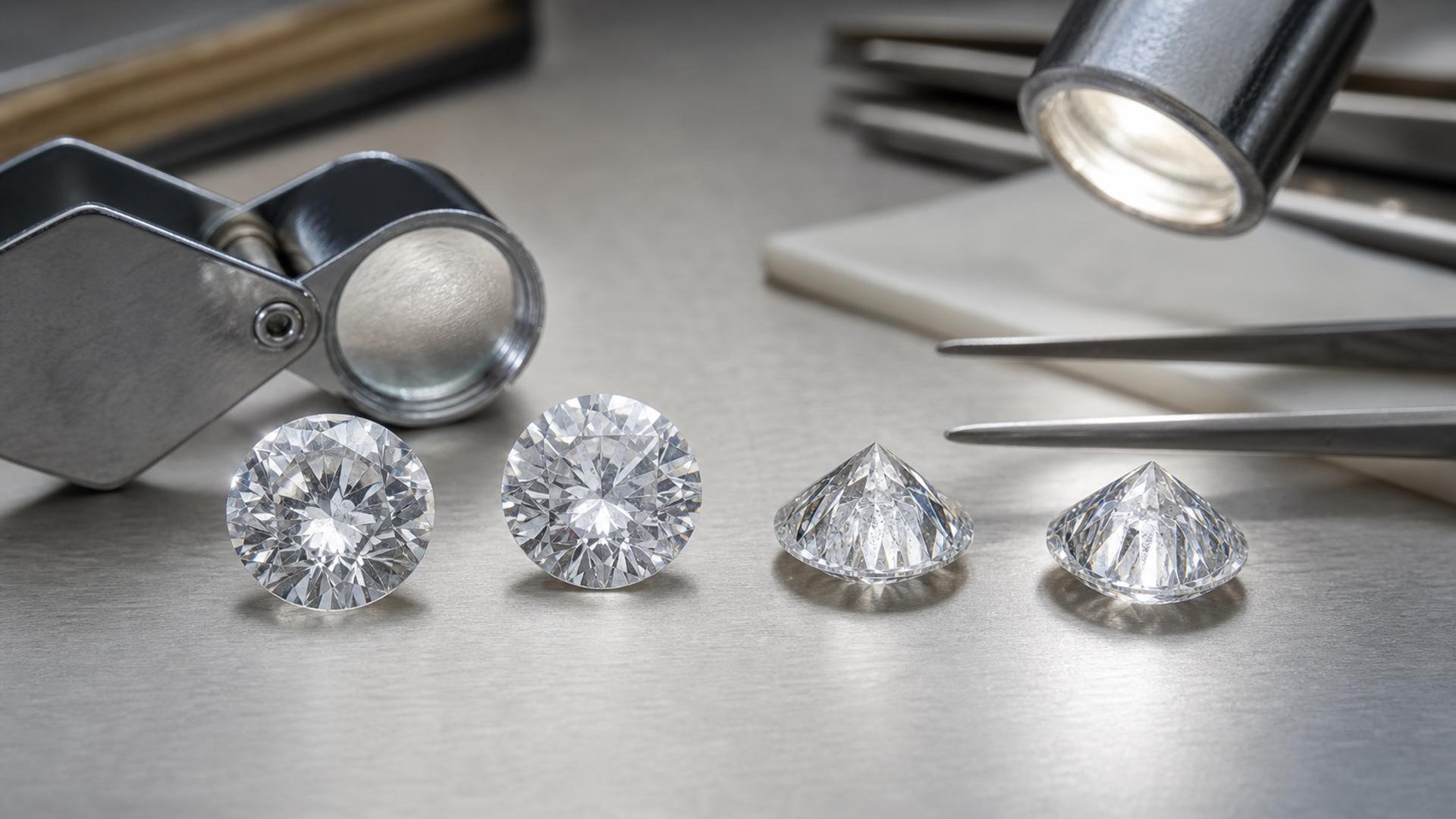
For most engagement rings and everyday jewellery, a well-chosen VS1 or VS2 diamond offers the better balance of appearance and price. VVS1 and VVS2 diamonds contain inclusions that are difficult for a skilled grader to see at 10× magnification, while VS inclusions range from difficult to somewhat easy to see at 10×. In many face-up viewing conditions, both can appear clean to the unaided eye. Pay for VVS when rarity, documentation, collecting preference or a particularly revealing shape matters—not because the initials automatically make the diamond more beautiful.
VVS vs VS in one table
| Grade family | GIA definition at 10× | Typical unaided-eye appearance | Best reason to buy |
|---|---|---|---|
| VVS1 | Minute inclusions extremely difficult for a skilled grader to see | Usually eye-clean | Rarity, high-spec collection or personal preference |
| VVS2 | Minute inclusions very difficult to see | Usually eye-clean | Similar rarity with slightly lower price than VVS1 |
| VS1 | Minor inclusions difficult to see | Commonly eye-clean | High confidence for many shapes and sizes |
| VS2 | Minor inclusions somewhat easy for a grader to see | Often eye-clean, but inspect stone-specific location | Strong value when the inclusion is unobtrusive |
These descriptions do not predict every diamond. Clarity is assigned by size, number, position, nature and relief of characteristics. Two VS2 stones can look different, and one may be a far better purchase.
What the grade actually measures
GIA’s clarity guide explains that grading is performed at 10× magnification and that the scale contains eleven grades. VVS means “very, very slightly included”; VS means “very slightly included.” The grade describes the relative absence of inclusions and blemishes under standard grading conditions.
It does not grade sparkle. Cut quality controls how facets return light and can have a larger visual effect than moving one or two clarity grades. It does not grade colour, carat weight or origin. A VVS diamond with weak proportions can look less lively than a well-cut VS diamond.
Clarity also does not guarantee durability. Most VVS and VS inclusions are not structural concerns, but the nature and position of a characteristic matter. A grading report and professional inspection are more informative than the grade alone.
Why the difference is often invisible
The grading environment is deliberately more demanding than ordinary viewing. A skilled grader uses magnification, controlled lighting and a systematic search. An unaided observer sees the diamond face-up, at a normal distance, while it is moving and reflecting light. Tiny characteristics can disappear in that visual activity.
Shape changes visibility. Brilliant-cut diamonds break up reflections and often hide small inclusions effectively. Step-cut shapes such as emerald and Asscher cuts have broad, open facets that can reveal characteristics more readily. Larger diamonds can also make inclusions easier to see because the stone provides a larger window.
Location matters. A dark crystal under the table may be more apparent than a pale pinpoint near the edge. An inclusion near the girdle may be hidden by a prong, though setting decisions should be made by a qualified jeweller because some locations need care.
The correct question is not “Is VS2 eye-clean?” It is “Is this VS2 diamond eye-clean to me, from the top and side, at my normal viewing distance and under several lighting conditions?”
Clarity value ladder
Use this sequence before spending more:
Choose a cut quality and shape that create the visual performance you want.
Set a colour range appropriate to the metal, shape and personal sensitivity.
Choose the size range and face-up dimensions.
Find the lowest clarity grade that meets your eye-clean and durability requirements.
Compare the price of moving to VVS with what the same budget buys in cut, size or setting quality.
This prevents clarity from absorbing money that would create a larger visible improvement elsewhere.
For example, moving from VS1 to VVS2 may produce no visible change without magnification, while the same budget could improve cut precision or move to a slightly larger face-up spread. Conversely, a buyer creating a tightly specified high-jewellery piece may value VVS documentation even when the appearance is similar.
When VVS is worth paying for
You value rarity as part of ownership
Higher clarity is rarer, and rarity influences price. Some buyers enjoy owning a diamond whose minute inclusions are difficult even for a grader to find. That is a legitimate collecting preference if it is conscious.
The diamond is large or has an open step cut
A larger emerald-cut diamond can reveal characteristics more readily. VVS may provide additional confidence, although a clean VS1 can still be excellent. Inspect actual videos and the stone in person rather than applying a universal minimum.
Documentation is central to the brief
For a high-spec gift, heirloom or matched suite, the grading specification may be part of the object’s story. Consistent VVS grades can matter to the commission even when the unaided-eye difference is small.
The price premium is modest
Inventory is irregular. Occasionally a VVS stone is priced close to a comparable VS stone because of other factors. Compare the complete specification rather than assuming a fixed percentage premium.
When VS is the smarter choice
The stone is eye-clean in real viewing
If a VS1 or VS2 diamond has no visible inclusion from the top at your agreed distance, higher clarity will not make that specific view cleaner.
Cut and proportions need the budget
GIA’s diamond quality overview emphasises that value is a combination of the 4Cs. Sacrificing cut quality to preserve VVS initials is usually a poor visual trade.
The setting protects or disguises the characteristic
A well-placed prong may obscure a benign inclusion near the edge. This must be planned with the jeweller; hiding an inclusion should never create setting stress.
The jewellery will be worn daily
Daily pieces acquire surface wear, require cleaning and are seen at normal distance. A clean VS stone often delivers the intended visual result while leaving budget for a secure, well-made setting.
A stone-by-stone inspection protocol
| Check | What to request | Why it matters |
|---|---|---|
| Independent report | Report number and issuing laboratory | Confirms measured grade and characteristics |
| Face-up video | Neutral light, no heavy editing | Shows whether inclusions distract during movement |
| Side view | Pavilion and girdle visible | Reveals characteristics hidden face-up |
| Inclusion plot/comments | Match to the physical stone | Helps locate and understand grade-setting features |
| Lighting comparison | Diffuse daylight and spotlight | Separates transparency from sparkle |
| Eye-clean definition | Distance, vision standard and viewing side | Prevents seller and buyer using different meanings |
| Return period | Written, sufficient for inspection | Allows independent verification |
GIA’s buyer guide recommends a grading report because subtle quality differences may be impossible to identify reliably without laboratory evaluation. Verify that the report number and physical characteristics match the stone.
Natural and laboratory-grown diamonds
Do not assume that the same clarity shorthand always appears in the same way on every report. GIA announced a move to descriptive quality terminology for laboratory-grown diamonds, and reporting practices can evolve. Confirm the report type, date and terminology. Natural versus laboratory-grown origin is a separate decision from whether inclusions are visible.
Clarity characteristics can occur in both. Origin, disclosure, price behaviour and resale expectations should be discussed separately rather than smuggled into a VVS-versus-VS comparison.
For that broader decision, read our moissanite vs diamond cost and durability guide. If the question is origin rather than clarity, compare lab-grown and natural diamond rings.
Mounted diamonds require extra caution
A setting can hide part of the girdle and pavilion, limit weighing and make some characteristics harder to inspect. If the diamond already sits in jewellery, ask whether the grading report was issued before setting and whether the report number can be verified. A qualified appraiser can assess whether the mounted stone appears consistent with the document, but some conclusions may require removal.
Do not accept destructive testing or unapproved unsetting during an ordinary sales inspection. Clarify responsibility for damage, insurance and resetting before any work begins. For an important purchase, the ability to inspect a loose centre stone before final setting is often more useful than paying for one additional clarity grade.
Common buying mistakes
Treating VVS as a synonym for better sparkle.
Rejecting every VS2 without inspecting the actual inclusion.
Buying from a highly magnified image and forgetting normal viewing distance.
Ignoring cut, transparency and face-up dimensions.
Accepting “eye-clean” without defining from which angle and distance.
Assuming a grading report proves beauty rather than recorded characteristics.
Paying a rarity premium that was never part of the buyer’s goal.
Before final payment, compare at least two stones with the same shape, similar dimensions and similar cut quality. A grade-to-grade comparison is meaningful only when the other variables are controlled. Otherwise the brighter stone may be winning because of cut or proportion rather than clarity.
Final verdict
VVS is a rarity and specification choice. VS is often the appearance-and-value choice. Start with cut, inspect the individual diamond and define eye-clean in writing. If a VS stone looks clean in the conditions that matter, the VVS premium buys microscopic rarity rather than a visible upgrade. That can be worthwhile—but only when you know that is what you want.
![How to Scan Receipts and Documents with Your Phone [Full Guide]](https://cdn.sanity.io/images/e0gp1l2g/production/0db13feec1d5e72b8a8a5f976d1f3e86619c9228-3840x1860.webp?w=180&h=180&q=78&auto=format&fit=crop)
![How to Scan Receipts and Documents with Your Phone [Full Guide]](https://cdn.sanity.io/images/e0gp1l2g/production/0db13feec1d5e72b8a8a5f976d1f3e86619c9228-3840x1860.webp?w=800&h=450&q=82&auto=format&fit=crop)
![Top 10 Two-Tone Carbon-Fibre Watches for Men [2026 List]](https://cdn.sanity.io/images/e0gp1l2g/production/18870799ba33fab0e038968359cd5772d7d7db30-1024x576.webp?w=800&h=450&q=82&auto=format&fit=crop)
![Top 10 Luxury Watches with Digital Complication Displays for Men [Latest]](https://cdn.sanity.io/images/e0gp1l2g/production/c4f6bf8c080f291c39f7cc85c7344ecff2fd3799-1024x553.webp?w=800&h=450&q=82&auto=format&fit=crop)