

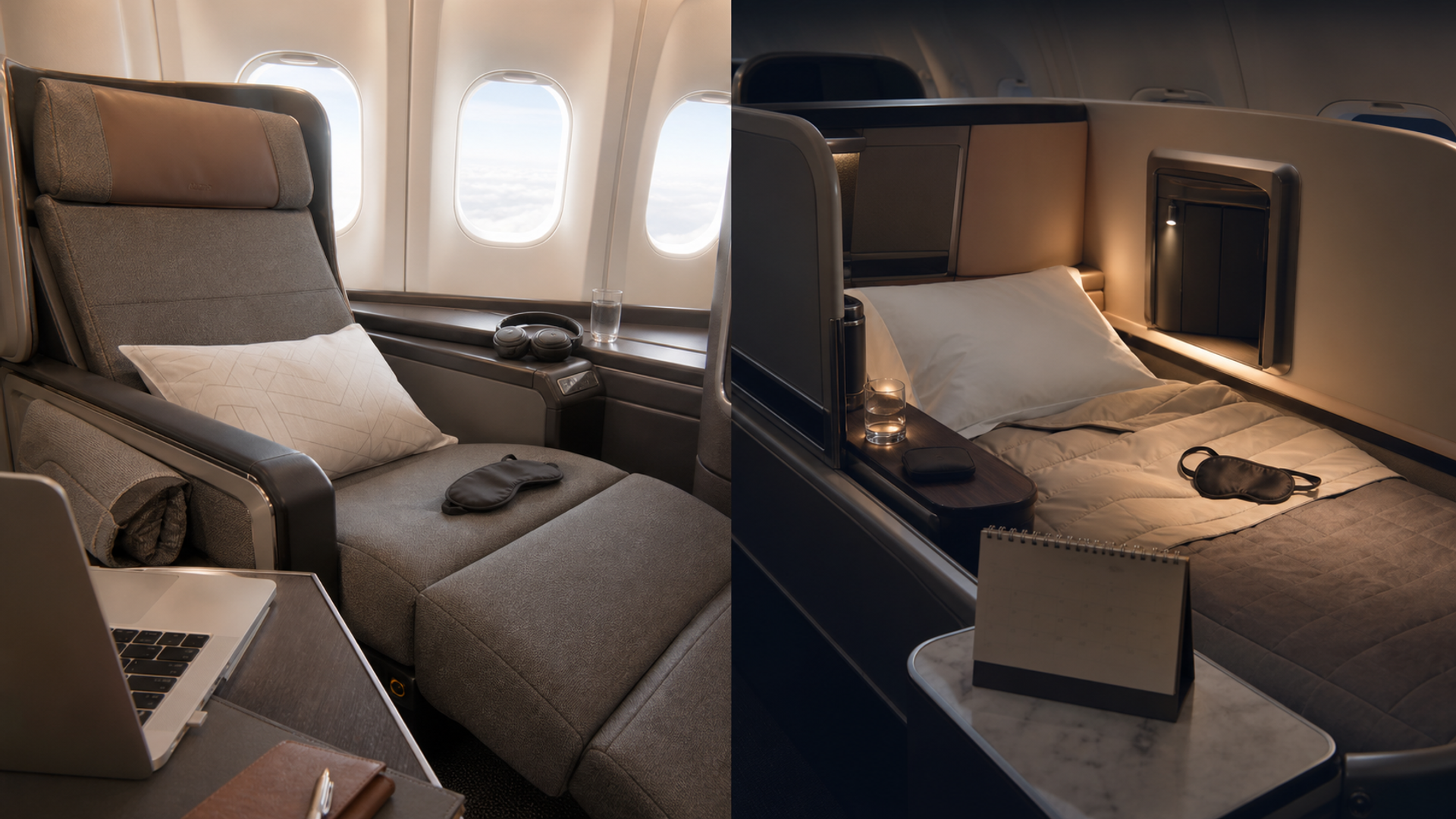
Delta Premium Select is usually the rational upgrade when you need more personal space, a calmer meal and a better chance of resting without paying for a bed. Delta One becomes the stronger choice when sleep, direct aisle access, lounge time and next-day performance have a real financial or personal value. The decision is less about which cabin is “better” and more about what the journey must protect.
This Delta Premium Select vs Delta One guide compares the seat, sleep, airport experience, service and fare gap. Aircraft configuration matters, so confirm the exact flight before paying: Delta’s own fleet pages show that cabins and seat dimensions vary by aircraft.
Quick verdict
Choose Delta Premium Select when the flight is daytime, the fare gap is large, you can tolerate a recliner and you mainly want width, legroom and a more deliberate service than the main cabin. Choose Delta One when the flight crosses a sleep window, the arrival day is important, privacy matters, or a missed night of sleep would cost more than the upgrade.
The most useful number is not the ticket difference alone. Divide the extra fare by the number of hours in which Delta One gives you something Premium Select cannot: a flat sleeping surface, easier aisle access, a more protected workspace or a useful lounge interval. That “cost per protected hour” makes unlike fares easier to compare.
Delta Premium Select vs Delta One at a glance
| Decision factor | Delta Premium Select | Delta One | Who should care most |
|---|---|---|---|
| Seat | Wider recliner with greater pitch than economy | Lie-flat seat; layout varies by aircraft | Tall travellers and overnight flyers |
| Sleep | Improved posture, but still seated | Horizontal sleep is possible | Anyone landing before a demanding day |
| Privacy | More separation than main cabin | Higher privacy, strongest in suite-equipped aircraft | Solo travellers and confidential work |
| Aisle access | May require stepping past a neighbour | Commonly direct, but verify aircraft | Light sleepers and frequent movers |
| Airport | Premium check-in benefits vary; no equivalent lounge proposition | Lounge and premium-ground benefits may apply by itinerary | Long connections and disruption-prone trips |
| Service | Elevated meal and amenity presentation | More individualised premium service | Travellers who value pacing and quiet |
| Best value | Day flights and moderate fare gaps | Overnight sectors and high-value arrival days | Buyers comparing outcome, not prestige |
Start with the aircraft, not the cabin name
The same label can produce a different experience across the fleet. Delta’s Boeing 767-300ER layout, for example, publishes aircraft-specific cabin dimensions and seat counts. Newer Delta One suites and older lie-flat products should not be treated as interchangeable, while Premium Select can also differ in shell, screen and storage.
Before purchase, open the seat map for the exact flight number and date. Look for three things: whether Delta One is a suite or a more open lie-flat seat, whether every passenger has direct aisle access, and where Premium Select sits relative to galleys and lavatories. Then repeat the check after any schedule-change email. An equipment swap can change the value of the upgrade without changing the cabin name on the ticket.
This is also why broad photographs from a search result are weak evidence. Use Delta’s current Premium Select overview and Delta One overview, then verify the operating aircraft. A codeshare needs an additional check because the operating airline controls the hard product.
Seat and personal space: recliner versus bed
Premium Select changes the geometry of sitting. More pitch, a wider seat, a leg or foot support and a smaller cabin can reduce the physical friction of a long flight. It is particularly persuasive for travellers who can sleep upright, prefer a window and do not need to move repeatedly. The improvement is meaningful, but the body remains in a seated position.
Delta One changes the category of the seat. A lie-flat surface allows side sleeping and removes the sustained hip angle of a recliner. Direct aisle access can also matter more than another inch of width: it lets a traveller stand, use the lavatory or speak with crew without coordinating with a neighbour. On an overnight flight, those freedoms protect both sleep and dignity.
Do not assume that a bed guarantees good sleep. Seat location, cabin temperature, turbulence, meal timing and your own sleep habits remain decisive. A traveller who stays awake to work may gain less from Delta One than someone who can decline part of the service, convert the seat early and sleep for four uninterrupted hours.
Sleep value is about the arrival, not the departure
The cleanest way to judge an overnight upgrade is to work backwards from the first fixed commitment after landing. If you arrive at 07:00 and lead a negotiation at 11:00, the flight is part of the workday. If you arrive for a quiet hotel afternoon, Premium Select may leave enough recovery time.
Build a simple arrival ledger:
Mark the realistic sleep window after take-off, meal service and descent.
Estimate how much of that window you can use in a recliner and in a flat bed.
Add time recovered from easier boarding, baggage or lounge access only when the itinerary actually includes those benefits.
Give the following day a value: replaceable leisure time, a family event, or a commercial commitment.
Compare that value with the fare difference.
This method avoids paying for a premium label on a flight where the useful sleep window is only two hours. It also explains why a six-hour eastbound red-eye can justify Delta One more readily than a ten-hour daytime westbound sector.
Airport, lounge and disruption value
Ground benefits can be worth more than the meal in the air. A long connection offers time to work, shower, eat or reset. A short connection offers little lounge value, even when entry is included. Check the fare, status and airport rules rather than assuming every Delta One itinerary produces the same access.
Disruption changes the calculation again. Premium handling does not remove weather or air-traffic delays, but a quiet place to work and a more protected service channel can make a long irregular-operation day less costly. The value is highest for travellers who need power, privacy and a stable place to reorganise the next leg.
Eligible VERTU clients may also use human Concierge support to coordinate suitable ground transport, dining or itinerary changes around a premium trip, subject to availability and service terms. That support can complement airline channels; it cannot replace Delta’s operational decisions and cannot guarantee seats, upgrades, lounge admission or recovery outcomes. The cabin should still be chosen on its own merits.
For a wider route-level view, compare the best business-class airlines by seat, lounge and journey time. The Singapore Airlines Premium Economy vs Business guide shows how the same decision framework changes with another carrier and fleet.
Service, food and the risk of overvaluing theatre
Premium Select generally creates a more intentional meal and amenity experience than the main cabin. Delta One adds more space, courses and personal pacing. Those differences can make a long flight feel calmer, but food should rarely carry the upgrade decision by itself. Menus change, individual dishes vary and a late departure can make a long service actively reduce sleep.
For an overnight flight, ask whether you will eat in the lounge, eat quickly onboard or skip the main meal. If the answer is “sleep as soon as possible”, the bed and service pacing matter; the menu is secondary. On a daytime flight, a better meal and workspace may represent a larger share of the value because you intend to stay awake.
A fare-gap test you can reuse
Suppose Premium Select costs $1,600 return and Delta One costs $3,400, a difference of $1,800. If the itinerary contains two overnight sectors and Delta One protects three useful hours on each, the upgrade costs $300 per protected hour. That may be rational before two critical workdays, but excessive for a holiday with recovery time.
Now suppose the difference falls to $900. The same six protected hours cost $150 each. The answer changes even though the seats do not. Always compare the live fare, cancellation terms and loyalty earnings together; a restrictive bargain can be worse than a flexible lower cabin.
Avoid pretending that mileage has a fixed cash value. Use the value you actually receive from your programme and the alternatives available on the same dates. If an award ticket creates a poor schedule or a risky self-connection, the nominal saving can disappear.
Who should choose each cabin?
Premium Select is usually the better fit for a couple on a daytime flight, a leisure traveller with an easy arrival day, or a buyer whose upgrade gap would otherwise pay for several hotel nights. It also makes sense when the operating aircraft offers a particularly good recliner and Delta One is an older configuration at a high fare.
Delta One is usually the better fit for a solo traveller on an overnight sector, someone who must arrive functional, a passenger who needs frequent aisle access, or a traveller with a long connection that makes the ground benefits useful. It becomes less compelling when the sleep window is short, the cabin is an older open layout or the fare difference is disproportionate.
Final decision
Delta Premium Select wins on disciplined value: it buys measurable space and calmer service without forcing you to pay for a bed you may not use. Delta One wins when the bed, aisle access, privacy and ground experience protect an outcome that matters after landing.
Check the aircraft, calculate the protected hours, price the arrival day and review the fare conditions. If those four checks point in the same direction, the upgrade decision is no longer a guess.
Sources
Delta, Delta Premium Select, accessed 1 August 2026.
Delta, Delta One, accessed 1 August 2026.
Delta, Boeing 767-300ER aircraft page, accessed 1 August 2026.


![Top 10 Luxury Smartwatches for Business Travel [2026]](https://cdn.sanity.io/images/e0gp1l2g/production/8b5e5b21db42a1c5f040e828bd041857353a8eb2-2560x1382.webp?w=800&h=450&q=82&auto=format&fit=crop)