

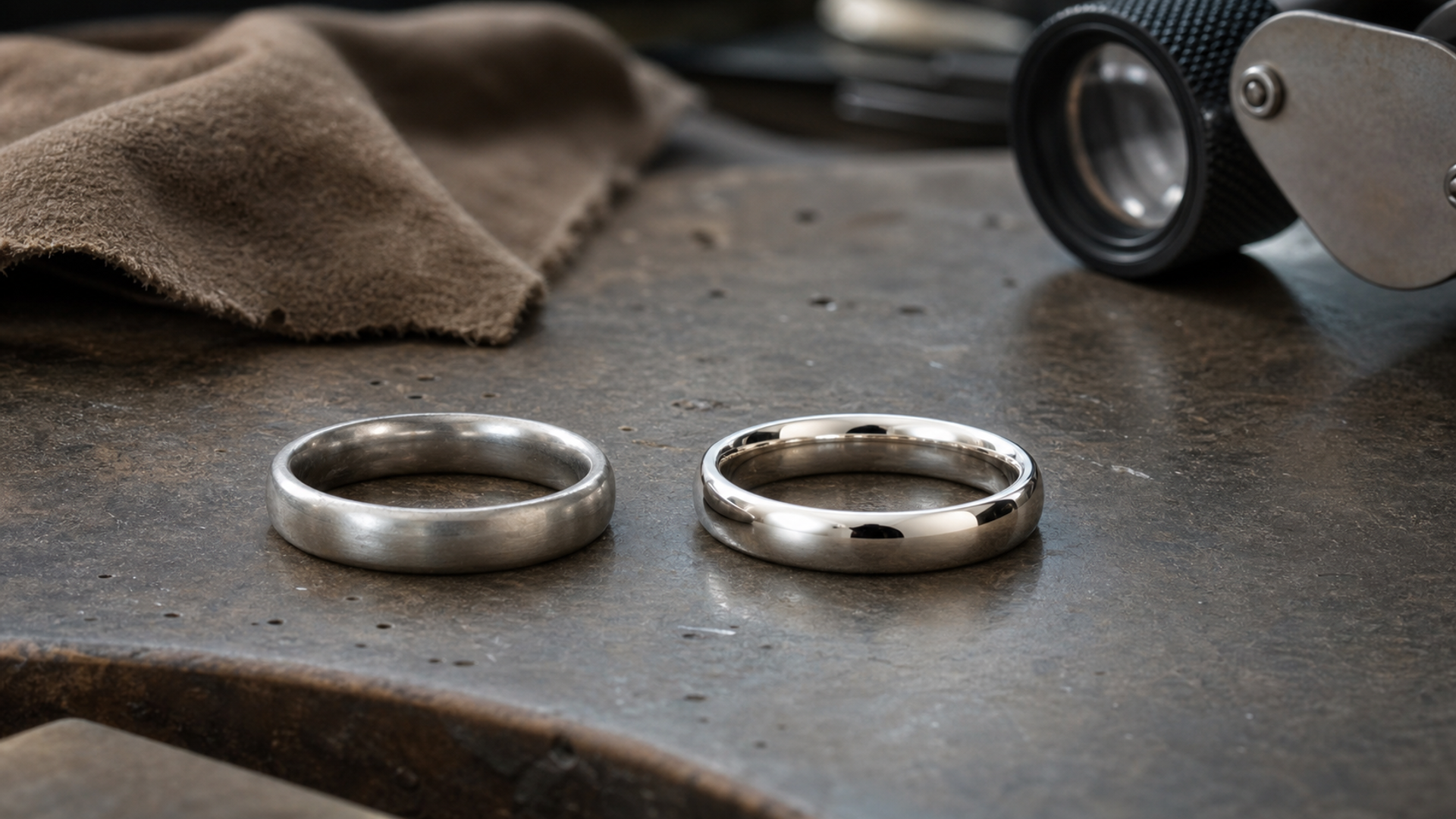
Platinum is usually the better lifetime-ring metal for someone who wants a naturally white colour, substantial feel and no rhodium-plating cycle. White gold is usually the better choice for someone who wants a lighter ring, a lower initial price and a bright, highly polished appearance that can be renewed. Both can hold precious stones securely for decades when the ring is properly engineered and maintained; neither eliminates inspection, wear or repair.
The choice is complicated because showroom pieces often look almost identical. Most white gold is an alloy of gold and white metals and is commonly rhodium plated to produce a crisp white surface. Platinum used in jewellery is a naturally white metal, usually sold at a high fineness. Years later, the two metals tend to age differently. That future appearance—not the first five minutes under display lighting—is where the decision should begin.
Lifetime-ring decision matrix
| Factor | White gold | Platinum | What changes the answer |
|---|---|---|---|
| Colour | Often rhodium plated for a bright white finish | Naturally grey-white | Whether the owner accepts plating maintenance |
| Weight | Lighter at comparable dimensions | Denser and noticeably heavier | Comfort preference and ring width |
| Surface wear | Scratches and plating wear can expose warmer alloy | Develops a soft patina and displaced-metal marks | Whether high polish or patina is preferred |
| Initial cost | Usually lower for a comparable design | Usually higher because of density, fineness and fabrication | Metal weight and labour, not spot price alone |
| Skin sensitivity | Alloy and solder composition must be checked | High-fineness platinum is often selected when nickel sensitivity is a concern | Individual sensitivity and the complete component list |
| Repair | Widely repairable by skilled jewellers | Requires platinum-capable tools and technique | Access to an experienced local workshop |
| Setting behaviour | Strong, practical and familiar to workshops | Prongs can wear by displacement rather than metal loss, but still need service | Design, prong dimensions and workmanship |
| Long-term maintenance | Cleaning, inspection and possible replating | Cleaning, inspection and optional repolishing | Owner’s desired finish and service interval |
The colour is only identical when new
White gold is not a single colour. Its alloy may be slightly warm, grey or cool depending on the metals used. Rhodium plating creates the brilliant white finish many buyers associate with new engagement rings. The coating is thin and gradually wears at the palm, edges and other contact points. The underlying colour can then become visible, sometimes within months for hard wear and sometimes after years.
Platinum is white through the material, so there is no contrasting coating to wear away. It does not remain mirror-bright automatically. Fine scratches diffuse the surface and create a softer grey patina. Some owners consider that a beautiful record of use; others prefer periodic refinishing. A couple choosing a wedding set should view an aged platinum sample and a white-gold sample with plating wear before deciding which maintenance story feels acceptable.
Rhodium replating is not inherently a defect. It is a planned service, like refinishing a watch case. The problem arises when the owner was never told about it, cannot access the original finish or discovers that frequent polishing is altering fine detail.
Weight and comfort are personal
Platinum is dense. A platinum ring made to the same dimensions as a white-gold ring will feel heavier. In a slim band the difference may be modest; in a wide or stone-intensive design it can be immediately noticeable. Some buyers equate the weight with permanence and quality. Others find it tiring, especially when the ring rotates on a tapered finger.
White gold allows a physically substantial design at a lower weight. That can help large centre stones or wide bands feel more balanced. But “lighter” must not become “thin”. Compare the cross-section at the base of the shank, the thickness beneath stones and the mass around the shoulders. A heavily hollowed ring can be uncomfortable and difficult to repair regardless of metal.
Try the ring with the intended wedding band. Two rings can trap moisture, rub against each other and alter balance. Small differences in profile often matter more to daily comfort than a metal’s marketing reputation.
Scratches, patina and metal movement
All precious-metal rings scratch. White gold may retain a high-polish look well, depending on alloy hardness, but the rhodium surface will mark and wear. During refinishing, a jeweller polishes the metal and applies new plating. Repeated aggressive polishing removes material and can soften edges, so it should be done deliberately rather than whenever a hairline appears.
Platinum is often described as “moving” rather than simply wearing away when scratched: a mark can displace metal and create raised edges. That characteristic contributes to its patina and can support long-term setting life, but it does not make platinum immune to thinning. Prongs still abrade, galleries still distort and rings still require rebuilding after enough wear.
Finish choice can reduce visual anxiety. Brushed, hammered and satin surfaces accommodate ordinary marks differently from mirror polish. Ask whether the workshop can recreate the chosen finish after a resize or repair.
Stone security depends on engineering
Metal is only one part of stone security. Prong thickness, angle, bearing cut, gallery support, stone shape and the wearer’s routine determine risk. Platinum is respected for secure settings, particularly in fine prongs, but a poorly cut or underbuilt platinum prong is not safer than a well-made white-gold one. White gold has a long service history in engagement jewellery and can be excellent when the alloy and design are appropriate.
Inspect the ring from the side. A very high centre stone may be vulnerable to impact. Sharp corners on emerald, pear and marquise cuts need protection. Pavé set into an ultra-thin band leaves little repair reserve. If a ring will be worn during travel, gym work or childcare, a lower basket or bezel may improve real-world security more than changing metal.
Ask the jeweller how the ring will be inspected. A useful answer identifies prongs, stone movement, shank thickness and previous solder joints. “Platinum never loses metal” or “white gold is stronger” is too vague to guide a lifetime purchase.
Skin sensitivity and alloy disclosure
High-fineness platinum is often chosen by people concerned about nickel exposure, but no online guide can diagnose an allergy. White-gold alloys differ by manufacturer and country; some use nickel, while others use palladium or alternative systems. Solder, spring components and resizing material may also differ from the main ring body.
Request the complete alloy and component specification where sensitivity is known. “18K white gold” tells you the gold percentage, not the identity of every remaining metal. A rhodium coating can initially separate skin from the underlying alloy, but wear may expose it. Consultation with a qualified clinician is appropriate for a history of contact dermatitis.
Platinum purity marks and local hallmark rules should also be read carefully. A stamp is evidence of claimed fineness, not an assessment of craftsmanship or biocompatibility.
Cost: calculate the finished ring and service path
Platinum rings often cost more because a comparable ring uses more metal by weight, the alloy is high-fineness and fabrication can demand specialised labour. White gold usually starts lower and may allow more budget for the stone or a stronger setting. Market prices alone do not predict the retail difference.
Add expected service. White gold may need rhodium replating if a bright white appearance is essential. Platinum may need optional refinishing if the owner dislikes patina. Both need cleaning, inspection, resizing where possible and occasional structural repair. Ask for local service prices and whether work must return to the original maker.
Insurance valuations should name the metal and construction accurately. Keep the invoice, hallmark photographs, stone report and repair history. The most expensive ring to own is often the one whose design makes ordinary maintenance difficult.
Resizing and future repair
Finger size can change over decades. Plain bands are generally easier to resize than full-eternity settings, patterned shanks and rings with stones around the circumference. White gold requires colour and alloy matching plus replating after some work. Platinum requires a jeweller who controls heat and contamination correctly and can restore the finish.
Before purchase, ask the feasible resizing range. If the answer is “not resizable”, understand the replacement strategy. A lifetime ring should have a documented service future, especially when the design is proprietary or the owner may live in several countries.
The same applies to wedding-band pairing. Rings made from different metals can wear each other where they rub. A small spacer, matched profile or periodic inspection can prevent unexpected thinning.
Where VERTU’s craft lens is relevant
VERTU’s product knowledge base describes a craft philosophy centred on material selection, detailed finishing and serviceable ownership, including one-craftsman assembly for Signature V. That does not make VERTU a ring authority, and it does not change the independent white-gold-versus-platinum verdict. The relevant connection is the same discipline: judge a luxury object by material disclosure, construction, finish and aftercare rather than by a premium label alone.
Questions to settle before ordering
Is the white-gold ring rhodium plated, and what colour is the alloy beneath it?
Does the buyer prefer platinum patina or a renewable bright-white finish?
Is the extra platinum weight comfortable in the exact ring width?
What alloy metals, solders and findings contact the skin?
Is the stone setting thick enough for decades of inspection and rebuilding?
Can the ring be resized, and by how much?
Who can service the piece in the owner’s likely countries of residence?
What does replating, refinishing and prong rebuilding cost?
Will an adjacent band rub against the ring?
Does the invoice state fineness, weight, stones and treatments clearly?
Verdict
Choose platinum for natural white colour, satisfying weight and an ageing process that produces patina without a plating cycle. Choose white gold for lower initial cost, lighter feel and a brilliant white surface that can be renewed. A well-proportioned ring in either metal can become a lifetime piece. Put construction, comfort and a credible repair path ahead of the assumption that one metal is permanently “better”.
Related VERTU reading
Our gold versus platinum durability guide applies similar questions to earrings. The 2026 luxury watches and jewellery trends guide covers the wider collector context.
![How to Scan Receipts and Documents with Your Phone [Full Guide]](https://cdn.sanity.io/images/e0gp1l2g/production/0db13feec1d5e72b8a8a5f976d1f3e86619c9228-3840x1860.webp?w=180&h=180&q=78&auto=format&fit=crop)
![How to Scan Receipts and Documents with Your Phone [Full Guide]](https://cdn.sanity.io/images/e0gp1l2g/production/0db13feec1d5e72b8a8a5f976d1f3e86619c9228-3840x1860.webp?w=800&h=450&q=82&auto=format&fit=crop)
![Top 10 Two-Tone Carbon-Fibre Watches for Men [2026 List]](https://cdn.sanity.io/images/e0gp1l2g/production/18870799ba33fab0e038968359cd5772d7d7db30-1024x576.webp?w=800&h=450&q=82&auto=format&fit=crop)
![Top 10 Luxury Watches with Digital Complication Displays for Men [Latest]](https://cdn.sanity.io/images/e0gp1l2g/production/c4f6bf8c080f291c39f7cc85c7344ecff2fd3799-1024x553.webp?w=800&h=450&q=82&auto=format&fit=crop)