

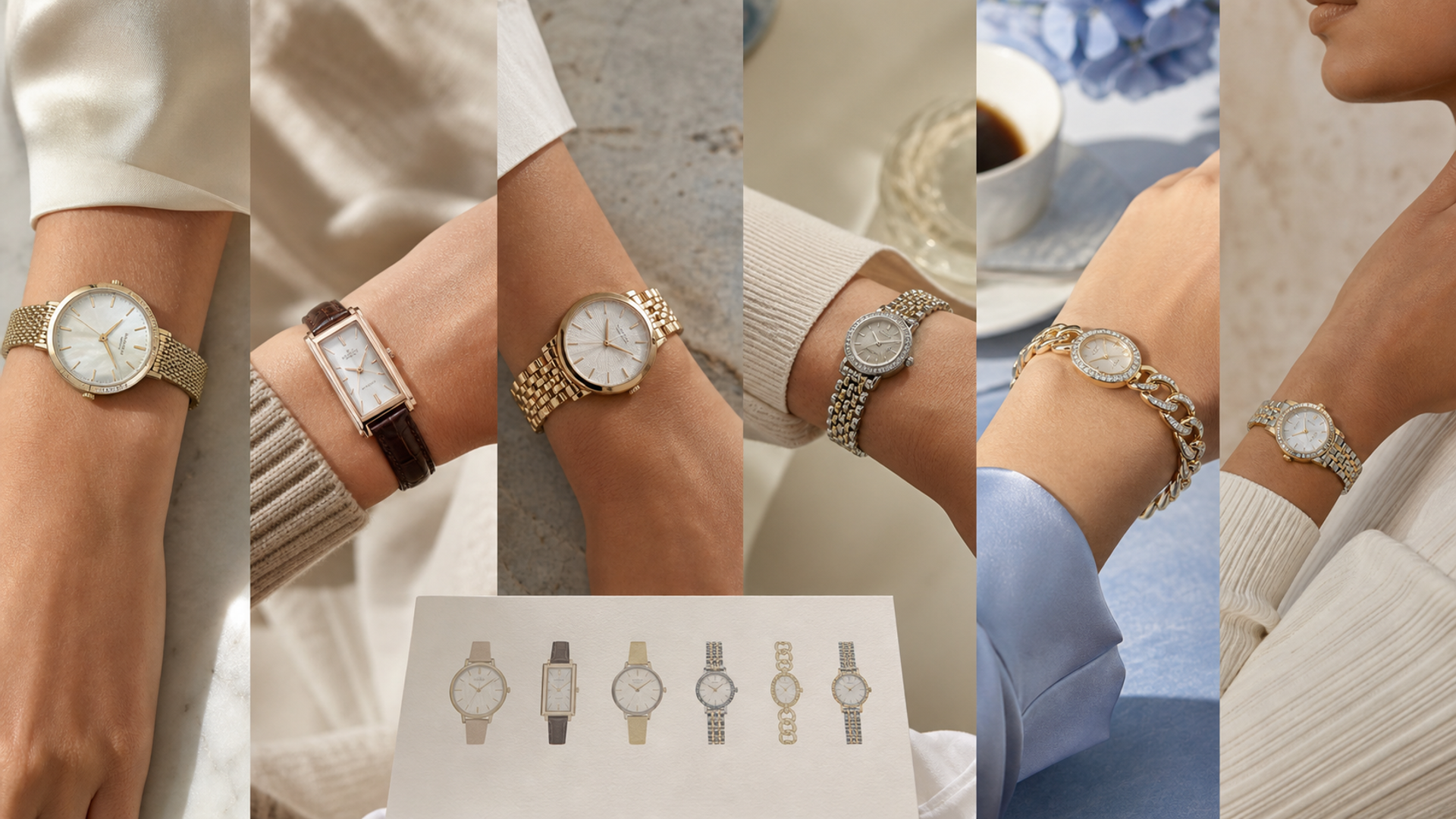
The best luxury watch for a woman is not automatically the smallest version of a men’s model or the one with the most diamonds. It is the watch whose shape, weight, movement, bracelet and level of formality fit the wearer’s actual week. A rectangular hand-wound watch, a compact steel sports watch and a sculptural jewellery watch solve different problems; they should not be ranked as though they were substitutes.
This 2026 guide builds a shortlist by use rather than status. It covers round and shaped cases, mechanical and quartz movements, bracelet comfort, dial legibility and the service questions that matter after the boutique experience is over.
The shortlist at a glance
| Wearer need | Strong model family to inspect | Why it belongs on the list | Check before buying |
|---|---|---|---|
| One elegant everyday watch | Cartier Tank or Panthère families | Distinct shape and strong day-to-evening range | Bracelet fit, water exposure and movement type |
| Classic mechanical daily wear | Rolex Lady-Datejust or smaller Oyster Perpetual | Robust case-and-bracelet proposition with clear sizing choices | Availability, dial legibility and total price |
| Modern versatile sports watch | Omega Aqua Terra or Constellation families | Broad size and material choices with mechanical options | Exact calibre, thickness and clasp comfort |
| Reversible design and engraving potential | Jaeger-LeCoultre Reverso | Shaped case with a strong design identity | Wrist curvature and manual-winding routine |
| Jewellery-first statement | Bulgari Serpenti | Bracelet-like presence and sculptural form | Weight, sizing, service and styling frequency |
| Quiet craft choice | Grand Seiko smaller references | Dial and finishing interest without broad recognition | Case height, bracelet articulation and local service |
The table is a starting point, not a claim that every reference suits every buyer. Collections change and some configurations may not be available in all markets. Inspect the current official catalogue and try the exact reference.
Choose the case shape before the brand
Round watches are easy to compare by diameter, but diameter alone is an incomplete fit measure. Lug-to-lug length, thickness, crown position and bracelet drop determine how a watch sits. A 36 mm round case with long lugs can wear larger than a compact rectangular case whose dimensions look greater on paper.
Rectangular and tonneau watches create a different relationship with the wrist. Cartier’s current women’s watch selection shows how Tank, Panthère and other shaped families use proportion as part of the design. The correct size should look intentional at both arm’s length and close range; it should not merely cover the most wrist possible.
Photograph each candidate in three conditions: with bare wrist, beneath the cuff most often worn, and at the distance another person sees it. Boutique mirrors and close-up phone lenses can exaggerate scale. A neutral photograph is a better ownership preview.
Mechanical, quartz or hand-wound?
Movement choice is a lifestyle decision. An automatic watch suits someone who enjoys a mechanical object, wears it regularly and accepts periodic service. Quartz can be the more sophisticated answer for a slim jewellery watch that must remain ready after weeks in a drawer. Hand-wound movements create a deliberate ritual and can support elegant proportions, but they require participation.
Do not let movement snobbery override the intended use. If the watch is for formal evenings twice a month, a precise quartz movement may remove friction. If the buyer wants to observe finishing, discuss calibres and build a collection, a mechanical movement offers more engagement.
Ask what the service centre will replace, whether water resistance is restored after work, and how long the expected intervention takes. A movement that is technically impressive but unsupported in the owner’s region can become an inconvenience.
For a deeper comparison, the automatic versus quartz movement guide separates maintenance, precision and use rather than treating one technology as inherently superior.
Bracelet and strap comfort decides repeated wear
A luxury bracelet should articulate around the wrist without pinching, pulling hair or forcing the clasp off-centre. Removable links need to produce a precise fit; a bracelet that is one link too loose can rotate, while one too tight becomes uncomfortable in heat. Micro-adjustment is especially valuable for travel and seasonal changes.
Leather straps can make a shaped watch feel lighter and more formal, but sweat, humidity and water shorten their life. Consider the cost and availability of replacements. Integrated bracelets and proprietary straps may create a coherent design but reduce flexibility.
Try the watch for at least fifteen minutes. Bend the wrist, type, lift a bag and fasten a coat. A crown or case edge that feels minor in a static pose can become the reason the watch stays at home.
Six useful watch profiles
Cartier Tank or Panthère: the design-led choice
Tank references reward buyers who want architectural clarity and a watch that works with tailoring, knitwear and evening clothes. Panthère leans more overtly towards jewellery through its flexible bracelet and polished presence. The choice is not simply rectangular versus bracelet: compare how much visual formality the wearer wants on an ordinary day.
Check movement type, water-resistance guidance and how polished surfaces will acquire marks. Fine scratches are part of normal ownership, but a buyer who expects a permanently mirror-like finish may be happier with a more brushed sports design.
Rolex Lady-Datejust or Oyster Perpetual: the classic daily path
The Rolex Lady-Datejust collection combines a date display with a range of dial, bezel, bracelet and metal choices. A smaller Oyster Perpetual can provide a cleaner time-only alternative. Both should be judged by wrist fit and dial readability rather than recognisability alone.
Availability is a hard gate. Do not build a decision around an uncertain allocation or a secondary-market premium that makes the purchase uncomfortable. Compare authorised and verified channels, and document reference, condition and warranty.
Omega Aqua Terra or Constellation: the versatile modern option
Omega’s women’s watch catalogue spans sport, dress and jewellery-oriented designs. Aqua Terra references can serve as water-capable everyday watches, while Constellation offers a more distinctive integrated design language. The exact size, calibre and material determine the experience.
Magnetic resistance and chronometer testing may matter for a mechanical daily watch, but thickness and weight matter every hour. Put the specification sheet behind the wrist test, not ahead of it.
Jaeger-LeCoultre Reverso: the shaped mechanical choice
The Reverso’s rotating case gives it a functional origin and a distinctive canvas. Some owners value the possibility of engraving or a second display; others simply prefer the geometry. The case can appear long on a small wrist, so compare length and curvature rather than choosing by width.
Manual-winding versions suit a wearer who enjoys a daily ritual. Confirm how the selected movement is operated and serviced, and avoid forcing the mechanism or case.
Bulgari Serpenti: the jewellery-first decision
Serpenti is closer to wearable sculpture than a neutral round watch. That is its strength. It can replace a bracelet rather than accompany one, creating a clear evening or statement role. It is less suitable for a buyer seeking discreet uniformity.
Sizing must be exact because the relationship between coils, case and wrist is the design. Ask how adjustment works and what service requires before assuming it behaves like a conventional bracelet watch.
Grand Seiko: the quiet craft route
Smaller Grand Seiko references can offer strong dial texture, polished surfaces and precise movements without the broad social signal of more recognisable Swiss brands. The official Grand Seiko collection should be filtered by dimensions and movement, then tested in daylight where the finishing becomes visible.
Bracelet design and case thickness vary. Buyers who love the dial should still test the clasp, link geometry and service route. Craft detail cannot compensate for a poor physical fit.
A seven-point boutique test
Measure the wrist at the point where the watch will sit.
Check case length, thickness and bracelet drop, not just diameter.
Read the time in low light and without reading glasses if that reflects real use.
Operate the crown and clasp with the non-dominant hand.
Photograph the watch from one metre away.
Ask for the written service and warranty route in the owner’s country.
Leave the boutique and review the photographs the next day.
This test filters out purchases driven mainly by lighting, attention or scarcity. The right watch remains convincing when the sales environment is gone.
Build around the wearer’s life
A lawyer who moves between court, meetings and dinner may need a discreet steel or shaped watch that slips under a cuff. A creative director may prefer a strong design object. A frequent traveller may prioritise water resistance, legibility and a bracelet. Someone who already wears jewellery daily may want the watch to integrate with it rather than compete.
If this is a gift, do not guess from age or gender. Borrow a frequently worn bracelet for measurement, study metal preference and confirm whether the recipient enjoys mechanical rituals. A surprise can remain a surprise while the final reference is chosen together.
The three-watch collection framework helps buyers avoid duplicating an existing role. A second formal watch may add less value than a robust travel piece or a distinct jewellery watch.
Final decision
The best luxury watches for women in 2026 are those selected by shape, fit, movement and use. Cartier leads the shaped design conversation, Rolex offers a strong classic daily proposition, Omega provides broad modern variety, and Reverso, Serpenti and Grand Seiko serve more specific tastes.
Shortlist by role, test the exact reference, verify the service path and buy only when the watch feels natural beyond the boutique. Luxury is not the number of features; it is the absence of friction over years of repeated wear.
Sources
Cartier, Watches Selection for Her, accessed 1 August 2026.
Rolex, Lady-Datejust Collection, accessed 1 August 2026.
Omega, Women’s Watches, accessed 1 August 2026.
Grand Seiko, Official Collections, accessed 1 August 2026.
![How to Scan Receipts and Documents with Your Phone [Full Guide]](https://cdn.sanity.io/images/e0gp1l2g/production/0db13feec1d5e72b8a8a5f976d1f3e86619c9228-3840x1860.webp?w=180&h=180&q=78&auto=format&fit=crop)
![How to Scan Receipts and Documents with Your Phone [Full Guide]](https://cdn.sanity.io/images/e0gp1l2g/production/0db13feec1d5e72b8a8a5f976d1f3e86619c9228-3840x1860.webp?w=800&h=450&q=82&auto=format&fit=crop)
![Top 10 Two-Tone Carbon-Fibre Watches for Men [2026 List]](https://cdn.sanity.io/images/e0gp1l2g/production/18870799ba33fab0e038968359cd5772d7d7db30-1024x576.webp?w=800&h=450&q=82&auto=format&fit=crop)
![Top 10 Luxury Watches with Digital Complication Displays for Men [Latest]](https://cdn.sanity.io/images/e0gp1l2g/production/c4f6bf8c080f291c39f7cc85c7344ecff2fd3799-1024x553.webp?w=800&h=450&q=82&auto=format&fit=crop)