

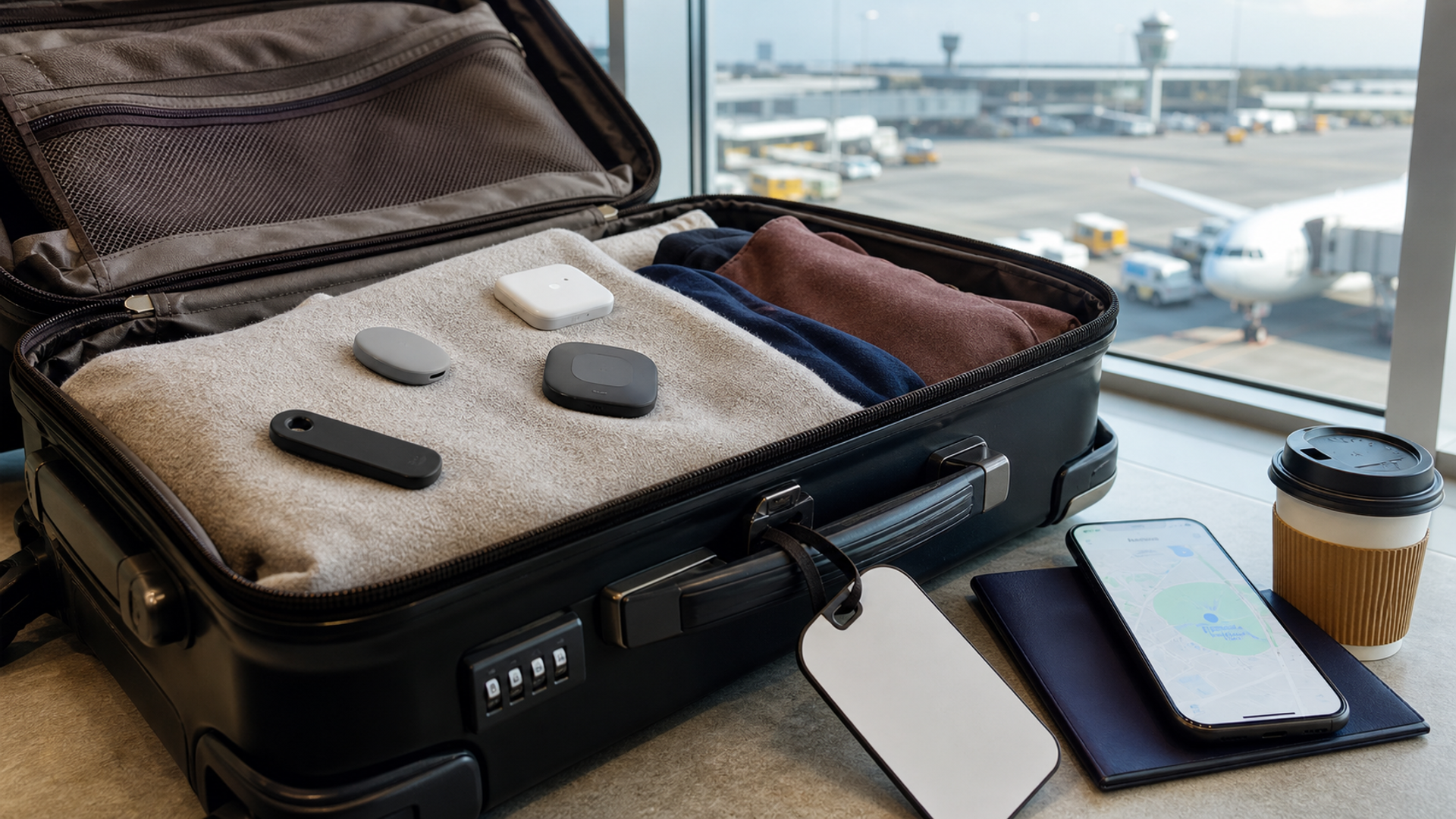
The best luggage tracker in 2026 is usually the one built for your phone's native finding network. For an iPhone user, the current AirTag is the simplest default; for a compatible Android user, a Google Find Hub tag such as moto tag can be the stronger fit; for a Galaxy household, SmartTag2 remains a coherent SmartThings choice. Chipolo POP is useful when you want one hardware model that can be configured for either Apple Find My or Google Find Hub. The airline's battery rules and your recovery process matter more than a marginal specification win.
A Bluetooth tag does not turn a suitcase into live GPS baggage. It reports through nearby participating devices, and the map is evidence—not authority over the airline's baggage system. The right choice therefore combines four things: network compatibility, nearby-finding capability, battery compliance and a practical method for sharing useful location information during a baggage claim.
The 2026 decision matrix
| Tracker | Best for | Finding network | Nearby finding | Power model | Critical limitation |
|---|---|---|---|---|---|
| Apple AirTag, current generation | iPhone-led travel | Apple Find My | Precision Finding on supported Apple devices | Replaceable coin cell | Best experience is tied to Apple's ecosystem |
| moto tag | Broad Android use | Google Find Hub | BLE; UWB on supported phone/tag/region combinations | Replaceable battery, approximate life subject to use | Compatibility and UWB availability vary |
| Samsung Galaxy SmartTag2 | Galaxy households | SmartThings Find | Search features on compatible Galaxy hardware | Replaceable coin cell | Requires a compatible Galaxy device and Samsung account |
| Chipolo POP | Households choosing Apple or Google at setup | Apple Find My or Google Find Hub | Network and nearby features depend on chosen platform | Replaceable battery | It joins one network at a time; switching requires setup changes |
This is not a universal ranking of radio performance. Official specifications do not create identical real-world airport coverage, and network density varies by place. The matrix is a fit guide based on current manufacturer and platform documentation observed on 3 August 2026.
Choose the network before the tag
The tag spends most of its life out of direct Bluetooth range. Its usefulness then depends on other participating devices detecting it and relaying an encrypted location. That makes ecosystem choice the first decision.
Apple's current AirTag page says the tag broadcasts a secure Bluetooth signal that nearby devices in the Find My network can detect. The current generation, introduced in January 2026, adds a louder speaker and expanded finding range according to Apple's launch notice. Apple also supports temporarily sharing an item's location with participating airlines; sharing ends when the item is recovered or after a defined period. Check that your airline participates before treating the feature as part of the recovery plan.
For Android, Google's Find Hub guidance says compatible tags are added after pairing. Precise directional finding requires support from both the tag and the phone, and Google lists device, software and regional qualifications. That is why “has UWB” is not enough: confirm that your actual handset and destination support the feature.
Samsung's SmartTag2 product page makes the ecosystem boundary explicit: SmartThings Find registration, a Samsung account and compatible Galaxy hardware are required. It is sensible for an established Galaxy household, but not a neutral Android recommendation.
Chipolo's current compatibility guidance positions POP as hardware that can work with Apple Find My or Google Find Hub under each platform's requirements. That flexibility is attractive for gifts or households that may change phones, but the tag is configured to a selected network rather than tracking simultaneously across both.
What each shortlist option does best
AirTag: the iPhone default and strongest airline-sharing story
AirTag is the straightforward answer for most iPhone travellers because setup, map, Lost Mode, nearby finding and item sharing live inside Find My. The current model's improved speaker and finding range are practical for locating a bag in a room, car or baggage office. Its strongest travel-specific advantage is the ability to create a temporary location link for a participating airline.
It is not a reason to confront baggage staff with a moving dot. Location can lag, point to a sorting area inaccessible to passengers or reflect the last nearby Apple device. Share the information through the airline's accepted process and let staff reconcile it with the bag tag and baggage file.
moto tag: the useful Android baseline
Motorola says moto tag uses Google's finding network, has a replaceable battery and carries an IP67 laboratory rating with qualifications. Its support page describes Bluetooth Low Energy and UWB for nearby finding, but UWB needs compatible hardware and availability varies.
For an Android buyer, that makes moto tag a strong reference design: native Find Hub integration, a familiar coin form and no separate tracking subscription. Verify the current phone compatibility before buying several units, especially if directional finding is the feature you value.
Galaxy SmartTag2: coherent inside Samsung, narrow outside it
SmartTag2 is a rational choice when the traveller already uses a compatible Galaxy phone and SmartThings Find. Samsung's official material lists its ecosystem requirements and publishes battery and environmental-resistance claims. The product's loop also suits luggage attachments better than a bare coin.
Its weakness is not quality but portability across ecosystems. A mixed iPhone/Android family or a traveller expecting to leave Galaxy may prefer a more transferable choice.
Chipolo POP: the flexible hardware choice
POP's distinction is that the buyer can choose Apple Find My or Google Find Hub while using the same general tag model. Chipolo says it has a replaceable battery with an approximate one-year life, while actual performance depends on use.
The appeal is procurement simplicity, not a secret third network. Once configured, the chosen platform supplies the broad finding layer. Read the switching and reset instructions before relying on it for a trip immediately after changing phones.
The airline rule comes before the product ranking
Small luggage trackers use batteries, and aviation rules—not marketing—control whether they may travel in checked baggage. The FAA's current PackSafe guidance describes baggage location tags as portable electronic devices, sets limits for lithium content or watt-hours in checked baggage, and advises passengers to check with their airline. It also warns that international requirements may differ.
That means the safe process is specific:
identify the battery type and rating in the manufacturer documentation;
check the operating airline's current tracker and battery policy;
repeat the check for codeshares or an itinerary involving carriers with different rules;
confirm international restrictions for the journey, not only the departure country;
do not confuse a tiny tracker with a powered smart suitcase whose removable battery follows different handling rules.
Our separate guide to AirTag checked-luggage rules goes deeper into that boundary. If the airline requires the device to be switched off in circumstances that defeat tracking, follow the rule; a locator is not worth creating a safety or boarding problem.
Privacy is a buying criterion
Item networks can be abused to track people, so platform safeguards matter. Google's unknown-tracker documentation says Android can alert users to compatible tags and Apple AirTags travelling with them, and provides steps to locate, identify and disable a tag. Apple likewise describes cross-platform unwanted-tracking alerts on its AirTag page.
Before a trip, name each tag plainly, enable the platform's security updates and explain shared-bag tracking to companions. Never hide a tag in another person's property without consent. If an unknown-tracker alert appears, treat it as a personal-safety signal rather than simply dismissing it because you are travelling.
Location history is also sensitive. Share a temporary airline link only when needed, remove access after recovery, and avoid posting live screenshots publicly. A baggage claim number and a controlled link are more useful than broadcasting your hotel or onward route.
Build a recovery system, not a gadget collection
The tracker should be one layer in a lost-bag plan. Photograph the suitcase and its distinctive features before check-in. Keep the airline bag-tag receipt. Place contact details inside the bag without exposing unnecessary personal information on the exterior. Carry medicines, travel documents, essential electronics and one change of clothing in cabin baggage where rules permit.
If the bag does not arrive:
file the airline's baggage report before leaving the airport where possible;
save the report reference and contact channel;
check the tag location, time of last update and movement pattern;
share the location through the airline's supported method if available;
describe the evidence calmly—do not enter restricted baggage areas;
keep receipts and follow the airline's claim process for delayed baggage expenses;
remove shared location access when the case is closed.
The best travel accessories for long-haul business trips are the ones that reduce a specific failure mode. A tag qualifies because it can narrow uncertainty; it does not replace the official baggage record.
Which tracker should you buy?
Choose AirTag if you use an iPhone and value the most integrated setup plus the current airline-sharing feature. Choose moto tag if Google Find Hub is your native platform and your phone supports the nearby-finding features you want. Choose SmartTag2 if your travel devices are firmly inside Samsung's Galaxy ecosystem. Choose Chipolo POP if you want hardware that can be configured for either major platform and accept that it uses one at a time.
Then perform the less exciting checks that make the purchase useful: battery rating, airline permission, current software, sharing method and a written recovery protocol. The best luggage tracker is not the one with the loudest promise. It is the one that fits your phone, remains compliant on the itinerary and supplies evidence you know how to use.
Related VERTU reading
Sources and verification
Sources were checked for this 3 August 2026 publication package. Terms and specifications can change; recheck the linked source before acting.
![How to Scan Receipts and Documents with Your Phone [Full Guide]](https://cdn.sanity.io/images/e0gp1l2g/production/0db13feec1d5e72b8a8a5f976d1f3e86619c9228-3840x1860.webp?w=180&h=180&q=78&auto=format&fit=crop)
![How to Scan Receipts and Documents with Your Phone [Full Guide]](https://cdn.sanity.io/images/e0gp1l2g/production/0db13feec1d5e72b8a8a5f976d1f3e86619c9228-3840x1860.webp?w=800&h=450&q=82&auto=format&fit=crop)
![Top 10 Two-Tone Carbon-Fibre Watches for Men [2026 List]](https://cdn.sanity.io/images/e0gp1l2g/production/18870799ba33fab0e038968359cd5772d7d7db30-1024x576.webp?w=800&h=450&q=82&auto=format&fit=crop)
![Top 10 Luxury Watches with Digital Complication Displays for Men [Latest]](https://cdn.sanity.io/images/e0gp1l2g/production/c4f6bf8c080f291c39f7cc85c7344ecff2fd3799-1024x553.webp?w=800&h=450&q=82&auto=format&fit=crop)