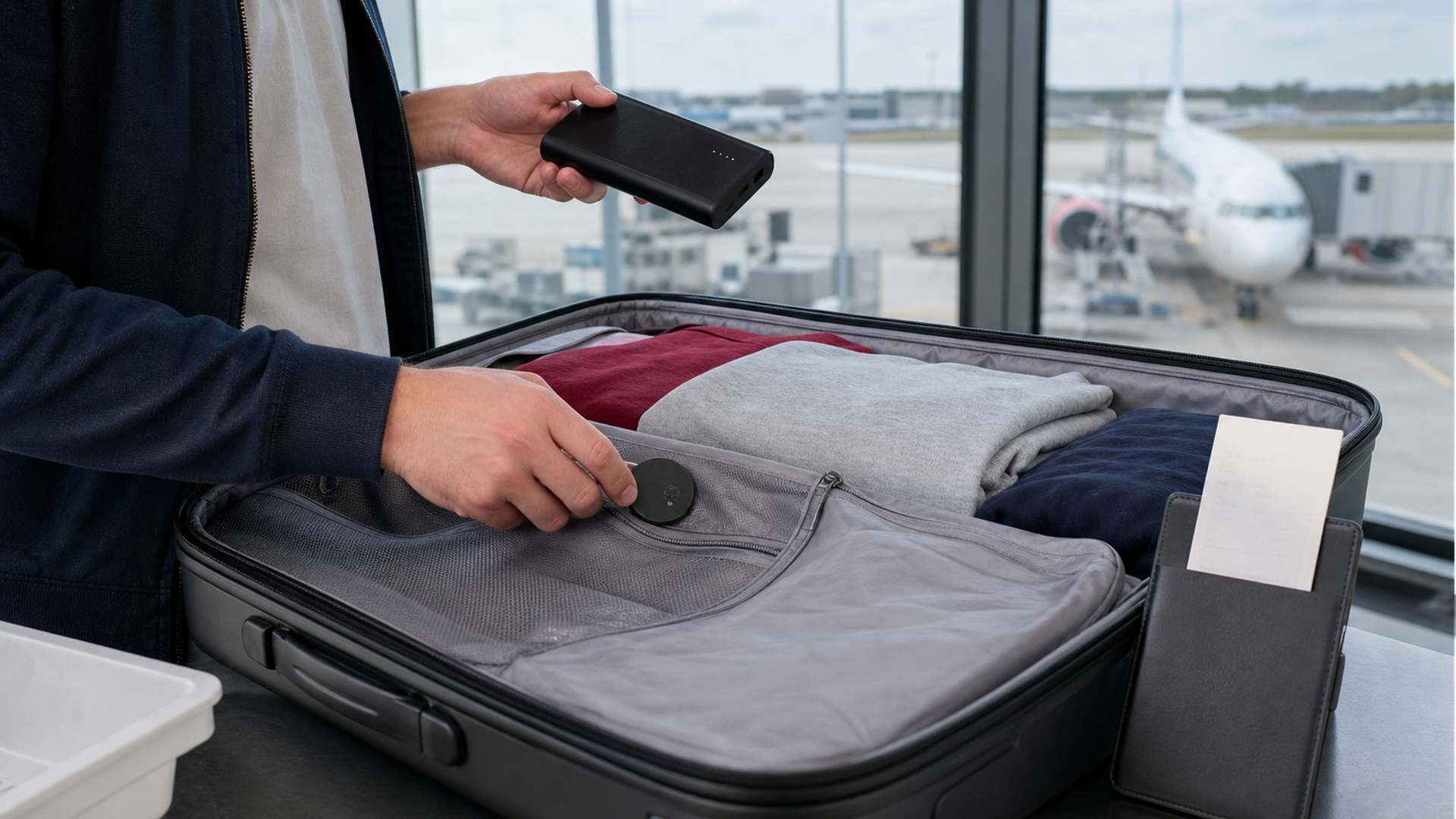
An AirTag or similar small luggage tracker can generally travel active in checked baggage when its installed battery stays within the applicable small-battery threshold, but you must still check the operating airline's policy. In the United States, the FAA says a tracker in checked baggage must not exceed 0.3 g of lithium metal or 2.7 Wh for lithium-ion batteries. A smart suitcase with a power bank is a different category and may require the battery to be removed.
The distinction matters. A coin-cell tracker is not the same thing as a suitcase designed to charge a laptop. Travellers who call both “smart luggage” can follow the wrong rule.
The three-device rule check
| Device | Battery role | Checked-bag starting point | Action before flying |
|---|---|---|---|
| Small Bluetooth luggage tracker | Location only | Often allowed active within small-battery limit | Confirm battery specification and airline policy |
| GPS/cellular tracker | Location with larger power demand | Rules depend on battery size and transmitter | Obtain exact Wh/content and carrier approval where required |
| Smart suitcase with removable power bank | Powers other devices | Battery must normally be removed for checking | Carry removed battery in cabin under power-bank rules |
| Smart suitcase with non-removable large battery | Integrated power | May be refused | Do not arrive without written carrier confirmation |
Start with the label and manual. “Tracker” describes a purpose, not a battery specification.
What the FAA says in 2026
The FAA updated its PackSafe baggage-with-batteries guidance on 13 April 2026. It permits baggage equipped with small installed batteries in checked luggage when the lithium content is no more than 0.3 g for lithium-metal batteries or the rating is no more than 2.7 Wh for lithium-ion batteries. It specifically identifies baggage location trackers and tells travellers to check with the airline.
For international journeys, the FAA warns that rules may differ. The operating carrier and jurisdictions along the itinerary matter. A policy accepted on the outbound flight does not automatically answer a different airline on the return.
IATA's broader smart-baggage guidance focuses on the risk created by integrated power banks, motors and other electronics. A battery whose primary purpose is charging another device is treated as a power bank and belongs in the cabin. The 2026 passenger guidance limits lithium-ion power banks to two units not exceeding 100 Wh under its general framework, subject to stricter airline rules.
Why the tracker should stay hidden but serviceable
A tracker placed in an obvious external pocket can be removed. One buried so deeply that its battery cannot be inspected creates a different problem. Use an internal pocket or purpose-made holder that does not crush the device and can be reached when necessary.
Record the serial number and confirm the battery is healthy before closing the bag. Test that the tracker appears in its app after the suitcase is packed. A location last updated at home is not proof that the device is functioning at the airport.
Do not use a tracker as a covert surveillance device. Anti-stalking alerts and platform rules exist for safety. Track your own property, share location only with appropriate parties and stop sharing when the recovery task ends.
What location sharing can and cannot do
Apple's Find My system lets an owner create a temporary Share Item Location page for an AirTag or compatible item. Apple says the link can be given to an airline to help locate mishandled baggage, stops when the item is reunited, can be ended by the owner and expires after seven days.
Apple's current Find My page lists more than 50 participating airlines. That makes the feature operationally more useful than sending a screenshot of a moving dot, because authorised airline staff can use a temporary link within an established workflow.
It does not give the passenger authority to enter a baggage-handling area or demand that an aircraft be searched. A tracker provides evidence and direction. The airline's baggage process still controls physical recovery.
The delayed-bag action timeline
At the carousel: confirm, do not assume
Wait until the airline marks delivery complete. Check the correct carousel and any oversize area. Use the tracker to gather context, but do not close the airline app or lose the bag-tag receipt while staring at the map.
Before leaving the airport: create the official report
File a property irregularity or delayed-baggage report with the airline. Keep the reference number, bag-tag number and contact channel. A tracker location without an official report can leave the recovery workflow unstarted.
After the report: share the minimum useful information
If the airline supports it, create a temporary location link and provide it through the approved channel. Avoid posting the link publicly. Record when and with whom it was shared.
If the location moves
Update the airline through the case reference. A location at an airport, warehouse or street is not permission to confront staff or a private individual. The reading can be approximate, delayed or based on nearby network devices.
When the bag returns
End the shared link, inspect the bag and tracker, and document damage before closing the claim. Replace a damaged battery or device according to the manufacturer's instructions.
Privacy checklist for executives
Name the tracker by bag, not by sensitive client or itinerary.
Use account multi-factor authentication or a passkey.
Review who can see the item's location.
Share a temporary link only through the airline's approved workflow.
Stop sharing immediately after recovery.
Do not place confidential papers in checked baggage because a tracker exists.
Keep the baggage receipt and recovery case separate from the suitcase.
A tracker reduces uncertainty; it does not make checked luggage a secure document vault. Executives should keep identity documents, authentication devices, medication and irreplaceable data in the cabin, subject to applicable rules.
For account resilience, review the most secure phones and the controls that matter. For network access after arrival, prepare an eSIM or hotspot decision and a hotel connectivity threat model.
Five checks before attaching a tracker
The exact battery chemistry and rating are documented.
The operating airline permits it on every sector.
The tracker is paired, named and reporting.
The airline app and baggage receipt are also ready.
The recovery process is understood before a loss occurs.
The practical verdict
Put a compliant small tracker in checked luggage, but do not confuse it with a smart suitcase power bank. Verify the battery threshold, confirm every operating airline, keep the baggage receipt and use an official temporary-location-sharing workflow if the bag is delayed.
The tracker is most valuable as evidence inside a disciplined recovery process. It is not insurance, physical custody or permission to bypass the airline.