

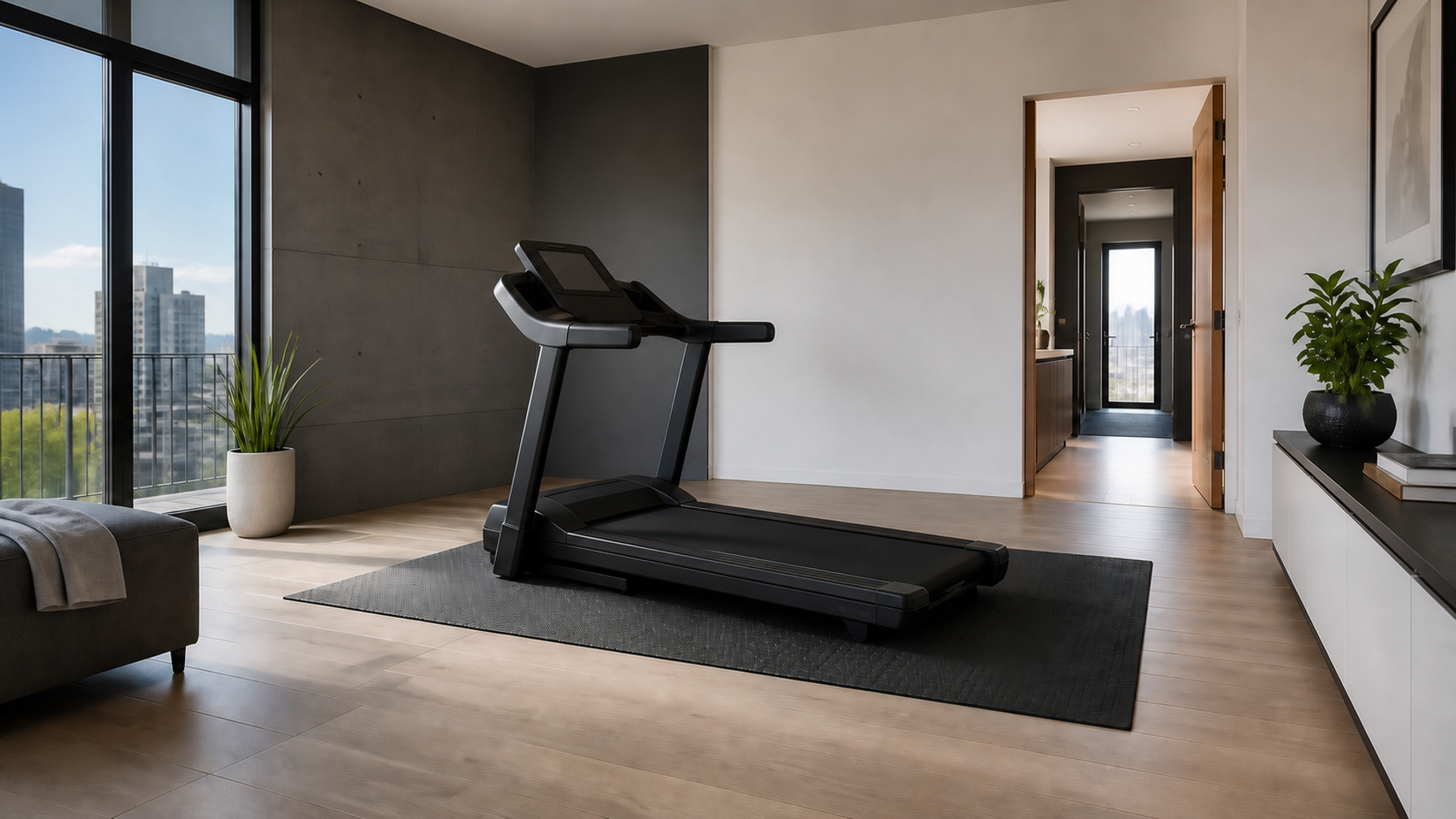
A treadmill can fit on a product page and still fail in a home. The machine must accommodate the user's gait and intended speed, leave safe clearance, work on the available circuit, control vibration and remain serviceable after it is assembled. Folding dimensions matter, but so do the dimensions when the deck is down and a person is moving at speed. Start with the room and user rather than a motor headline.
Map the room and the fastest user
Measure the full operating footprint, ceiling clearance and access route; then choose a stable deck long and wide enough for the fastest intended user. Verify the electrical requirement, emergency stop, user limit, noise under load, warranty labour and local service. A compact walking pad is a different tool from a running treadmill, and neither should be treated as a storage object when it is in motion.
| Decision factor | Walking-focused compact setup | Running-focused full treadmill | Shared multi-user system |
|---|---|---|---|
| User pace | Controlled walking is the real ceiling | Jogging and running drive deck choice | Machine fits the fastest authorised user |
| Operating space | Compact footprint still preserves clearance | Dedicated deployed space is available | Room layout supports every user and observer |
| Deck fit | Stride remains centred at low speed | Length and width suit full running gait | Tallest user sets the minimum |
| Noise | Floor transmission is acceptable at walking pace | Structure tolerates repeated running impact | Schedule and mat control household conflict |
| Controls | Low-speed increments and stop are simple | Speed and incline respond predictably | Profiles never hide safety functions |
| Service | Portable unit still has parts support | In-home service and removal are credible | Warranty covers the shared duty cycle |
| Safety boundary | Desk and storage do not obstruct the belt | Emergency key and rear clearance are used | Children and pets are excluded during operation |
This best treadmill for home matrix is the article's working value object. Read the best treadmill for home rows together: the decisive failure mode depends on this topic's evidence, operating context and reader objective.
Safety and activity evidence
Evidence 1. The US Consumer Product Safety Commission maintains sports, fitness and recreation safety information and product-recall resources; buyers should check the exact model and follow current manufacturer safety instructions.
Evidence 2. CDC physical-activity guidance explains that adults can accumulate activity in different ways, but it does not make one treadmill design appropriate for every person or medical condition.
Evidence 3. A treadmill's usable deck, stability, speed control and emergency-stop behaviour have to be evaluated together because a large motor rating does not prove safe or comfortable operation.
Evidence 4. Room noise combines motor sound, foot strike, frame vibration, floor construction and speed, so unloaded showroom sound is weak evidence for an upstairs flat.
Reader-visible sources checked for this article:
cpsc.gov — reader-visible current or official evidence
cdc.gov — reader-visible current or official evidence
For best treadmill for home, these sources establish only the claims inside their documented scope. Recheck every changeable specification, availability condition, price, policy or service term in the relevant market before acting.
Evaluate the moving system, not one specification
On user pace, popularity is not enough. The evidence for option one is that controlled walking is the real ceiling. Option two means jogging and running drive deck choice. Option three is rational where machine fits the fastest authorised user. Recheck any changeable term immediately before commitment.
The decision changes at operating space. Choose the first path only if compact footprint still preserves clearance; move to the second when dedicated deployed space is available; use the third when room layout supports every user and observer. Save the downside that would make this row fail.
For deck fit, the first route works when stride remains centred at low speed; the second requires length and width suit full running gait. The control for the third is tallest user sets the minimum. Verify this row against the exact product, property, account or environment before it can reverse the decision.
The noise row exposes a practical boundary. Route one assumes floor transmission is acceptable at walking pace, while route two is defensible only when structure tolerates repeated running impact. Route three depends on schedule and mat control household conflict. If that evidence is absent, keep the more reversible option.
Read controls as a stop/go test: low-speed increments and stop are simple supports the first option; speed and incline respond predictably supports the second; and profiles never hide safety functions supports the third. Record which source proves the condition and when it was checked.
A buyer can resolve service without starting from a brand preference. Ask whether portable unit still has parts support; compare that with whether in-home service and removal are credible; then use warranty covers the shared duty cycle as the third route's safeguard. An unknown condition stays unknown.
On safety boundary, popularity is not enough. The evidence for option one is that desk and storage do not obstruct the belt. Option two means emergency key and rear clearance are used. Option three is rational where children and pets are excluded during operation. Recheck any changeable term immediately before commitment.
Facts that would reverse the current choice
Reversal control 1 — User pace. Before choosing Walking-focused compact setup, write down how the decision changes if “Controlled walking is the real ceiling” proves false. Do the same for Running-focused full treadmill and “Jogging and running drive deck choice”. Keep the Shared multi-user system route available until “Machine fits the fastest authorised user” is verified. This control belongs to best treadmill for home; update it from the cited source or exact supplier rather than copying a generic checklist.
Reversal control 2 — Operating space. Before choosing Walking-focused compact setup, write down how the decision changes if “Compact footprint still preserves clearance” proves false. Do the same for Running-focused full treadmill and “Dedicated deployed space is available”. Keep the Shared multi-user system route available until “Room layout supports every user and observer” is verified. This control belongs to best treadmill for home; update it from the cited source or exact supplier rather than copying a generic checklist.
Reversal control 3 — Deck fit. Before choosing Walking-focused compact setup, write down how the decision changes if “Stride remains centred at low speed” proves false. Do the same for Running-focused full treadmill and “Length and width suit full running gait”. Keep the Shared multi-user system route available until “Tallest user sets the minimum” is verified. This control belongs to best treadmill for home; update it from the cited source or exact supplier rather than copying a generic checklist.
Reversal control 4 — Noise. Before choosing Walking-focused compact setup, write down how the decision changes if “Floor transmission is acceptable at walking pace” proves false. Do the same for Running-focused full treadmill and “Structure tolerates repeated running impact”. Keep the Shared multi-user system route available until “Schedule and mat control household conflict” is verified. This control belongs to best treadmill for home; update it from the cited source or exact supplier rather than copying a generic checklist.
Reversal control 5 — Controls. Before choosing Walking-focused compact setup, write down how the decision changes if “Low-speed increments and stop are simple” proves false. Do the same for Running-focused full treadmill and “Speed and incline respond predictably”. Keep the Shared multi-user system route available until “Profiles never hide safety functions” is verified. This control belongs to best treadmill for home; update it from the cited source or exact supplier rather than copying a generic checklist.
Reversal control 6 — Service. Before choosing Walking-focused compact setup, write down how the decision changes if “Portable unit still has parts support” proves false. Do the same for Running-focused full treadmill and “In-home service and removal are credible”. Keep the Shared multi-user system route available until “Warranty covers the shared duty cycle” is verified. This control belongs to best treadmill for home; update it from the cited source or exact supplier rather than copying a generic checklist.
Reversal control 7 — Safety boundary. Before choosing Walking-focused compact setup, write down how the decision changes if “Desk and storage do not obstruct the belt” proves false. Do the same for Running-focused full treadmill and “Emergency key and rear clearance are used”. Keep the Shared multi-user system route available until “Children and pets are excluded during operation” is verified. This control belongs to best treadmill for home; update it from the cited source or exact supplier rather than copying a generic checklist.
Measure operating clearance
Tape the machine's deployed footprint on the floor, add the manufacturer-required clear zone and walk the route from the delivery entrance. Include baseboards, doors, radiators, sloped ceilings and the user's height at maximum incline. A folding deck does not create clearance while exercising. In a shared room, ask whether another person can enter without stepping into the belt path and whether pets or children can be excluded during use.
Fit deck length to gait and speed
Walking, jogging and running create different stride demands. A taller runner or faster pace generally needs more usable belt length and confidence at the edges. Published deck dimensions should refer to the moving surface, not the outside frame. Test at realistic speed with the safety key attached, note whether the rails interfere with arm swing and avoid using a handrail to compensate for a deck that feels too short.
Treat stability and controls as primary
Speed and incline controls should be reachable and predictable without long menu navigation. The frame should not rock when the intended user lands near the middle of the deck. Emergency stop must be understood by everyone who uses the machine. Confirm startup behaviour after power loss, maximum user mass and whether software, account or subscription dependencies affect basic operation. A screen is optional; controlled movement is not.
Test noise on the real floor
A rubber mat may reduce surface damage and some vibration, but it cannot correct an unstable subfloor or poor machine alignment. Test at walking and running speeds with the heaviest intended user if possible. Listen in the room below and next door. Consider time of use, ventilation and headphones. A machine that is technically quiet but transmits low-frequency impact through the structure may still be unsuitable for an apartment.
Plan maintenance and exit
Belts need alignment and maintenance according to the manual; decks, rollers and electronics may need service. Ask who provides in-home labour, whether moving the machine voids coverage and how a heavy unit leaves the room. Check recalls using the exact model. A long parts warranty is less useful when labour, transport or local technicians are unavailable. Save the serial number and purchase record before assembly.
Three home-treadmill profiles
Apartment walking and light jogging
Prioritise controllable low speeds, verified operating noise, modest footprint and a stable mat. Test transmission to adjacent rooms rather than relying on a decibel claim. Define the fact that would reverse this recommendation before committing.
Multiple runners in a dedicated room
Choose deck size, frame stability, ventilation and service support for the tallest, fastest and heaviest intended user. A larger machine is justified only when the route and floor can support it. Define the fact that would reverse this recommendation before committing.
Desk walking
A walking pad can suit low-speed movement when desk height, concentration, emergency stop and storage are planned. It is not a substitute for a running deck or an excuse to operate without clearance. Define the fact that would reverse this recommendation before committing.
Action checklist
Tape the deployed footprint and safe clearance.
Measure ceiling height at full incline.
Verify delivery route and floor load.
Match usable deck to the fastest user's gait.
Test speed controls and emergency stop.
Confirm electrical circuit requirements.
Evaluate noise with a real user on the real floor.
Check exact-model recalls and user limit.
Confirm labour, parts and local service.
Plan child, pet and storage controls.
Continue the decision
The linked VERTU articles expand adjacent parts of the best treadmill for home decision. They do not substitute for the external evidence above.
The home-treadmill verdict
Measure the full operating footprint, ceiling clearance and access route; then choose a stable deck long and wide enough for the fastest intended user. Verify the electrical requirement, emergency stop, user limit, noise under load, warranty labour and local service. A compact walking pad is a different tool from a running treadmill, and neither should be treated as a storage object when it is in motion.
Keep the best treadmill for home decision reversible until its material cost, safety, access, privacy and compatibility facts are verified. Unknown evidence stays unknown; it is never silently scored as favourable.
![How to Scan Receipts and Documents with Your Phone [Full Guide]](https://cdn.sanity.io/images/e0gp1l2g/production/0db13feec1d5e72b8a8a5f976d1f3e86619c9228-3840x1860.webp?w=180&h=180&q=78&auto=format&fit=crop)
![How to Scan Receipts and Documents with Your Phone [Full Guide]](https://cdn.sanity.io/images/e0gp1l2g/production/0db13feec1d5e72b8a8a5f976d1f3e86619c9228-3840x1860.webp?w=800&h=450&q=82&auto=format&fit=crop)
![Top 10 Two-Tone Carbon-Fibre Watches for Men [2026 List]](https://cdn.sanity.io/images/e0gp1l2g/production/18870799ba33fab0e038968359cd5772d7d7db30-1024x576.webp?w=800&h=450&q=82&auto=format&fit=crop)
![Top 10 Luxury Watches with Digital Complication Displays for Men [Latest]](https://cdn.sanity.io/images/e0gp1l2g/production/c4f6bf8c080f291c39f7cc85c7344ecff2fd3799-1024x553.webp?w=800&h=450&q=82&auto=format&fit=crop)