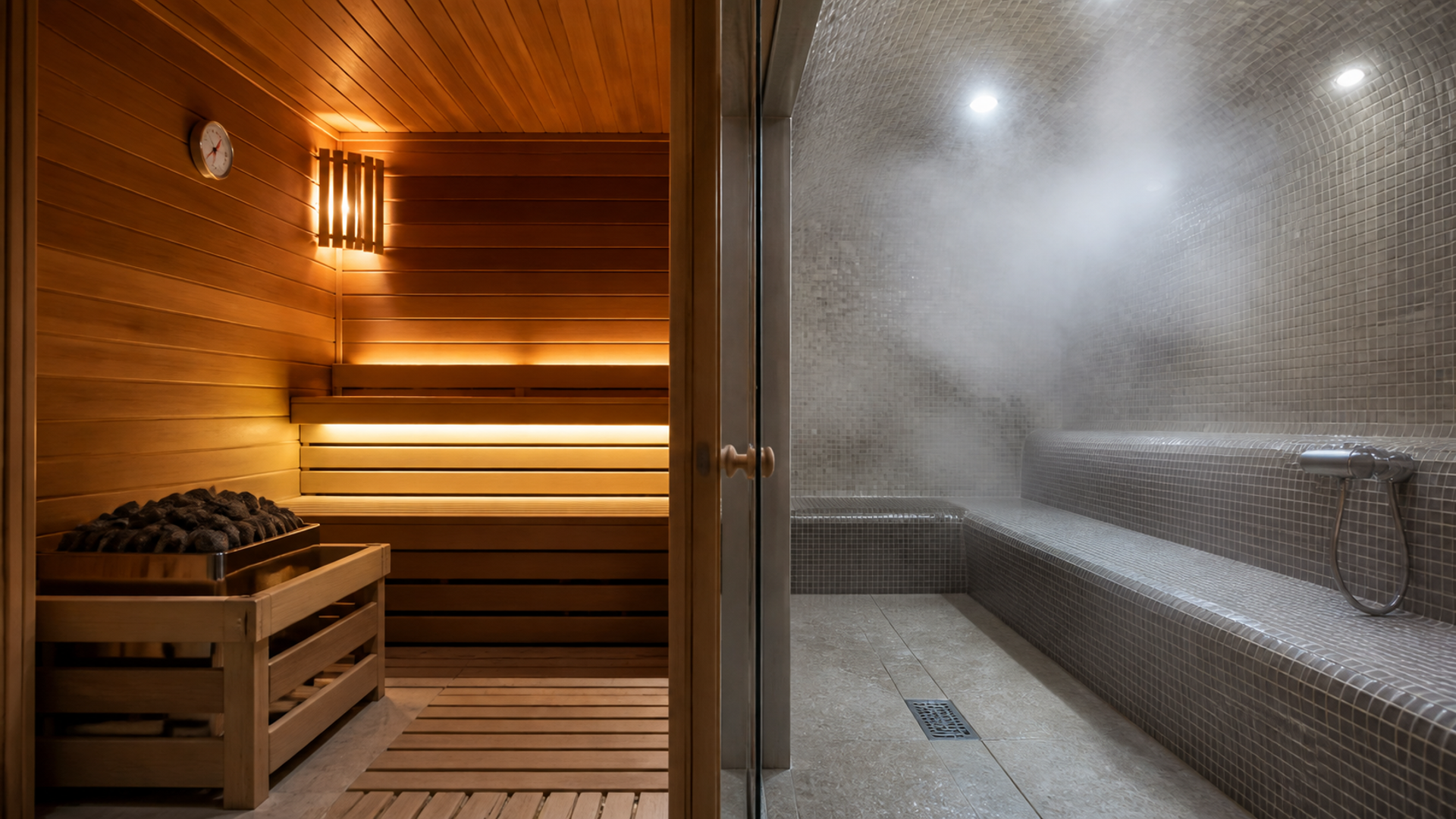
A sauna and a steam room expose the body to heat in different humidity conditions. A conventional sauna uses hotter, much drier air; a steam room uses lower air temperature with very high humidity. Comfort, respiratory response, hydration, cleaning and medical context can therefore differ even when both spaces feel intensely warm.
Choose the environment, not a wellness promise
Choose a dry sauna when the user tolerates dry heat and wants the easier-to-control timber environment. Choose a steam room when humid heat feels more comfortable and the installation can manage water, drainage and sanitation. Skip the session or seek medical advice when heat exposure, medication, pregnancy, cardiovascular risk or current illness makes self-experiment unsafe.
| Decision factor | Dry sauna | Steam room | Skip or seek medical advice |
|---|---|---|---|
| Heat sensation | Hot dry air is comfortable at a conservative exposure | Dense humidity feels easier to tolerate | Symptoms or uncertainty stop the session |
| Breathing comfort | Dry air does not aggravate the user | Humidity provides subjective comfort without distress | Respiratory symptoms require professional guidance |
| Hydration | Water and cool-down are planned | Water and cool-down are planned | Alcohol, illness or dehydration are stop conditions |
| Cleaning | Timber surfaces and ventilation have a routine | Tile, drains and steam equipment are sanitised | Poor maintenance blocks use |
| Home installation | Heat, clearance and electrical design are certified | Waterproofing, drainage and generator access are certified | Use a maintained commercial facility instead |
| Medical boundary | A clinician has cleared relevant conditions | A clinician has cleared relevant conditions | No wellness claim overrides a medical contraindication |
This sauna vs steam room matrix is the article's working value object. Read the sauna vs steam room rows together: the decisive failure mode depends on this topic's evidence, operating context and reader objective.
Dry heat and humid heat compared
Evidence 1. Cleveland Clinic describes sauna exposure as a heat stress that can affect circulation and hydration; claimed benefits do not remove individual safety limits.
Evidence 2. Published reviews of sauna use vary in population, protocol and outcome, so observational associations should not be presented as guaranteed treatment effects.
Evidence 3. Steam-room humidity changes perceived heat and building moisture load, making ventilation, drainage and cleaning part of the decision rather than an afterthought.
Evidence 4. Dizziness, chest pain, breathing difficulty, faintness or other concerning symptoms are reasons to leave the heat and seek appropriate care.
Reader-visible sources checked for this article:
health.clevelandclinic.org — reader-visible current or official evidence
pmc.ncbi.nlm.nih.gov — reader-visible current or official evidence
For sauna vs steam room, these sources establish only the claims inside their documented scope. Recheck every changeable specification, availability condition, price, policy or service term in the relevant market before acting.
Control exposure and maintenance
On heat sensation, popularity is not enough. The evidence for option one is that hot dry air is comfortable at a conservative exposure. Option two means dense humidity feels easier to tolerate. Option three is rational where symptoms or uncertainty stop the session. Recheck any changeable term immediately before commitment.
The decision changes at breathing comfort. Choose the first path only if dry air does not aggravate the user; move to the second when humidity provides subjective comfort without distress; use the third when respiratory symptoms require professional guidance. Save the downside that would make this row fail.
For hydration, the first route works when water and cool-down are planned; the second requires water and cool-down are planned. The control for the third is alcohol, illness or dehydration are stop conditions. Verify this row against the exact product, property, account or environment before it can reverse the decision.
The cleaning row exposes a practical boundary. Route one assumes timber surfaces and ventilation have a routine, while route two is defensible only when tile, drains and steam equipment are sanitised. Route three depends on poor maintenance blocks use. If that evidence is absent, keep the more reversible option.
Read home installation as a stop/go test: heat, clearance and electrical design are certified supports the first option; waterproofing, drainage and generator access are certified supports the second; and use a maintained commercial facility instead supports the third. Record which source proves the condition and when it was checked.
A buyer can resolve medical boundary without starting from a brand preference. Ask whether a clinician has cleared relevant conditions; compare that with whether a clinician has cleared relevant conditions; then use no wellness claim overrides a medical contraindication as the third route's safeguard. An unknown condition stays unknown.
Facts that would reverse the current choice
Reversal control 1 — Heat sensation. Before choosing Dry sauna, write down how the decision changes if “Hot dry air is comfortable at a conservative exposure” proves false. Do the same for Steam room and “Dense humidity feels easier to tolerate”. Keep the Skip or seek medical advice route available until “Symptoms or uncertainty stop the session” is verified. This control belongs to sauna vs steam room; update it from the cited source or exact supplier rather than copying a generic checklist.
Reversal control 2 — Breathing comfort. Before choosing Dry sauna, write down how the decision changes if “Dry air does not aggravate the user” proves false. Do the same for Steam room and “Humidity provides subjective comfort without distress”. Keep the Skip or seek medical advice route available until “Respiratory symptoms require professional guidance” is verified. This control belongs to sauna vs steam room; update it from the cited source or exact supplier rather than copying a generic checklist.
Reversal control 3 — Hydration. Before choosing Dry sauna, write down how the decision changes if “Water and cool-down are planned” proves false. Do the same for Steam room and “Water and cool-down are planned”. Keep the Skip or seek medical advice route available until “Alcohol, illness or dehydration are stop conditions” is verified. This control belongs to sauna vs steam room; update it from the cited source or exact supplier rather than copying a generic checklist.
Reversal control 4 — Cleaning. Before choosing Dry sauna, write down how the decision changes if “Timber surfaces and ventilation have a routine” proves false. Do the same for Steam room and “Tile, drains and steam equipment are sanitised”. Keep the Skip or seek medical advice route available until “Poor maintenance blocks use” is verified. This control belongs to sauna vs steam room; update it from the cited source or exact supplier rather than copying a generic checklist.
Reversal control 5 — Home installation. Before choosing Dry sauna, write down how the decision changes if “Heat, clearance and electrical design are certified” proves false. Do the same for Steam room and “Waterproofing, drainage and generator access are certified”. Keep the Skip or seek medical advice route available until “Use a maintained commercial facility instead” is verified. This control belongs to sauna vs steam room; update it from the cited source or exact supplier rather than copying a generic checklist.
Reversal control 6 — Medical boundary. Before choosing Dry sauna, write down how the decision changes if “A clinician has cleared relevant conditions” proves false. Do the same for Steam room and “A clinician has cleared relevant conditions”. Keep the Skip or seek medical advice route available until “No wellness claim overrides a medical contraindication” is verified. This control belongs to sauna vs steam room; update it from the cited source or exact supplier rather than copying a generic checklist.
Set a conservative protocol
Record room type, displayed temperature, entry time, hydration and symptoms. Start shorter than the facility maximum and leave immediately when the body gives a warning.
Separate comfort from treatment
Describe sleepiness, relaxation or breathing comfort as personal observations, not proof that heat treats disease, detoxifies the body or replaces clinical care.
Audit hygiene and building systems
Inspect cleaning logs, odour, visible damage, drainage, ventilation and service access. A luxurious finish cannot compensate for uncontrolled moisture or neglected equipment.
Plan cool-down
Allow a gradual cool-down, drinking water and time before driving, alcohol or strenuous exercise. Record any delayed symptoms that would change future exposure.
Three wellness settings
Healthy occasional spa user
Either environment can be tested conservatively when the facility is maintained and warning symptoms are respected. Define the fact that would reverse this recommendation before committing.
Home wellness renovation
The building and maintenance burden may decide before the preferred sensation. Define the fact that would reverse this recommendation before committing.
User with relevant medical risk
Personal medical advice and a conservative stop decision take priority over comparison content. Define the fact that would reverse this recommendation before committing.
Action checklist
Check personal contraindications.
Avoid alcohol.
Hydrate beforehand.
Start with a short session.
Use a visible timer.
Leave on warning symptoms.
Inspect cleaning.
Verify ventilation.
Plan cool-down.
Record the response.
Continue the decision
The linked VERTU articles expand adjacent parts of the sauna vs steam room decision. They do not substitute for the external evidence above.
The sauna-steam verdict
Choose a dry sauna when the user tolerates dry heat and wants the easier-to-control timber environment. Choose a steam room when humid heat feels more comfortable and the installation can manage water, drainage and sanitation. Skip the session or seek medical advice when heat exposure, medication, pregnancy, cardiovascular risk or current illness makes self-experiment unsafe.
Keep the sauna vs steam room decision reversible until its material cost, safety, access, privacy and compatibility facts are verified. Unknown evidence stays unknown; it is never silently scored as favourable.