A damp basement is not solved by buying the largest portable dehumidifier and closing the door. Water can enter through leaks, ground moisture, humid air or condensation, and each route needs its own control. A dehumidifier is useful when sized to measured conditions, given clear airflow and paired with a reliable drainage plan. It is not a repair for bulk water or an excuse to ignore mould and building defects.
Diagnose moisture before sizing equipment
Measure relative humidity and temperature over time, stop active water entry, then size a certified dehumidifier for the actual space and moisture load. Prefer automatic defrost for cool conditions, a dependable gravity drain or correctly installed pump where continuous operation is needed, and verified efficiency rather than old capacity labels. Set a sensible humidity target, keep airflow clear and clean the filter and drain path.
| Decision factor | Bucket-managed portable unit | Continuous gravity-drain unit | Pump-assisted monitored system |
|---|---|---|---|
| Moisture source | Intermittent humidity after sources are controlled | Sustained load with a lower drain available | Drain elevation requires a pump and monitoring |
| Capacity | Measured load fits periodic emptying | Certified removal supports continuous duty | Pump and unit capacity match the same duty |
| Temperature | Room stays within stated operating range | Defrost handles cool continuous conditions | Pump route also stays within environmental limits |
| Drain risk | Full-bucket stop is acceptable | Hose has secure continuous fall | Overflow controls and pump failure are planned |
| Noise | Fan schedule avoids occupied periods | Fixed location is acoustically acceptable | Pump cycle does not disturb adjacent rooms |
| Efficiency | Part-time operation meets the target | Integrated energy factor matters in long duty | Monitoring proves the extra mechanism is justified |
| Escalation | Rising readings trigger source inspection | Continuous run without control triggers diagnosis | Alarm or overflow triggers immediate intervention |
This best dehumidifier for basement matrix is the article's working value object. Read the best dehumidifier for basement rows together: the decisive failure mode depends on this topic's evidence, operating context and reader objective.
What ENERGY STAR and indoor-air guidance establish
Evidence 1. ENERGY STAR explains that dehumidifier capacity is measured as water removal per day under specified test conditions and provides efficiency information for certified products.
Evidence 2. ENERGY STAR uses integrated energy factor to compare litres of water removed per kilowatt-hour under its applicable criteria, so efficiency is distinct from maximum capacity.
Evidence 3. EPA indoor-air guidance emphasises moisture control and attention to sources; a portable dehumidifier does not replace correcting leaks or other water entry.
Evidence 4. Cold basement conditions can reduce water removal and promote coil frost, which makes temperature range and defrost behaviour material selection criteria.
Reader-visible sources checked for this article:
energystar.gov — reader-visible current or official evidence
epa.gov — reader-visible current or official evidence
For best dehumidifier for basement, these sources establish only the claims inside their documented scope. Recheck every changeable specification, availability condition, price, policy or service term in the relevant market before acting.
Match capacity, temperature and drainage
The moisture source row exposes a practical boundary. Route one assumes intermittent humidity after sources are controlled, while route two is defensible only when sustained load with a lower drain available. Route three depends on drain elevation requires a pump and monitoring. If that evidence is absent, keep the more reversible option.
Read capacity as a stop/go test: measured load fits periodic emptying supports the first option; certified removal supports continuous duty supports the second; and pump and unit capacity match the same duty supports the third. Record which source proves the condition and when it was checked.
A buyer can resolve temperature without starting from a brand preference. Ask whether room stays within stated operating range; compare that with whether defrost handles cool continuous conditions; then use pump route also stays within environmental limits as the third route's safeguard. An unknown condition stays unknown.
On drain risk, popularity is not enough. The evidence for option one is that full-bucket stop is acceptable. Option two means hose has secure continuous fall. Option three is rational where overflow controls and pump failure are planned. Recheck any changeable term immediately before commitment.
The decision changes at noise. Choose the first path only if fan schedule avoids occupied periods; move to the second when fixed location is acoustically acceptable; use the third when pump cycle does not disturb adjacent rooms. Save the downside that would make this row fail.
For efficiency, the first route works when part-time operation meets the target; the second requires integrated energy factor matters in long duty. The control for the third is monitoring proves the extra mechanism is justified. Verify this row against the exact product, property, account or environment before it can reverse the decision.
The escalation row exposes a practical boundary. Route one assumes rising readings trigger source inspection, while route two is defensible only when continuous run without control triggers diagnosis. Route three depends on alarm or overflow triggers immediate intervention. If that evidence is absent, keep the more reversible option.
Facts that would reverse the current choice
Reversal control 1 — Moisture source. Before choosing Bucket-managed portable unit, write down how the decision changes if “Intermittent humidity after sources are controlled” proves false. Do the same for Continuous gravity-drain unit and “Sustained load with a lower drain available”. Keep the Pump-assisted monitored system route available until “Drain elevation requires a pump and monitoring” is verified. This control belongs to best dehumidifier for basement; update it from the cited source or exact supplier rather than copying a generic checklist.
Reversal control 2 — Capacity. Before choosing Bucket-managed portable unit, write down how the decision changes if “Measured load fits periodic emptying” proves false. Do the same for Continuous gravity-drain unit and “Certified removal supports continuous duty”. Keep the Pump-assisted monitored system route available until “Pump and unit capacity match the same duty” is verified. This control belongs to best dehumidifier for basement; update it from the cited source or exact supplier rather than copying a generic checklist.
Reversal control 3 — Temperature. Before choosing Bucket-managed portable unit, write down how the decision changes if “Room stays within stated operating range” proves false. Do the same for Continuous gravity-drain unit and “Defrost handles cool continuous conditions”. Keep the Pump-assisted monitored system route available until “Pump route also stays within environmental limits” is verified. This control belongs to best dehumidifier for basement; update it from the cited source or exact supplier rather than copying a generic checklist.
Reversal control 4 — Drain risk. Before choosing Bucket-managed portable unit, write down how the decision changes if “Full-bucket stop is acceptable” proves false. Do the same for Continuous gravity-drain unit and “Hose has secure continuous fall”. Keep the Pump-assisted monitored system route available until “Overflow controls and pump failure are planned” is verified. This control belongs to best dehumidifier for basement; update it from the cited source or exact supplier rather than copying a generic checklist.
Reversal control 5 — Noise. Before choosing Bucket-managed portable unit, write down how the decision changes if “Fan schedule avoids occupied periods” proves false. Do the same for Continuous gravity-drain unit and “Fixed location is acoustically acceptable”. Keep the Pump-assisted monitored system route available until “Pump cycle does not disturb adjacent rooms” is verified. This control belongs to best dehumidifier for basement; update it from the cited source or exact supplier rather than copying a generic checklist.
Reversal control 6 — Efficiency. Before choosing Bucket-managed portable unit, write down how the decision changes if “Part-time operation meets the target” proves false. Do the same for Continuous gravity-drain unit and “Integrated energy factor matters in long duty”. Keep the Pump-assisted monitored system route available until “Monitoring proves the extra mechanism is justified” is verified. This control belongs to best dehumidifier for basement; update it from the cited source or exact supplier rather than copying a generic checklist.
Reversal control 7 — Escalation. Before choosing Bucket-managed portable unit, write down how the decision changes if “Rising readings trigger source inspection” proves false. Do the same for Continuous gravity-drain unit and “Continuous run without control triggers diagnosis”. Keep the Pump-assisted monitored system route available until “Alarm or overflow triggers immediate intervention” is verified. This control belongs to best dehumidifier for basement; update it from the cited source or exact supplier rather than copying a generic checklist.
Map where the water comes from
Check after rain, during humid weather and when heating or cooling patterns change. Look for plumbing leaks, wall staining, floor seepage, condensation on pipes and open windows. Record relative humidity in more than one location because a finished room and an enclosed storage corner can differ. Active standing water, structural leakage or widespread mould requires the appropriate building or remediation response before a portable appliance is treated as the answer.
Read current capacity correctly
Compare current test-basis capacity and certified efficiency rather than reusing old category labels from archived reviews. Room area alone is not enough: ceiling height, air exchange, temperature, moisture load and whether doors remain open all affect duty. A unit that cycles occasionally in a dry finished basement faces a different task from one expected to remove continuous ground moisture.
Design a fail-safe drain
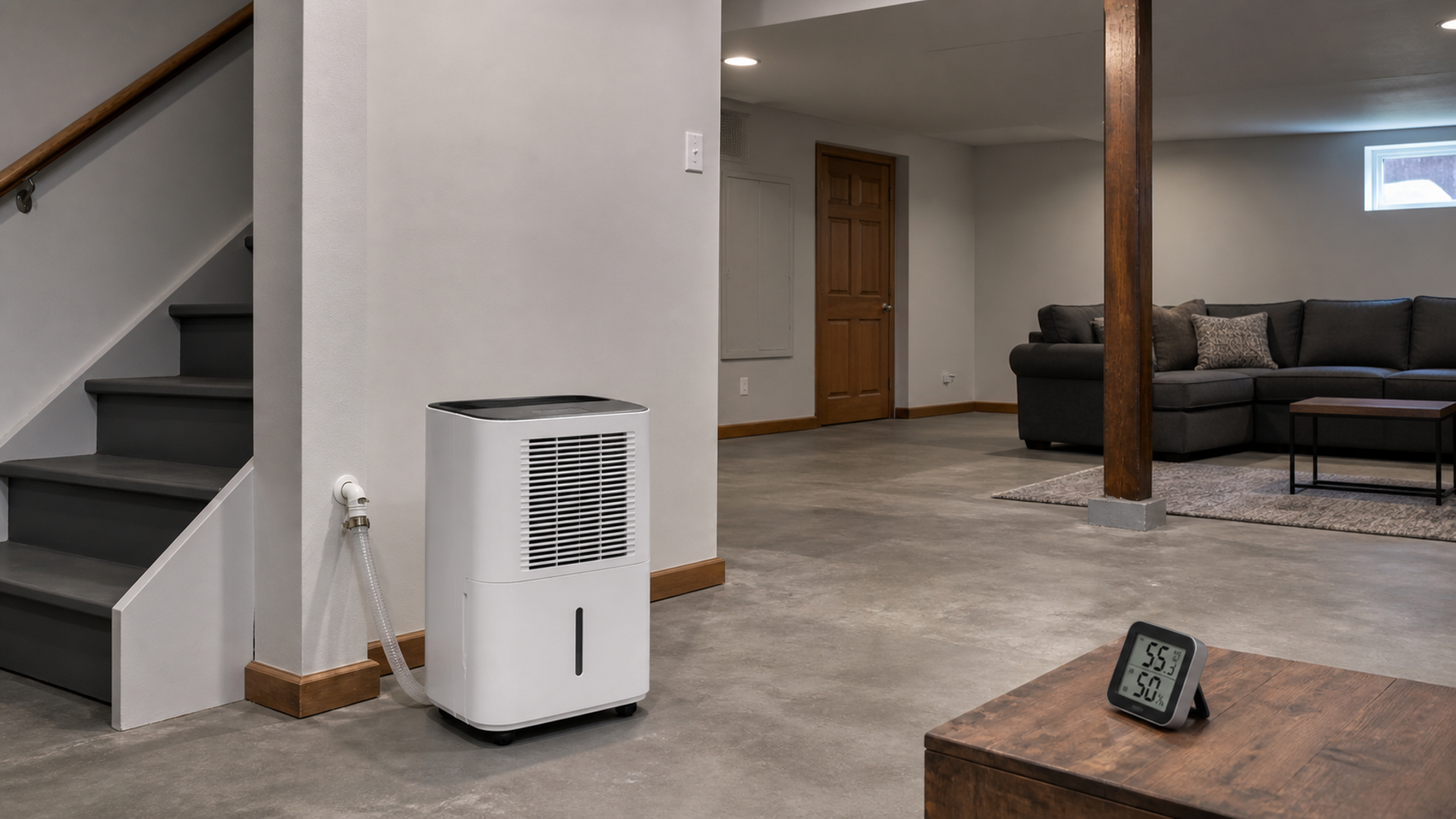
A bucket is simple but stops collection when full and demands regular carrying. A gravity hose needs continuous fall, secure routing and a drain that cannot back up. A pump can lift water but introduces another component, power dependency and overflow risk. Test the full route with clean water, secure the hose against movement and inspect it for kinks, algae and freezing. Never route water where a failure can damage wiring or finishes.
Account for temperature and airflow
Place the unit with the clearances required by its instructions, not tight against stored boxes. Cool-air performance and automatic defrost matter in unheated spaces. Keep doors positioned according to the zone being controlled and use a separate hygrometer to check whether the built-in reading is representative. Excessively low settings can waste energy and may not solve the underlying source.
Plan noise, maintenance and outage behaviour
Compressor and fan noise can transmit through a finished basement. Listen at the target fan speed and from the room above. Clean filters, inspect coils and sanitise the bucket or drain route as instructed. Confirm restart behaviour after a power cut and whether settings are retained. If the unit runs continuously without reaching target humidity, investigate sizing, airflow and moisture entry rather than simply lowering the set point.
Three basement moisture profiles
Finished occupied basement
Prioritise verified noise, controlled drainage, efficient part-load operation and a location that does not obstruct furniture. Track humidity near the occupied zone and a cooler exterior wall. Define the fact that would reverse this recommendation before committing.
Cool storage basement
Automatic defrost, low-temperature operating limits and airflow around stored items are decisive. Gravity drainage is attractive only when the route remains reliable. Define the fact that would reverse this recommendation before committing.
Post-leak drying period
Correct the leak and follow appropriate drying or remediation guidance first. A dehumidifier can support controlled drying, but capacity and safety should match the event rather than become a permanent disguise. Define the fact that would reverse this recommendation before committing.
Action checklist
Log humidity and temperature for several days.
Locate and correct bulk water entry.
Compare current certified capacity.
Check integrated energy factor.
Verify low-temperature and defrost behaviour.
Choose bucket, gravity drain or pump deliberately.
Test overflow and power-loss behaviour.
Preserve intake and exhaust clearance.
Measure noise in adjacent rooms.
Clean filter, bucket and drain route on schedule.
Continue the decision
The linked VERTU articles expand adjacent parts of the best dehumidifier for basement decision. They do not substitute for the external evidence above.
The basement-dehumidifier verdict
Measure relative humidity and temperature over time, stop active water entry, then size a certified dehumidifier for the actual space and moisture load. Prefer automatic defrost for cool conditions, a dependable gravity drain or correctly installed pump where continuous operation is needed, and verified efficiency rather than old capacity labels. Set a sensible humidity target, keep airflow clear and clean the filter and drain path.
Keep the best dehumidifier for basement decision reversible until its material cost, safety, access, privacy and compatibility facts are verified. Unknown evidence stays unknown; it is never silently scored as favourable.