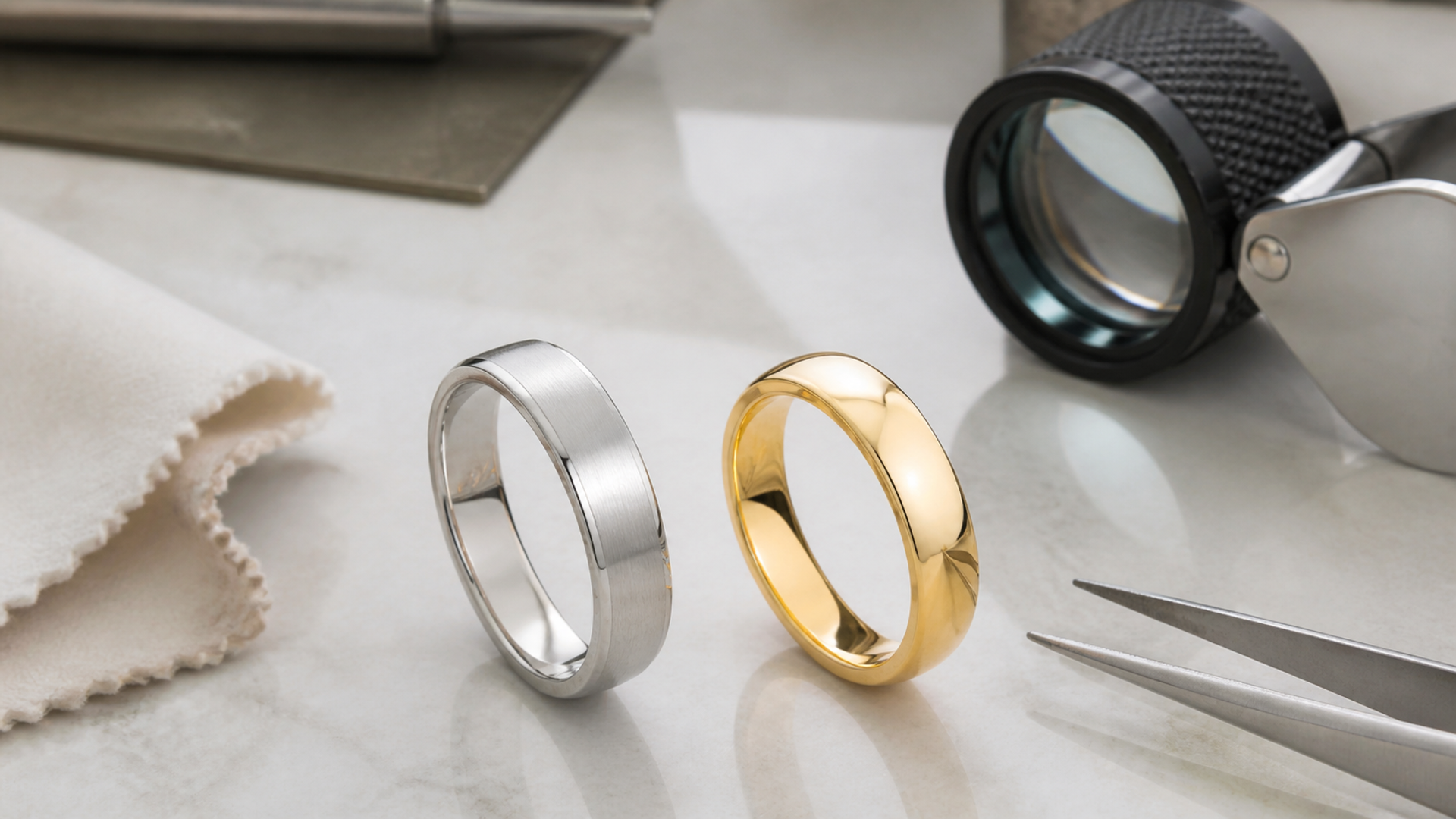
White gold and yellow gold begin with gold alloyed for strength, but their colour, surface maintenance and interaction with stones differ. White gold is commonly alloyed with white metals and often rhodium plated; yellow gold preserves a warmer appearance through its alloy recipe. Karat, craftsmanship and the exact alloy matter as much as colour.
Choose the colour in the light you live in
Choose white gold when a cool neutral frame suits the stone and periodic plating is acceptable. Choose yellow gold when warm colour, visible patina and simpler colour continuity fit the wardrobe. Use both when a two-tone setting solves the design, but keep karat, alloy, solder and future repair compatibility documented.
| Decision factor | White gold | Yellow gold | Use both deliberately |
|---|---|---|---|
| Colour intent | Cool white framing is central | Warm gold is central | Two-tone contrast is deliberate |
| Stone interaction | White reflections support the chosen stone | Warm reflections support the chosen stone | Prongs and shank use colour strategically |
| Surface care | Rhodium inspection and replating are accepted | Polish and patina are accepted | Each surface has a care plan |
| Skin sensitivity | The exact white alloy is disclosed | The exact yellow alloy is disclosed | A jeweller confirms all contact metals |
| Repair route | Matching plating and solder are available | Matching alloy and finish are available | The maker can preserve both colours |
| Wardrobe | Cool metals dominate daily wear | Warm metals dominate daily wear | Existing pieces genuinely mix |
This white gold vs yellow gold matrix is the article's working value object. Read the white gold vs yellow gold rows together: the decisive failure mode depends on this topic's evidence, operating context and reader objective.
What gold alloys and plating establish
Evidence 1. GIA explains that pure gold is too soft for most jewellery and is alloyed with other metals for strength and colour.
Evidence 2. White gold can be made with different alloy recipes and is often rhodium plated, so its maintenance depends on the exact piece.
Evidence 3. Yellow gold is also an alloy; 14K and 18K pieces differ in gold content and may differ in hardness, colour and repair behaviour.
Evidence 4. Metal colour can reflect into a diamond or gemstone, which means the complete setting should be judged rather than the loose stone alone.
Reader-visible sources checked for this article:
consumer.ftc.gov — reader-visible current or official evidence
chanel.com — reader-visible current or official evidence
For white gold vs yellow gold, these sources establish only the claims inside their documented scope. Recheck every changeable specification, availability condition, price, policy or service term in the relevant market before acting.
Plan a lifetime of wear and repair
On colour intent, popularity is not enough. The evidence for option one is that cool white framing is central. Option two means warm gold is central. Option three is rational where two-tone contrast is deliberate. Recheck any changeable term immediately before commitment.
The decision changes at stone interaction. Choose the first path only if white reflections support the chosen stone; move to the second when warm reflections support the chosen stone; use the third when prongs and shank use colour strategically. Save the downside that would make this row fail.
For surface care, the first route works when rhodium inspection and replating are accepted; the second requires polish and patina are accepted. The control for the third is each surface has a care plan. Verify this row against the exact product, property, account or environment before it can reverse the decision.
The skin sensitivity row exposes a practical boundary. Route one assumes the exact white alloy is disclosed, while route two is defensible only when the exact yellow alloy is disclosed. Route three depends on a jeweller confirms all contact metals. If that evidence is absent, keep the more reversible option.
Read repair route as a stop/go test: matching plating and solder are available supports the first option; matching alloy and finish are available supports the second; and the maker can preserve both colours supports the third. Record which source proves the condition and when it was checked.
A buyer can resolve wardrobe without starting from a brand preference. Ask whether cool metals dominate daily wear; compare that with whether warm metals dominate daily wear; then use existing pieces genuinely mix as the third route's safeguard. An unknown condition stays unknown.
Facts that would reverse the current choice
Reversal control 1 — Colour intent. Before choosing White gold, write down how the decision changes if “Cool white framing is central” proves false. Do the same for Yellow gold and “Warm gold is central”. Keep the Use both deliberately route available until “Two-tone contrast is deliberate” is verified. This control belongs to white gold vs yellow gold; update it from the cited source or exact supplier rather than copying a generic checklist.
Reversal control 2 — Stone interaction. Before choosing White gold, write down how the decision changes if “White reflections support the chosen stone” proves false. Do the same for Yellow gold and “Warm reflections support the chosen stone”. Keep the Use both deliberately route available until “Prongs and shank use colour strategically” is verified. This control belongs to white gold vs yellow gold; update it from the cited source or exact supplier rather than copying a generic checklist.
Reversal control 3 — Surface care. Before choosing White gold, write down how the decision changes if “Rhodium inspection and replating are accepted” proves false. Do the same for Yellow gold and “Polish and patina are accepted”. Keep the Use both deliberately route available until “Each surface has a care plan” is verified. This control belongs to white gold vs yellow gold; update it from the cited source or exact supplier rather than copying a generic checklist.
Reversal control 4 — Skin sensitivity. Before choosing White gold, write down how the decision changes if “The exact white alloy is disclosed” proves false. Do the same for Yellow gold and “The exact yellow alloy is disclosed”. Keep the Use both deliberately route available until “A jeweller confirms all contact metals” is verified. This control belongs to white gold vs yellow gold; update it from the cited source or exact supplier rather than copying a generic checklist.
Reversal control 5 — Repair route. Before choosing White gold, write down how the decision changes if “Matching plating and solder are available” proves false. Do the same for Yellow gold and “Matching alloy and finish are available”. Keep the Use both deliberately route available until “The maker can preserve both colours” is verified. This control belongs to white gold vs yellow gold; update it from the cited source or exact supplier rather than copying a generic checklist.
Reversal control 6 — Wardrobe. Before choosing White gold, write down how the decision changes if “Cool metals dominate daily wear” proves false. Do the same for Yellow gold and “Warm metals dominate daily wear”. Keep the Use both deliberately route available until “Existing pieces genuinely mix” is verified. This control belongs to white gold vs yellow gold; update it from the cited source or exact supplier rather than copying a generic checklist.
Inspect under neutral and warm light
View the complete piece next to the wearer's skin and existing jewellery. Shop lighting can hide the difference between alloy colour and plating.
Ask for alloy and hallmark facts
Record karat, hallmark, plating, nickel or palladium disclosure where available, solder and manufacturer. Colour names alone do not identify the metal recipe.
Model maintenance
Ask how often the maker expects inspection or replating for the wear pattern, what polishing removes and whether the finish can be reproduced locally.
Protect repair continuity
Keep invoices, photographs and service records. A future jeweller needs the original alloy and finish information to avoid a visibly mismatched repair.
Three jewellery wardrobes
Colourless diamond with cool wardrobe
White gold can create the intended neutral frame when plating maintenance is accepted. Define the fact that would reverse this recommendation before committing.
Warm-toned daily jewellery
Yellow gold can integrate naturally while allowing visible wear to become part of the piece. Define the fact that would reverse this recommendation before committing.
Heirloom or mixed-metal stack
A deliberate two-tone design can reduce matching pressure when its repair route is documented. Define the fact that would reverse this recommendation before committing.
Action checklist
Verify karat hallmark.
Ask for alloy disclosure.
Confirm rhodium plating.
Check skin sensitivities.
View in mixed light.
Compare with existing jewellery.
Inspect stone reflections.
Price future service.
Photograph the finish.
Keep repair records.
Continue the decision
The linked VERTU articles expand adjacent parts of the white gold vs yellow gold decision. They do not substitute for the external evidence above.
The gold-colour verdict
Choose white gold when a cool neutral frame suits the stone and periodic plating is acceptable. Choose yellow gold when warm colour, visible patina and simpler colour continuity fit the wardrobe. Use both when a two-tone setting solves the design, but keep karat, alloy, solder and future repair compatibility documented.
Keep the white gold vs yellow gold decision reversible until its material cost, safety, access, privacy and compatibility facts are verified. Unknown evidence stays unknown; it is never silently scored as favourable.