For a ring, bracelet or chain that will be worn hard every day, 14K gold is usually the more forgiving choice. For richer colour, higher gold content and jewellery worn with moderate care, 18K is usually more luxurious. The decision should not be reduced to “14K is durable, 18K is premium”. Alloy composition, colour, skin sensitivity, construction, weight and repair practice can matter as much as the karat stamp.
Karat describes the proportion of gold in a 24-part system. Fourteen-karat gold is 14 parts gold out of 24, or about 58.3 per cent; 18K is 18 parts out of 24, or 75 per cent. The remaining metal is an alloy selected to change colour, strength, casting behaviour and cost. That means two pieces stamped with the same karat can wear or look different if their alloy recipes and construction differ.
14K versus 18K at a glance
| Question | 14K gold | 18K gold | Better fit |
|---|---|---|---|
| Gold content | About 58.3% | 75% | 18K for higher precious-metal content |
| Yellow colour | Usually lighter and less saturated | Usually deeper, warmer yellow | 18K for classic rich gold colour |
| Scratch and dent resistance | Often harder because of more alloy metal | Often softer, though alloy and work-hardening matter | 14K for rougher daily wear |
| Price | Lower gold cost at similar weight | Higher gold cost at similar weight | 14K for budget control |
| Weight and construction | Depends on design and whether the piece is solid or hollow | Depends on design and whether the piece is solid or hollow | Compare grams and construction, not karat alone |
| Skin response | More non-gold alloy is present | Less non-gold alloy is present | 18K may help some wearers, but the exact alloy must be known |
| Repair and resizing | Widely serviceable | Widely serviceable, but colour matching matters | Use a jeweller familiar with the exact alloy |
| Long-term appearance | Can retain shape well but still scratches | Develops visible wear and patina sooner in some designs | Decide whether patina is acceptable |
Why 14K is often the practical everyday metal
Adding alloy metals generally makes gold harder than pure 24K gold. Because 14K contains a larger alloy fraction than 18K, it often resists deformation and deep scratching better in comparable designs. That is valuable for thin rings, exposed bracelets and chains that meet desks, door handles and gym equipment. It is not permission to treat fine jewellery as protective equipment: clasps wear, hollow links dent and prongs loosen regardless of karat.
The cost difference can also create a better design. A fixed budget may buy a more substantial 14K band rather than a very light 18K band. Thickness and mass can be decisive. A robust 14K ring may outlast a delicate 18K ring, but a well-engineered 18K piece can outlast a poorly made 14K one. Ask for gram weight, dimensions and whether the piece is solid, hollow or semi-hollow.
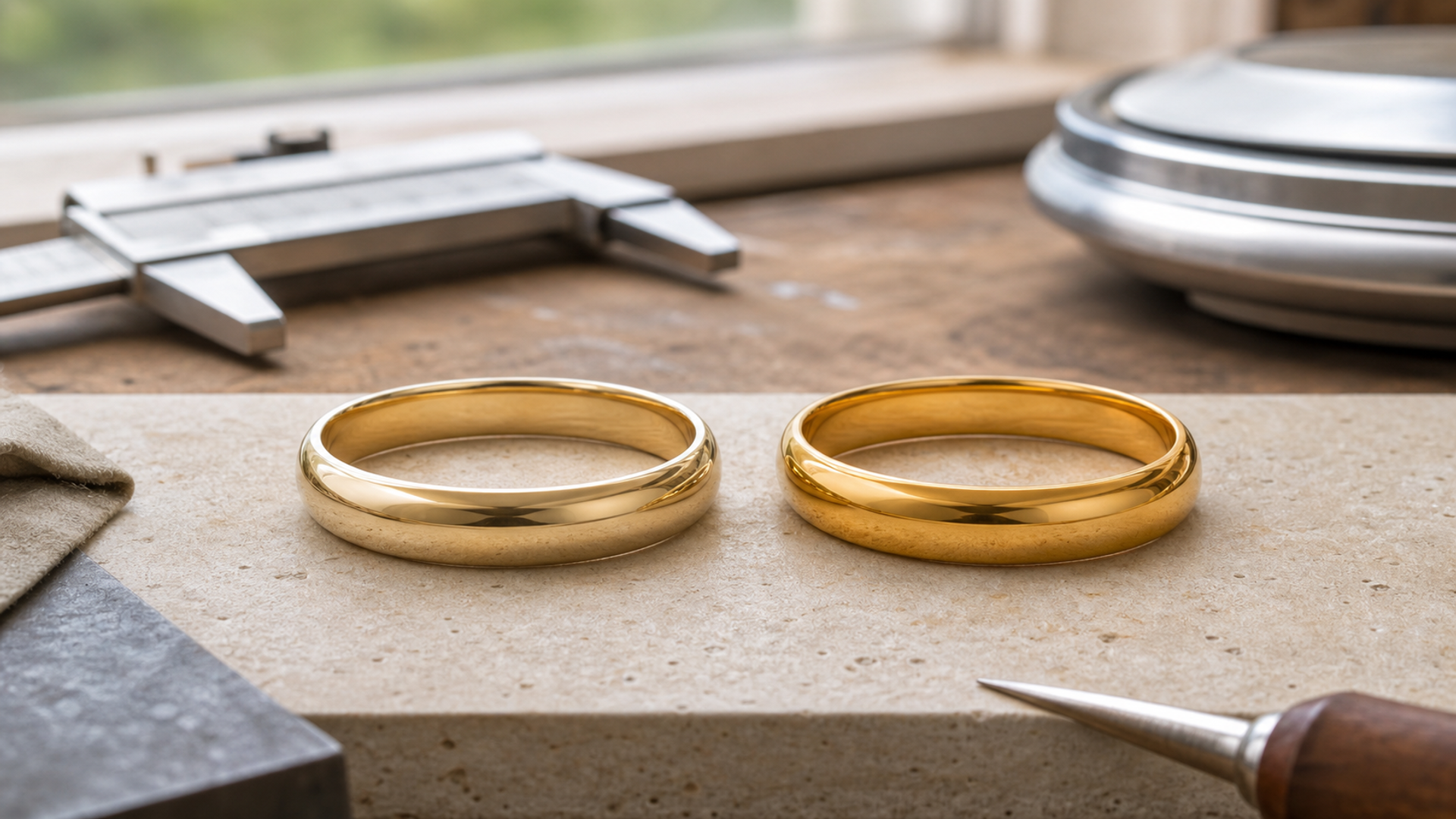
Fourteen-karat yellow gold is usually paler than 18K. Some buyers prefer that restrained colour, particularly when mixing metals or wearing jewellery with a steel watch. Others find it lacks the depth that makes yellow gold visually distinctive. This is aesthetic evidence, not a quality failure.
Why 18K remains the fine-jewellery standard
Eighteen-karat gold places more gold on the skin and usually shows a richer colour. In yellow gold, the difference can be immediately visible beside 14K. In rose and white gold, alloy design has a larger influence, but the 750 fineness mark still signals 75 per cent gold content. Many high-jewellery houses favour 18K because it balances precious-metal content, workability and practical wear.
The metal’s relative softness allows fine finishing and develops a surface history. Polished areas acquire hairlines; edges become gentler; satin finishes evolve. Some owners view this as damage, while others value it as patina. If a mirror finish must remain immaculate, neither 14K nor 18K will satisfy without careful wear and periodic refinishing.
Higher gold content can reduce exposure to some alloy metals, but 18K is not automatically hypoallergenic. White gold may contain nickel in some markets or use palladium-based alloys; solders and findings can differ from the main body. Anyone with a known metal sensitivity should request the precise alloy and component information, then consult an appropriate medical professional rather than relying on the karat number.
Yellow, white and rose gold change the answer
Yellow gold is the cleanest karat comparison because the gold colour remains visible. Eighteen-karat yellow tends to look warmer and more saturated, while 14K can look slightly cooler. Alloy recipes vary, so compare the finished pieces rather than judging colour from a website swatch.
White gold introduces plating and alloy questions. Many white-gold pieces are rhodium plated to create a bright white surface. As the coating wears, the warmer underlying alloy can become visible at high-contact areas. The maintenance interval depends on wear, chemistry and desired appearance, not simply whether the piece is 14K or 18K. Ask whether the piece is plated, what colour the alloy is beneath the plating and what replating costs.
Rose gold obtains its colour largely from copper. A higher copper fraction can make 14K rose gold appear stronger in colour than 18K, although recipes differ. Copper can also affect wear and skin response. Do not assume a generic “rose gold” photograph represents the exact piece.
Construction beats a simple purity hierarchy
A karat stamp says nothing about whether a chain is hollow, whether a bracelet hinge is well engineered or whether a ring has enough metal around the stones for future repairs. Examine high-stress zones: clasp tongues, jump rings, gallery rails, pavé edges, prongs and the lower half of a ring shank. These areas determine whether daily jewellery remains serviceable.
For chains, compare link thickness, soldering, clasp size and whether the design kinks. For bracelets, test articulation and closure security. For rings, ask how much resizing is feasible and whether the design can be rebuilt after years of wear. Jewellery designed only for a showroom can be inconvenient to maintain regardless of gold content.
Weight deserves context. A heavier piece is not automatically better, but an implausibly light piece may be hollow or thin. Request the weight in grams and compare like-for-like lengths and sizes. If a seller will not disclose construction, price comparison becomes unreliable.
Scratches, dents and polishing
Both 14K and 18K gold scratch. Everyday surfaces contain harder particles, and jewellery rubs against other metal objects. Fourteen-karat may conceal wear longer in some designs because it is harder; 18K may accumulate marks more quickly. Finish matters too: high polish shows fine lines, while brushed or textured surfaces can absorb them visually.
Frequent polishing removes metal. It can soften edges, reduce engraving and weaken fine details over time. A better maintenance strategy is to accept ordinary hairlines, clean safely and reserve refinishing for meaningful service intervals. Before authorising polish, ask what will be removed and whether the original finish can be reproduced.
Dents are a construction issue as much as a purity issue. Hollow jewellery can collapse and may be difficult to restore invisibly. A solid, properly proportioned piece is easier to repair. If the jewellery will be worn while travelling, working with equipment or caring for children, prioritise secure, low-profile design over a fragile visual effect.
Hallmarks and what they do not prove
Common fineness marks include 585 for 14K and 750 for 18K, reflecting parts per thousand of gold. Hallmark systems differ by country. A stamp can be useful evidence, but it can also be counterfeited and does not assess craftsmanship, weight, origin or condition. High-value purchases should come with an invoice naming the metal fineness, weight where appropriate, stones and maker.
The US Federal Trade Commission publishes guidance intended to prevent deceptive jewellery descriptions. Buyers should be alert to gold-plated, gold-filled, vermeil and bonded descriptions, which are not the same as solid 14K or 18K construction. Ask the seller to state plainly which parts are solid gold and which are plated or base metal.
For vintage jewellery, previous repairs may use different solder or replacement components. A competent jeweller can test the piece and identify risks before resizing or aggressive cleaning.
Total ownership cost
The purchase price is only the beginning. Add resizing, clasp repair, stone tightening, rhodium replating where relevant, insurance and eventual refinishing. An 18K piece that the owner loves and wears for decades may deliver better value than a cheaper 14K piece left unused. Conversely, paying for higher gold content makes little sense when the design is too delicate for the owner’s routine.
Resale calculations should be conservative. Scrap value depends on recoverable metal weight and market price; retail jewellery also contains design, labour, brand and distribution costs that may not be recovered. Signed pieces can behave differently in the secondary market, but a karat upgrade alone does not make jewellery an investment.
The best financial discipline is to buy a design that survives use, keep documentation and avoid repeated remaking or replacement.
Everyday-use decision checklist
Will the piece be worn during work, travel, exercise or childcare?
Is rich yellow colour more important than resistance to dents?
What is the finished weight, and is the construction solid or hollow?
Which alloy metals are present in the body, solder and findings?
Is white gold rhodium plated, and what is the replating plan?
Are clasps, hinges, prongs and links substantial enough for daily wear?
Can the ring be resized or the component repaired locally?
Does the invoice state 14K/585 or 18K/750 clearly?
What routine inspections does the maker recommend?
Is the complete 18K piece affordable without compromising design strength?
Verdict
Choose 14K for hard daily wear, a lower purchase cost and a design that benefits from a harder alloy. Choose 18K for richer gold colour, higher precious-metal content and the feel of traditional fine jewellery—provided the wearer accepts surface marks and chooses adequate construction. When two pieces are otherwise equal, karat matters. In the real world they rarely are equal, so inspect weight, alloy, finish and engineering before letting a purity number make the decision.
Related VERTU reading
Compare the same durability logic across metals in gold versus platinum for luxury earrings. For VERTU-specific precious-metal context, see VERTU gold phone materials and craftsmanship.