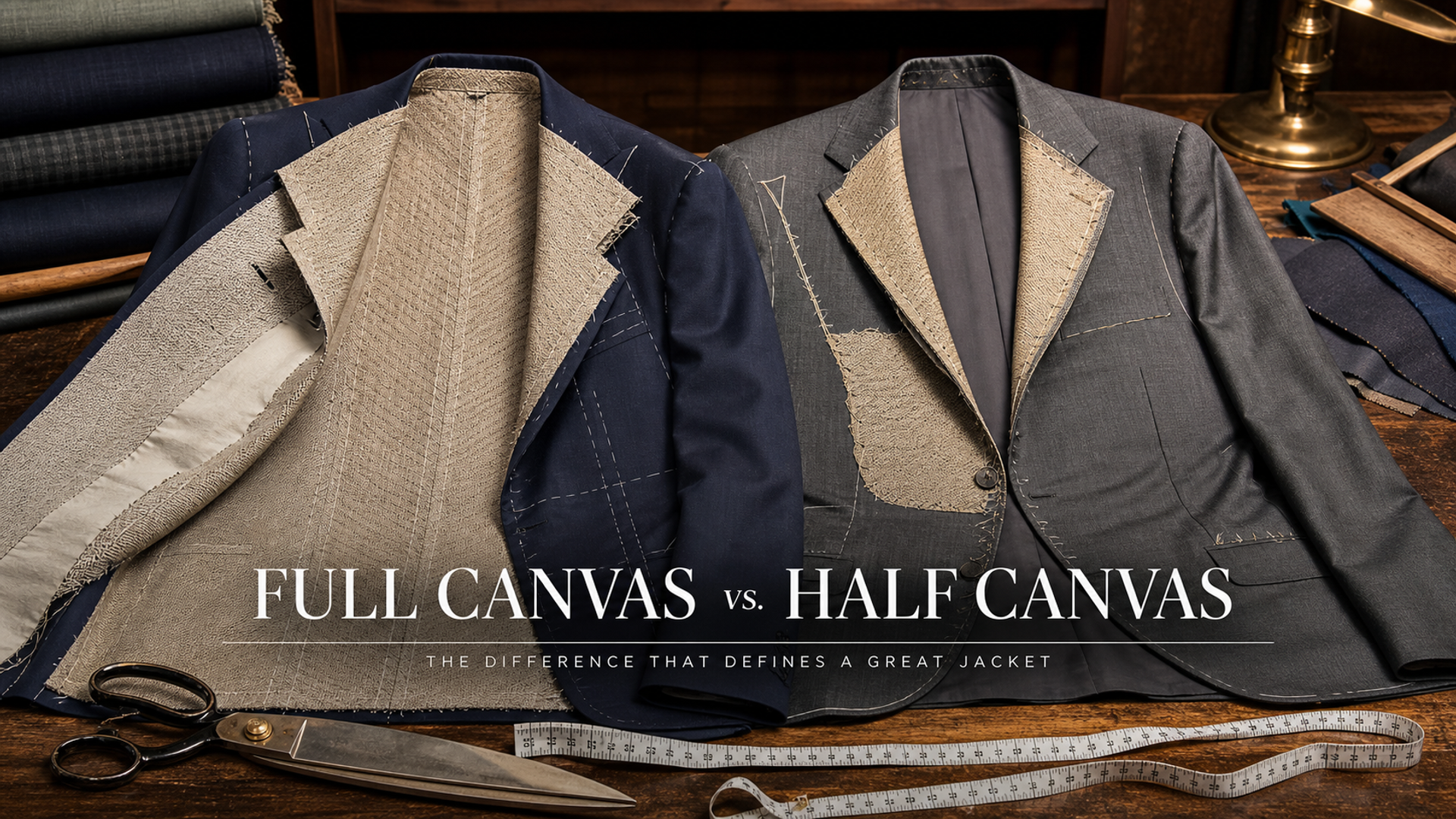
Full canvas and half canvas describe how a tailored jacket is supported beneath its visible cloth. The distinction can affect drape, break-in, heat, alteration tolerance and cost, but it does not turn every full-canvas suit into a better purchase. Cloth, pattern, fit, pressing and the wearer's climate still decide whether extra internal structure creates value.
Start with the jacket's job
Choose full canvas when frequent wear, long ownership and gradual moulding to the body justify the extra work. Choose half canvas when a lighter price and simpler structure meet the use case. Compare both in similar cloth and fit before paying for construction that the wearer cannot feel or use.
| Decision factor | Full canvas | Half canvas | Try both with the same cloth |
|---|---|---|---|
| Wear frequency | Frequent rotation rewards long-term shape | Occasional use limits the payback | Track expected wears per year |
| Climate | Breathable natural structure suits the route | Less internal structure can feel easier | Try both in the destination climate |
| Drape | Chest and lapel roll are priorities | A clean competent silhouette is enough | Judge from front, side and movement |
| Alteration | Future adjustment room matters | Initial fit is unlikely to change | Ask which seams and balance can move |
| Break-in | Gradual moulding is welcome | Immediate familiarity matters | Wear the jacket for thirty minutes |
| Cost per wear | Higher entry cost will be amortised | Budget protects cloth and fit | Calculate the complete suit cost |
This full canvas vs half canvas suit matrix is the article's working value object. Read the full canvas vs half canvas suit rows together: the decisive failure mode depends on this topic's evidence, operating context and reader objective.
What tailoring evidence establishes
Evidence 1. Savile Row Bespoke describes bespoke tailoring as an individual process built around pattern, fitting and craft rather than a single construction label.
Evidence 2. A canvas supports the jacket between cloth and lining; the exact extent and materials must be confirmed with the maker.
Evidence 3. Cloth weight, lining, padding and climate can influence comfort as much as the canvas category.
Evidence 4. Fit, balance and pressing remain article-specific workmanship questions; full canvas cannot rescue an unsuitable pattern.
Reader-visible sources checked for this article:
savilerowbespoke.com — reader-visible current or official evidence
huntsmansavilerow.com — reader-visible current or official evidence
For full canvas vs half canvas suit, these sources establish only the claims inside their documented scope. Recheck every changeable specification, availability condition, price, policy or service term in the relevant market before acting.
Compare structure over years
The wear frequency row exposes a practical boundary. Route one assumes frequent rotation rewards long-term shape, while route two is defensible only when occasional use limits the payback. Route three depends on track expected wears per year. If that evidence is absent, keep the more reversible option.
Read climate as a stop/go test: breathable natural structure suits the route supports the first option; less internal structure can feel easier supports the second; and try both in the destination climate supports the third. Record which source proves the condition and when it was checked.
A buyer can resolve drape without starting from a brand preference. Ask whether chest and lapel roll are priorities; compare that with whether a clean competent silhouette is enough; then use judge from front, side and movement as the third route's safeguard. An unknown condition stays unknown.
On alteration, popularity is not enough. The evidence for option one is that future adjustment room matters. Option two means initial fit is unlikely to change. Option three is rational where ask which seams and balance can move. Recheck any changeable term immediately before commitment.
The decision changes at break-in. Choose the first path only if gradual moulding is welcome; move to the second when immediate familiarity matters; use the third when wear the jacket for thirty minutes. Save the downside that would make this row fail.
For cost per wear, the first route works when higher entry cost will be amortised; the second requires budget protects cloth and fit. The control for the third is calculate the complete suit cost. Verify this row against the exact product, property, account or environment before it can reverse the decision.
Facts that would reverse the current choice
Reversal control 1 — Wear frequency. Before choosing Full canvas, write down how the decision changes if “Frequent rotation rewards long-term shape” proves false. Do the same for Half canvas and “Occasional use limits the payback”. Keep the Try both with the same cloth route available until “Track expected wears per year” is verified. This control belongs to full canvas vs half canvas suit; update it from the cited source or exact supplier rather than copying a generic checklist.
Reversal control 2 — Climate. Before choosing Full canvas, write down how the decision changes if “Breathable natural structure suits the route” proves false. Do the same for Half canvas and “Less internal structure can feel easier”. Keep the Try both with the same cloth route available until “Try both in the destination climate” is verified. This control belongs to full canvas vs half canvas suit; update it from the cited source or exact supplier rather than copying a generic checklist.
Reversal control 3 — Drape. Before choosing Full canvas, write down how the decision changes if “Chest and lapel roll are priorities” proves false. Do the same for Half canvas and “A clean competent silhouette is enough”. Keep the Try both with the same cloth route available until “Judge from front, side and movement” is verified. This control belongs to full canvas vs half canvas suit; update it from the cited source or exact supplier rather than copying a generic checklist.
Reversal control 4 — Alteration. Before choosing Full canvas, write down how the decision changes if “Future adjustment room matters” proves false. Do the same for Half canvas and “Initial fit is unlikely to change”. Keep the Try both with the same cloth route available until “Ask which seams and balance can move” is verified. This control belongs to full canvas vs half canvas suit; update it from the cited source or exact supplier rather than copying a generic checklist.
Reversal control 5 — Break-in. Before choosing Full canvas, write down how the decision changes if “Gradual moulding is welcome” proves false. Do the same for Half canvas and “Immediate familiarity matters”. Keep the Try both with the same cloth route available until “Wear the jacket for thirty minutes” is verified. This control belongs to full canvas vs half canvas suit; update it from the cited source or exact supplier rather than copying a generic checklist.
Reversal control 6 — Cost per wear. Before choosing Full canvas, write down how the decision changes if “Higher entry cost will be amortised” proves false. Do the same for Half canvas and “Budget protects cloth and fit”. Keep the Try both with the same cloth route available until “Calculate the complete suit cost” is verified. This control belongs to full canvas vs half canvas suit; update it from the cited source or exact supplier rather than copying a generic checklist.
Compare like with like
Try jackets in similar cloth weight, shoulder treatment and size. Fasten them, sit, reach and walk. Watch the lapel, chest and skirt instead of squeezing the front to guess at construction.
Ask the maker to show the structure
Request a clear description of where canvas runs, whether fusible support is also used, and how the chest and lapel are built. Keep the answer on the order record.
Model ownership, not showroom prestige
Estimate wear, cleaning, travel and likely alterations. A well-fitted half-canvas suit worn often may be a stronger purchase than an elaborate jacket that stays in the wardrobe.
Protect the finished garment
Use a supportive hanger, allow recovery between wears and follow the cloth maker's care advice. Return to a competent tailor when balance, buttons or lining need attention.
Three suit-buying situations
Weekly professional rotation
Full canvas can justify its cost when the jacket is worn often and the owner values evolving drape. Define the fact that would reverse this recommendation before committing.
Occasional formal use
Half canvas can preserve budget for cloth and fit when annual wear is low. Define the fact that would reverse this recommendation before committing.
Hot-climate travel
The lighter-feeling result should win after a realistic wear test, regardless of construction prestige. Define the fact that would reverse this recommendation before committing.
Action checklist
Confirm the construction in writing.
Compare similar cloth weights.
Inspect balance from every side.
Sit and reach in the jacket.
Ask about alteration allowance.
Price the complete suit.
Estimate wears per year.
Check climate and lining.
Review care and pressing.
Keep fitting notes.
Continue the decision
The linked VERTU articles expand adjacent parts of the full canvas vs half canvas suit decision. They do not substitute for the external evidence above.
The canvas verdict
Choose full canvas when frequent wear, long ownership and gradual moulding to the body justify the extra work. Choose half canvas when a lighter price and simpler structure meet the use case. Compare both in similar cloth and fit before paying for construction that the wearer cannot feel or use.
Keep the full canvas vs half canvas suit decision reversible until its material cost, safety, access, privacy and compatibility facts are verified. Unknown evidence stays unknown; it is never silently scored as favourable.