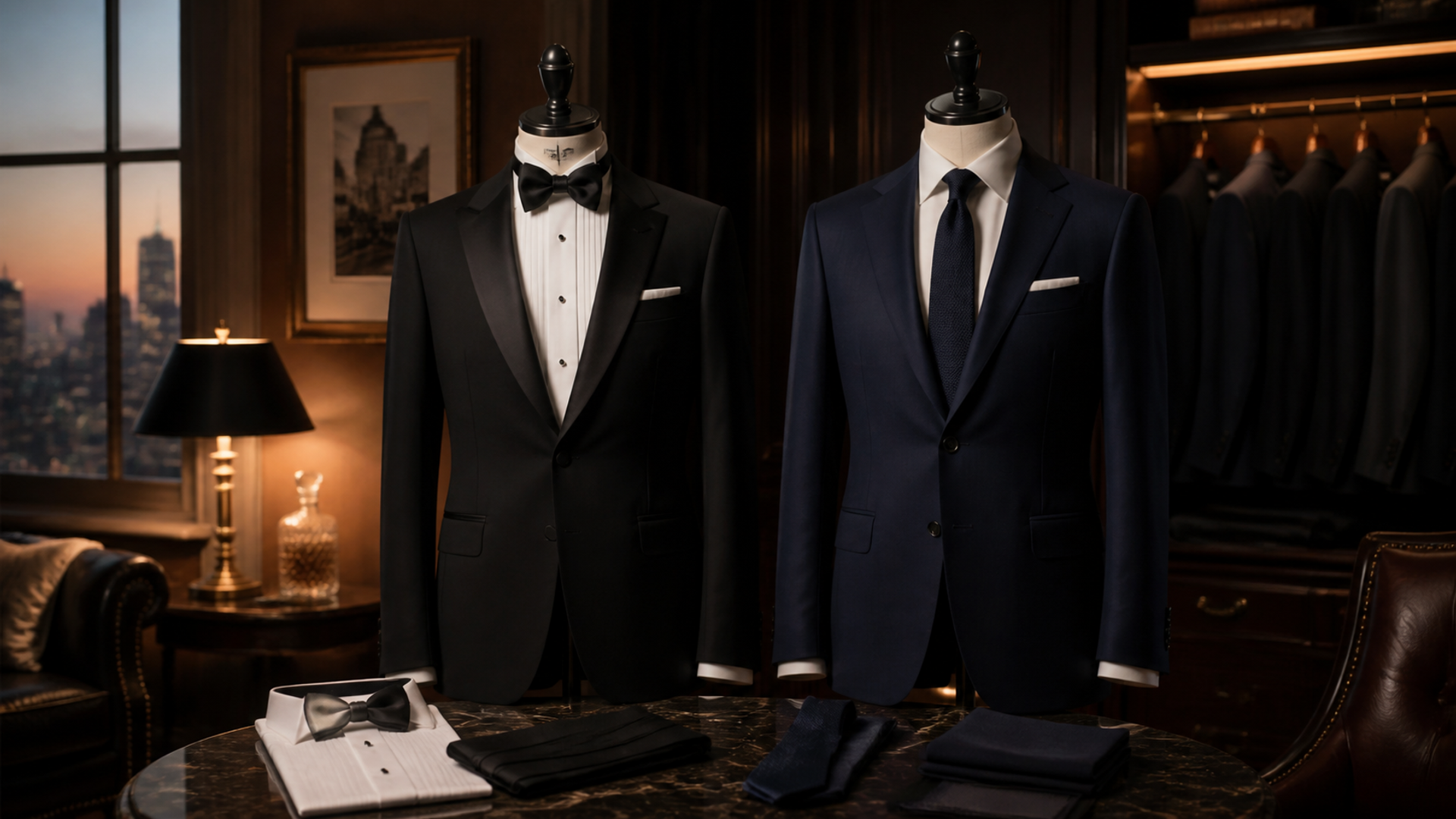
A tuxedo and a dark suit can look close on a hanger while communicating different levels of formality. Satin-faced lapels, matching trouser braid, a formal shirt and bow tie mark the tuxedo system; a suit uses matching cloth without those evening details and earns far more business rewear. The invitation and host convention should decide before personal preference.
Start with the invitation
Choose a tuxedo for black-tie events where formal evening details are expected. Choose a dark suit for business, weddings and occasions whose dress code allows conventional tailoring. Rent or defer when one uncertain event cannot justify alterations, shoes, shirt and accessories or when the invitation has not been clarified.
| Decision factor | Tuxedo | Dark suit | Rent or defer |
|---|---|---|---|
| Dress code | Black tie or an explicit tuxedo request | Business formal, cocktail or suit-appropriate wedding | Ask the host when wording is ambiguous |
| Lapels and trousers | Satin facing and coordinated trouser braid are intentional | Self-fabric details preserve suit versatility | Do not assemble a hybrid by accident |
| Shirt and neckwear | Formal shirt and bow tie complete the system | Dress shirt and suitable tie follow the event | Price the complete outfit before buying |
| Rewear | A recurring formal calendar supports ownership | Work and social use support repeated wear | Rental can protect capital for a rare event |
| Fit timeline | Alterations can be completed and tested | Alterations support broader use | Do not rush an irreversible purchase |
| Travel | The itinerary protects formal components | One suit covers more meetings and dinners | Rent at destination only with a proven fitting plan |
This tuxedo vs suit matrix is the article's working value object. Read the tuxedo vs suit rows together: the decisive failure mode depends on this topic's evidence, operating context and reader objective.
What makes a tuxedo different
Evidence 1. Traditional tuxedo details commonly include satin on the lapel and a matching stripe or braid on the trousers, while a business suit generally uses self fabric.
Evidence 2. Black tie is a complete dress system rather than a black jacket alone; shirt, neckwear, shoes and accessories affect whether the result reads as intentional.
Evidence 3. A dark suit usually has greater daytime and business rewear, but it is not automatically a substitute when the invitation explicitly requires black tie.
Evidence 4. Alteration quality and timing can matter more than label prestige because sleeve, trouser, collar and jacket balance determine the visible fit.
Reader-visible sources checked for this article:
theblacktux.com — reader-visible current or official evidence
theblacktux.com — reader-visible current or official evidence
For tuxedo vs suit, these sources establish only the claims inside their documented scope. Recheck every changeable specification, availability condition, price, policy or service term in the relevant market before acting.
Build the complete formal system
Read dress code as a stop/go test: black tie or an explicit tuxedo request supports the first option; business formal, cocktail or suit-appropriate wedding supports the second; and ask the host when wording is ambiguous supports the third. Record which source proves the condition and when it was checked.
A buyer can resolve lapels and trousers without starting from a brand preference. Ask whether satin facing and coordinated trouser braid are intentional; compare that with whether self-fabric details preserve suit versatility; then use do not assemble a hybrid by accident as the third route's safeguard. An unknown condition stays unknown.
On shirt and neckwear, popularity is not enough. The evidence for option one is that formal shirt and bow tie complete the system. Option two means dress shirt and suitable tie follow the event. Option three is rational where price the complete outfit before buying. Recheck any changeable term immediately before commitment.
The decision changes at rewear. Choose the first path only if a recurring formal calendar supports ownership; move to the second when work and social use support repeated wear; use the third when rental can protect capital for a rare event. Save the downside that would make this row fail.
For fit timeline, the first route works when alterations can be completed and tested; the second requires alterations support broader use. The control for the third is do not rush an irreversible purchase. Verify this row against the exact product, property, account or environment before it can reverse the decision.
The travel row exposes a practical boundary. Route one assumes the itinerary protects formal components, while route two is defensible only when one suit covers more meetings and dinners. Route three depends on rent at destination only with a proven fitting plan. If that evidence is absent, keep the more reversible option.
Facts that would reverse the current choice
Reversal control 1 — Dress code. Before choosing Tuxedo, write down how the decision changes if “Black tie or an explicit tuxedo request” proves false. Do the same for Dark suit and “Business formal, cocktail or suit-appropriate wedding”. Keep the Rent or defer route available until “Ask the host when wording is ambiguous” is verified. This control belongs to tuxedo vs suit; update it from the cited source or exact supplier rather than copying a generic checklist.
Reversal control 2 — Lapels and trousers. Before choosing Tuxedo, write down how the decision changes if “Satin facing and coordinated trouser braid are intentional” proves false. Do the same for Dark suit and “Self-fabric details preserve suit versatility”. Keep the Rent or defer route available until “Do not assemble a hybrid by accident” is verified. This control belongs to tuxedo vs suit; update it from the cited source or exact supplier rather than copying a generic checklist.
Reversal control 3 — Shirt and neckwear. Before choosing Tuxedo, write down how the decision changes if “Formal shirt and bow tie complete the system” proves false. Do the same for Dark suit and “Dress shirt and suitable tie follow the event”. Keep the Rent or defer route available until “Price the complete outfit before buying” is verified. This control belongs to tuxedo vs suit; update it from the cited source or exact supplier rather than copying a generic checklist.
Reversal control 4 — Rewear. Before choosing Tuxedo, write down how the decision changes if “A recurring formal calendar supports ownership” proves false. Do the same for Dark suit and “Work and social use support repeated wear”. Keep the Rent or defer route available until “Rental can protect capital for a rare event” is verified. This control belongs to tuxedo vs suit; update it from the cited source or exact supplier rather than copying a generic checklist.
Reversal control 5 — Fit timeline. Before choosing Tuxedo, write down how the decision changes if “Alterations can be completed and tested” proves false. Do the same for Dark suit and “Alterations support broader use”. Keep the Rent or defer route available until “Do not rush an irreversible purchase” is verified. This control belongs to tuxedo vs suit; update it from the cited source or exact supplier rather than copying a generic checklist.
Reversal control 6 — Travel. Before choosing Tuxedo, write down how the decision changes if “The itinerary protects formal components” proves false. Do the same for Dark suit and “One suit covers more meetings and dinners”. Keep the Rent or defer route available until “Rent at destination only with a proven fitting plan” is verified. This control belongs to tuxedo vs suit; update it from the cited source or exact supplier rather than copying a generic checklist.
Translate the invitation
Record the exact wording, venue, start time, hosts and regional convention. Contact the organiser for consequential ambiguity rather than using social photographs as the authority.
Fit the complete outfit
Try the jacket, trousers, shirt, shoes and waist treatment together after normal movement. Sit, walk, raise the arms and photograph the silhouette from front, side and back.
Calculate rewear value
Count realistic formal and business uses over three years, then include tailoring, cleaning, shoes and replacement accessories. A lower price per wear is useful only if the garment fits the actual calendar.
Pack for recovery
Carry the shirt and critical accessories in hand luggage, allow pressing time and retain a local alteration or rental fallback for destination events.
Three event wardrobes
Explicit black-tie gala
A properly fitted tuxedo is the low-risk answer when the invitation is unambiguous. Define the fact that would reverse this recommendation before committing.
Board meeting and evening dinner
A dark suit normally delivers broader rewear when black tie is not required. Define the fact that would reverse this recommendation before committing.
One destination wedding
Rental or a clarified dress code can avoid buying an incomplete formal wardrobe. Define the fact that would reverse this recommendation before committing.
Action checklist
Read the exact invitation.
Confirm local convention.
Choose lapel style.
Fit shirt and neckwear.
Check trouser break.
Walk in the shoes.
Allow alteration time.
Price cleaning.
Plan hand luggage.
Photograph the final fit.
Continue the decision
The linked VERTU articles expand adjacent parts of the tuxedo vs suit decision. They do not substitute for the external evidence above.
The tuxedo-suit verdict
Choose a tuxedo for black-tie events where formal evening details are expected. Choose a dark suit for business, weddings and occasions whose dress code allows conventional tailoring. Rent or defer when one uncertain event cannot justify alterations, shoes, shirt and accessories or when the invitation has not been clarified.
Keep the tuxedo vs suit decision reversible until its material cost, safety, access, privacy and compatibility facts are verified. Unknown evidence stays unknown; it is never silently scored as favourable.