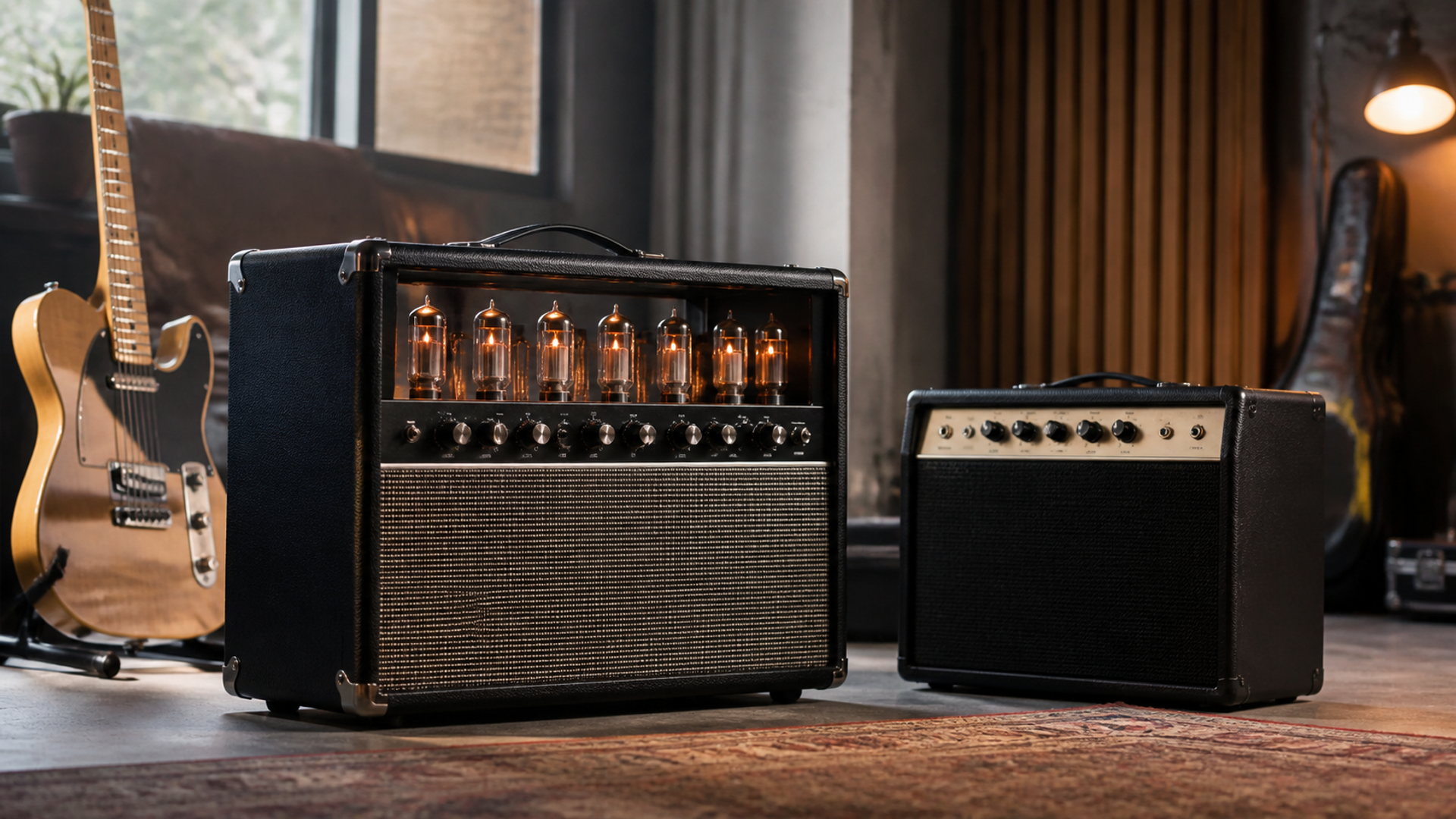
Tube and solid-state guitar amplifiers use different amplification technologies, but the familiar claim that one is warm and the other sterile is too crude for a buying decision. Preamp design, power stage, speaker, cabinet, wattage, controls and playing level can outweigh the category. Tube amps also introduce heat, fragile valves and maintenance; solid-state designs range from simple analogue circuits to sophisticated digital modelling. The relevant test uses the player's guitar, pedals, room and realistic volume.
Room and playing level come first
Choose a tube amplifier when its response and breakup at usable volume justify the weight, heat and maintenance. Choose a solid-state amplifier when predictable clean power, low weight, low-volume consistency or reliability matters more. Use modelling or a two-amp plan when silent practice, recording, many sounds and live simplicity cannot be covered by one traditional circuit.
| Decision factor | Tube amplifier | Solid-state amplifier | Use modelling or a two-amp plan |
|---|---|---|---|
| Response | Power-stage behaviour can be part of the feel | Clean headroom and response vary widely | Audition exact models |
| Volume | Desired breakup may require significant level | Many designs retain character at low level | Test in the real room |
| Maintenance | Valves age and can require qualified service | Fewer routine valve tasks | Check local repair support |
| Weight and heat | Transformers and valves can add both | Compact designs can travel easily | Compare the complete rig |
| Features | Traditional controls may be focused | Modelling, effects and direct outputs may be integrated | Buy only features used |
| Reliability | Spare valves and handling can matter | Electronics can also fail and vary in repairability | Plan a gig fallback |
This tube amp vs solid state amp matrix is the article's working value object. Read the tube amp vs solid state amp rows together: the decisive failure mode depends on this topic's evidence, operating context and reader objective.
Circuit category does not fix the tone
Evidence 1. Fender's amplifier guidance distinguishes tube amplification from digital and solid-state approaches while presenting them as use-dependent choices.
Evidence 2. Marshall's beginner guidance recommends choosing power and features for the intended setting rather than assuming more wattage or one circuit is always better.
Evidence 3. Yamaha's amplifier guidance links speaker, power and use case, reinforcing the need to judge the complete system.
Evidence 4. Perceived tonal preference must be compared at controlled loudness because louder playback can bias an audition.
Reader-visible sources checked for this article:
fender.com — reader-visible current or official evidence
marshall.com — reader-visible current or official evidence
hub.yamaha.com — reader-visible current or official evidence
For tube amp vs solid state amp, these sources establish only the claims inside their documented scope. Recheck every changeable specification, availability condition, price, policy or service term in the relevant market before acting.
Audition at matched loudness
Read response as a stop/go test: power-stage behaviour can be part of the feel supports the first option; clean headroom and response vary widely supports the second; and audition exact models supports the third. Record which source proves the condition and when it was checked.
A buyer can resolve volume without starting from a brand preference. Ask whether desired breakup may require significant level; compare that with whether many designs retain character at low level; then use test in the real room as the third route's safeguard. An unknown condition stays unknown.
On maintenance, popularity is not enough. The evidence for option one is that valves age and can require qualified service. Option two means fewer routine valve tasks. Option three is rational where check local repair support. Recheck any changeable term immediately before commitment.
The decision changes at weight and heat. Choose the first path only if transformers and valves can add both; move to the second when compact designs can travel easily; use the third when compare the complete rig. Save the downside that would make this row fail.
For features, the first route works when traditional controls may be focused; the second requires modelling, effects and direct outputs may be integrated. The control for the third is buy only features used. Verify this row against the exact product, property, account or environment before it can reverse the decision.
The reliability row exposes a practical boundary. Route one assumes spare valves and handling can matter, while route two is defensible only when electronics can also fail and vary in repairability. Route three depends on plan a gig fallback. If that evidence is absent, keep the more reversible option.
Facts that would reverse the current choice
Reversal control 1 — Response. Before choosing Tube amplifier, write down how the decision changes if “Power-stage behaviour can be part of the feel” proves false. Do the same for Solid-state amplifier and “Clean headroom and response vary widely”. Keep the Use modelling or a two-amp plan route available until “Audition exact models” is verified. This control belongs to tube amp vs solid state amp; update it from the cited source or exact supplier rather than copying a generic checklist.
Reversal control 2 — Volume. Before choosing Tube amplifier, write down how the decision changes if “Desired breakup may require significant level” proves false. Do the same for Solid-state amplifier and “Many designs retain character at low level”. Keep the Use modelling or a two-amp plan route available until “Test in the real room” is verified. This control belongs to tube amp vs solid state amp; update it from the cited source or exact supplier rather than copying a generic checklist.
Reversal control 3 — Maintenance. Before choosing Tube amplifier, write down how the decision changes if “Valves age and can require qualified service” proves false. Do the same for Solid-state amplifier and “Fewer routine valve tasks”. Keep the Use modelling or a two-amp plan route available until “Check local repair support” is verified. This control belongs to tube amp vs solid state amp; update it from the cited source or exact supplier rather than copying a generic checklist.
Reversal control 4 — Weight and heat. Before choosing Tube amplifier, write down how the decision changes if “Transformers and valves can add both” proves false. Do the same for Solid-state amplifier and “Compact designs can travel easily”. Keep the Use modelling or a two-amp plan route available until “Compare the complete rig” is verified. This control belongs to tube amp vs solid state amp; update it from the cited source or exact supplier rather than copying a generic checklist.
Reversal control 5 — Features. Before choosing Tube amplifier, write down how the decision changes if “Traditional controls may be focused” proves false. Do the same for Solid-state amplifier and “Modelling, effects and direct outputs may be integrated”. Keep the Use modelling or a two-amp plan route available until “Buy only features used” is verified. This control belongs to tube amp vs solid state amp; update it from the cited source or exact supplier rather than copying a generic checklist.
Reversal control 6 — Reliability. Before choosing Tube amplifier, write down how the decision changes if “Spare valves and handling can matter” proves false. Do the same for Solid-state amplifier and “Electronics can also fail and vary in repairability”. Keep the Use modelling or a two-amp plan route available until “Plan a gig fallback” is verified. This control belongs to tube amp vs solid state amp; update it from the cited source or exact supplier rather than copying a generic checklist.
Define the playing room
Record practice, studio, rehearsal and venue size plus acceptable sound level. Measure or consistently match audition loudness and include household or venue constraints. In this tube amplifier versus solid-state amplifier comparison, preserve the exact item, setting, date and test condition in the evidence log. Keep measured results separate from category shorthand and repeat the check in the intended environment. If the preferred sound appears only above the usable level, choose another circuit or attenuation plan. When that reversal condition appears, reopen the choice instead of defending the original preference.
Use the actual signal chain
Bring the normal guitar, pickups, pedals and cables and set both amplifiers from neutral starting points. Compare clean, edge-of-breakup and driven sounds without rapid level jumps. In this tube amplifier versus solid-state amplifier comparison, preserve the exact item, setting, date and test condition in the evidence log. Keep measured results separate from category shorthand and repeat the check in the intended environment. If a pedal or speaker explains the preference, update the amplifier verdict. When that reversal condition appears, reopen the choice instead of defending the original preference.
Test touch and noise
Play sustained notes, muted rhythm, dynamic picking and volume-knob changes. Listen for hum, hiss, fan noise, rattles and microphonic behaviour at realistic gain. In this tube amplifier versus solid-state amplifier comparison, preserve the exact item, setting, date and test condition in the evidence log. Keep measured results separate from category shorthand and repeat the check in the intended environment. If noise prevents recording or quiet practice, reject that setup. When that reversal condition appears, reopen the choice instead of defending the original preference.
Model upkeep and transport
Price valve replacement, qualified service, carrying case, weight and warm-up or cooling time. Check dimensions against stairs, vehicle and stage. In this tube amplifier versus solid-state amplifier comparison, preserve the exact item, setting, date and test condition in the evidence log. Keep measured results separate from category shorthand and repeat the check in the intended environment. If the rig will stay home because it is burdensome, choose the amplifier that will actually be used. When that reversal condition appears, reopen the choice instead of defending the original preference.
Build a failure plan
Test direct output, backup amplifier, spare cables and a rapid stage changeover. Document safe valve handling and never open hazardous equipment without qualifications. In this tube amplifier versus solid-state amplifier comparison, preserve the exact item, setting, date and test condition in the evidence log. Keep measured results separate from category shorthand and repeat the check in the intended environment. If one component can end a paid performance, add a verified fallback. When that reversal condition appears, reopen the choice instead of defending the original preference.
Four players, four answers
Apartment practice
A controllable solid-state or modelling amp may work better at low level. Define the fact that would reverse this recommendation before committing.
Studio player seeking power-stage interaction
A suitable tube amp can justify maintenance when the room permits it. Define the fact that would reverse this recommendation before committing.
Touring musician
Weight, consistency, repair access and backup time can favour solid state. Define the fact that would reverse this recommendation before committing.
Player with many genres
A modelling or two-amp plan can avoid forcing one circuit into every role. Define the fact that would reverse this recommendation before committing.
Action checklist
Define room volume.
Bring the normal guitar.
Bring normal pedals.
Match loudness.
Test clean headroom.
Test breakup.
Listen for noise.
Check weight.
Check heat.
Price service.
Plan a backup.
Record the sound that reverses the choice.
Continue the decision
The linked VERTU articles expand adjacent parts of the tube amp vs solid state amp decision. They do not substitute for the external evidence above.
The tube-versus-solid-state verdict
Choose a tube amplifier when its response and breakup at usable volume justify the weight, heat and maintenance. Choose a solid-state amplifier when predictable clean power, low weight, low-volume consistency or reliability matters more. Use modelling or a two-amp plan when silent practice, recording, many sounds and live simplicity cannot be covered by one traditional circuit.
Keep the tube amp vs solid state amp decision reversible until its material cost, safety, access, privacy and compatibility facts are verified. Unknown evidence stays unknown; it is never silently scored as favourable.