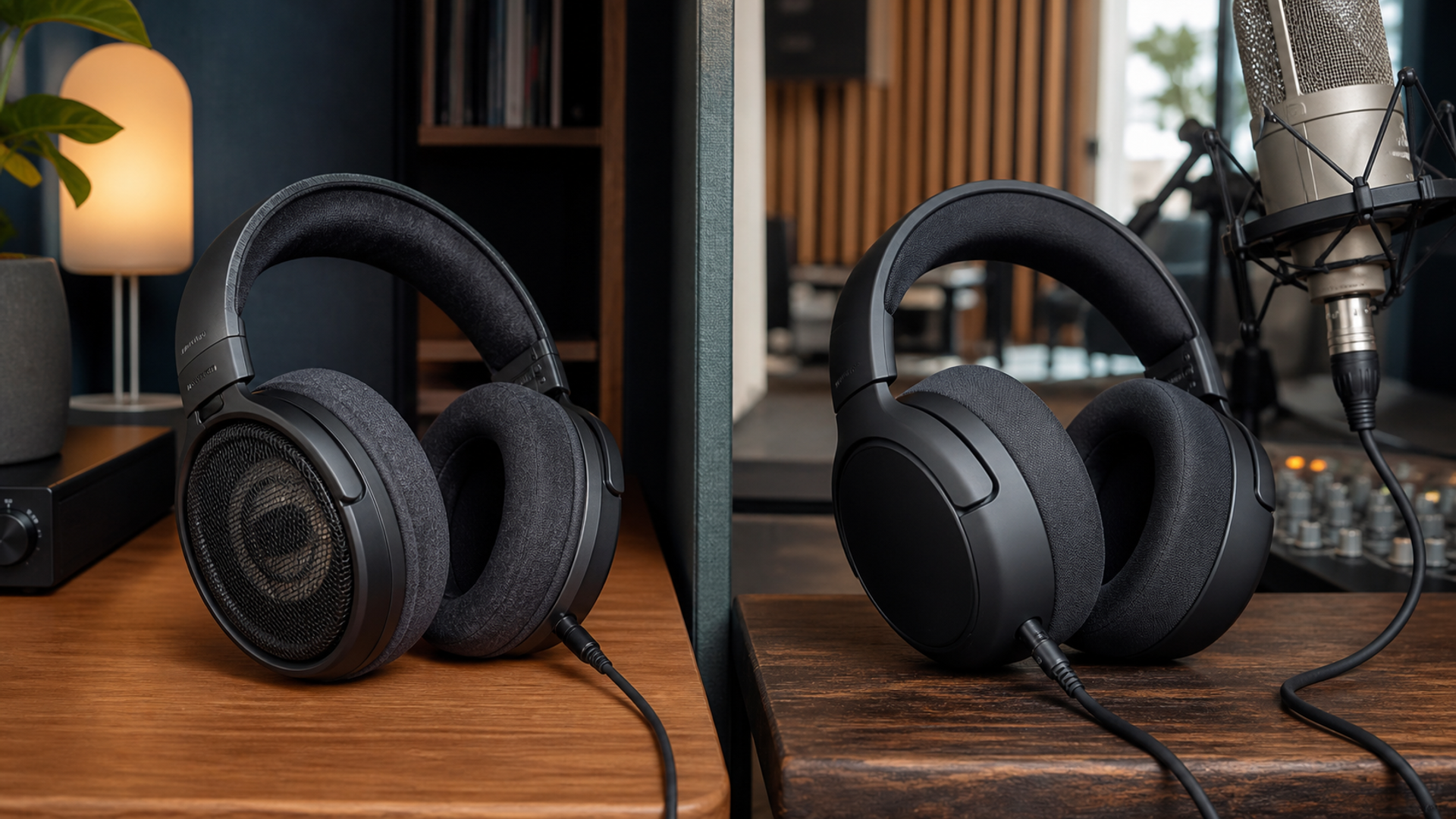
Open-back headphones allow more acoustic interaction through the earcup; closed-back headphones seal the rear of the driver more fully. That construction changes leakage, isolation, heat, pressure behaviour and how the design is tuned, but it does not guarantee one sound quality ranking. The same listener may rationally prefer open headphones in a quiet room and closed headphones beside colleagues, family or a recording microphone. The decision therefore starts with the environment and failure consequence before tonal taste.
The room is part of the headphone
Choose open-back headphones for a quiet private room when leakage is acceptable and the exact tuning and comfort win. Choose closed-back headphones when isolation, microphone bleed or nearby listeners matter. Use two tools or another form factor when one pair cannot safely cover studio, travel, office and home contexts without a serious compromise.
| Decision factor | Open-back headphones | Closed-back headphones | Use two tools or another form factor |
|---|---|---|---|
| Leakage | Sound can escape through open cups | Closed cups usually reduce outward leakage | Test at actual volume and distance |
| Isolation | Environmental sound remains more audible | Passive isolation is usually stronger | Noise cancellation is a separate feature |
| Microphone use | Bleed can enter a sensitive microphone | Closed design can reduce bleed | Run a real recording test |
| Comfort | Airflow may reduce heat for some listeners | Pads and seal can increase warmth | Clamp, pad and weight still matter |
| Sound | Design may create an open spatial impression | Design may support controlled bass and isolation | Judge exact models, not labels |
| Safety | Awareness can help in a private safe setting | Isolation can conceal alarms or traffic | Do not use either unsafely |
This open back vs closed back headphones matrix is the article's working value object. Read the open back vs closed back headphones rows together: the decisive failure mode depends on this topic's evidence, operating context and reader objective.
Leakage and isolation move in opposite directions
Evidence 1. Shure recording guidance differentiates open and closed headphones by isolation, leakage and monitoring context.
Evidence 2. Focal's direct explanation similarly treats the two constructions as tools for different environments rather than a universal quality hierarchy.
Evidence 3. Open or closed construction does not determine impedance, sensitivity, frequency response, comfort or amplifier requirement by itself.
Evidence 4. Listening level and duration remain hearing-risk variables regardless of enclosure type.
Reader-visible sources checked for this article:
shure.com — reader-visible current or official evidence
focal.com — reader-visible current or official evidence
For open back vs closed back headphones, these sources establish only the claims inside their documented scope. Recheck every changeable specification, availability condition, price, policy or service term in the relevant market before acting.
Test at equal level with a microphone nearby
The leakage row exposes a practical boundary. Route one assumes sound can escape through open cups, while route two is defensible only when closed cups usually reduce outward leakage. Route three depends on test at actual volume and distance. If that evidence is absent, keep the more reversible option.
Read isolation as a stop/go test: environmental sound remains more audible supports the first option; passive isolation is usually stronger supports the second; and noise cancellation is a separate feature supports the third. Record which source proves the condition and when it was checked.
A buyer can resolve microphone use without starting from a brand preference. Ask whether bleed can enter a sensitive microphone; compare that with whether closed design can reduce bleed; then use run a real recording test as the third route's safeguard. An unknown condition stays unknown.
On comfort, popularity is not enough. The evidence for option one is that airflow may reduce heat for some listeners. Option two means pads and seal can increase warmth. Option three is rational where clamp, pad and weight still matter. Recheck any changeable term immediately before commitment.
The decision changes at sound. Choose the first path only if design may create an open spatial impression; move to the second when design may support controlled bass and isolation; use the third when judge exact models, not labels. Save the downside that would make this row fail.
For safety, the first route works when awareness can help in a private safe setting; the second requires isolation can conceal alarms or traffic. The control for the third is do not use either unsafely. Verify this row against the exact product, property, account or environment before it can reverse the decision.
Facts that would reverse the current choice
Reversal control 1 — Leakage. Before choosing Open-back headphones, write down how the decision changes if “Sound can escape through open cups” proves false. Do the same for Closed-back headphones and “Closed cups usually reduce outward leakage”. Keep the Use two tools or another form factor route available until “Test at actual volume and distance” is verified. This control belongs to open back vs closed back headphones; update it from the cited source or exact supplier rather than copying a generic checklist.
Reversal control 2 — Isolation. Before choosing Open-back headphones, write down how the decision changes if “Environmental sound remains more audible” proves false. Do the same for Closed-back headphones and “Passive isolation is usually stronger”. Keep the Use two tools or another form factor route available until “Noise cancellation is a separate feature” is verified. This control belongs to open back vs closed back headphones; update it from the cited source or exact supplier rather than copying a generic checklist.
Reversal control 3 — Microphone use. Before choosing Open-back headphones, write down how the decision changes if “Bleed can enter a sensitive microphone” proves false. Do the same for Closed-back headphones and “Closed design can reduce bleed”. Keep the Use two tools or another form factor route available until “Run a real recording test” is verified. This control belongs to open back vs closed back headphones; update it from the cited source or exact supplier rather than copying a generic checklist.
Reversal control 4 — Comfort. Before choosing Open-back headphones, write down how the decision changes if “Airflow may reduce heat for some listeners” proves false. Do the same for Closed-back headphones and “Pads and seal can increase warmth”. Keep the Use two tools or another form factor route available until “Clamp, pad and weight still matter” is verified. This control belongs to open back vs closed back headphones; update it from the cited source or exact supplier rather than copying a generic checklist.
Reversal control 5 — Sound. Before choosing Open-back headphones, write down how the decision changes if “Design may create an open spatial impression” proves false. Do the same for Closed-back headphones and “Design may support controlled bass and isolation”. Keep the Use two tools or another form factor route available until “Judge exact models, not labels” is verified. This control belongs to open back vs closed back headphones; update it from the cited source or exact supplier rather than copying a generic checklist.
Reversal control 6 — Safety. Before choosing Open-back headphones, write down how the decision changes if “Awareness can help in a private safe setting” proves false. Do the same for Closed-back headphones and “Isolation can conceal alarms or traffic”. Keep the Use two tools or another form factor route available until “Do not use either unsafely” is verified. This control belongs to open back vs closed back headphones; update it from the cited source or exact supplier rather than copying a generic checklist.
Map every listening location
List private room, office, aircraft, train, studio, shared bedroom and outdoor use. Assign leakage and isolation tolerance to each. For this open-back versus closed-back headphones decision, keep the exact item, setting, date and test condition in one evidence log. Separate a measured result from category shorthand and repeat the check in the intended environment. If one high-frequency setting cannot tolerate leakage, reverse an open-only plan. If that reversal condition appears, reopen the decision instead of defending the earlier preference.
Run a leakage test
Play speech and music at normal level while another person listens at one and three metres. Record with the intended microphone position. For this open-back versus closed-back headphones decision, keep the exact item, setting, date and test condition in one evidence log. Separate a measured result from category shorthand and repeat the check in the intended environment. If speech remains intelligible to others or enters the mic, choose stronger isolation. If that reversal condition appears, reopen the decision instead of defending the earlier preference.
Match level before judging
Use the same source and measured or carefully matched playback level. Switch slowly and score tonal balance, spatial cues and fatigue. For this open-back versus closed-back headphones decision, keep the exact item, setting, date and test condition in one evidence log. Separate a measured result from category shorthand and repeat the check in the intended environment. If louder playback explains excitement, discard that comparison. If that reversal condition appears, reopen the decision instead of defending the earlier preference.
Test thermal comfort
Wear each pair for the longest normal session and record heat, clamp, pad pressure and glasses interaction. Repeat after movement and in warm conditions. For this open-back versus closed-back headphones decision, keep the exact item, setting, date and test condition in one evidence log. Separate a measured result from category shorthand and repeat the check in the intended environment. If discomfort shortens safe use, sound preference cannot rescue the pair. If that reversal condition appears, reopen the decision instead of defending the earlier preference.
Check drive and repair needs
Verify impedance, sensitivity, connector, cable, pad availability and amplifier output. Price replacement pads and cables. For this open-back versus closed-back headphones decision, keep the exact item, setting, date and test condition in one evidence log. Separate a measured result from category shorthand and repeat the check in the intended environment. If a required amplifier or unavailable consumable breaks the use case, choose another model. If that reversal condition appears, reopen the decision instead of defending the earlier preference.
Four listening environments, four answers
Quiet dedicated study
An open pair may deliver the preferred experience without disturbing anyone. Define the fact that would reverse this recommendation before committing.
Shared office
A closed pair can protect colleagues and reduce distraction. Define the fact that would reverse this recommendation before committing.
Voice recording desk
Microphone bleed testing can make closed construction decisive. Define the fact that would reverse this recommendation before committing.
Mixed travel and home
Two purpose-built pairs can be more rational than one compromised flagship. Define the fact that would reverse this recommendation before committing.
Action checklist
List environments.
Set leakage limit.
Set isolation need.
Test microphone bleed.
Match playback level.
Check clamp.
Check heat.
Check glasses fit.
Verify impedance.
Verify connector.
Price pads.
Protect hearing.
Continue the decision
The linked VERTU articles expand adjacent parts of the open back vs closed back headphones decision. They do not substitute for the external evidence above.
The open-versus-closed-back verdict
Choose open-back headphones for a quiet private room when leakage is acceptable and the exact tuning and comfort win. Choose closed-back headphones when isolation, microphone bleed or nearby listeners matter. Use two tools or another form factor when one pair cannot safely cover studio, travel, office and home contexts without a serious compromise.
Keep the open back vs closed back headphones decision reversible until its material cost, safety, access, privacy and compatibility facts are verified. Unknown evidence stays unknown; it is never silently scored as favourable.