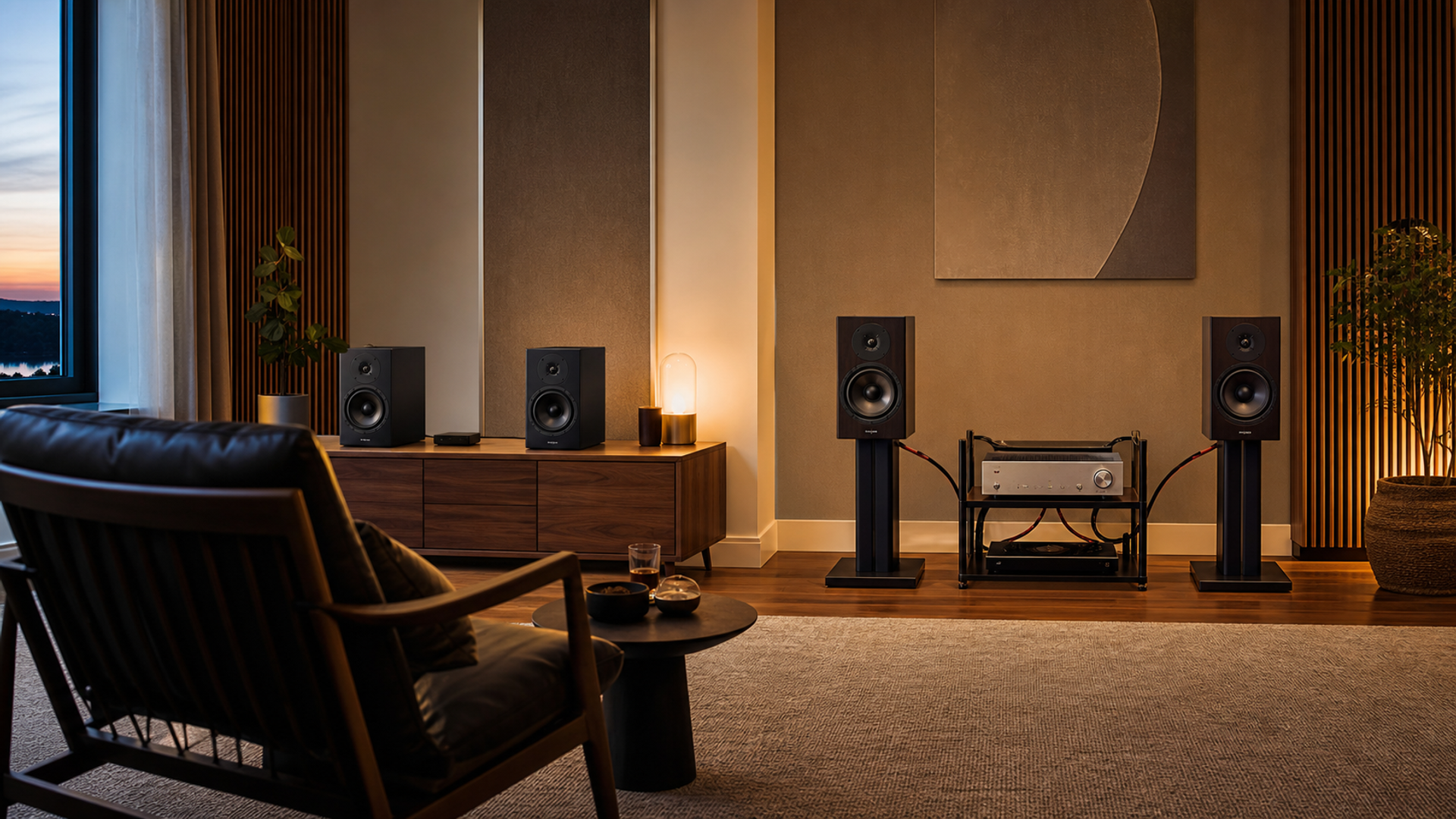
Active and passive speakers organise amplification and crossover duties differently. An active design can integrate amplifiers, signal processing and drivers as a factory-aligned system; a passive speaker needs compatible external amplification and places more system matching in the owner's hands. Powered is not always identical to fully active, and wireless marketing does not remove power cables or software dependencies. The useful comparison draws the complete signal chain, room, sources, listening distance, service route and desired upgrade path.
Draw the signal chain before choosing boxes
Choose active speakers when compact integration, known amplifier matching and a controlled system are the priority. Choose passive speakers when component choice, long-term serviceability and staged upgrades justify more boxes and matching work. Use a mixed or professionally designed system when multiple zones, subwoofers, room correction or installed wiring make a simple binary choice misleading.
| Decision factor | Active speaker system | Passive speaker system | Use a mixed or professionally designed system |
|---|---|---|---|
| Amplification | Built into the speaker or system | External amplifier must match load and level | Document every gain stage |
| Crossover | May operate before amplification with DSP or analogue control | Usually passive network after power amplifier | Confirm the exact architecture |
| Cabling | Needs power plus signal or network | Needs speaker cable from amplifier | Plan safe routes and outlets |
| Upgrade | Integrated electronics can limit module swapping | Amplifier and source can change separately | Value system stability as well |
| Service | Electronics and drivers share an enclosure | Fault domains are more separated | Check parts and repair support |
| Room fit | DSP may offer alignment tools | External electronics can add correction | Measure at the listening seat |
This active vs passive speakers matrix is the article's working value object. Read the active vs passive speakers rows together: the decisive failure mode depends on this topic's evidence, operating context and reader objective.
Amplification location changes upgrade paths
Evidence 1. KEF's direct comparison describes active Hi-Fi speakers as integrating amplification while passive speakers depend on separate electronics.
Evidence 2. Genelec explains active crossovers operating at low signal level before dedicated amplifiers, illustrating a genuine active architecture rather than a marketing label.
Evidence 3. Yamaha guidance distinguishes powered and passive loudspeakers and notes different cabling, setup and expansion implications.
Evidence 4. Room position, directivity, listening distance and acoustic treatment can outweigh architecture when comparing sound.
Reader-visible sources checked for this article:
uk.kef.com — reader-visible current or official evidence
genelec.com — reader-visible current or official evidence
usa.yamaha.com — reader-visible current or official evidence
For active vs passive speakers, these sources establish only the claims inside their documented scope. Recheck every changeable specification, availability condition, price, policy or service term in the relevant market before acting.
Listen at the seat, not beside the speaker
For amplification, the first route works when built into the speaker or system; the second requires external amplifier must match load and level. The control for the third is document every gain stage. Verify this row against the exact product, property, account or environment before it can reverse the decision.
The crossover row exposes a practical boundary. Route one assumes may operate before amplification with DSP or analogue control, while route two is defensible only when usually passive network after power amplifier. Route three depends on confirm the exact architecture. If that evidence is absent, keep the more reversible option.
Read cabling as a stop/go test: needs power plus signal or network supports the first option; needs speaker cable from amplifier supports the second; and plan safe routes and outlets supports the third. Record which source proves the condition and when it was checked.
A buyer can resolve upgrade without starting from a brand preference. Ask whether integrated electronics can limit module swapping; compare that with whether amplifier and source can change separately; then use value system stability as well as the third route's safeguard. An unknown condition stays unknown.
On service, popularity is not enough. The evidence for option one is that electronics and drivers share an enclosure. Option two means fault domains are more separated. Option three is rational where check parts and repair support. Recheck any changeable term immediately before commitment.
The decision changes at room fit. Choose the first path only if dSP may offer alignment tools; move to the second when external electronics can add correction; use the third when measure at the listening seat. Save the downside that would make this row fail.
Facts that would reverse the current choice
Reversal control 1 — Amplification. Before choosing Active speaker system, write down how the decision changes if “Built into the speaker or system” proves false. Do the same for Passive speaker system and “External amplifier must match load and level”. Keep the Use a mixed or professionally designed system route available until “Document every gain stage” is verified. This control belongs to active vs passive speakers; update it from the cited source or exact supplier rather than copying a generic checklist.
Reversal control 2 — Crossover. Before choosing Active speaker system, write down how the decision changes if “May operate before amplification with DSP or analogue control” proves false. Do the same for Passive speaker system and “Usually passive network after power amplifier”. Keep the Use a mixed or professionally designed system route available until “Confirm the exact architecture” is verified. This control belongs to active vs passive speakers; update it from the cited source or exact supplier rather than copying a generic checklist.
Reversal control 3 — Cabling. Before choosing Active speaker system, write down how the decision changes if “Needs power plus signal or network” proves false. Do the same for Passive speaker system and “Needs speaker cable from amplifier”. Keep the Use a mixed or professionally designed system route available until “Plan safe routes and outlets” is verified. This control belongs to active vs passive speakers; update it from the cited source or exact supplier rather than copying a generic checklist.
Reversal control 4 — Upgrade. Before choosing Active speaker system, write down how the decision changes if “Integrated electronics can limit module swapping” proves false. Do the same for Passive speaker system and “Amplifier and source can change separately”. Keep the Use a mixed or professionally designed system route available until “Value system stability as well” is verified. This control belongs to active vs passive speakers; update it from the cited source or exact supplier rather than copying a generic checklist.
Reversal control 5 — Service. Before choosing Active speaker system, write down how the decision changes if “Electronics and drivers share an enclosure” proves false. Do the same for Passive speaker system and “Fault domains are more separated”. Keep the Use a mixed or professionally designed system route available until “Check parts and repair support” is verified. This control belongs to active vs passive speakers; update it from the cited source or exact supplier rather than copying a generic checklist.
Reversal control 6 — Room fit. Before choosing Active speaker system, write down how the decision changes if “DSP may offer alignment tools” proves false. Do the same for Passive speaker system and “External electronics can add correction”. Keep the Use a mixed or professionally designed system route available until “Measure at the listening seat” is verified. This control belongs to active vs passive speakers; update it from the cited source or exact supplier rather than copying a generic checklist.
Draw the complete chain
List sources, conversion, volume control, crossover, amplification, speakers, subwoofer and network services. Mark every analogue, digital, power and wireless dependency. For this active versus passive speakers decision, keep the exact item, setting, date and test condition in one evidence log. Separate a measured result from category shorthand and repeat the check in the intended environment. If an essential source cannot connect cleanly, reverse the architecture choice. If that reversal condition appears, reopen the decision instead of defending the earlier preference.
Measure the room
Record dimensions, seat distance, boundary clearance, reflective surfaces and acceptable speaker positions. Measure or audition from the real seat at matched level. For this active versus passive speakers decision, keep the exact item, setting, date and test condition in one evidence log. Separate a measured result from category shorthand and repeat the check in the intended environment. If placement dominates the result, fix placement before buying electronics. If that reversal condition appears, reopen the decision instead of defending the earlier preference.
Run a level-matched audition
Use the same recordings and approximate sound pressure, avoiding rapid louder-is-better judgement. Score dialogue, tonal balance, bass integration, imaging and fatigue over time. For this active versus passive speakers decision, keep the exact item, setting, date and test condition in one evidence log. Separate a measured result from category shorthand and repeat the check in the intended environment. If a difference disappears at matched level, do not pay for the wrong cause. If that reversal condition appears, reopen the decision instead of defending the earlier preference.
Simulate a failure
Disconnect network, reboot, remove one source and ask how amplification or control would be repaired. Record warranty, parts, software support and shipping burden. For this active versus passive speakers decision, keep the exact item, setting, date and test condition in one evidence log. Separate a measured result from category shorthand and repeat the check in the intended environment. If one integrated fault silences the whole room without support, reduce its value. If that reversal condition appears, reopen the decision instead of defending the earlier preference.
Map the five-year upgrade path
List likely source, streaming, room, subwoofer and amplification changes. Price cables, stands, power, service and resale with the speakers. For this active versus passive speakers decision, keep the exact item, setting, date and test condition in one evidence log. Separate a measured result from category shorthand and repeat the check in the intended environment. If theoretical flexibility will never be used, choose the simpler stable system. If that reversal condition appears, reopen the decision instead of defending the earlier preference.
Four rooms, four answers
Small design-led living room
A well-integrated active pair can reduce boxes and matching work. Define the fact that would reverse this recommendation before committing.
Long-term enthusiast system
Passive speakers can support staged amplifier and source changes. Define the fact that would reverse this recommendation before committing.
Desktop near-field setup
Active monitors can align amplification and short listening distance. Define the fact that would reverse this recommendation before committing.
Whole-home installation
A designed mixed system may handle zones and maintenance more rationally. Define the fact that would reverse this recommendation before committing.
Action checklist
Draw signal chain.
List sources.
Measure room.
Mark outlets.
Plan cable routes.
Match audition level.
Test real seat.
Check subwoofer path.
Check software dependence.
Check repair route.
Price five years.
Write upgrade plan.
Continue the decision
The linked VERTU articles expand adjacent parts of the active vs passive speakers decision. They do not substitute for the external evidence above.
The active-versus-passive-speaker verdict
Choose active speakers when compact integration, known amplifier matching and a controlled system are the priority. Choose passive speakers when component choice, long-term serviceability and staged upgrades justify more boxes and matching work. Use a mixed or professionally designed system when multiple zones, subwoofers, room correction or installed wiring make a simple binary choice misleading.
Keep the active vs passive speakers decision reversible until its material cost, safety, access, privacy and compatibility facts are verified. Unknown evidence stays unknown; it is never silently scored as favourable.