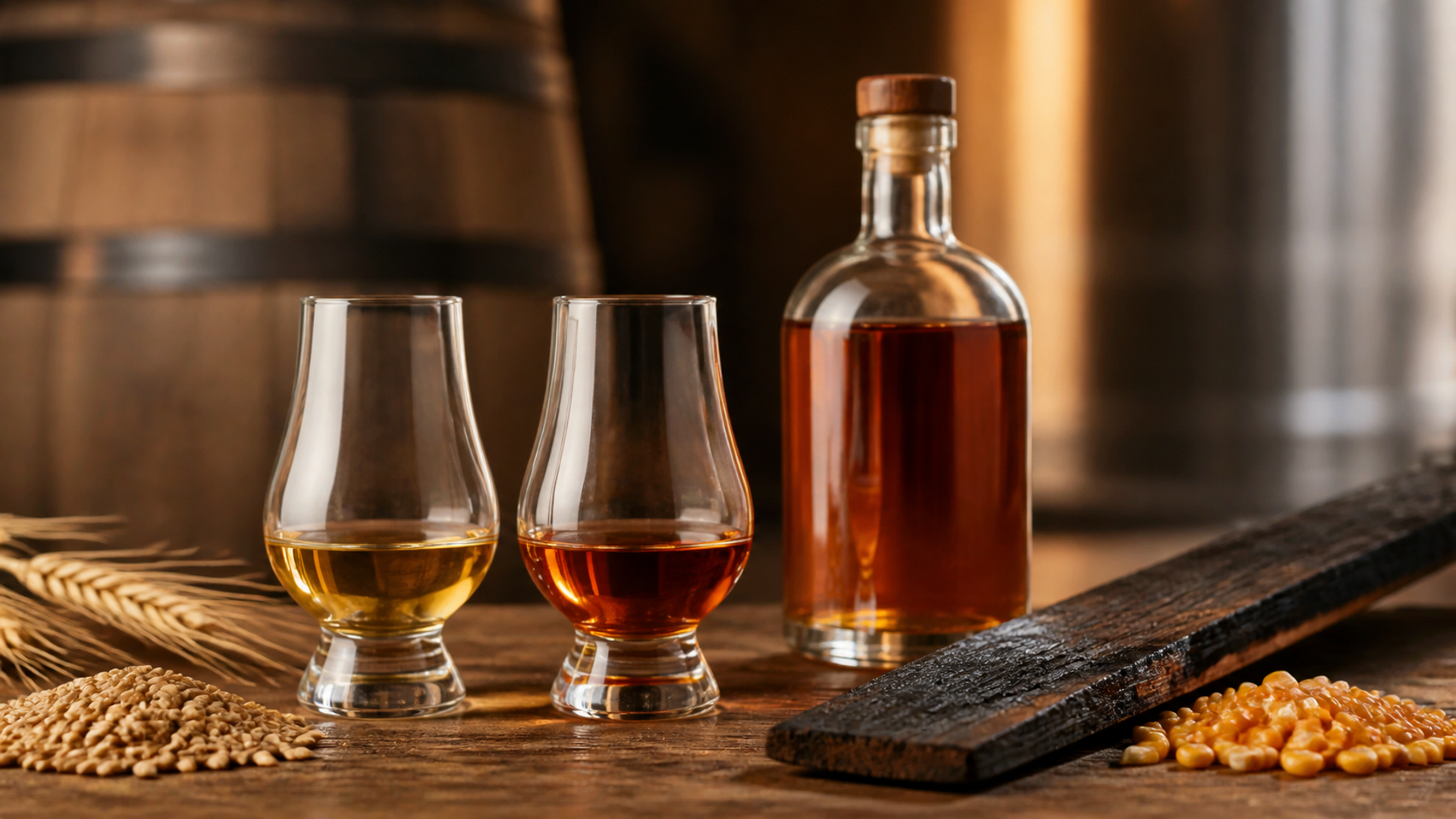
Bourbon is whiskey, but whiskey is not automatically bourbon. United States rules define bourbon through grain, proof and new charred-oak requirements, while whiskey is the wider family containing many origins, grains and production traditions. That legal distinction matters because it prevents misleading substitutions. It does not make every bourbon sweeter, better or more valuable than every Scotch, rye, Irish whiskey or other bottle. Producer, age, proof, cask history, condition, price and the intended pour still decide what belongs in the glass.
Start with the legal identity
Choose bourbon when the American identity, corn-led recipe and new charred-oak maturation fit the flavour and occasion. Choose another whiskey when a different grain, origin, cask system or style better serves the drink. Choose by exact bottle and serve when disclosure, proof, tasting result, cocktail role and replacement cost matter more than the category name.
| Decision factor | Bourbon | Another whiskey | Choose by bottle and serve |
|---|---|---|---|
| Legal identity | United States bourbon standards apply | Rules vary by whiskey class and origin | Verify the exact designation |
| Grain | Mash contains at least 51% corn | Barley, rye, wheat and other grains vary | Read producer disclosure |
| Oak | New charred oak is required | Cask history depends on category | Check the maturation statement |
| Proof | Entry and bottling limits shape the category | Strength varies widely | Taste at matched dilution |
| Age | Straight and age wording have defined consequences | Age rules vary by jurisdiction | Decode the youngest component |
| Serve | Can suit neat pours and cocktails | Other styles may fit smoke, spice or malt | Test the intended recipe |
This whiskey vs bourbon matrix is the article's working value object. Read the whiskey vs bourbon rows together: the decisive failure mode depends on this topic's evidence, operating context and reader objective.
The label sets boundaries, not quality
Evidence 1. Title 27 of the United States Code of Federal Regulations defines bourbon whiskey within the standards of identity for distilled spirits.
Evidence 2. The bourbon standard includes a mash of at least 51 percent corn, distillation at no more than 160 proof and storage in charred new oak containers at no more than 125 proof.
Evidence 3. TTB labelling guidance distinguishes class, type, age and other statements that must be read together rather than inferred from packaging colour or price.
Evidence 4. Legal identity authenticates production boundaries; it does not establish sensory preference, bottle condition, provenance or fair value.
Reader-visible sources checked for this article:
ecfr.gov — reader-visible current or official evidence
ttb.gov — reader-visible current or official evidence
ttb.gov — reader-visible current or official evidence
For whiskey vs bourbon, these sources establish only the claims inside their documented scope. Recheck every changeable specification, availability condition, price, policy or service term in the relevant market before acting.
Taste under controlled conditions
The legal identity row exposes a practical boundary. Route one assumes united States bourbon standards apply, while route two is defensible only when rules vary by whiskey class and origin. Route three depends on verify the exact designation. If that evidence is absent, keep the more reversible option.
Read grain as a stop/go test: mash contains at least 51% corn supports the first option; barley, rye, wheat and other grains vary supports the second; and read producer disclosure supports the third. Record which source proves the condition and when it was checked.
A buyer can resolve oak without starting from a brand preference. Ask whether new charred oak is required; compare that with whether cask history depends on category; then use check the maturation statement as the third route's safeguard. An unknown condition stays unknown.
On proof, popularity is not enough. The evidence for option one is that entry and bottling limits shape the category. Option two means strength varies widely. Option three is rational where taste at matched dilution. Recheck any changeable term immediately before commitment.
The decision changes at age. Choose the first path only if straight and age wording have defined consequences; move to the second when age rules vary by jurisdiction; use the third when decode the youngest component. Save the downside that would make this row fail.
For serve, the first route works when can suit neat pours and cocktails; the second requires other styles may fit smoke, spice or malt. The control for the third is test the intended recipe. Verify this row against the exact product, property, account or environment before it can reverse the decision.
Facts that would reverse the current choice
Reversal control 1 — Legal identity. Before choosing Bourbon, write down how the decision changes if “United States bourbon standards apply” proves false. Do the same for Another whiskey and “Rules vary by whiskey class and origin”. Keep the Choose by bottle and serve route available until “Verify the exact designation” is verified. This control belongs to whiskey vs bourbon; update it from the cited source or exact supplier rather than copying a generic checklist.
Reversal control 2 — Grain. Before choosing Bourbon, write down how the decision changes if “Mash contains at least 51% corn” proves false. Do the same for Another whiskey and “Barley, rye, wheat and other grains vary”. Keep the Choose by bottle and serve route available until “Read producer disclosure” is verified. This control belongs to whiskey vs bourbon; update it from the cited source or exact supplier rather than copying a generic checklist.
Reversal control 3 — Oak. Before choosing Bourbon, write down how the decision changes if “New charred oak is required” proves false. Do the same for Another whiskey and “Cask history depends on category”. Keep the Choose by bottle and serve route available until “Check the maturation statement” is verified. This control belongs to whiskey vs bourbon; update it from the cited source or exact supplier rather than copying a generic checklist.
Reversal control 4 — Proof. Before choosing Bourbon, write down how the decision changes if “Entry and bottling limits shape the category” proves false. Do the same for Another whiskey and “Strength varies widely”. Keep the Choose by bottle and serve route available until “Taste at matched dilution” is verified. This control belongs to whiskey vs bourbon; update it from the cited source or exact supplier rather than copying a generic checklist.
Reversal control 5 — Age. Before choosing Bourbon, write down how the decision changes if “Straight and age wording have defined consequences” proves false. Do the same for Another whiskey and “Age rules vary by jurisdiction”. Keep the Choose by bottle and serve route available until “Decode the youngest component” is verified. This control belongs to whiskey vs bourbon; update it from the cited source or exact supplier rather than copying a generic checklist.
Reversal control 6 — Serve. Before choosing Bourbon, write down how the decision changes if “Can suit neat pours and cocktails” proves false. Do the same for Another whiskey and “Other styles may fit smoke, spice or malt”. Keep the Choose by bottle and serve route available until “Test the intended recipe” is verified. This control belongs to whiskey vs bourbon; update it from the cited source or exact supplier rather than copying a generic checklist.
Decode the complete label
Photograph class, type, age statement, proof, producer, bottler and country before tasting. Reconcile unfamiliar wording with the regulator or recognised authority for that origin. For this whiskey versus bourbon decision, record the exact item, place, date, measurement and source in the evidence log. Keep observations separate from category shorthand, repeat the check in the environment that matters, and price the downside of a wrong choice. If the claimed identity cannot be verified, stop assigning it a category premium. When that condition appears, reopen the choice instead of defending the original preference.
Taste blind at matched strength
Use equal pours, identical glasses and a consistent rest time, then compare neat and with measured water. Score aroma, sweetness, grain, oak, alcohol integration, texture and finish separately. For this whiskey versus bourbon decision, record the exact item, place, date, measurement and source in the evidence log. Keep observations separate from category shorthand, repeat the check in the environment that matters, and price the downside of a wrong choice. If preference changes after proof is matched, revise the label-led judgement. When that condition appears, reopen the choice instead of defending the original preference.
Test the intended serve
Prepare the actual highball, Old Fashioned or food pairing using fixed recipes and fresh ingredients. Record whether the spirit disappears, dominates or balances the drink. For this whiskey versus bourbon decision, record the exact item, place, date, measurement and source in the evidence log. Keep observations separate from category shorthand, repeat the check in the environment that matters, and price the downside of a wrong choice. If a cheaper bottle performs better in the normal serve, redirect the budget. When that condition appears, reopen the choice instead of defending the original preference.
Price provenance and replacement
Separate retail price, tax, scarcity, auction fee and condition risk from flavour. Check whether the bottle can be replaced for regular use. For this whiskey versus bourbon decision, record the exact item, place, date, measurement and source in the evidence log. Keep observations separate from category shorthand, repeat the check in the environment that matters, and price the downside of a wrong choice. If scarcity prevents learning or repeat service, choose an available benchmark. When that condition appears, reopen the choice instead of defending the original preference.
Store and document
Keep bottles upright, protected from heat, sunlight and damaged closures, and record fill and seal condition. Retain invoices and photographs for consequential purchases. For this whiskey versus bourbon decision, record the exact item, place, date, measurement and source in the evidence log. Keep observations separate from category shorthand, repeat the check in the environment that matters, and price the downside of a wrong choice. If condition is uncertain, do not treat age or rarity as guaranteed value. When that condition appears, reopen the choice instead of defending the original preference.
Four occasions, four sensible answers
First comparative tasting
One verified bourbon beside contrasting malt and rye styles teaches more than a prestige ladder. Define the fact that would reverse this recommendation before committing.
Cocktail bar
A consistent, available bourbon can be the better tool when the recipe needs oak and grain weight. Define the fact that would reverse this recommendation before committing.
Formal gift
A clearly documented bottle should match the recipient's palate rather than relying on category fame. Define the fact that would reverse this recommendation before committing.
Collector purchase
Provenance, seal, fill, storage and market liquidity matter beyond the word bourbon. Define the fact that would reverse this recommendation before committing.
Action checklist
Verify the class and type.
Record the mash disclosure.
Read the age wording.
Record proof.
Check producer and bottler.
Taste blind.
Match dilution.
Test the normal serve.
Check condition.
Check replacement cost.
Save provenance.
Write the reversal condition.
Continue the decision
The linked VERTU articles expand adjacent parts of the whiskey vs bourbon decision. They do not substitute for the external evidence above.
The whiskey-versus-bourbon verdict
Choose bourbon when the American identity, corn-led recipe and new charred-oak maturation fit the flavour and occasion. Choose another whiskey when a different grain, origin, cask system or style better serves the drink. Choose by exact bottle and serve when disclosure, proof, tasting result, cocktail role and replacement cost matter more than the category name.
Keep the whiskey vs bourbon decision reversible until its material cost, safety, access, privacy and compatibility facts are verified. Unknown evidence stays unknown; it is never silently scored as favourable.